

|
시장보고서
상품코드
2116094
아시아태평양의 체외진단 시장 : 시장 점유율 분석, 업계 동향과 통계, 성장 예측(2026-2031년)Asia Pacific In-Vitro Diagnostics - Market Share Analysis, Industry Trends & Statistics, Growth Forecasts (2026 - 2031) |
||||||
 Mordor Intelligence
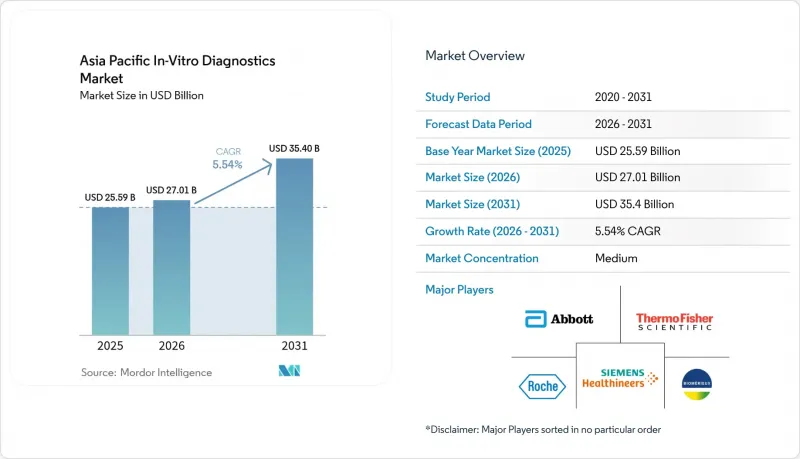
Mordor Intelligence에 따르면 2026년 아시아태평양의 체외진단(IVD) 시장 규모는 270억 1,000만 달러로 추정되며, 2025년 255억 9,000만 달러에서 확대되어 2031년에는 354억 달러에 달할 것으로 예측됩니다. 2026년부터 2031년까지 CAGR은 5.54%가 될 전망입니다.
본 보고서는 검사 유형(임상화학, 분자진단 등), 제품(기기, 시약 등), 사용 방법(일회용 IVD 기기, 재사용 가능한 IVD 기기), 용도(감염병, 당뇨병 등), 최종사용자(진단 검사실 등), 국가(중국, 일본 등)별로 분류되어 있습니다. 시장 전망은 금액(달러) 기준으로 제시되어 있습니다.
아시아태평양 체외진단 시장의 동향 및 인사이트
인구 고령화로 인해 고부가가치 진단 검사에 대한 수요가 확대되고 있습니다.
2024년, 일본의 65세 이상 인구 비율은 29.1%에 달했으며, 중국의 고령 인구는 연간 3.2%의 속도로 증가하고 있어, 이는 종양학 및 심혈관질환 검사 수요 증가로 이어지고 있습니다. 각국의 보건부는 다운스트림 치료비를 절감하기 위해 적극적인 검진을 장려하고 있으며, 조기 검사에 1달러를 지출할 때마다 향후 의료비를 3.4달러 절약할 수 있는 것으로 알려져 있습니다. 2025년에 로슈(Roche)사의 ‘Elecsys pTau181’ 분석법이 출시됨에 따라, pTau181 등의 바이오마커가 일상적인 검사 워크플로우에 도입되고 있습니다. 알츠하이머병, 프레이일 검사 패널, 심신 마커와 같은 고령자 대상 전문 진단은 고가 마이크로 부문을 형성하기 시작했습니다.
정부가 의무화한 암 및 감염병 선별 검사 프로그램
중국의 ‘건강 중국 2030’ 이니셔티브에서는 2024년에 87억 달러가 암 검진 인프라에 투입된 반면, 인도에서는 2024-2025 회계연도를 대비해 진단 관련 예산을 43% 증액했습니다. 전국적으로 표준화된 프로토콜은 자동화된 고처리량 플랫폼을 권장하며, 우선순위 질환에 대응하는 기업에 인센티브를 제공하고 있습니다. bioMerieux사는 현재 이러한 공중보건 과제에 대응하기 위해 전 세계 연구개발 예산의 75%를 항생제 내성 검사에 할당하고 있습니다. 경제 기획 담당자들은 선별 검사의 보급률을 노동 생산성 향상과 연계하고 있으며, 이로 인해 진단 분야는 거시적 개발 전략에 더욱 깊이 통합되고 있습니다.
여러 규제 당국에 의한 장기적인 승인 절차가 제품 출시를 지연시키고 있습니다.
승인까지의 평균 기간은 일본이 18-24개월, 중국이 14-20개월인 반면, 유럽과 미국의 신청 서류의 경우 9-12개월입니다. 규정 준수 관련 비용은 지역별로 37% 더 높으며, 소규모 혁신 기업들은 전담 규제 대응 팀을 보유한 다국적 기업과 제휴하거나 시장 점유율을 양보할 수밖에 없는 상황에 몰리고 있습니다. 아세안(ASEAN)의 규제 조화 로드맵은 진전을 보이고 있지만, 각국의 국내법 반영 상황에 차이가 있어 그 혜택을 누리기까지는 시간이 걸리고 있습니다. 개발 주기가 짧은 기술은 승인되기 전에 구식이 될 위험이 있어, 기업은 출시 순서를 조정하거나 반복적인 업그레이드에 대응할 수 있는 모듈식 신청 방식을 채택할 수밖에 없습니다.
부문 분석
2025년, 면역진단은 아시아태평양 체외 진단약 시장에서 25.12%의 점유율을 차지했으며, 이는 감염 관리 및 만성 질환 모니터링 분야에서 확고하게 자리 잡은 이용 현황을 반영합니다. 분자진단은 연평균 성장률(CAGR) 9.71%로 예측되어 시장 전체의 5.54%라는 추세를 크게 상회하며, 2031년까지 아시아태평양 체외 진단 시약 시장 규모에서 차지하는 비중이 꾸준히 상승할 전망입니다. 투자는 정밀 종양학 및 실시간 병원체 감시 분야에 집중되고 있으며, PCR이 여전히 주류를 이루는 반면 차세대 염기서열 분석은 다운스트림 공정으로 이동하고 있습니다.
현장(Point-of-Care) 분자진단 플랫폼은 현재 1시간 이내에 결과를 도출할 수 있게 되어, 패혈증 및 호흡기질환의 분류(트라이아지)에 필수적입니다. AI를 활용한 알고리즘은 분자진단 결과와 결합함으로써 진단 정확도를 28% 향상시킵니다. COVID-19로 인한 인프라 구축의 급증은 견고한 도입 기반을 남겼으며, 보다 광범위한 검사 시장으로의 진입 장벽을 낮췄습니다. 멀티플렉스 기능, 시료 채취부터 결과 도출까지의 간편성, 클라우드 분석을 통합한 공급업체는 마이크로랩 및 응급실 부문의 예산을 확보하는 데 있어 가장 유리한 입장에 있습니다.
검사 워크플로우에 내재된 재구매의 경제성 덕분에 2025년에는 시약 및 키트가 매출의 59.65%를 차지했습니다. 장비는 여전히 중요하지만, 소프트웨어와 서비스는 연평균 11.07%의 성장률을 기록하며 아시아태평양의 체외진단 시장 규모에서 차지하는 비중을 확대해 나갈 전망입니다. 검사실에서는 원시 데이터를 실용적인 의료 인사이트로 전환하기 위해 클라우드 기반 검사 정보 시스템, 미들웨어 분석, AI 기반 의사결정 지원이 요구되고 있습니다.
로슈의 2025년판 ‘cobas’ 로드맵에는 이용률 격차를 지적하고 검사 패널을 추천하는 기계 학습 모듈이 통합되어 있어, 의료 기관이 비용과 임상적 성과 간의 균형을 맞추는 데 도움이 됩니다. 가동 시간 보장 및 지속적인 알고리즘 업그레이드와 연계된 구독 모델은 지속적인 수익원을 확대합니다. 전자의무기록 및 보험사 포털과의 상호 운용성은 입찰 시 중요한 기준이 되고 있으며, 오픈 API 전략을 추진하는 벤더에게 유리하게 작용하고 있습니다.
기타 혜택:
- 엑셀 형식의 시장 예측(ME) 시트
- 3개월간의 애널리스트 지원
자주 묻는 질문
목차
제1장 소개
제2장 조사 방법
제3장 주요 요약
제4장 시장 구도
제5장 시장 규모와 성장 예측
제6장 경쟁 구도
제7장 시장 기회와 향후 전망
KSM 26.08.26According to Mordor Intelligence, Asia-Pacific in-vitro diagnostics market size in 2026 is estimated at USD 27.01 billion, growing from 2025 value of USD 25.59 billion with 2031 projections showing USD 35.4 billion, growing at 5.54% CAGR over 2026-2031.
This report is Segmented by Test Type (Clinical Chemistry, Molecular Diagnostics, and More), Product (Instruments, Reagents, and More), Usability (Disposable IVD Devices, and Reusable IVD Devices), Application (Infectious Diseases, Diabetes, and More), End User (Diagnostic Laboratories, and More), and Country (China, Japan, and More). The Market Forecasts are Provided in Terms of Value (USD).
Asia Pacific In-Vitro Diagnostics Market Trends and Insights
Demographic ageing escalating demand for high-value diagnostics
Japan's 65+ cohort reached 29.1% in 2024 and China's elderly population is expanding 3.2% yearly, translating into higher volumes for oncology and cardiovascular assays. Health ministries are backing proactive detection to trim downstream treatment spending, with every USD 1 spent on early testing saving USD 3.4 in future care. Biomarkers such as pTau181 are entering routine workflows following the 2025 launch of Roche's Elecsys pTau181 assay. Specialized geriatric diagnostics-Alzheimer's, frailty panels, and cardio-renal markers-are beginning to form micro-segments that command premium pricing.
Government-mandated cancer & infectious-disease screening programs
China's Healthy China 2030 initiative directed USD 8.7 billion to cancer-screening infrastructure in 2024, while India lifted diagnostic allocations by 43% for 2024-2025. Standardized nationwide protocols favor automated, high-throughput platforms and incentivize firms aligned with priority diseases. bioMerieux now channels 75% of its global R&D budget to antimicrobial-resistance assays to meet these public-health agendas. Economic planners link screening coverage to labor-productivity gains, further embedding diagnostics in macro-development strategy.
Lengthy multi-agency regulatory approvals delaying product launches
Average clearance spans 18-24 months in Japan and 14-20 months in China, against 9-12 months for Western dossiers. Compliance outlays run 37% higher regionally, pushing smaller innovators to partner or concede share to multinationals that can field dedicated regulatory teams. ASEAN's harmonization roadmap shows progress, yet uneven national transposition slows benefits. Rapid-cycle technologies risk obsolescence before approval, compelling firms to sequence launches or adopt modular filings that can accommodate iterative upgrades.
Other drivers and restraints analyzed in the detailed report include:
- Expansion of automated laboratory hubs into Tier-2/3 cities improving test accessibility
- Localization incentives drawing IVD manufacturing CAPEX
- Skills shortage in molecular and bio-informatics outside metropolitan laboratories
For complete list of drivers and restraints, kindly check the Table Of Contents.
Segment Analysis
Immunodiagnostics held 25.12% Asia-Pacific in-vitro diagnostics market share in 2025, reflecting entrenched use across infection control and chronic-disease monitoring. Molecular diagnostics is forecast for a 9.71% CAGR, dwarfing the broader 5.54% trend, and its Asia-Pacific in-vitro diagnostics market size contribution will climb steadily through 2031. Investment funnels into precision oncology and real-time pathogen surveillance, with PCR remaining the workhorse while next-generation sequencing moves downstream.
Point-of-care molecular platforms now deliver results in under an hour, vital for sepsis and respiratory triage. AI-augmented algorithms raise diagnostic accuracy by 28% when paired with molecular outputs. The COVID-19 infrastructure boom left a durable installed base, lowering entry barriers for broader assays. Suppliers that integrate multiplex capability, sample-to-answer simplicity, and cloud analytics are best placed to win micro-lab and emergency-department budgets.
Reagents and kits provided 59.65% of revenue in 2025 thanks to repeat-purchase economics inherent in testing workflows. Instruments remain critical, yet software and services will compound at 11.07% annually and account for a rising slice of Asia-Pacific in-vitro diagnostics market size. Laboratories demand cloud laboratory-information systems, middleware analytics, and AI-driven decision support to convert raw data into actionable care insights.
Roche's 2025 cobas roadmap embeds machine-learning modules that flag utilization gaps and recommend test panels, helping facilities balance cost and clinical yield. Subscription models tied to uptime guarantees and continuous algorithm upgrades broaden recurring revenue streams. Interoperability with electronic medical records and payer portals has become a key tender criterion, advantaging vendors that champion open-API strategies.
Complete Report Scope:
- By Test Type
- Clinical Chemistry
- Molecular Diagnostics
- Immunodiagnostics
- Hematology
- Coagulation
- Microbiology
- Urinalysis
- By Product
- Instruments
- Reagents & Kits
- Software & Services
- By Usability
- Disposable IVD Devices
- Reusable IVD Devices
- By Application
- Infectious Diseases
- Diabetes
- Oncology
- Cardiology
- Autoimmune Diseases
- Nephrology
- Respiratory Diseases
- Other Applications
- By End User
- Diagnostic Laboratories
- Hospitals & Clinics
- Academic & Research Institutes
- Home Care & Self-testing
- By Country
- China
- Japan
- India
- Australia
- South Korea
- Rest of Asia-Pacific
List of Companies Covered in this Report:
- Abbott Laboratories
- Roche
- Danaher
- Siemens Healthineers
- Thermo Fisher Scientific
- bioMerieux
- Sysmex
- QIAGEN
- Beckton Dickinson
- Bio-Rad Laboratories
- Arkray
- Tosoh
- QuidelOrtho
- Agilent Technologies
- Mindray
- Seegene
- DiaSorin S.p.A. (Luminex)
- Genrui Biotech Inc.
- Werfen Life Diagnostic
- Fujirebio Holdings Inc.
- Meril Life Science
Additional Benefits:
- The market estimate (ME) sheet in Excel format
- 3 months of analyst support
TABLE OF CONTENTS
1 Introduction
- 1.1 Study Assumptions & Market Definition
- 1.2 Scope of the Study
2 Research Methodology
3 Executive Summary
4 Market Landscape
- 4.1 Market Overview
- 4.2 Market Drivers
- 4.2.1 Demographic Ageing Escalating Demand For High-Value Diagnostics
- 4.2.2 Government-Mandated Cancer & Infectious-Disease Screening Programs
- 4.2.3 Expansion Of Automated Laboratory Hubs Into Tier-2/3 Cities Improving Test Accessibility
- 4.2.4 Localization Incentives Drawing IVD Manufacturing CAPEX
- 4.2.5 Rising Diabetes & Metabolic-Syndrome Burden Sustaining Assay Volumes
- 4.3 Market Restraints
- 4.3.1 Lengthy Multi-Agency Regulatory Approvals Delaying Product Launches
- 4.3.2 Skills Shortage In Molecular And Bio-Informatics Outside Metropolitan Laboratories
- 4.3.3 Quality Variability Of Ultra-Low-Cost Domestic Reagents Eroding Clinician Confidence
- 4.4 Supply-Chain Analysis
- 4.5 Regulatory Outlook
- 4.6 Porter's Five Forces Analysis
- 4.6.1 Bargaining Power of Suppliers
- 4.6.2 Bargaining Power of Buyers
- 4.6.3 Threat of New Entrants
- 4.6.4 Threat of Substitute Products
- 4.6.5 Intensity of Competitive Rivalry
5 Market Size & Growth Forecasts (Value, USD)
- 5.1 By Test Type
- 5.1.1 Clinical Chemistry
- 5.1.2 Molecular Diagnostics
- 5.1.3 Immunodiagnostics
- 5.1.4 Hematology
- 5.1.5 Coagulation
- 5.1.6 Microbiology
- 5.1.7 Urinalysis
- 5.2 By Product
- 5.2.1 Instruments
- 5.2.2 Reagents & Kits
- 5.2.3 Software & Services
- 5.3 By Usability
- 5.3.1 Disposable IVD Devices
- 5.3.2 Reusable IVD Devices
- 5.4 By Application
- 5.4.1 Infectious Diseases
- 5.4.2 Diabetes
- 5.4.3 Oncology
- 5.4.4 Cardiology
- 5.4.5 Autoimmune Diseases
- 5.4.6 Nephrology
- 5.4.7 Respiratory Diseases
- 5.4.8 Other Applications
- 5.5 By End User
- 5.5.1 Diagnostic Laboratories
- 5.5.2 Hospitals & Clinics
- 5.5.3 Academic & Research Institutes
- 5.5.4 Home Care & Self-testing
- 5.6 By Country
- 5.6.1 China
- 5.6.2 Japan
- 5.6.3 India
- 5.6.4 Australia
- 5.6.5 South Korea
- 5.6.6 Rest of Asia-Pacific
6 Competitive Landscape
- 6.1 Market Concentration
- 6.2 Market Share Analysis
- 6.3 Company Profiles (includes Global level Overview, Market level overview, Core Business Segments, Financials, Headcount, Key Information, Market Rank, Market Share, Products and Services, and analysis of Recent Developments)
- 6.3.1 Abbott Laboratories
- 6.3.2 F. Hoffmann-La Roche Ltd.
- 6.3.3 Danaher Corporation
- 6.3.4 Siemens Healthineers AG
- 6.3.5 Thermo Fisher Scientific Inc.
- 6.3.6 bioMerieux SA
- 6.3.7 Sysmex Corporation
- 6.3.8 QIAGEN N.V.
- 6.3.9 Becton, Dickinson and Company
- 6.3.10 Bio-Rad Laboratories, Inc.
- 6.3.11 ARKRAY, Inc.
- 6.3.12 Tosoh Corporation
- 6.3.13 QuidelOrtho Corporation
- 6.3.14 Agilent Technologies, Inc.
- 6.3.15 Mindray Medical International Ltd.
- 6.3.16 Seegene Inc.
- 6.3.17 DiaSorin S.p.A. (Luminex)
- 6.3.18 Genrui Biotech Inc.
- 6.3.19 Werfen Life Diagnostic
- 6.3.20 Fujirebio Holdings Inc.
- 6.3.21 Meril Life Sciences Pvt. Ltd.
7 Market Opportunities & Future Outlook
- 7.1 White-space & Unmet-need Assessment


