

|
시장보고서
상품코드
2116101
호흡기 보호 장비 : 시장 점유율 분석, 업계 동향 및 통계, 성장 예측(2026-2031년)Respiratory Protection Equipment - Market Share Analysis, Industry Trends & Statistics, Growth Forecasts (2026 - 2031) |
||||||
 Mordor Intelligence
Mordor Intelligence에 의하면, 호흡기 보호 장비 시장 규모는 2025년에 124억 2,000만 달러로 평가되었습니다. 2026년 131억 달러에서 2031년까지 181억 달러에 이를 것으로 예상되며, 예측 기간(2026-2031년) CAGR은 6.67%를 나타낼 전망입니다.
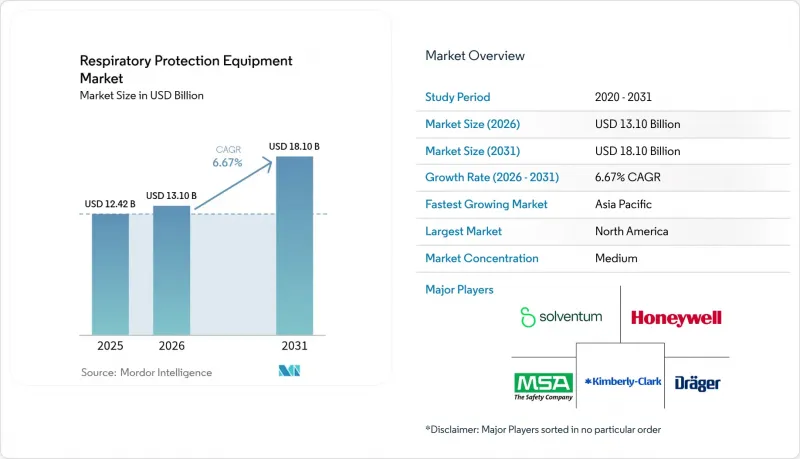
본 보고서는 제품 유형(일회용 호흡기 보호 장비, 기타), 보호 유형(입자 전용 호흡기 보호 장비, 기타), 마스크 등급(N 시리즈, 기타), 페이스피스 소재(실리콘, 기타), 최종 사용자 산업(석유 및 가스, 기타), 유통 채널(직접 판매, 기타),지역(북미, 기타)별로 분류되어 있습니다. 시장 예측은 금액(달러) 기준으로 제시되어 있습니다.
세계의 호흡기 보호 장비 시장 동향 및 인사이트
엄격한 작업장 안전 규제
세계 각국의 규제 당국은 노출 관련 규정을 강화하고 있으며, 고용주들은 자발적인 프로그램에서 의무적인 착용 적합성 테스트 및 기록 관리로 전환해야만 하는 상황에 처해 있습니다. 2025년 7월 미국에서 제안된 일반 마스크에 대한 의료적 적격성 심사 폐지안은 수천 개의 계약업체에 대해 행정 처리 비용을 즉시 절감해 줄 것입니다. 2024년부터 전면 시행되고 있는 OSHA의 실리카 규제는 근로자의 노출 상한선을 50µg/m³로 설정하여, 석재 절단 및 샌드블라스팅 작업에서 P100 필터에 대한 수요를 촉진하고 있습니다. 유럽의 EN 149 규격 개정에 따라 2024년에 나노 입자에 대한 포집 효율 검사가 추가되고, FFP3 인증의 기술적 기준이 상향 조정됨에 따라 국제적인 브랜드 기업들은 제품 라인업을 재설계해야 하는 상황에 직면해 있습니다. 자급식 호흡 장치에 관한 새로운 ISO 규격에서는 내열성과 통신 기능 기준이 강화되어, 이에 따라 지자체 차량의 교체 속도가 빨라지고 있습니다. 이러한 움직임들이 맞물리면서 호흡기 보호 장비 시장에는 의무화로 인한 안정적인 최소 수요가 창출되고 있습니다.
직업성 및 감염성 호흡기 질환 발생률의 상승
규폐증, 만성 폐쇄성 폐질환(COPD), 천식은 여전히 주요 직업성 질환으로 상위권에 자리 잡고 있으며, 한편 의료 시스템은 조류 인플루엔자의 인간 감염 확산 및 Mpox 집단 감염에 대비하고 있습니다. NIOSH는 현재 병원에 재사용형 엘라스토머 마스크를 90일분 비축할 것을 권고하고 있으며, 이로 인해 내구성이 뛰어난 마스크 주문이 위기 상황이 아닌 기간에도 이어지고 있습니다. 2024년에 실시된 12시간 간호 교대 근무를 대상으로 한 임상 연구에 따르면, 참가자의 82%가 호흡 부하는 높지만 총 비용이 낮다는 이유로 며칠에 걸친 사용에는 엘라스토머 마스크를 선호한다고 보고되었습니다. 아시아의 건설 붐은 실리카 노출을 악화시키고 있으며, 인도와 중국의 공식 등록 데이터에 따르면 질병 발생률이 증가하고 있는 것으로 나타나, 이에 따라 새로운 호흡기 보호 장비 의무화 규정이 도입되었습니다. WHO의 2024년판 대비 지침에서는 호흡기 보호 장비가 ‘Tier 1’ 대책으로 지정되어 있으며, 각 회원국의 의료 종사자 수의 10%에 해당하는 비축량을 확보할 것을 요구하고 있습니다. 이러한 요인들이 복합적으로 작용하여 호흡기 보호 장비 시장은 견조한 상승세를 유지하고 있습니다.
고급 호흡기 보호 장비(RPE)의 높은 도입 및 유지 비용
동력식 공기 정화 시스템이나 공급식 공기 시스템은 1대당 800-3,000달러의 비용에 더해 연간 20%의 유지비가 들기 때문에 중소규모 기업들은 더 저렴한 일회용 제품을 선택하는 경향이 있습니다. 안셀(Ansell)사가 8,000만 달러를 투자해 건설 중인 인도 공장으로 인해 엘라스토머 마스크의 입고 비용은 15% 절감될 전망이지만, 개당 1-3달러인 일회용 N95 마스크가 초기 비용 면에서는 여전히 유리합니다. 병원도 유사한 경제적 과제에 직면해 있습니다. 지방 의료시설에서는 집중 제염 설비가 갖춰져 있지 않아 엘라스토머 마스크 사용을 피하고 있습니다. 소방서에서는 자급식 호흡 장치(SCBA) 1대당 5,000-8,000달러의 예산을 편성하고 있지만, 매년 실시하는 유량 검사 및 실린더 재인증에 드는 비용을 마련하는 데 어려움을 겪고 있습니다. 따라서 높은 자본 집약성이 호흡기 보호 장비 시장의 도입률을 제한하는 요인이 되고 있습니다.
부문별 분석
일회용 마스크는 가격과 편의성 면에서 여전히 주류를 이루고 있으며, 2025년 호흡기 보호 장비 시장 매출의 34.58%를 차지했습니다. 그러나 클린룸 작업자와 용접공들이 더 가벼운 송풍기와 통합형 센서를 채택함에 따라, 동력식 공기 정화 호흡기는 9.44%라는 가장 높은 연평균 성장률(CAGR)을 나타낼 전망입니다. 하프 마스크형 엘라스토머 호흡 보호구는 40달러짜리 페이스피스와 15달러짜리 카트리지로 시즌 내내 가치를 제공할 수 있어, 석유 및 가스 작업자들에게 여전히 표준으로 자리 잡고 있습니다. 풀페이스형 모델은 눈 보호 기능을 추가하여 농약 처리나 밀폐 공간에서의 작업에 적합합니다. 공급식 공기 호흡기 및 자급식 호흡기(SCBA) 솔루션은 도장 부스 및 소방 부문에서 틈새 시장이지만 고부가가치 시장을 차지하고 있습니다.
MSA는 2024년 optrel과의 제휴를 통해 호흡 추적형 송풍기를 용접용 헬멧에 통합하여 사용자의 피로를 18% 줄였습니다. 이러한 통합은 업스트림 기술이 규정 준수 및 평균 판매 가격(ASP)을 어떻게 향상시키는지 보여줍니다. 대조적으로, 일회용 제품에 대한 수요는 여전히 가격 탄력성이 높아, 10%의 가격 상승 시 판매량이 6-8% 감소할 가능성이 있습니다. 이러한 높은 가격 민감도는 호흡기 보호 장비 시장에서 저비용 일회용 제품이 판매량 측면에서 주도권을 계속 잡고 있음에도 불구하고, 프리미엄 제품이 성장을 주도하는 이유를 여실히 보여줍니다.
2025년 전 세계 매출에서 입자 전용 장비가 44.63%를 차지했으나, 생물학적 및 감염성 병원체 대응 모델은 2031년까지 연평균 성장률(CAGR) 8.94%로 성장할 전망입니다. WHO가 호흡기 보호 장비를 최우선 대책 수준으로 지정함에 따라, 병원에서는 현재 엘라스토머 재질 또는 P100 카트리지를 90일 분량으로 공식 비축하고 있습니다. 가스·증기용 카트리지는 화학 공장이나 폐수 처리 시설에서 활용되고 있지만, 빈번한 교체가 필요합니다. 복합 필터는 스프레이 도장이나 농약 혼합 등 여러 가지 위험이 동시에 존재하는 현장에서 사용됩니다.
2024년 임상 비교 조사에 따르면, 의료 종사자의 82%가 일회용 N95 마스크에 비해 총 비용이 낮기 때문에 며칠간 사용 시에는 엘라스토머 마스크를 선호하는 것으로 나타났습니다. NIOSH(미국 국립노동안전보건연구소)가 입자상 물질과 가스에 대한 성능을 별도로 평가하고 있기 때문에 인증 절차는 여전히 복잡하며, 이로 인해 개발 기간이 길어지고 있습니다. 그럼에도 불구하고, 생물학적 규제가 추가됨에 따라 재난 대비 지출이 안정화됨에 따라, 높은 여과 성능을 갖춘 장비가 호흡기 보호 장비 시장에서 더 큰 점유율을 차지할 것으로 전망됩니다.
지역별 분석
북미는 2025년 매출의 37.52%를 차지했습니다. 이는 OSHA의 결정질 실리카 규제 시행과 유전 활동이 맞물려 안정적인 수주를 이끌었기 때문입니다. 연방 정부의 산불 연기 대책용 비축 물량이 공중 보건 측면 수요를 창출하는 한편, 탄소 포집 시범 사업은 특수한 장비가 필요한 새로운 유독 가스 시나리오를 만들어내고 있습니다. 캐나다 정부의 지역사회 N95 마스크 배포에 대한 투자가 농촌 지역의 보급을 뒷받침하고 있으며, 멕시코의 마키라도라 지역에서는 규제 시행 상황에 차이가 있음에도 불구하고 일회용 마스크 판매량이 유지되고 있습니다.
아시아태평양의 호흡기 보호 장비 시장은 2031년 연평균 성장률(CAGR)이 8.32%로, 다른 모든 지역을 상회하고 있습니다. 인도에서는 현재 대규모 작업 현장에서 호흡기 보호 장비 제공이 의무화되어 있으며, 중국에서는 광산의 기계화로 인해 보수 작업에 종사하는 근로자의 분진 노출이 일시적으로 증가하고 있습니다. 또한 일본에서는 노동력의 고령화에 따라 가볍고 인체공학적인 설계가 중요시되고 있습니다. 호주에서는 2020년부터 2025년에 걸쳐 리튬 생산량이 두 배로 증가할 전망이며, 이로 인해 심부 고온 광산에서의 PAPR 수요가 높아지고 있습니다. 한국에서는 반도체 및 바이오의약품 부문에 대한 투자로 인해 클린룸의 수율을 유지하기 위해 FFP3 또는 P100의 여과 성능이 우선시되고 있습니다.
유럽에서는 EN 149의 나노 입자 관련 개정으로 조달 기준이 상향 조정되었고, 화학 산업이 풀페이스형 호흡기 보호 장비 재고를 갱신하고 있어 한 자릿수 중반대의 성장률을 유지하고 있습니다. 독일의 주요 화학 기업들은 염소-알칼리 제조 과정에서 엄격한 보호 기준을 유지하고 있습니다. 프랑스 원자력 시설의 유지보수 일정에서는 공급식 호흡기 보호 장비가 요구되는 반면, 영국에서는 2024년 HSE(보건안전집행국) 개정안에 따라 착용 적합성 테스트 기록 관리가 더욱 엄격해집니다. 중동에서는 자푸라(Jafurah)와 같은 가스 관련 메가 프로젝트를 통해 수요가 확대되고 있으며, 남아프리카공화국의 광업 부문에서 설비 갱신이 이루어짐에 따라 고성능 여과 기능을 갖춘 장비의 수주가 지속되고 있습니다. 남미 일부 지역, 예를 들어 브라질의 농업 관련 산업이나 아르헨티나의 리튬 산업에서는 견조한 판매량을 보이고 있으나, 유통 병목 현상에 직면해 있어 온라인 채널이 이를 해결하기 위해 노력하고 있습니다.
기타 혜택
- 엑셀 형식 시장 예측(ME) 시트
- 3개월간의 애널리스트 지원
자주 묻는 질문
목차
제1장 서론
제2장 조사 방법
제3장 개요
제4장 시장 구도
제5장 시장 규모 및 성장 예측
제6장 경쟁 구도
제7장 시장 기회 및 향후 전망
KTH 26.08.31According to Mordor Intelligence, the respiratory protection equipment market size was valued at USD 12.42 billion in 2025 and is estimated to grow from USD 13.10 billion in 2026 to reach USD 18.10 billion by 2031, at a CAGR of 6.67% during the forecast period (2026-2031).
This report is Segmented by Product Type (Disposable Respirators, and More), Protection Type (Particulate-Only, and More), Mask Rating (N-Series, and More), Facepiece Material (Silicone, and More), End-User Industry (Oil & Gas, and More), Distribution Channel (Direct Sales, and More), and Geography (North America, and More). The Market Forecasts are Provided in Terms of Value (USD).
Global Respiratory Protection Equipment Market Trends and Insights
Stringent Workplace Safety Regulations
Global regulators have tightened exposure rules, forcing employers to move from voluntary programs to mandatory fit testing and record keeping. The U.S. proposal in July 2025 that drops medical clearance for common masks immediately removes paperwork costs for thousands of contractors. OSHA's silica rule, in full enforcement since 2024, caps worker exposure at 50 µg/m3 and drives orders for P100 filters in stone cutting and sandblasting. Europe's EN 149 update added nano-particle efficiency tests in 2024, lifting the technical bar for FFP3 approvals and prompting international brands to redesign portfolios. New ISO standards for self-contained breathing apparatus strengthen thermal and communication benchmarks, which accelerates municipal fleet upgrades. Combined, these moves inject a steady floor of compulsory demand into the respiratory protection equipment market.
Rising Incidence of Occupational and Infectious Respiratory Diseases
Silicosis, COPD, and asthma continue to rank among the top work-related illnesses, while healthcare systems prepare for avian influenza spillovers and mpox clusters. NIOSH now advises hospitals to keep a 90-day cache of reusable elastomeric masks, pushing durable-mask orders beyond crisis periods. A 2024 clinical study covering 12-hour nursing shifts reported that 82% of participants favored elastomerics for multi-day use because of lower total cost despite higher breathing effort. Asia's construction boom aggravates silica Exposure, and state registries in India and China show rising disease incidence, leading to new mandatory respirator rules. WHO's 2024 preparedness guidance names respiratory protection a Tier 1 countermeasure, prompting stockpiles equal to 10% of each member state's health-care workforce. These factors compound to keep the respiratory protection equipment market on a solid upward trajectory.
High Acquisition and Maintenance Cost of Advanced RPE
Powered air-purifying and supplied-air systems cost USD 800-3,000 per unit plus 20% annual upkeep, which pushes smaller firms toward cheaper disposables. Ansell's USD 80 million Indian factory will cut elastomeric landed cost by 15%, yet disposable N95s at USD 1-3 each still win on cash outlay. Hospitals face parallel economics: rural facilities avoid elastomerics because they lack centralized decontamination. Fire departments budgeting USD 5,000-8,000 per SCBA struggle to fund annual flow testing and cylinder recertification. Capital intensity therefore caps adoption rates in the respiratory protection equipment market.
Other drivers and restraints analyzed in the detailed report include:
- Industrial Expansion in High-Particulate Sectors (Construction, Mining)
- Upstream Oil & Gas Resurgence in Toxic-Gas Fields
- Low Wearer Comfort and Compliance Rates
For complete list of drivers and restraints, kindly check the Table Of Contents.
Segment Analysis
Disposable masks still dominate on price and convenience, accounting for 34.58% of 2025 revenue in the respiratory protection equipment market. Powered air-purifying respirators, however, are projected to record the highest 9.44% CAGR as clean-room operators and welders embrace lighter blowers and integrated sensors. Half-mask elastomerics remain the standard for oil-and-gas crews because a USD 40 facepiece plus USD 15 cartridges delivers season-long value. Full-face models capture pesticide and confined-space tasks by adding eye protection. Supplied-air and SCBA solutions hold niche but high-value pockets in paint booths and firefighting.
MSA's 2024 partnership with optrel blended breath-following blowers into welding helmets, cutting user fatigue by 18%. This integration shows how upstream technology raises compliance and ASPs. Disposable demand, by contrast, stays highly price elastic; a 10% price hike can reduce unit volume by 6-8%. Such sensitivity underscores why premium devices will capture growth even as low-cost disposables hold volume leadership in the respiratory protection equipment market.
Particulate-only gear delivered 44.63% of 2025 worldwide sales, yet biological and infectious-agent models will expand at an 8.94% CAGR to 2031. Hospitals now formalize 90-day caches of elastomeric or P100 cartridges after WHO placed respiratory protection in its top countermeasure tier. Gas-and-vapor cartridges support chemical and wastewater sites but require frequent replacement. Combination filters handle spray-painting and pesticide mixing where simultaneous hazards exist.
A clinical comparison in 2024 showed 82% of healthcare workers preferred elastomerics for multi-day use because of lower total cost over disposable N95s. Certifications remain complex since NIOSH evaluates particulate and gas claims separately, which stretches development timelines. Even so, added biological regulations position high-filtration devices to capture greater respiratory protection equipment market share as preparedness spending stabilizes.
Complete Report Scope:
- By Product Type
- Disposable Respirators
- Half-Mask Reusable Respirators
- Full-Face Reusable Respirators
- Powered Air-Purifying Respirators (PAPR)
- Supplied-Air Respirators (SAR)
- Self-Contained Breathing Apparatus (SCBA)
- Escape Respirators
- By Protection Type
- Particulate-Only Respirators
- Gas & Vapor Respirators
- Combination (Particulate + Gas/Vapor)
- Biological/Infectious-Agent Respirators
- By Mask Rating
- N-Series (N95, N99, N100)
- R-Series (R95, R99, R100)
- P-Series (P95, P99, P100)
- FFP1
- FFP2
- FFP3
- By Facepiece Material
- Silicone
- Thermoplastic Elastomer (TPE)
- Neoprene / Rubber
- Fabric / Polypropylene (Disposable)
- By End-user Industry
- Oil & Gas
- Healthcare & Pharmaceuticals
- Construction
- Mining
- Firefighting & Emergency Responders
- Manufacturing
- Chemicals
- Others
- By Distribution Channel
- Direct Sales
- Distributors / Wholesalers
- Online Retail
- By Geography
- North America
- United States
- Canada
- Mexico
- Europe
- Germany
- France
- United Kingdom
- Italy
- Spain
- Rest of Europe
- Asia-Pacific
- China
- Japan
- India
- South Korea
- Australia
- Rest of Asia-Pacific
- Middle East & Africa
- GCC
- South Africa
- Rest of Middle East & Africa
- South America
- Brazil
- Argentina
- Rest of South America
- North America
Geography Analysis
North America generated 37.52% of 2025 revenue as OSHA enforcement of the crystalline-silica rule combined with oil-field activity to drive steady orders. Federal wildfire-smoke stockpiles add a public health layer of demand, while carbon-capture pilots create new toxic-gas scenarios that need specialized gear. Canada's government investment in community N95 distribution underpins rural uptake, and Mexico's maquiladora belt sustains disposable volumes despite uneven enforcement.
The Asia-Pacific respiratory protection equipment market outpaces all regions with an 8.32% CAGR to 2031. India now enforces respirator provision on large sites, China's mine mechanization temporarily raises dust exposure for retrofit workers, and Japan's aging labor force values lighter ergonomic designs. Australia doubles lithium output between 2020 and 2025, which favors PAPRs in deep, hot mines. South Korea's semiconductor and biopharma investments prefer FFP3 or P100 filtration to protect clean-room yields.
Europe maintains mid-single-digit expansion as EN 149 nano-particle updates lift procurement grades and the chemical sector renews full-face inventories. Germany's chemical giants keep stringent chlor-alkali protection standards. France's nuclear-maintenance schedules call for supplied-air systems, while the UK's HSE update in 2024 tightens fit-test record keeping. The Middle East builds demand through gas megaprojects like Jafurah, and South Africa's mining upgrades sustain orders for high-filtration gear. South American pockets such as Brazilian agribusiness and Argentine lithium see healthy volumes but face distribution bottlenecks that online channels aim to solve.
- Alpha Pro Tech Ltd.
- Avon Protection plc
- Bullard
- Delta Plus Group
- Dragerwerk
- Gentex Corporation
- GVS Group
- Honeywell International
- Intersurgical Ltd.
- JSP Ltd.
- Kimberly-Clark Worldwide
- Lakeland Industries Inc.
- Medline Industries
- Moldex-Metric
- MSA Safety Incorporated
- Optrel AG
- RPB Safety LLC
- Shigematsu Works Co. Ltd.
- Solventum
- Sundstrom Safety AB
Additional Benefits:
- The market estimate (ME) sheet in Excel format
- 3 months of analyst support
TABLE OF CONTENTS
1 Introduction
- 1.1 Study Assumptions & Market Definition
- 1.2 Scope of the Study
2 Research Methodology
3 Executive Summary
4 Market Landscape
- 4.1 Market Overview
- 4.2 Market Drivers
- 4.2.1 Stringent Workplace Safety Regulations
- 4.2.2 Rising Incidence of Occupational & Infectious Respiratory Diseases
- 4.2.3 Industrial Expansion in High-Particulate Sectors
- 4.2.4 Upstream Oil & Gas Resurgence in Toxic-Gas Fields
- 4.2.5 Smart, Sensor-Embedded Respirators Enable Predictive Maintenance
- 4.2.6 Government Stockpiling Amid Record Wildfire Smoke Seasons
- 4.3 Market Restraints
- 4.3.1 High Acquisition & Maintenance Cost of Advanced RPE
- 4.3.2 Low Wearer-Comfort & Compliance Rates
- 4.3.3 Critical Filter-Media Supply Chain Constraints
- 4.3.4 Unclear Nano-Particle Exposure Regulations Delaying Approvals
- 4.4 Value / Supply-Chain Analysis
- 4.5 Regulatory Landscape
- 4.6 Technological Outlook
- 4.7 Porter's Five Forces Analysis
- 4.7.1 Threat of New Entrants
- 4.7.2 Bargaining Power of Suppliers
- 4.7.3 Bargaining Power of Buyers
- 4.7.4 Threat of Substitutes
- 4.7.5 Intensity of Competitive Rivalry
5 Market Size & Growth Forecasts (Value in USD)
- 5.1 By Product Type
- 5.1.1 Disposable Respirators
- 5.1.2 Half-Mask Reusable Respirators
- 5.1.3 Full-Face Reusable Respirators
- 5.1.4 Powered Air-Purifying Respirators (PAPR)
- 5.1.5 Supplied-Air Respirators (SAR)
- 5.1.6 Self-Contained Breathing Apparatus (SCBA)
- 5.1.7 Escape Respirators
- 5.2 By Protection Type
- 5.2.1 Particulate-Only Respirators
- 5.2.2 Gas & Vapor Respirators
- 5.2.3 Combination (Particulate + Gas/Vapor)
- 5.2.4 Biological/Infectious-Agent Respirators
- 5.3 By Mask Rating
- 5.3.1 N-Series (N95, N99, N100)
- 5.3.2 R-Series (R95, R99, R100)
- 5.3.3 P-Series (P95, P99, P100)
- 5.3.4 FFP1
- 5.3.5 FFP2
- 5.3.6 FFP3
- 5.4 By Facepiece Material
- 5.4.1 Silicone
- 5.4.2 Thermoplastic Elastomer (TPE)
- 5.4.3 Neoprene / Rubber
- 5.4.4 Fabric / Polypropylene (Disposable)
- 5.5 By End-user Industry
- 5.5.1 Oil & Gas
- 5.5.2 Healthcare & Pharmaceuticals
- 5.5.3 Construction
- 5.5.4 Mining
- 5.5.5 Firefighting & Emergency Responders
- 5.5.6 Manufacturing
- 5.5.7 Chemicals
- 5.5.8 Others
- 5.6 By Distribution Channel
- 5.6.1 Direct Sales
- 5.6.2 Distributors / Wholesalers
- 5.6.3 Online Retail
- 5.7 By Geography
- 5.7.1 North America
- 5.7.1.1 United States
- 5.7.1.2 Canada
- 5.7.1.3 Mexico
- 5.7.2 Europe
- 5.7.2.1 Germany
- 5.7.2.2 France
- 5.7.2.3 United Kingdom
- 5.7.2.4 Italy
- 5.7.2.5 Spain
- 5.7.2.6 Rest of Europe
- 5.7.3 Asia-Pacific
- 5.7.3.1 China
- 5.7.3.2 Japan
- 5.7.3.3 India
- 5.7.3.4 South Korea
- 5.7.3.5 Australia
- 5.7.3.6 Rest of Asia-Pacific
- 5.7.4 Middle East & Africa
- 5.7.4.1 GCC
- 5.7.4.2 South Africa
- 5.7.4.3 Rest of Middle East & Africa
- 5.7.5 South America
- 5.7.5.1 Brazil
- 5.7.5.2 Argentina
- 5.7.5.3 Rest of South America
- 5.7.1 North America
6 Competitive Landscape
- 6.1 Market Concentration
- 6.2 Market Share Analysis
- 6.3 Company Profiles (includes Global level Overview, Market level overview, Core Segments, Financials as available, Strategic Information, Market Rank/Share for key companies, Products and Services, and Recent Developments)
- 6.3.1 Alpha Pro Tech Ltd.
- 6.3.2 Avon Protection plc
- 6.3.3 Bullard
- 6.3.4 Delta Plus Group
- 6.3.5 Dragerwerk AG & Co. KGaA
- 6.3.6 Gentex Corporation
- 6.3.7 GVS Group
- 6.3.8 Honeywell International Inc.
- 6.3.9 Intersurgical Ltd.
- 6.3.10 JSP Ltd.
- 6.3.11 Kimberly-Clark Corporation
- 6.3.12 Lakeland Industries Inc.
- 6.3.13 Medline Industries LP
- 6.3.14 Moldex-Metric Inc.
- 6.3.15 MSA Safety Incorporated
- 6.3.16 Optrel AG
- 6.3.17 RPB Safety LLC
- 6.3.18 Shigematsu Works Co. Ltd.
- 6.3.19 Solventum
- 6.3.20 Sundstrom Safety AB
7 Market Opportunities & Future Outlook
- 7.1 White-space & Unmet-need Assessment


