|
시장보고서
상품코드
2116106
유압작동유 : 시장 점유율 분석, 업계 동향 및 통계, 성장 예측(2026-2031년)Hydraulic Fluid - Market Share Analysis, Industry Trends & Statistics, Growth Forecasts (2026 - 2031) |
||||||
 Mordor Intelligence
Mordor Intelligence에 의하면, 유압작동유 시장 규모는 2025년에 17억 6,000만 리터로 평가되었습니다. 2026년 18억 4,000만 리터에서 2031년까지 22억 7,000만 리터에 이를 것으로 예상되며, 예측 기간(2026-2031년) CAGR은 4.32%를 나타낼 전망입니다.
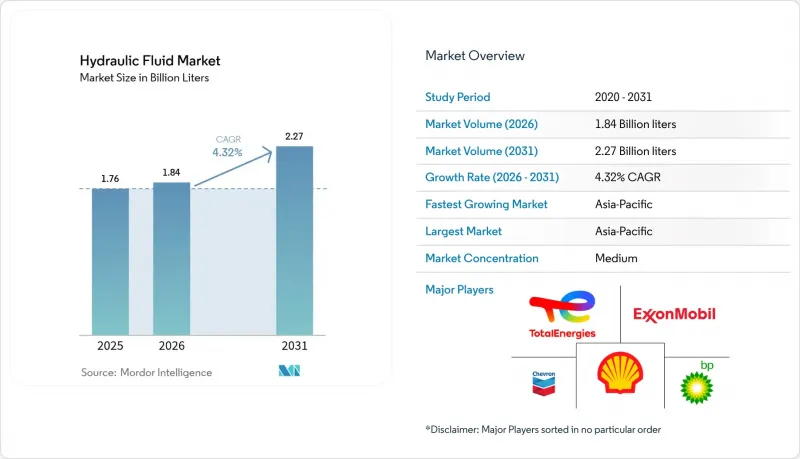
본 보고서는 기유 유형(광유, 합성유 등), 용도(이동식 유압 시스템 및 산업용/고정식 유압 시스템), 최종 사용자 산업(자동차, 기타 운송 장비, 중장비 등), 지역(아시아태평양, 북미 등)별로 분류되어 있습니다. 시장 예측은 수량(리터) 기준으로 제시되어 있습니다.
세계의 유압작동유 시장 동향 및 인사이트
건설 및 광업 활동의 확대
건설 기계는 유압 장비 사용량의 76%를 차지하고 있어, 유압 유압작동유 소비를 주도하고 있습니다. 중국의 ‘일대일로’ 구상과 인도의 ‘국가 인프라 계획’에 따른 견실한 인프라 구축은 굴삭기, 로더, 크레인의 지속적인 구매로 이어지고 있으며, 이러한 장비들은 고온, 분진 및 장시간 가동 주기에 대응할 수 있는 고품질 유압작동유를 필요로 합니다. 미국의 지하 광업 안전 규정에 따르면 MSHA(광산 안전 보건국)가 승인한 난연성 유압작동유의 사용이 의무화되어 있어, 이로 인해 인산 에스테르계 및 물-글리콜 혼합 유압작동유 수요가 증가하고 있습니다. 팬데믹 이후 메가 프로젝트의 회복에 더해, 도시화와 자원 채굴의 진전이 맞물리면서 유압작동유 시장에 지속적인 호재가 되고 있습니다.
자동차 및 전기차(EV) 생산 확대가 첨단 유압 시스템 수요를 뒷받침
전기차 조립 라인에서는 여전히 고출력 유압 프레스와 배터리 팩 이송 장치가 사용되고 있습니다. 이러한 공정에서는 뛰어난 전기 절연성과 열 안정성을 갖춘 유압작동유가 필요하며, 수성 또는 저열전도성 에스테르계 유압작동유와 같은 새로운 배합 기술 개발이 진행되고 있습니다. 토탈에너지스는 최근 전기차 냉각 루프용 수성 윤활유를 출시했습니다. 이는 유체 공급업체들이 새로운 구동계 아키텍처에 맞추어 사업 전략을 재검토하고 있음을 보여줍니다. 스티어 바이 와이어(steer-by-wire) 및 Brake-by-wire(brake-by-wire)의 도입으로 기존 자동차용 유체의 사용량은 감소하고 있지만, 전기차 배터리 생산, 기가 프레스, 화이트 바디 제조 분야에서 발생하는 새로운 기회가 그 감소분을 상쇄하고 있습니다.
원유 가격 변동이 광물유계 유체 비용에 영향
기유 가격은 원유 가격 변동과 연동됩니다. OPEC+의 생산 조정은 그룹 II 및 그룹 III 원료 가격에 파급되어, 대량의 유압작동유 재고에 의존하는 최종 사용자에게 예산 편성상의 골칫거리가 되고 있습니다. 정유시설의 가동 중단이나 지정학적 긴장으로 인한 공급 차질은 고정 가격 공급 계약 하에서 사업을 영위하는 블렌더의 이익률을 급격히 압박할 가능성이 있습니다. 광물유는 총 판매량의 거의 절반을 차지하고 있기 때문에 가격 급등은 유압작동유 시장 전체로 파급되어 단기적인 수요 지연을 초래할 우려가 있습니다.
부문별 분석
2025년, 광물유는 유압작동유 시장의 48.81%를 차지했으며, 그 위상은 뛰어난 가성비와 광범위한 OEM 승인을 바탕으로 하고 있습니다. 바이오 제품은 시장 점유율이 한 자릿수 중반에 그치고 있지만, 최종 사용자가 지속가능성 인증을 추구하고 규제 당국이 유출 방지 규정을 강화함에 따라 5.03%라는 가장 높은 연평균 성장률(CAGR)을 나타낼 전망입니다. 생분해성이라는 특성이 환경 규제와 부합함에 따라, 농업 및 해양 분야의 바이오베이스 등급 유압작동유 시장 규모는 현저히 확대될 것으로 예측됩니다. 바이오에스터는 과거 산화 위험이 있어 채택이 제한되었으나, 현재는 최신 산화 방지제 패키지를 통해 유압작동유의 수명이 연장되고 있습니다. 이는 슬러지 형성을 해결하기 위해 재생 가능한 합성 기유를 사용한 셰브론(Chevron)사의 ‘Clarity Bio EliteSyn AW’ 출시에서 알 수 있듯이입니다. 항공우주 분야의 비행 제어 시스템에서는 인산 에스테르의 성능을 타협할 수 없기 때문에 합성 에스테르가 여전히 주류를 이루고 있습니다.
성장 전망은 지역에 따라 다릅니다. 유럽에서는 해운 사업자들에게 EU 에코라벨 인증을 받은 유압작동유 사용이 권장되고 있어, 급속 생분해성 기준을 충족하는 푸크스(FUCHS)의 ‘PLANTOHYD’ 시리즈에 대한 수요가 증가하고 있습니다. 북미에서는 에너지 절약을 목적으로 한 고성능 그룹 III 블렌드에 초점이 맞추어져 있습니다. 아시아태평양에서는 비용 측면의 우위와 강화되는 환경 요건이 양립하고 있어, 지역 블렌더들은 경쟁력을 유지하기 위해 광물유와 식물성 기름의 배합 비율을 조정하고 있습니다. 상승 추세를 보이고는 있으나, 가격 차이로 인해 전면적인 대체는 완만한 수준에 그칠 것이며, 2031년까지 유압작동유 시장에서의 판매량 주력으로 광물유가 계속해서 중심적인 위치를 차지할 것입니다.
지역별 분석
아시아태평양은 계속해서 유압작동유 소비의 중심지이며, 2025년에는 전 세계 총량의 40.75%를 차지했으며 연평균 성장률(CAGR) 5.36%라는 가장 높은 성장 전망을 유지하고 있습니다. 건설 기계 분야에서의 중국의 주도적 지위와 인도의 트랙터 붐이 이 지역의 우위를 뒷받침하고 있습니다. 엑슨모빌은 2025년에 싱가포르 레지드 업그레이드 프로젝트를 완료하고, 고성능 유압작동유의 보급을 뒷받침하는 EHC 340 MAX 베이스 스톡을 하루 2만 배럴 추가 생산함으로써 현지 공급망을 강화했습니다. 가와사키 중공업은 국내 수요에 대응하고 수입 의존도를 낮추기 위해 인도 내 유압 부품 생산 능력을 두 배로 늘렸습니다. 정책 주도의 인프라 확충과 대규모 농업 기계화가 맞물려, 유압 유압작동유 시장에서 아시아태평양의 우위를 확고히 하고 있습니다.
북미는 판매 대수 증가세가 둔화되고 있음에도 불구하고 기술적 영향력을 유지하고 있습니다. 이 대륙에서는 예측 분석을 가능하게 하는 센서 내장형 유압작동유 시험 도입을 주도하고 있으며, 셰브론(Chevron) 등 대형 블렌딩 업체들은 ESG 목표에 부합하기 위해 재생 가능한 베이스 오일을 시장에 출시하기 시작했습니다. 제조업의 국내 복귀(리쇼어링)로 인해 공작기계 및 로봇 셀용 윤활유 수요가 증가하고 있으며, 이는 유압 부품 사용량이 적은 순수 전기 경차 수요 감소를 부분적으로 상쇄하고 있습니다. 캐나다가 2025년 하노버 메세(Hannover Messe)의 공동 주최국이 된 것은 특수 유압작동유가 필요한 청정 기술에 관한 국경을 초월한 협력에 주목을 받고 있습니다. 유럽에서는 환경 규제 준수가 우선시되고 있으며, 임업, 해양, 토목 공사 프로젝트에서 생분해성 배합 유압작동유가 선호되고 있습니다. 독일의 첨단 단조 및 다이캐스팅 거점은 초고압을 견디는 고품질의 무아연 혼합 유압작동유에 의존하고 있습니다. 항공우주 분야에서 강점을 가진 프랑스와 이탈리아는 난연성 인산 에스테르 유압작동유 수요를 주도하고 있습니다. 한편, 남미, 중동 및 아프리카는 현재 규모는 작지만, 광업 프로젝트가 가속화되고 각국 정부가 도로 및 철도 회랑 정비에 주력하고 있어 높은 성장 잠재력이 예상됩니다. 현지 공급망은 여전히 미발달 상태이므로 수입이 주류를 이루고 있으며, 환율 변동은 이 지역 구매자들에게 전략적 우려 사항으로 작용하고 있습니다. 전반적으로, 지역별 특유의 요인들이 세계 유압작동유 시장의 성장 스토리에 미묘한 뉘앙스를 더하고 있지만, 대륙을 불문하고 공통된 요소는 중장비 작업에서 유체 동력 기술이 필수적인 역할을 수행하고 있다는 점입니다.
기타 혜택 :
- 엑셀 형식 시장 예측(ME) 시트
- 3개월간의 애널리스트 지원
자주 묻는 질문
목차
제1장 서론
제2장 조사 방법
제3장 개요
제4장 시장 구도
제5장 시장 규모 및 성장 예측
제6장 경쟁 구도
제7장 시장 기회 및 향후 전망
KTH 26.08.31According to Mordor Intelligence, the hydraulic fluid market size was valued at 1.76 billion liters in 2025 and estimated to grow from 1.84 billion liters in 2026 to reach 2.27 billion liters by 2031, at a CAGR of 4.32% during the forecast period (2026-2031).
This report is Segmented by Base-Oil Type (Mineral Oil, Synthetic Oil, and More), Application (Mobile Hydraulic Systems and Industrial/Stationary Hydraulic Systems), End-User Industry (Automotive, Other Transportation, Heavy Equipment, and More), and Geography (Asia-Pacific, North America, and More). The Market Forecasts are Provided in Terms of Volume (Liters).
Global Hydraulic Fluid Market Trends and Insights
Expanding Construction and Mining Activities
Construction equipment accounts for 76% of hydraulic equipment usage and therefore dominates fluid consumption. Robust infrastructure pipelines under China's Belt and Road framework and India's National Infrastructure Pipeline translate into sustained purchases of excavators, loaders, and cranes that demand premium fluids capable of coping with heat, dust, and extended duty cycles. Safety regulations in U.S. underground mining stipulate MSHA-approved fire-resistant fluids, boosting demand for phosphate-ester and water-glycol blends. The post-pandemic rebound in mega-projects, alongside urbanization and resource extraction, creates a durable tailwind for the hydraulic fluid market.
Automotive and EV Production Growth Boosting Demand for Advanced Hydraulics
Electric-vehicle assembly lines still rely on high-force hydraulic presses and battery-pack lifting rigs. These stations require fluids with superior electrical insulation and thermal stability, prompting formulation innovation such as water-based and low-conduction esters. TotalEnergies recently debuted water-based lubricants aimed at EV cooling loops, underscoring how fluid suppliers are repositioning around new drivetrain architectures. While steer-by-wire and brake-by-wire cut conventional automotive fluid volumes, incremental opportunities in EV battery production, giga-presses, and body-in-white operations offset volume losses.
Volatility in Crude-Oil Prices Impacting Mineral-Oil Fluid Costs
Base-oil prices track crude swings. OPEC+ production adjustments ripple through Group II and Group III feedstocks, creating budgeting headaches for end users that rely on large hydraulic fluid inventories. Supply upsets caused by refinery outages or geopolitical tensions can rapidly squeeze margins for blenders who operate under fixed-price supply contracts. Because mineral oil accounts for nearly half of all liters sold, price spikes ripple across the hydraulic fluid market and may prompt short-term demand deferral.
Other drivers and restraints analyzed in the detailed report include:
- Shift Toward Energy-Efficient Hydraulic Equipment in Manufacturing
- Agricultural Mechanization Surge in Emerging Economies
- High Cost and Limited Supply of Synthetic and Bio-Based Fluids
For complete list of drivers and restraints, kindly check the Table Of Contents.
Segment Analysis
Mineral oils controlled 48.81% of the hydraulic fluid market in 2025, a position underpinned by favorable cost-performance ratios and broad OEM approvals. Bio-based products, while only mid-single-digit share, are forecast to register the quickest 5.03% CAGR as end users pursue sustainability certifications and regulators tighten spill-prevention rules. The hydraulic fluid market size for bio-based grades is expected to widen noticeably in agriculture and marine sectors as biodegradable features align with environmental mandates. Bio-ester oxidation risks once limited adoption, yet modern antioxidant packages now extend fluid life, as shown by Chevron's Clarity Bio EliteSyn AW launch that uses a renewable synthetic base to tackle sludge formation. Synthetic esters remain entrenched in aerospace flight-control systems where phosphate-ester performance cannot be compromised.
Growth prospects differ across regions. Europe pushes maritime operators toward EU Ecolabel-approved fluids, propelling demand for FUCHS PLANTOHYD series that meets rapid biodegradability criteria. North America focuses on high-performance Group III blends aimed at energy savings. Asia-Pacific blends cost advantage with rising green requirements, so regional blenders balance mineral and vegetable-oil inputs to maintain competitiveness. Despite upward momentum, price differentials will slow wholesale substitution, ensuring mineral oil remains the volume backbone of the hydraulic fluid market through 2031.
Complete Report Scope:
- By Base-Oil Type
- Mineral Oil
- Synthetic Oil
- Semi-Synthetic Oil
- Bio-based Oil
- Fire-Resistant (Phosphate-ester, Water-glycol)
- By Application
- Mobile Hydraulic Systems
- Industrial/Stationary Hydraulic Systems
- By End-user Industry
- Automotive
- Other Transportation
- Heavy Equipment
- Food and Beverage
- Other End-user Industries (Construction, Power Generation and Utilities, Agriculture, etc.)
- By Geography
- Asia-Pacific
- China
- India
- Japan
- South Korea
- Rest of Asia-Pacific
- North America
- United States
- Canada
- Mexico
- Europe
- Germany
- United Kingdom
- Italy
- France
- Rest of Europe
- South America
- Brazil
- Argentina
- Rest of South America
- Middle East and Africa
- Saudi Arabia
- South Africa
- Rest of Middle East and Africa
- Asia-Pacific
Geography Analysis
Asia-Pacific remained the epicenter of hydraulic fluid consumption, holding 40.75% of global volume in 2025 and maintaining the quickest 5.36% CAGR outlook. China's leadership in construction machinery and India's tractor boom underpin regional dominance. ExxonMobil reinforced its local supply chain by completing the Singapore Resid Upgrade Project in 2025, adding 20,000 barrels per day of EHC 340 MAX basestock that supports broader adoption of high-performance fluids. Kawasaki Heavy Industries doubled hydraulic component capacity in India to service domestic demand and reduce import reliance. Policy-driven infrastructure expansion paired with large-scale agricultural mechanization cements Asia-Pacific's pre-eminence in the hydraulic fluid market.
North America remains technologically influential despite slower unit growth. The continent leads trials of sensor-integrated fluids that enable predictive analytics, and major blenders like Chevron are debuting renewable base oils to align with ESG targets. Manufacturing reshoring sparks incremental lubrication demand for machine tools and robotic cells, partially offsetting losses from electric-only light vehicles that use fewer hydraulic components. Canada's co-hosting role at Hannover Messe 2025 spotlights cross-border initiatives around clean technologies requiring specialty fluids. Europe prioritizes environmental compliance, thus favoring biodegradable formulations in forestry, offshore, and civil-works projects. Germany's advanced forging and die-casting hubs rely on premium zinc-free blends that withstand ultra-high pressures. France and Italy, both strong in aerospace, drive demand for fire-resistant phosphate-esters. Meanwhile, South America and the Middle East & Africa, though smaller today, show high upside as mining ventures accelerate and governments commit to road and rail corridors. Local supply chains remain underdeveloped, so imports dominate, making currency fluctuations a strategic concern for purchasers in these regions. Overall, geography-specific drivers add nuance to the global hydraulic fluid market growth narrative, yet the common denominator across continents is the indispensable role of fluid power in heavy-duty tasks.
- BP p.l.c
- Castrol Limited
- Chevron Corporation
- China Petroleum & Chemical Corporation (Sinopec)
- CITGO Petroleum Corporation
- CNPC
- Croda International PLC
- Eni SpA
- Exxon Mobil Corporation
- FUCHS
- Gazpromneft - Lubricants Ltd.
- Idemitsu Kosan Co.,Ltd.
- LUKOIL
- PETRONAS Lubricants International
- Phillips 66 Company
- Quaker Chemical Corporation
- Repsol
- Shell plc
- TotalEnergies
Additional Benefits:
- The market estimate (ME) sheet in Excel format
- 3 months of analyst support
TABLE OF CONTENTS
1 Introduction
- 1.1 Study Assumptions & Market Definition
- 1.2 Scope of the Study
2 Research Methodology
3 Executive Summary
4 Market Landscape
- 4.1 Market Overview
- 4.2 Market Drivers
- 4.2.1 Expanding construction & mining activities
- 4.2.2 Automotive & EV production growth boosting demand for advanced hydraulics
- 4.2.3 Shift toward energy-efficient hydraulic equipment in manufacturing
- 4.2.4 Agricultural mechanization surge in emerging economies
- 4.2.5 Rising adoption of fire-resistant phosphate-ester fluids in aerospace
- 4.3 Market Restraints
- 4.3.1 Volatility in crude-oil prices impacting mineral-oil fluid costs
- 4.3.2 High cost & limited supply of synthetic and bio-based fluids
- 4.3.3 Rapid electrification of mobile machinery reducing hydraulic content
- 4.4 Value Chain Analysis
- 4.5 Porter's Five Forces
- 4.5.1 Bargaining Power of Suppliers
- 4.5.2 Bargaining Power of Buyers
- 4.5.3 Threat of New Entrants
- 4.5.4 Threat of Substitutes
- 4.5.5 Degree of Competition
5 Market Size & Growth Forecasts (Volume)
- 5.1 By Base-Oil Type
- 5.1.1 Mineral Oil
- 5.1.2 Synthetic Oil
- 5.1.3 Semi-Synthetic Oil
- 5.1.4 Bio-based Oil
- 5.1.5 Fire-Resistant (Phosphate-ester, Water-glycol)
- 5.2 By Application
- 5.2.1 Mobile Hydraulic Systems
- 5.2.2 Industrial/Stationary Hydraulic Systems
- 5.3 By End-user Industry
- 5.3.1 Automotive
- 5.3.2 Other Transportation
- 5.3.3 Heavy Equipment
- 5.3.4 Food and Beverage
- 5.3.5 Other End-user Industries (Construction, Power Generation and Utilities, Agriculture, etc.)
- 5.4 By Geography
- 5.4.1 Asia-Pacific
- 5.4.1.1 China
- 5.4.1.2 India
- 5.4.1.3 Japan
- 5.4.1.4 South Korea
- 5.4.1.5 Rest of Asia-Pacific
- 5.4.2 North America
- 5.4.2.1 United States
- 5.4.2.2 Canada
- 5.4.2.3 Mexico
- 5.4.3 Europe
- 5.4.3.1 Germany
- 5.4.3.2 United Kingdom
- 5.4.3.3 Italy
- 5.4.3.4 France
- 5.4.3.5 Rest of Europe
- 5.4.4 South America
- 5.4.4.1 Brazil
- 5.4.4.2 Argentina
- 5.4.4.3 Rest of South America
- 5.4.5 Middle East and Africa
- 5.4.5.1 Saudi Arabia
- 5.4.5.2 South Africa
- 5.4.5.3 Rest of Middle East and Africa
- 5.4.1 Asia-Pacific
6 Competitive Landscape
- 6.1 Market Concentration
- 6.2 Strategic Moves
- 6.3 Market Share (%)/Ranking Analysis
- 6.4 Company Profiles (includes Global level Overview, Market level overview, Core Segments, Financials as available, Strategic Information, Market Rank/Share, Products & Services, Recent Developments)
- 6.4.1 BP p.l.c
- 6.4.2 Castrol Limited
- 6.4.3 Chevron Corporation
- 6.4.4 China Petroleum & Chemical Corporation (Sinopec)
- 6.4.5 CITGO Petroleum Corporation
- 6.4.6 CNPC
- 6.4.7 Croda International PLC
- 6.4.8 Eni SpA
- 6.4.9 Exxon Mobil Corporation
- 6.4.10 FUCHS
- 6.4.11 Gazpromneft - Lubricants Ltd.
- 6.4.12 Idemitsu Kosan Co.,Ltd.
- 6.4.13 LUKOIL
- 6.4.14 PETRONAS Lubricants International
- 6.4.15 Phillips 66 Company
- 6.4.16 Quaker Chemical Corporation
- 6.4.17 Repsol
- 6.4.18 Shell plc
- 6.4.19 TotalEnergies
7 Market Opportunities & Future Outlook
- 7.1 White-space & Unmet-need Assessment
- 7.2 Rising Awareness Towards Bio-Based Oils