|
시장보고서
상품코드
2116112
심장 발작 진단 : 시장 점유율 분석, 업계 동향 및 통계, 성장 예측(2026-2031년)Heart Attack Diagnostics - Market Share Analysis, Industry Trends & Statistics, Growth Forecasts (2026 - 2031) |
||||||
 Mordor Intelligence
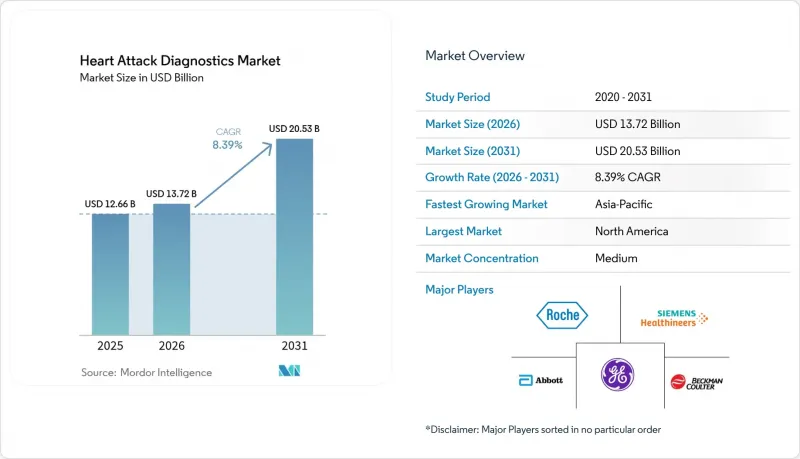
Mordor Intelligence에 의하면, 심장 발작 진단 시장 규모는 2025년에 126억 6,000만 달러로 평가되었습니다. 2026년 137억 2,000만 달러에서 2031년까지 205억 3,000만 달러에 이를 것으로 예상되며, 예측 기간(2026-2031년) CAGR은 8.39%를 나타낼 전망입니다.
본 보고서는 검사(심전도, 혈액 검사, 혈관 조영술(침습적·CT 관상동맥 조영술), 심장 CT/MRI, 기타), 최종 사용자(병원, 외래수술센터(ASC), 영상·병리 센터, 기타),지역(북미, 유럽, 아시아태평양, 중동 및 아프리카, 남미)별로 분류되어 있습니다. 시장 예측은 금액(미 달러) 기준으로 제시되어 있습니다.
세계의 심장 발작 진단 시장 동향 및 인사이트
전 세계적으로 증가하는 심혈관 질환의 부담과 고령화
인구 통계학적 변화가 심근경색 진단 시장을 재편하고 있습니다. 평균 수명이 늘어남에 따라 당뇨병, 신장 질환, 고혈압 등의 동반 질환이 겹치면서, 기존 진단 알고리즘의 특이도를 떨어뜨리는 비전형적인 증상 양상이 나타나고 있습니다. 유럽심장학회(ESC)는 2050년까지 심방세동의 유병률이 2배로 증가할 것으로 예측하고 있으며, 갑작스러운 심근 사건을 예방하기 위해 만성적인 심박 리듬 모니터링이 필요한 환자층이 확대될 전망입니다. 그 결과, 보험사 측은 현재 고감도 검사나 원격 심박 모니터링에 대한 투자를 임의 경비가 아닌 비용 절감책으로 인식하고 있습니다. 이에 대응하여 의료기기 제조업체들은 거의 실시간으로 위험도를 계층화하는 클라우드 기반 분석 기능을 탑재함으로써, 환자가 중환자실로 이송되기 훨씬 전에 임상적 판단을 지원하고 있습니다.
응급·중환자 치료 현장에서 신속하고 정확한 진단에 대한 수요 증가
심근경색의 확정 진단에 소요되는 시간이 1분이라도 늦어질 때마다 사망 위험이 높아집니다. 따라서 응급의학과 의사는 10분 이내에 검사실 수준의 정확도로 결과를 도출할 수 있는 진단법에 의존할 수밖에 없습니다. 임상 레지스트리에 따르면, 정기적인 심혈관내과 후속 관리를 받지 않는 환자의 병원 내 사망률이 24% 더 높은 것으로 나타나, 일선에서의 트리아지의 중요성이 부각되고 있습니다. 현재, 현장 진단 분석기나 휴대용 심전도 판독기에는 전문의의 소견을 재현하는 AI 알고리즘이 탑재되어 있어, 인력 부족 시설의 기술 격차를 메우고 있습니다. 이러한 기능은 심혈관 전문의가 부족하고, 항공 이송 지연으로 인해 치료의 적기 기회를 놓칠 가능성이 있는 지방 병원에서 특히 큰 효과를 발휘합니다.
고도화된 진단 시스템 및 소모품에 대한 고액의 설비 투자 비용과 운영 비용
고속 처리 능력의 화학 분석 장치나 CZT-SPECT 카메라의 정가는 200만 달러를 초과하는 경우도 있지만, 더 큰 부담이 되는 것은 시약 키트의 지속적인 구입비, 연간 유지보수 계약, 직원 연수 비용입니다. 소규모 지역 병원에서는 일반적인 예산 주기 내에서 이러한 비용을 회수할 만큼 충분한 검체를 처리하는 경우가 거의 없습니다. 그러나 소아 이식 병동의 사례에서는 일회성 관류 혈액 검사를 실시함으로써 안전성을 해치지 않으면서 수술 후 모니터링 비용을 10분의 1로 줄일 수 있는 것으로 나타났습니다. 이 사례는 목표 지향적인 혁신을 통해 비용 장벽을 극복할 수 있음을 보여주지만, 그러한 해결책을 더 광범위한 환자층으로 확대하는 데에는 여전히 과제가 남아 있습니다.
부문별 분석
2025년, 혈액 검사는 심근경색 진단 시장의 41.02%를 차지했습니다. 이러한 위상은 심근경색이 의심되는 첫 1시간 이내에 ‘양성인지 음성인지’에 대한 명확한 답변을 도출해내는 고감도 심근 트로포닌 I/T 키트에 의해 뒷받침되고 있습니다. 이 규모는 심근경색 진단 시장에서 구체적인 시장 규모상의 우위를 가져와 51억 9,000만 달러의 매출을 창출했으며, 이 부문이 시약 공급업체의 현금 흐름 원동력임을 입증하고 있습니다. CK-MB 및 미오글로빈과 같은 병행 검사는 만성 질환으로 인해 기준선 트로포닌 수치가 상승한 경우, 진단을 확정하거나 배제하는 데 있어 여전히 임상적으로 중요합니다. 그러나 수요 추세는 변화하고 있습니다. 웨어러블 심전도 플랫폼은 연평균 성장률(CAGR) 12.74%로 발전하고 있으며, 2020년대 후반에는 1차 심박 리듬 분석에서 혈관 조영 검사 의뢰 건수를 능가할 것으로 예측됩니다. 클라우드 기반 대시보드는 지속적인 데이터 스트림을 심혈관 의료 센터로 전송하며, 알고리즘이 ST 부문 편위나 색전성 심근 사건을 예고하는 발작성 심방세동을 감지하면 경보를 발령합니다.
이러한 성장 격차는 심장 발작 진단 시장이 단편적인 바이오마커 스냅샷에서 종합적인 실시간 생리학적 모니터링으로 전환되고 있음을 여실히 보여줍니다. 통합형 솔루션은 손가락 끝 채혈을 통한 트로포닌 검사 키트,스마트 패치형 심전도 센서, AI 기반 증상 추적기를 단일 구독 모델로 결합하고 있습니다. 이 접근 방식은 조기 심박 리듬 감지를 통해 고비용의 응급 이송이나 카테터실 입원을 피할 수 있으므로 건강보험사에게 매력적입니다. 영상 진단은 여전히 전략적 중요성을 유지하고 있습니다. CT 관상동맥 조영술과 심장 MRI는 플라크 부하, 좌심실 박출률, 미세혈관 관류를 정량화하여 예후 판정 및 치료법 선택을 지원합니다. 상호 운용 가능한 대시보드 내에서 생화학적, 전기적, 구조적 데이터를 통합할 수 있는 벤더는 생태계 효과를 통해 높은 이익률을 확보하고 사용자를 확보할 수 있을 것으로 보입니다.
지역별 분석
2025년에는 북미가 35.02%의 점유율로 전 세계 매출을 주도했습니다. 이는 새로운 바이오마커와 디지털 심전도 분석에 대해 긴 지급 지연 없이 환급을 수행하는 성숙한 지불자 제도에 힘입은 결과입니다. 미국에서는 트로포닌 검사 소요 시간 목표가 병원 결제에 연동되는 품질 지표에 포함되어 있어, 10분 이내에 결과를 도출할 수 있는 기기가 유리한 도입 기회를 확보할 수 있게 되었습니다. 캐나다의 단일 지불자 제도에서는 결과에 기반한 조달을 중시하고 있어, 단독 검사보다는 총 입원 건수를 줄이는 멀티플랫폼형 솔루션이 장려되고 있습니다. 미국심장협회(AHA)와 유럽심장학회(ESC)가 발행하는 임상 실무 지침이 널리 채택되어, 국경을 넘는 임상 채널이 원활해지고 있습니다.
유럽에서는 국민건강보험 제도와 엄격한 근거 기반의 승인 절차를 통해 방대한 수의 검사가 실시되고 있습니다. 독일의 ‘Netzwerk Herzzentren’은 바이오마커 프로토콜을 표준화하고 있는 반면, 영국의 국민보건서비스(NHS)는 지역 클리닉에서 AI를 활용한 심전도 분류 검사를 운영하고 있습니다. 이탈리아, 프랑스, 스페인에서는 국내 제조업체가 공립 병원과 제휴하여 소모품을 현지에서 생산함으로써 공급망 제약을 회피하고, 도입이 가속화되고 있습니다. 유럽 의료기기 규정(MDR)에 따른 규제 조화는 규정 준수 비용을 지속적으로 상승시키고 있지만, 회원국 간 시장 접근을 조화시키는 효과도 있습니다.
아시아태평양은 가장 빠르게 성장하는 지역으로, 2026년부터 2031년까지 연평균 성장률(CAGR) 10.41%로 확대되고 있습니다. 중국의 ‘건강중국 2030’ 청사진에서는 심혈관 질환이 국가 우선 과제로 자리 잡고 있으며, 공립병원을 대상으로 지급시에서 고감도 트로포닌 검사 및 저방사선 CT 혈관조영술의 도입이 추진되고 있습니다. 일본의 초고령화 사회는 엄격한 개인정보 보호법에 준거한 클라우드 저장소에 데이터를 업로드할 수 있는 휴대용 심장 모니터에 대한 수요를 가속화하고 있습니다. 인도의 ‘아유슈만 바라트’ 계획은 보험 적용 범위를 확대하고, 민관 협력을 통해 지역 병원에 현장 진단용 트로포닌 검사 키트의 보급을 촉진하고 있습니다. 이러한 노력들이 맞물려 심근경색 진단 시장은 확대되고 있지만, 각 벤더사는 다양한 지불자 구조에 맞추어 가격 책정 및 서비스 모델을 조정해야 합니다.
중동 및 아프리카 전역에서 걸프협력회의(GCC) 회원국들은 최첨단 바이오마커 분석 장비를 도입한 서유럽 수준의 3차 의료 센터에 투자하고 있습니다. 대조적으로, 사하라 이남 아프리카 국가들의 보건부는 인프라가 미비한 환경에서도 작동하는 휴대용 진단 기기를 선호하고 있습니다. 남미 국가들은 통화 변동에 어려움을 겪고 있지만, 브라질의 통합 보건 시스템(SUS)은 휴대용 심전도 장비를 갖춘 전국적인 흉통 대응 유닛에 자금을 지원하고 있습니다. 이러한 동향은 북미가 수익의 벤치마크를 설정하고 있는 반면, 장기적인 판매량 증가는 신흥 시장 수요에 맞춘 전략에 점점 더 좌우되고 있음을 보여줍니다.
기타 혜택
- 엑셀 형식 시장 예측(ME) 시트
- 3개월간의 애널리스트 지원
자주 묻는 질문
목차
제1장 서론
제2장 조사 방법
제3장 개요
제4장 시장 구도
제5장 시장 규모 및 성장 예측
제6장 경쟁 구도
제7장 시장 기회 및 향후 전망
KTH 26.08.31According to Mordor Intelligence, the heart attack diagnostics market size was valued at USD 12.66 billion in 2025 and estimated to grow from USD 13.72 billion in 2026 to reach USD 20.53 billion by 2031, at a CAGR of 8.39% during the forecast period (2026-2031).
This report is Segmented by Test (Electrocardiogram, Blood Tests, Angiogram (Invasive & CT Coronary), Cardiac CT/MRI, and Other Tests), End User (Hospitals, Ambulatory Surgical Centers, Diagnostic Imaging & Pathology Centers, and More), and Geography (North America, Europe, Asia-Pacific, The Middle East and Africa, and South America). The Market Forecasts are Provided in Terms of Value (USD).
Global Heart Attack Diagnostics Market Trends and Insights
Growing Global Burden of Cardiovascular Disease & Aging Population
The demographic wave is reshaping the heart attack diagnostics market. As average life expectancy rises, comorbidities such as diabetes, renal disease, and hypertension converge to create atypical symptom profiles that blunt the specificity of historical diagnostic algorithms. The European Society of Cardiology predicts atrial fibrillation prevalence will double by 2050, widening the pool of patients who require chronic rhythm monitoring to avoid sudden myocardial events. Consequently, payers now view investment in high-sensitivity assays and remote rhythm monitors as a cost-containment measure rather than a discretionary expense. Device makers are responding by embedding cloud-based analytics that stratify risk in near-real time, supporting clinical decisions long before patients reach critical-care beds.
Rising Demand for Rapid, Accurate Diagnosis in Emergency & Critical-Care Settings
Every minute lost while confirming myocardial infarction raises mortality risk. Emergency-department physicians must therefore rely on diagnostics that deliver lab-grade accuracy within a sub-10-minute window. Clinical registries show that patients lacking regular cardiology follow-up experience 24% higher in-hospital mortality, underscoring the stakes of frontline triage. Point-of-care analyzers and handheld ECG readers now incorporate AI algorithms that replicate specialist interpretation, closing skills gaps in understaffed facilities. These capabilities are especially impactful in rural hospitals, where cardiologists are scarce and air-transfer delays can exceed therapeutic time windows.
High Capital and Operating Costs of Advanced Diagnostic Systems & Consumables
Sticker prices for high-throughput chemistry analyzers or CZT-SPECT cameras can exceed USD 2 million, but the larger burden lies in recurring reagent kits, annual service contracts, and staff training. Smaller community hospitals rarely process enough specimens to recoup those costs within typical budgeting cycles. Pediatric transplant units, however, demonstrate that once-perfusion blood tests can reduce post-operative monitoring expenses tenfold without compromising safety. This example illustrates that targeted innovation can overcome cost barriers, yet scaling such solutions across broader populations remains challenging.
Other drivers and restraints analyzed in the detailed report include:
- Continuous Innovation in Cardiac Biomarkers, Imaging & Analytics Technologies
- Expansion of Decentralized / Point-of-Care Testing Infrastructure Worldwide
- Stringent Regulatory Approval Pathways and Compliance Requirements
For complete list of drivers and restraints, kindly check the Table Of Contents.
Segment Analysis
Blood assays secured 41.02% of the heart attack diagnostics market in 2025, a position underpinned by high-sensitivity cardiac troponin I/T kits that generate definitive yes-or-no answers within the first hour of suspected infarction. That scale translates into a tangible heart attack diagnostics market size advantage, yielding USD 5.19 billion in revenues and affirming the segment as a cash-flow engine for reagent suppliers. Parallel tests such as CK-MB and myoglobin remain clinically relevant for rule-in or rule-out scenarios when baseline troponin is elevated due to chronic disease. Yet the demand profile is changing. Wearable ECG platforms are advancing at a 12.74% CAGR and are projected to overtake angiogram referrals for first-line rhythm analysis by the late-2020s. Cloud-based dashboards push continuous data streams to cardiology hubs, triggering alerts when algorithms detect ST-segment deviation or paroxysmal atrial fibrillation, a precursor to embolic myocardial events.
This growth gap underscores how the heart attack diagnostics market is migrating from episodic biomarker snapshots toward holistic, real-time physiologic surveillance. Integrated solutions combine fingerstick troponin kits, smart-patch ECG sensors, and AI-curated symptom trackers within a single subscription model. The approach appeals to health insurers because early rhythm detection can avert ambulance transfers and catheter lab admissions, both high-cost events. Imaging still holds strategic relevancy. CT coronary angiography and cardiac MRI quantify plaque burden, left-ventricular ejection fraction, and microvascular perfusion, supporting prognosis and therapy selection. Vendors capable of harmonizing biochemical, electrical, and structural data within interoperable dashboards are likely to command premium margins and lock-in users through ecosystem effects.
Complete Report Scope:
- By Test
- Electrocardiogram (12-lead, 3-lead, Wearable)
- Blood Tests
- Cardiac Troponin I/T
- CK-MB & Myoglobin
- BNP & NT-proBNP
- Angiogram (Invasive & CT Coronary)
- Cardiac CT/MRI
- Other Tests
- By End User
- Hospitals
- Ambulatory Surgical Centers
- Diagnostic Imaging & Pathology Centers
- Home-based & Tele-cardiology Settings
- Other End Users
- Geography
- North America
- United States
- Canada
- Mexico
- Europe
- Germany
- United Kingdom
- France
- Italy
- Spain
- Rest of Europe
- Asia-Pacific
- China
- Japan
- India
- Australia
- South Korea
- Rest of Asia-Pacific
- Middle East & Africa
- GCC
- South Africa
- Rest of Middle East & Africa
- South America
- Brazil
- Argentina
- Rest of South America
- North America
Geography Analysis
North America led global revenue with a 35.02% share in 2025, fueled by mature payer systems that reimburse novel biomarkers and digital ECG analytics without lengthy coverage lags. The United States has embedded troponin turnaround-time targets into quality metrics tied to hospital payment, ensuring that devices capable of sub-10-minute results secure favorable placement. Canada's single-payer structure stresses outcomes-based procurement, promoting multi-platform solutions that reduce total admissions rather than stand-alone tests. Clinical practice guidelines issued by the American Heart Association and the European Society of Cardiology are widely adopted, smoothing cross-border clinical pathways.
Europe contributes a substantial volume of procedures through universal coverage and rigorous evidence-based approval processes. Germany's Netzwerk Herzzentren has standardized biomarker protocols, while the United Kingdom's National Health Service is trialing AI-enabled ECG triage in community clinics. Adoption across Italy, France, and Spain accelerates where domestic producers partner with public hospitals to localize production of consumables, thereby sidestepping supply-chain constraints. Regulatory convergence under the European Medical Device Regulation continues to raise compliance costs but also harmonizes market access across member states.
Asia-Pacific is the fastest-growing territory, expanding at a 10.41% CAGR from 2026 to 2031. China's Healthy China 2030 blueprint earmarks cardiovascular illness as a national priority, pushing public hospitals to deploy high-sensitivity troponin and low-radiation CT angiography in prefecture-level cities. Japan's super-aging demographic accelerates demand for ambulatory cardiac monitors that can upload data to cloud repositories compliant with stringent privacy laws. India's Ayushman Bharat scheme widens insurance coverage, encouraging public-private partnerships to distribute point-of-care troponin kits into district hospitals. Collectively, these initiatives enlarge the heart attack diagnostics market, but vendors must tailor price points and service models to heterogeneous payer structures.
Across the Middle East & Africa, Gulf Cooperation Council states invest in Western-standard tertiary centers that install state-of-the-art biomarker analyzers. In contrast, sub-Saharan health ministries favor portable diagnostics that function in low-infrastructure settings. South American nations grapple with currency volatility; however, Brazil's Unified Health System funds nationwide chest-pain units equipped with handheld ECG devices. These dynamics illustrate that while North America sets revenue benchmarks, long-term volume growth increasingly hinges on strategies tuned to emerging-market needs.
- Abbott Laboratories
- Roche
- Siemens Healthineers
- GE Healthcare
- Koninklijke Philips
- Beckman Coulter (Danaher)
- bioMerieux
- QuidelOrtho
- Hitachi
- Schiller
- Toshiba Electronic Devices & Storage
- Midmark
- WuXi Diagnostics
- Becton Dickinson & Co.
- Nihon Kohden Corp.
- AliveCor
- PerkinElmer
- Sysmex Corp.
- Thermo Fisher Scientific
- AstraZeneca plc (Dx collaborations)
Additional Benefits:
- The market estimate (ME) sheet in Excel format
- 3 months of analyst support
TABLE OF CONTENTS
1 Introduction
- 1.1 Study Assumptions & Market Definition
- 1.2 Scope of the Study
2 Research Methodology
3 Executive Summary
4 Market Landscape
- 4.1 Market Overview
- 4.2 Market Drivers
- 4.2.1 Growing Global Burden of Cardiovascular Disease & Aging Population
- 4.2.2 Rising Demand for Rapid, Accurate Diagnosis In Emergency & Critical-Care Settings
- 4.2.3 Continuous Innovation in Cardiac Biomarkers, Imaging & Analytics Technologies
- 4.2.4 Expansion Of Decentralized/Point-Of-Care Testing Infrastructure Worldwide
- 4.2.5 Favourable Government Initiatives and Reimbursement for Early MI Detection
- 4.2.6 Increasing Healthcare Expenditure and Adoption Across Emerging Markets
- 4.3 Market Restraints
- 4.3.1 High Capital and Operating Costs of Advanced Diagnostic Systems & Consumables
- 4.3.2 Stringent Regulatory Approval Pathways and Compliance Requirements
- 4.3.3 Shortage of Skilled Healthcare Professionals Trained In Cardiac Diagnostics
- 4.3.4 Limited Accessibility and Reimbursement in Low-Resource Settings
- 4.4 Regulatory Landscape
- 4.5 Porter's Five Forces Analysis
- 4.5.1 Bargaining Power of Buyers
- 4.5.2 Bargaining Power of Suppliers
- 4.5.3 Threat of New Entrants
- 4.5.4 Threat of Substitutes
- 4.5.5 Intensity of Competitive Rivalry
5 Market Size & Growth Forecasts (Value, USD)
- 5.1 By Test
- 5.1.1 Electrocardiogram (12-lead, 3-lead, Wearable)
- 5.1.2 Blood Tests
- 5.1.2.1 Cardiac Troponin I/T
- 5.1.2.2 CK-MB & Myoglobin
- 5.1.2.3 BNP & NT-proBNP
- 5.1.3 Angiogram (Invasive & CT Coronary)
- 5.1.4 Cardiac CT/MRI
- 5.1.5 Other Tests
- 5.2 By End User
- 5.2.1 Hospitals
- 5.2.2 Ambulatory Surgical Centers
- 5.2.3 Diagnostic Imaging & Pathology Centers
- 5.2.4 Home-based & Tele-cardiology Settings
- 5.2.5 Other End Users
- 5.3 Geography
- 5.3.1 North America
- 5.3.1.1 United States
- 5.3.1.2 Canada
- 5.3.1.3 Mexico
- 5.3.2 Europe
- 5.3.2.1 Germany
- 5.3.2.2 United Kingdom
- 5.3.2.3 France
- 5.3.2.4 Italy
- 5.3.2.5 Spain
- 5.3.2.6 Rest of Europe
- 5.3.3 Asia-Pacific
- 5.3.3.1 China
- 5.3.3.2 Japan
- 5.3.3.3 India
- 5.3.3.4 Australia
- 5.3.3.5 South Korea
- 5.3.3.6 Rest of Asia-Pacific
- 5.3.4 Middle East & Africa
- 5.3.4.1 GCC
- 5.3.4.2 South Africa
- 5.3.4.3 Rest of Middle East & Africa
- 5.3.5 South America
- 5.3.5.1 Brazil
- 5.3.5.2 Argentina
- 5.3.5.3 Rest of South America
- 5.3.1 North America
6 Competitive Landscape
- 6.1 Market Concentration
- 6.2 Market Share Analysis
- 6.3 Company Profiles (Includes Global Level Overview, Market Level Overview, Core Segments, Financials As Available, Strategic Information, Market Rank/Share, Products & Services, Recent Developments)
- 6.3.1 Abbott Laboratories
- 6.3.2 F. Hoffmann-La Roche Ltd
- 6.3.3 Siemens Healthineers
- 6.3.4 GE HealthCare
- 6.3.5 Koninklijke Philips N.V.
- 6.3.6 Beckman Coulter (Danaher)
- 6.3.7 bioMrieux SA
- 6.3.8 QuidelOrtho Corporation
- 6.3.9 Hitachi Ltd.
- 6.3.10 Schiller AG
- 6.3.11 Toshiba Electronic Devices & Storage
- 6.3.12 Midmark Corporation
- 6.3.13 WuXi Diagnostics
- 6.3.14 Becton Dickinson & Co.
- 6.3.15 Nihon Kohden Corp.
- 6.3.16 AliveCor Inc.
- 6.3.17 PerkinElmer Inc.
- 6.3.18 Sysmex Corp.
- 6.3.19 Thermo Fisher Scientific Inc.
- 6.3.20 AstraZeneca plc (Dx collaborations)
7 Market Opportunities & Future Outlook
- 7.1 White-space & Unmet-need Assessment