

|
시장보고서
상품코드
2116132
경장영양 튜브 : 시장 점유율 분석, 업계 동향 및 통계, 성장 예측(2026-2031년)Enteral Feeding Tubes - Market Share Analysis, Industry Trends & Statistics, Growth Forecasts (2026 - 2031) |
||||||
 Mordor Intelligence
Mordor Intelligence에 의하면, 2026년 경장영양 튜브 시장 규모는 29억 8,000만 달러로 추정되고 2025년 28억 2,000만 달러에서 확대해, 2031년에는 39억 5,000만 달러에 이를 것으로 예측됩니다.
2026년부터 2031년까지 연평균 성장률(CAGR) 5.78%로 성장할 것으로 전망됩니다.
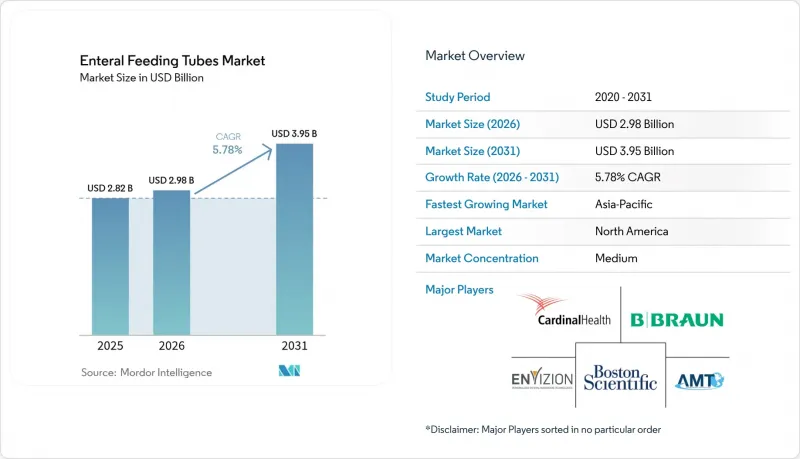
본 보고서는 제품별(비강·경장영양 튜브, 기타), 환자 유형별(성인, 기타), 용도별(종양학, 기타), 최종 사용자별(병원, 외래수술센터(ASC), 기타), 소재별(폴리우레탄·실리콘 튜브), 삽입 기술별(내시경 하 삽입, 기타),지역(북미, 유럽, 기타)별로 분류되어 있습니다. 시장 예측은 금액(달러) 기준으로 제시되어 있습니다.
세계의 경장영양 튜브 시장 동향 및 인사이트
만성 위장 질환 유병률 증가
세계적인 고령화에 더해, 암 및 염증성 장 질환의 유병률 증가가 경장영양에 대한 장기적인 수요를 뒷받침하고 있습니다. 2025년 영국 소화기학회(BSGI)가 발표한 지침에 따르면, 대부분의 암 환자가 조기 영양 지원이 필요한 여러 위장 증상을 보이는 것으로 확인되었습니다. 따라서 의료진은 치료 성과를 최적화하기 위해 고정밀 삽입 기술, 특히 전자기 유도 기술에 의존하고 있습니다. 의료계 관계자들은 질환과 관련된 영양실조를 예방함으로써 발생하는 비용 절감 효과를 인식하고 있으며, 이것이 경장영양 튜브 시장의 성장 궤도를 뒷받침하고 있습니다.
전 세계 영양실조 부담 증가
영양실조는 암 환자의 최대 80%에게 영향을 미치고 있으며, 고령자나 집중 치료를 받고 있는 환자층에게도 계속해서 큰 부담이 되고 있습니다. 업계 각사는 영양 공급을 개선하는 식물 유래 제제 및 경장영양 튜브의 혁신을 통해 이에 대응하고 있습니다. 암 간호 학회의 데이터에 따르면, 암 환자의 17-55%가 식량 불안을 겪고 있는 것으로 나타났으며, 이는 경장영양을 필수적인 것으로 만드는 사회적 결정 요인의 측면을 부각시키고 있습니다.
장기 요양 시설에서의 높은 튜브 관련 감염률
고령 환자를 대상으로 한 연구에 따르면, 추적 기간 중 사망률이 72%에 달하는 것으로 나타났으며, 이는 요양 시설에서 경관영양 도입을 저해하는 감염증 및 흡인 문제의 심각성을 여실히 드러냈습니다. 직원 교육의 불일치와 시설 내 전문 지식 부족으로 인해 시설 측은 모범 사례 프로토콜 준수에 어려움을 겪고 있으며, 이는 해당 부문에서 경관 영양 튜브 시장의 성장을 저해하고 있습니다.
부문별 분석
2025년에는 장루용 튜브가 전 세계 매출의 45.86%를 차지했으며, 암 환자 및 신경 질환 환자에 대한 장기적인 영양 지원에서 그 역할이 부각되었습니다. 전체 경장영양 튜브 시장에서 위루 버튼 및 PEG(경피적 위루술) 관련 다양한 제품은 편안함과 흡인 위험 감소 측면에서 의료 전문가들로부터 지속적인 지지를 받고 있습니다. 각 제조업체는 체내 고정 디스크와 얇은 포트의 개선을 추진하여 환자의 이동성을 높이고 있습니다. 연간 10.63%의 성장이 예상되는 자가 전개형 나선형 튜브는 내장된 마이크로모터와 가이드와이어를 이용하여 형광 투시 검사 없이 공장까지 도달합니다. 이러한 자동화로 인해 시술 시간이 단축되고 영상 촬영 비용이 절감됨에 따라, 비만 수술 및 중환자실에서 채택이 확대되고 있습니다.
비강-공장 튜브와 비강-위 튜브는 급성기 영양 공급에서 여전히 중요한 역할을 하고 있지만, 지출 비중은 점차 첨단 나선형 기기로 이동하고 있습니다. 경구 경장 튜브는 비강 삽입이 호흡을 방해하는 경우에 사용되는 신생아용 틈새 제품으로 남아 있습니다. 위를 통한 영양 공급이 금기되는 상부 위장관 수술 후 공장루 조성에 대한 수요가 증가하고 있으며, 이는 병원이 조기 회복 프로토콜을 충족하는 데 도움이 되고 있습니다. 자가 삽입형 설계와 첫 삽입 성공률 향상을 연관 짓는 임상 데이터는 더 광범위한 조달을 촉진하고 있으며, 장영양 튜브 시장의 프리미엄화 추세를 강화하고 있습니다.
2025년에는 고령화에 따라 연하 장애, 뇌졸중, 암 관련 악액질에 직면한 성인 환자가 매출의 69.98%를 차지했습니다. 병원에서는 수술이나 방사선 치료 후 발생하는 해부학적 변화에 대응하기 위해, 이러한 환자층에서 전자기식 트래커를 선호하여 채택하고 있습니다. 한편, 극저체중아의 생존율 향상과 신흥 시장에서 NICU(신생아 집중 치료실)의 기능 확충을 배경으로, 신생아 시장은 연평균 성장률(CAGR) 8.32%로 가장 빠른 성장세를 보이고 있습니다. 연구에 따르면, 일상적인 위 잔류액 검사를 폐지함으로써 입원 기간을 2일 단축할 수 있는 것으로 나타났으며, 이에 따라 조기 영양 공급 프로토콜의 보급이 확대되고 있습니다.
프렌치 사이즈가 작고 끝부분이 부드러운 소아 전용 튜브는 환자의 내약성을 향상시키고 있지만, 일부 지역에서는 보험 환급이 여전히 과제로 남아 있습니다. 성인 수요는 만성 질환에 의해 지속적으로 뒷받침되는 한편, 신생아 부문 수요 증가로 인해 지역별 소비 패턴이 다양화되어 전 연령층에 걸쳐 경장영양 튜브 시장이 유지될 전망입니다.
지역별 분석
북미는 견실한 보험 환급 제도, 확립된 임상 지침, 튜브 위치 확인 기술의 조기 도입에 힘입어 2025년에는 전 세계 매출의 38.12%를 차지했습니다. 미국은 연구 개발(R&D) 투자를 주도하고 있으며, 카디널 헬스(Cardinal Health)나 BD와 같은 기업들은 세계 시장 진출에 앞서 국내 파일럿 데이터를 바탕으로 전자기식 및 영상식 플랫폼을 개발하고 있습니다. 캐나다의 단일 지불자 모델은 주 전체에 걸친 계약을 확보하여 공급업체의 사업 규모를 확대되고 있습니다. 멕시코는 시장 규모는 작지만, 공립 병원을 위해 비용 대비 효율이 높은 폴리우레탄 튜브를 채택하여 지역 내 소비를 확대되고 있습니다.
아시아태평양은 인프라 정비와 규제 조화에 힘입어 연평균 성장률(CAGR) 8.79%로 확대되고 있으며, 이는 세계에서 가장 빠른 속도입니다. 중국에서 제정될 예정인 ‘의료기기법’은 규정 준수 중요성을 높일 것, 해외 기업의 등록 절차를 간소화하여 품질 실적이 입증된 세계 공급업체에 유리하게 작용할 것입니다. 인도의 위험 기반 분류 제도는 저위험 경장영양 키트의 승인을 가속화하지만, 여전히 현지에서 성능 데이터를 제출해야 합니다. 일본의 의료기기법 개정에 따라 심사 기간이 단축되어 무선 센서 시장 출시가 촉진되고 있습니다. 한국의 ‘디지털 의료기기법’은 AI를 활용한 모니터링을 장려하고 있으며, 이는 기존 튜브를 보완하는 형태를 띠고 있습니다. 이러한 조치들이 맞물려, 고령화와 신생아 돌봄 개선이라는 요인이 겹치는 아시아태평양 전체에서 경장영양 튜브 시장에 활력을 불어넣고 있습니다.
유럽에서는 엄격한 안전 프로토콜과 공공 부문의 막대한 지출로 인해 꾸준한 성장이 나타나고 있습니다. 독일과 영국은 오삽입 감사의 의무화를 계기로 전자기 유도 기술의 도입을 주도하고 있습니다. 남유럽과 동유럽 시장은 규모는 작지만, EU의 부흥 기금을 최신 내시경 장비 및 중환자실(ICU) 수용 능력 확충에 투자하고 있어, 첨단 튜브에 대한 접근성이 확대되고 있습니다. 중동 및 아프리카에서는 걸프협력회의(GCC) 회원국의 병원 확장 및 시술 건수를 늘리는 연수 프로그램에 힘입어 점진적인 성장이 나타나고 있습니다. 남미에서는 경제 변동에도 불구하고 브라질과 아르헨티나가 도입을 주도하고 있으며, 필수 영양 공급 장비를 확보하기 위해 공공 조달에 의존하고 있습니다. 이러한 지역별 다양한 동향이 경장영양 튜브 시장에서 다각적인 수익 기반을 공고히 하고 있습니다.
기타 혜택
- 엑셀 형식 시장 예측(ME) 시트
- 3개월간의 애널리스트 지원
자주 묻는 질문
목차
제1장 서론
제2장 조사 방법
제3장 개요
제4장 시장 구도
제5장 시장 규모 및 성장 예측
제6장 경쟁 구도
제7장 시장 기회 및 향후 전망
KTH 26.08.31According to Mordor Intelligence, enteral feeding tubes market size in 2026 is estimated at USD 2.98 billion, growing from 2025 value of USD 2.82 billion with 2031 projections showing USD 3.95 billion, growing at 5.78% CAGR over 2026-2031.
This report is Segmented by Product (Nasoenteral Feeding Tubes, and More), Patient Type (Adults, and More), Application (Oncology and More), End User (Hospitals, Ambulatory Surgical Centers, and More), Material (Polyurethane and Silicone Tubes), Placement Technology (Endoscopic Placement and More), and Geography (North America, Europe, and More). The Market Forecasts are Provided in Terms of Value (USD).
Global Enteral Feeding Tubes Market Trends and Insights
Rising Incidence of Chronic Gastrointestinal Disorders
An aging global population, coupled with higher cancer and inflammatory bowel disease prevalence, is fueling long-term demand for enteral nutrition. British Society of Gastroenterology guidance issued in 2025 confirms that most cancer patients present multiple gastrointestinal symptoms requiring early feeding support. Providers therefore rely on precision placement technologies, especially electromagnetic guidance, to optimize outcomes. Health systems acknowledge the cost avoidance that stems from preventing disease-related malnutrition, sustaining the enteral feeding tubes market's growth trajectory.
Growing Global Malnutrition Burden
Malnutrition affects up to 80% of oncology patients and continues to burden elderly and critical-care cohorts. Industry players answer with plant-based formulations and tube innovations that improve nutrient delivery. Oncology Nursing Society data showing 17-55% food-insecurity rates among cancer patients underline the social-determinant dimension that keeps enteral nutrition essential.
High Tube-Related Infection Rates in Long-Term Care Facilities
A study of geriatric patients showed 72% mortality during follow-up, spotlighting infection and aspiration challenges that dampen adoption in nursing homes. Inconsistent staff training and limited on-site expertise mean facilities struggle to meet best-practice protocols, restraining the enteral feeding tubes market in this segment.
Other drivers and restraints analyzed in the detailed report include:
- Sharp Uptick in Pre-Term Births in Low-Income Countries
- Adoption of Home Enteral Nutrition Programs by Payers
- Sub-Optimal Reimbursement for Paediatric Home Care
For complete list of drivers and restraints, kindly check the Table Of Contents.
Segment Analysis
Enterostomy tubes contributed 45.86% of global revenue in 2025, underscoring their role in long-term nutritional support for oncology and neurology patients. Within the enteral feeding tubes market size, gastrostomy buttons and PEG variants retain clinician preference for comfort and reduced aspiration risk. Manufacturers refine internal retention disks and low-profile ports, elevating patient mobility. Self-advancing spiral tubes, set to grow 10.63% annually, employ embedded micro-motors and guidewires to reach the jejunum without fluoroscopy. That automation lowers procedure time, trims imaging costs, and is gaining acceptance in bariatric and critical-care units.
Nasojejunal and nasogastric tubes stay relevant for acute feeding but share of spend is gradually edging toward advanced spiral devices. Oroenteric tubes remain a neonatal niche used when nasal placement impedes breathing. Jejunostomy demand rises following upper-GI surgeries where gastric feeding is contraindicated, helping hospitals meet enhanced-recovery protocols. Clinical data linking self-advancing designs to higher first-pass success supports wider procurement, reinforcing the enteral feeding tubes market's premiumization trend.
Adults provided 69.98% of revenue in 2025 as aging populations face dysphagia, stroke, and cancer-related cachexia. Hospitals favor electromagnetic trackers in these cohorts to navigate altered anatomy after surgery or radiation. Yet neonates deliver the fastest expansion at 8.32% CAGR, powered by improved survival of very-low-birth-weight infants and wider NICU capabilities in emerging markets. Studies show eliminating routine gastric residual checks can shorten hospital stays by two days, prompting broader acceptance of early feeding protocols.
Pediatric-specific tubes with narrower French sizes and softer tips improve tolerance, although reimbursement remains a headwind in some regions. Adult demand will stay anchored in chronic diseases, while neonatal gains diversify regional consumption patterns, sustaining the enteral feeding tubes market across age segments.
Complete Report Scope:
- By Product
- Nasoenteral Feeding Tubes
- Nasogastric Tubes
- Nasojejunal Tubes
- Enterostomy Tubes
- Gastrostomy Tubes (PEG, Button)
- Jejunostomy Tubes
- Oroenteric Tubes
- Self-Advancing Spiral Tubes
- Nasoenteral Feeding Tubes
- By Patient Type
- Adults
- Paediatrics
- Neonates
- By Application
- Oncology
- Neurology
- Gastroenterology
- Metabolic Disorders
- Hepatology
- Critical Care & Trauma
- By End User
- Hospitals
- Ambulatory Surgical Centres
- Home Care Settings
- Long-term Care Facilities
- By Material
- Polyurethane Tubes
- Silicone Tubes
- By Placement Technology
- Endoscopic Placement
- Fluoroscopic Placement
- Electromagnetic Tracking Placement
- Geography
- North America
- United States
- Canada
- Mexico
- Europe
- Germany
- United Kingdom
- France
- Italy
- Spain
- Rest of Europe
- Asia-Pacific
- China
- Japan
- India
- South Korea
- Australia
- Rest of Asia-Pacific
- Middle East and Africa
- GCC
- South Africa
- Rest of Middle East and Africa
- South America
- Brazil
- Argentina
- Rest of South America
- North America
Geography Analysis
North America held 38.12% of global revenue in 2025 due to robust reimbursement, established clinical guidelines, and early uptake of placement verification technologies. The United States drives R&D investment; companies like Cardinal Health and BD base electromagnetic or imaging platforms on domestic pilot data before global roll-out. Canada's single-payer model secures province-wide contracts, enhancing vendor scale. Mexico, while smaller, adopts cost-effective polyurethane tubes for public hospitals, broadening regional consumption.
Asia-Pacific is expanding at a 8.79% CAGR, the fastest globally, underpinned by infrastructure upgrades and regulatory harmonization. China's pending Medical Device Law raises compliance stakes but simplifies foreign registration, favoring global suppliers with quality records. India's risk-based classification fast-tracks low-risk feeding kits yet still demands local performance data. Japan's device-act amendments shorten review timelines, attracting launches of wireless sensors. South Korea's Digital Medical Products Act encourages AI-enabled monitoring, complementing traditional tubes. Collectively these measures inject momentum into the enteral feeding tubes market across Asia-Pacific, where aging populations and neonatal care improvements converge.
Europe delivers steady growth through stringent safety protocols and high public-sector spending. Germany and the United Kingdom lead adoption of electromagnetic guidance, motivated by mandating misplacement audits. Southern and Eastern European markets, though smaller, invest EU recovery funds into modern endoscopy and ICU capacity, widening access to advanced tubes. Middle East and Africa witness incremental gains, driven by Gulf Cooperation Council hospital expansions and training programs that lift procedural volumes. In South America, Brazil and Argentina spearhead uptake despite economic volatility, leaning on public procurement to secure essential nutrition devices. These varied regional dynamics ensure a diversified revenue base for the enteral feeding tubes market.
- Avanos Medical
- Cardinal Health
- Fresenius
- B. Braun
- Beckton Dickinson
- Boston Scientific
- Cook Group
- Conmed
- Applied Medical Resources
- Vygon
- ENvizion Medical
- Halyard Health
- Moog Inc. (Enteral Division)
- Nestle
- Danone
- Medtronic
- Amsino International
- ALCOR Scientific
- CORPAK MedSystems
- Baxter
Additional Benefits:
- The market estimate (ME) sheet in Excel format
- 3 months of analyst support
TABLE OF CONTENTS
1 Introduction
- 1.1 Study Assumptions & Market Definition
- 1.2 Scope of the Study
2 Research Methodology
3 Executive Summary
4 Market Landscape
- 4.1 Market Overview
- 4.2 Market Drivers
- 4.2.1 Rising Incidence Of Chronic Gastrointestinal Disorders
- 4.2.2 Growing Global Malnutrition Burden
- 4.2.3 Sharp Uptick In Pre-Term Births In Low-Income Countries
- 4.2.4 Adoption Of Home Enteral Nutrition Programs By Payers
- 4.2.5 Miniaturised, Wireless Sensors Enabling Placement Verification
- 4.2.6 Mandates For Nasogastric Tube Mis-Placement Audits In OECD Hospitals
- 4.3 Market Restraints
- 4.3.1 High Tube-Related Infection Rates In Long-Term Care Facilities
- 4.3.2 Sub-Optimal Reimbursement For Paediatric Home Care
- 4.3.3 Silicone Price Volatility Affecting OEM Margins
- 4.3.4 Sterilisation-Capacity Shortages Post-Ethylene-Oxide Curbs
- 4.4 Porter's Five Forces
- 4.4.1 Bargaining Power of Buyers/Consumers
- 4.4.2 Bargaining Power of Suppliers
- 4.4.3 Threat of New Entrants
- 4.4.4 Threat of Substitute Products
- 4.4.5 Intensity of Competitive Rivalry
5 Market Size & Growth Forecasts (Value, USD)
- 5.1 By Product
- 5.1.1 Nasoenteral Feeding Tubes
- 5.1.1.1 Nasogastric Tubes
- 5.1.1.2 Nasojejunal Tubes
- 5.1.2 Enterostomy Tubes
- 5.1.2.1 Gastrostomy Tubes (PEG, Button)
- 5.1.2.2 Jejunostomy Tubes
- 5.1.3 Oroenteric Tubes
- 5.1.4 Self-Advancing Spiral Tubes
- 5.1.1 Nasoenteral Feeding Tubes
- 5.2 By Patient Type
- 5.2.1 Adults
- 5.2.2 Paediatrics
- 5.2.3 Neonates
- 5.3 By Application
- 5.3.1 Oncology
- 5.3.2 Neurology
- 5.3.3 Gastroenterology
- 5.3.4 Metabolic Disorders
- 5.3.5 Hepatology
- 5.3.6 Critical Care & Trauma
- 5.4 By End User
- 5.4.1 Hospitals
- 5.4.2 Ambulatory Surgical Centres
- 5.4.3 Home Care Settings
- 5.4.4 Long-term Care Facilities
- 5.5 By Material
- 5.5.1 Polyurethane Tubes
- 5.5.2 Silicone Tubes
- 5.6 By Placement Technology
- 5.6.1 Endoscopic Placement
- 5.6.2 Fluoroscopic Placement
- 5.6.3 Electromagnetic Tracking Placement
- 5.7 Geography
- 5.7.1 North America
- 5.7.1.1 United States
- 5.7.1.2 Canada
- 5.7.1.3 Mexico
- 5.7.2 Europe
- 5.7.2.1 Germany
- 5.7.2.2 United Kingdom
- 5.7.2.3 France
- 5.7.2.4 Italy
- 5.7.2.5 Spain
- 5.7.2.6 Rest of Europe
- 5.7.3 Asia-Pacific
- 5.7.3.1 China
- 5.7.3.2 Japan
- 5.7.3.3 India
- 5.7.3.4 South Korea
- 5.7.3.5 Australia
- 5.7.3.6 Rest of Asia-Pacific
- 5.7.4 Middle East and Africa
- 5.7.4.1 GCC
- 5.7.4.2 South Africa
- 5.7.4.3 Rest of Middle East and Africa
- 5.7.5 South America
- 5.7.5.1 Brazil
- 5.7.5.2 Argentina
- 5.7.5.3 Rest of South America
- 5.7.1 North America
6 Competitive Landscape
- 6.1 Market Concentration
- 6.2 Market Share Analysis
- 6.3 Company Profiles (includes Global level Overview, Market level overview, Core Segments, Financials as available, Strategic Information, Market Rank/Share for key companies, Products & Services, and Recent Developments)
- 6.3.1 Avanos Medical Inc.
- 6.3.2 Cardinal Health
- 6.3.3 Fresenius Kabi AG
- 6.3.4 B. Braun Melsungen AG
- 6.3.5 Becton, Dickinson and Company
- 6.3.6 Boston Scientific Corporation
- 6.3.7 Cook Medical
- 6.3.8 Conmed Corporation
- 6.3.9 Applied Medical Technology Inc.
- 6.3.10 Vygon SA
- 6.3.11 ENvizion Medical Inc.
- 6.3.12 Halyard Health
- 6.3.13 Moog Inc. (Enteral Division)
- 6.3.14 Nestle Health Science
- 6.3.15 Danone Nutricia
- 6.3.16 Medtronic plc
- 6.3.17 Amsino International
- 6.3.18 ALCOR Scientific
- 6.3.19 CORPAK MedSystems
- 6.3.20 Baxter International Inc.
7 Market Opportunities & Future Outlook
- 7.1 White-space & Unmet-Need Assessment


