

|
시장보고서
상품코드
2116142
치과용 터빈 시장 : 점유율 분석, 업계 동향과 통계, 성장 예측(2026-2031년)Global Dental Turbine - Market Share Analysis, Industry Trends & Statistics, Growth Forecasts (2026 - 2031) |
||||||
 Mordor Intelligence
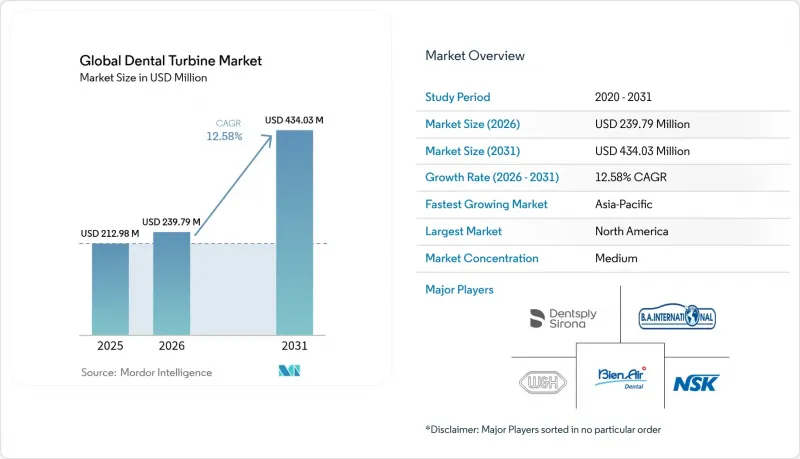
Mordor Intelligence에 의하면, 치과용 터빈 시장 규모는 2025년에 2억 1,298만 달러로 평가되었고 2026년 2억 3,979만 달러에서 2031년까지 4억 3,403만 달러에 이를 것으로 예측되며, 예측 기간(2026-2031년) CAGR은 12.58%를 나타낼 전망입니다.
본 보고서는 제품 유형별(공기 구동식 터빈, 전기 구동식 터빈, 하이브리드 공기·전기 구동식 터빈), 터빈 속도별(고속, 저속),재질(스테인리스 하우징 등), 최종 사용자(병원, 치과, 기타), 판매 채널(직접 판매, 치과 기기 판매점/도매업체, 온라인 플랫폼), 지역(북미, 유럽, 아시아태평양 등)별로 분류되어 있습니다.
전 세계 치과용 터빈 시장 동향 및 인사이트
심미 치과 및 저침습 치료에 대한 수요 증가
치과 진료에서는 심미적인 결과가 점점 더 중요시되면서, 진동이 적고 매끄러운 절삭면을 구현하는 터빈에 대한 수요가 증가하고 있습니다. 2024년 조사에 따르면, 치과의사의 81%가 심미 치료 계획 수립에 있어 인공지능(AI)이 유용하다고 생각하며, 이는 고토크·고정밀 기구에 대한 수요를 뒷받침하고 있습니다. 각 제조업체는 KaVo사의 ‘EXPERTtorque E680’ 시리즈와 같은 인체공학적 설계를 통해 이에 대응하고 있으며, 30 N의 바 고정력과 저소음을 실현하여 환자의 편안함을 향상시키고 있습니다. 이러한 변화는 선택적 치과 치료에 대한 자발적 지출이 여전히 높은 북미와 유럽에서 특히 두드러집니다. 토크 제어의 향상은 치아 구조를 보존하는 저침습적 접근 방식을 뒷받침하고 있으며, 터빈은 고품질 서비스 제공에 없어서는 안 될 요소가 되었습니다. 또한, 조용한 작동 소음은 스파와 같은 진료 환경을 내세우는 의료 기관의 차별화 요소가 되고 있습니다.
전 세계적으로 증가하는 충치 및 치주질환의 부담
세계보건기구(WHO)는 만성 구강 감염증과 알츠하이머병 등 전신 질환 간의 연관성을 지적하고 있으며, 이에 따라 각국 정부는 고성능 터빈을 활용한 수복 치료를 우선시하고 있습니다. 아시아 도시 지역의 설탕 소비량 증가는 젊은 층의 미치료 충치를 증가시켜, 진료 건수가 많은 치과 병원의 치료 건수를 끌어올리고 있습니다. 각 제조업체는 터빈이 매일의 혹독한 사용 주기를 견딜 수 있도록 보증 기간을 연장하고, 주요 부품을 강화하고 있습니다. 점검 주기를 연장함으로써 바쁜 진료소의 가동 중단 시간이 단축되는 한편, 내구성이 뛰어난 베어링은 반복적인 멸균 처리를 거치더라도 절삭 효율을 유지합니다. 치주병이 전신에 미치는 영향이 밝혀짐에 따라, 터빈은 단순한 일시적인 치료 기구에서 장기적인 치료비 절감을 목표로 하는 공중보건 전략의 핵심 인프라로 그 위상을 높이고 있습니다.
고급 터빈의 높은 초기 투자 비용 및 유지비
전동 핸드피스의 가격은 종종 5,000달러를 초과하여 라틴아메리카와 동남아시아의 개인 치과 진료소 예산을 압박하고 있습니다. 부적절한 윤활이나 오토클레이브를 통한 멸균 주기가 터빈의 수명을 단축시키기 때문에 총 소유 비용은 상승하고 있으며, 제조업체는 고장의 50% 이상이 불충분한 유지보수에서 기인한다고 지적하고 있습니다. 자동 위생 스테이션이 구비되지 않은 진료소에서는 추가 인건비가 발생할 뿐만 아니라, 진료 중단으로 이어질 수 있는 고장의 위험에도 직면합니다. 구독형 리스는 하드웨어, 유지보수, 교체 부품을 예측 가능한 요금으로 묶어 초기 비용을 부분적으로 상쇄하지만, 그 도입은 선진 시장에 국한되어 있습니다.
부문 분석
시장 점유율이 낮은 전동식 유닛은 2031년까지 연평균 성장률(CAGR) 15.27%로 확대될 전망이며, 2025년 치과용 터빈 시장 점유율의 64.62%를 차지했던 공기 구동식 시스템과의 격차를 점차 좁혀가고 있습니다. 치과 진료실에서는 에어로졸 저감이 우선시되고 있으며, 동료 심사를 거친 데이터에 따르면 플라즈마 정화 기술과 전동 터빈을 결합함으로써 공기 중의 병원체 수가 감소하는 것으로 확인되었습니다. 전동 핸드피스는 디지털 제어를 통한 토크를 제공하며, 강력한 절삭 시 발생하는 스톨을 방지함으로써 진료실의 생산성을 향상시킵니다.
이러한 성장은 조사 대상 치과의사의 81%가 도입하고 있는 인공지능(AI)을 활용한 워크플로우와의 호환성도 반영하고 있습니다. 치과 서비스 기관들이 대량 구매 계약을 체결함에 따라 전동 모델로의 전환이 가속화되고 있습니다. 하이브리드 터빈은 기존의 압축 공기 인프라를 활용하면서도 에어로졸 발생량을 줄이기 위한 전동 마이크로모터를 내장함으로써 이러한 전환을 원활하게 진행하고 있습니다. 그룹 진료소가 폐쇄형 멸균을 표준화함에 따라, 장비 사양서에서 밀폐형 베어링과 역류 방지 밸브가 점점 더 중요시되면서 전동 모델의 우위가 더욱 강화되고 있습니다.
2025년에는 고속 모델이 매출의 58.10%를 차지했으나, 임상의는 200,000 rpm을 초과하는 회전 수에서 치수 온도 상승을 관리해야 합니다. 각 제조업체는 치수강 부근의 상아질을 보호하기 위해 세라믹 볼 베어링과 첨단 냉각수 포트를 채택하고 있어, 안전성을 확보하면서도 고속 모델에 대한 선호도를 유지하고 있습니다. 저속 유닛은 치내 치료나 마무리 작업에 여전히 필수적이지만, 그 성장은 광범위한 시장 변화보다는 틈새 용도 수요에 좌우되고 있습니다.
정밀 치과 동향에서는 하나의 장치로 거친 절삭과 마무리 작업을 전환할 수 있는 가변 속도 제어가 선호되고 있습니다. KaVo사의 ‘직접 스톱 기술’은 버를 1초 이내에 정지시켜, 저침습성 증례에서 과도한 절삭을 최소화합니다. 향후 업그레이드에서는 미리 설정된 깊이에 도달했을 때 경고하는 햅틱 피드백이 탑재될 가능성이 있으며, 속도는 고정된 사양이 아닌 제어 가능한 매개변수로 통합될 것입니다.
지역별 분석
북미는 2025년 치과용 터빈 시장에서 39.30%의 점유율을 유지했습니다. 이는 성능 기준을 철저히 적용하고 고품질 핸드피스 채택을 촉진하는 FDA 510(k) 규정에 힘입은 결과입니다. 고급 수복 시술에 대한 보험 급여는 전동 터빈에 대한 설비 투자를 뒷받침하고 있습니다. 캐나다는 국경을 넘는 무역과 치과 관광의 혜택을 받고 있으며, 미국에서 승인된 기기가 추가 인증을 최소화하여 캐나다의 치과에 도입되고 있습니다.
아시아태평양은 인도와 중국이 중산층을 대상으로 치과 보험을 확대함에 따라 2031년까지 연평균 성장률(CAGR) 16.05%로 가장 높은 성장세를 보이고 있습니다. 도시 지역의 중산층 환자들은 신속하게 제공되는 심미적 수복 치료를 원하고 있으며, 이에 따라 치과에서는 진료 의자의 회전율을 극대화하기 위해 고속의 경량 터빈을 도입하고 있습니다. 중국의 국내 제조업체들은 비용 경쟁력이 있는 스테인리스 스틸 모델을 제공하는 반면, 국제 브랜드들은 정식 전자상거래 채널을 통해 프리미엄 틈새 시장을 공략하고 있습니다.
유럽에서는 의무화된 멸균 시험 기준치를 초과한 노후화된 장비의 교체가 필요하기 때문에 안정적인 교체 주기가 유지되고 있습니다. 조화로운 CE 마킹 덕분에 EU 역내에서 제품의 원활한 유통이 가능하지만, 브렉시트 이후의 규정에 따라 영국으로의 출하 시 추가 통관 서류가 필요해졌습니다. EU 역내에 생산 거점을 둔 제조업체는 공급망상의 마찰을 피하고 48시간 이내에 교체 부품을 납품할 수 있으므로, 시간적 제약이 엄격한 진료 현장에서 고객 충성도를 유지할 수 있습니다.
기타 혜택:
- 엑셀 형식 시장 예측(ME) 시트
- 3개월간의 애널리스트 지원
자주 묻는 질문
목차
제1장 서론
제2장 조사 방법
제3장 주요 요약
제4장 시장 구도
제5장 시장 규모와 성장 예측
제6장 경쟁 구도
제7장 시장 기회와 향후 전망
JHS 26.08.28According to Mordor Intelligence, the dental turbine market size was valued at USD 212.98 million in 2025 and estimated to grow from USD 239.79 million in 2026 to reach USD 434.03 million by 2031, at a CAGR of 12.58% during the forecast period (2026-2031).
This report is Segmented by Product Type (Air-Driven Turbine, Electric-Driven Turbine, Hybrid Air-Electric Turbine), by Turbine Speed (High-Speed, Low-Speed), by Material (Stainless-Steel Housing, and More), by End User (Hospitals, Dental Clinics, Others), by Distribution Channel (Direct Sales, Dental Dealers / Distributors, Online Platforms), by Geography (North America, Europe, Asia-Pacific, and More).
Global Dental Turbine Market Trends and Insights
Rising Demand for Cosmetic & Minimally-Invasive Procedures
Practices increasingly emphasize esthetic outcomes, driving a requirement for turbines that achieve smooth margins with low vibration. A 2024 survey reported that 81% of dentists view artificial intelligence as beneficial for cosmetic treatment planning, reinforcing demand for high-torque, precision instruments. Manufacturers respond with ergonomic designs such as KaVo's EXPERTtorque E680 series, which provides 30 N bur retention and low noise to improve patient comfort. The shift is most visible in North America and Europe, where discretionary spending on elective dentistry remains high. Enhanced torque control supports minimally invasive approaches that preserve tooth structure, making the turbines integral to premium service offerings. Quieter operation also differentiates providers that market spa-like clinical environments.
Growing Global Burden of Dental Caries & Periodontal Disease
The World Health Organization links chronic oral infections with systemic conditions such as Alzheimer's disease, prompting governments to prioritize restorative care that relies on high-performance turbines. Rising sugar consumption in urban Asia boosts untreated caries among youth, increasing procedure volumes in high-volume practices. Manufacturers extend warranty periods and reinforce key components so turbines withstand intensive daily cycles. Extended service intervals lower downtime for clinics confronting heavy caseloads, while durable bearings maintain cutting efficiency across repeated sterilization. Evidence of periodontal disease's systemic impact elevates turbines from episodic tools to core infrastructure in public-health strategies aimed at reducing long-term treatment costs.
High Capital & Servicing Costs of Premium Turbines
Electric handpieces often exceed USD 5,000, stretching budgets for solo practices in Latin America and Southeast Asia. Total cost of ownership rises because improper lubrication and autoclave cycles shorten turbine life, with manufacturers attributing over 50% of failures to inadequate maintenance. Clinics lacking automated hygiene stations face additional labor costs and risk service-interrupting damage. Subscription leasing partially offsets upfront expense by bundling hardware, maintenance, and replacements into predictable fees, yet adoption remains limited to advanced markets.
Other drivers and restraints analyzed in the detailed report include:
- Rapid Adoption of Electric & Hybrid Turbines for Aerosol Mitigation
- Integration with Chairside CAD/CAM & Digital Workflows
- Viable Substitutes (Electric Micromotors, Laser Dentistry)
For complete list of drivers and restraints, kindly check the Table Of Contents.
Segment Analysis
Electric-driven units accounted for a smaller base but are on pace to expand at 15.27% CAGR through 2031, narrowing the gap with air-driven systems that held 64.62% Dental turbine market share in 2025. Clinics prioritize aerosol mitigation, and peer-reviewed data confirms plasma purification paired with electric turbines lowers airborne pathogen counts. Electric handpieces provide digitally controlled torque that prevents stalling during heavy cuts, enhancing chairside productivity.
Growth also reflects alignment with artificial-intelligence-enabled workflows embraced by 81% of surveyed dentists. Dental service organizations negotiate bulk contracts, accelerating volume shifts toward electric models. Hybrid turbines bridge the transition by using existing compressed-air infrastructure while embedding electric micro-motors to cut aerosol volume. As group practices standardize on closed-loop sterilization, equipment spec sheets increasingly favor sealed bearings and anti-retraction valves, reinforcing electric advantages.
High-speed models commanded 58.10% revenue in 2025, yet clinicians must manage pulp temperature rise at rotations above 200,000 rpm. Manufacturers incorporate ceramic ball bearings and advanced coolant ports to protect dentine near the pulp chamber, sustaining preference for high-speed options while addressing safety. Low-speed units remain indispensable for endodontics and finishing tasks, but their growth is tied to niche application volume rather than broad market shifts.
Precision dentistry trends favor variable-speed controls that allow practitioners to toggle between rough-cut and fine-finish in a single unit. KaVo's Direct Stop Technology halts the bur within one second, minimizing over-prep in minimally invasive cases. Future upgrades may integrate haptic feedback that alerts when predefined depth settings are reached, embedding speed as a controllable parameter rather than a fixed specification.
Complete Report Scope:
- By Product Type
- Air-Driven Turbine
- Electric-Driven Turbine
- Hybrid Air-Electric Turbine
- By Turbine Speed
- High-Speed
- Low-Speed
- By Material
- Stainless-Steel Housing
- Titanium-Alloy Housing
- Others
- By End User
- Hospitals
- Dental Clinics
- Others
- By Distribution Channel
- Direct Sales
- Dental Dealers / Distributors
- Online Platforms
- By Geography
- North America
- United States
- Canada
- Mexico
- Europe
- Germany
- United Kingdom
- France
- Italy
- Spain
- Rest of Europe
- Asia-Pacific
- China
- Japan
- India
- Australia
- South Korea
- Rest of Asia-Pacific
- Middle East and Africa
- GCC
- South Africa
- Rest of Middle East and Africa
- South America
- Brazil
- Argentina
- Rest of South America
- North America
Geography Analysis
North America maintained 39.30% Dental turbine market share in 2025, underpinned by FDA 510(k) regulations that enforce performance standards and encourage adoption of premium handpieces.Insurance reimbursement for advanced restorative procedures supports capital investment in electric turbines. Canada benefits from cross-border trade and dental tourism that funnels US-approved devices into its clinics with minimal additional certification.
Asia-Pacific posts the highest CAGR at 16.05% through 2031 because India and China expand dental insurance to middle-income segments. Urban middle-class patients demand esthetic restorations delivered quickly, prompting clinics to install high-speed, lightweight turbines to maximize chair turnover. Domestic manufacturers in China offer cost-competitive stainless-steel models, while international brands target premium niches through authorized e-commerce channels.
Europe enjoys steady replacement cycles because equipment aging past mandatory sterilization test thresholds requires upgrading. Harmonized CE marking enables seamless product movement across the bloc, but post-Brexit rules add customs documentation for UK shipments. Manufacturers with EU-based production avoid supply-chain friction and can deliver replacement parts within 48 hours, maintaining customer loyalty in time-sensitive practices.
- Dentsply Sirona
- NSK (Nakanishi Inc.)
- KaVo Dental / Planmeca Group
- J. Morita Corp.
- Bien-Air Dental SA
- W&H Dentalwerk Burmoos GmbH
- DentalEZ
- Sinol Dental
- Guilin Woodpecker Medical Instrument Co. Ltd.
- Lares Research
- B.A. International
- MK-dent GmbH
- The Yoshida Dental Mfg. Co. Ltd.
- Nouvag
- Brasseler USA
- Dentamerica Inc.
- TKD S.p.A.
- Beyes Dental Canada Inc.
Additional Benefits:
- The market estimate (ME) sheet in Excel format
- 3 months of analyst support
TABLE OF CONTENTS
1 Introduction
- 1.1 Study Assumptions & Market Definition
- 1.2 Scope of the Study
2 Research Methodology
3 Executive Summary
4 Market Landscape
- 4.1 Market Overview
- 4.2 Market Drivers
- 4.2.1 Rising demand for cosmetic & minimally-invasive procedures
- 4.2.2 Growing global burden of dental caries & periodontal disease
- 4.2.3 Rapid adoption of electric & hybrid turbines for aerosol mitigation
- 4.2.4 Integration with chairside CAD/CAM & digital workflows
- 4.2.5 Subscription-based "handpiece-as-a-service" procurement models
- 4.2.6 Emerging-market insurance expansion for restorative dentistry
- 4.3 Market Restraints
- 4.3.1 High capital & servicing costs of premium turbines
- 4.3.2 Viable substitutes (electric micromotors, laser dentistry)
- 4.3.3 Noise-related occupational-health regulations
- 4.3.4 Stringent re-processing / sterilization turnaround times
- 4.4 Value / Supply-Chain Analysis
- 4.5 Regulatory Landscape
- 4.6 Technological Outlook
- 4.7 Porter's Five Forces Analysis
- 4.7.1 Threat of New Entrants
- 4.7.2 Bargaining Power of Buyers
- 4.7.3 Bargaining Power of Suppliers
- 4.7.4 Threat of Substitutes
- 4.7.5 Intensity of Competitive Rivalry
5 Market Size & Growth Forecasts (Value)
- 5.1 By Product Type
- 5.1.1 Air-Driven Turbine
- 5.1.2 Electric-Driven Turbine
- 5.1.3 Hybrid Air-Electric Turbine
- 5.2 By Turbine Speed
- 5.2.1 High-Speed
- 5.2.2 Low-Speed
- 5.3 By Material
- 5.3.1 Stainless-Steel Housing
- 5.3.2 Titanium-Alloy Housing
- 5.3.3 Others
- 5.4 By End User
- 5.4.1 Hospitals
- 5.4.2 Dental Clinics
- 5.4.3 Others
- 5.5 By Distribution Channel
- 5.5.1 Direct Sales
- 5.5.2 Dental Dealers / Distributors
- 5.5.3 Online Platforms
- 5.6 By Geography
- 5.6.1 North America
- 5.6.1.1 United States
- 5.6.1.2 Canada
- 5.6.1.3 Mexico
- 5.6.2 Europe
- 5.6.2.1 Germany
- 5.6.2.2 United Kingdom
- 5.6.2.3 France
- 5.6.2.4 Italy
- 5.6.2.5 Spain
- 5.6.2.6 Rest of Europe
- 5.6.3 Asia-Pacific
- 5.6.3.1 China
- 5.6.3.2 Japan
- 5.6.3.3 India
- 5.6.3.4 Australia
- 5.6.3.5 South Korea
- 5.6.3.6 Rest of Asia-Pacific
- 5.6.4 Middle East and Africa
- 5.6.4.1 GCC
- 5.6.4.2 South Africa
- 5.6.4.3 Rest of Middle East and Africa
- 5.6.5 South America
- 5.6.5.1 Brazil
- 5.6.5.2 Argentina
- 5.6.5.3 Rest of South America
- 5.6.1 North America
6 Competitive Landscape
- 6.1 Market Concentration
- 6.2 Market Share Analysis
- 6.3 Company Profiles (includes global-level overview, market-level overview, core segments, financials, strategic information, market rank/share, products & services, recent developments)
- 6.3.1 Dentsply Sirona Inc.
- 6.3.2 NSK (Nakanishi Inc.)
- 6.3.3 KaVo Dental / Planmeca Group
- 6.3.4 J. Morita Corp.
- 6.3.5 Bien-Air Dental SA
- 6.3.6 W&H Dentalwerk Burmoos GmbH
- 6.3.7 DentalEZ Inc.
- 6.3.8 Sinol Dental Ltd.
- 6.3.9 Guilin Woodpecker Medical Instrument Co. Ltd.
- 6.3.10 Lares Research
- 6.3.11 BA International
- 6.3.12 MK-dent GmbH
- 6.3.13 The Yoshida Dental Mfg. Co. Ltd.
- 6.3.14 Nouvag AG
- 6.3.15 Brasseler USA
- 6.3.16 Dentamerica Inc.
- 6.3.17 TKD S.p.A.
- 6.3.18 Beyes Dental Canada Inc.
7 Market Opportunities & Future Outlook
- 7.1 White-space & Unmet-Need Assessment


