|
시장보고서
상품코드
2116144
근위 경골 절골술용 플레이트 : 시장 점유율 분석, 업계 동향 및 통계, 성장 예측(2026-2031년)High Tibial Osteotomy Plates - Market Share Analysis, Industry Trends & Statistics, Growth Forecasts (2026 - 2031) |
||||||
 Mordor Intelligence
Mordor Intelligence에 의하면, 근위 경골 절골술용 플레이트 시장 규모는 2025년 2억 5,967만 달러로 평가되었습니다. 2026년에는 2억 7,036만 달러로 확대되어 2026-2031년에 걸쳐 CAGR 4.12%로 성장을 지속하여, 2031년에는 3억 3,078만 달러에 이를 것으로 예측됩니다.
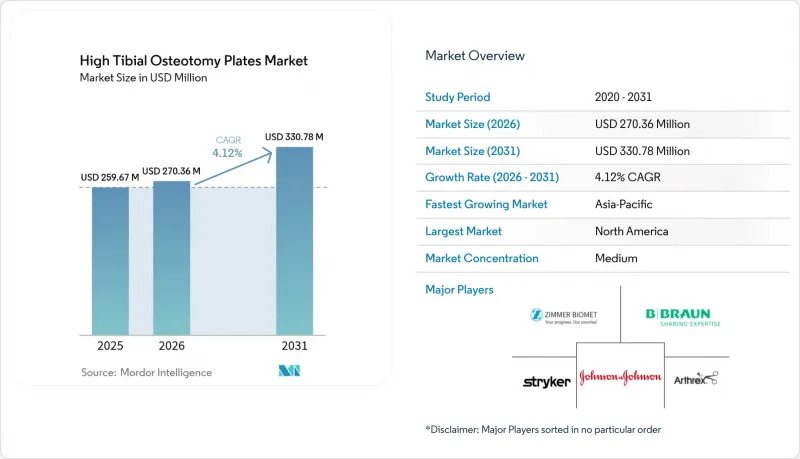
본 보고서는 소재별(금속(티타늄 플레이트 등), 폴리머, 생체흡수성), 수술 방식별(오픈 웨지 HTO, 클로징 웨지 HTO, 기타), 최종 사용자별(병원, 기타),지역별(북미, 유럽, 아시아태평양, 중동 및 아프리카, 남미)로 분류되어 있습니다. 시장 예측은 금액(미 달러) 기준으로 제시되어 있습니다.
세계의 근위 경골 절골술용 플레이트 시장 동향 및 인사이트
퇴행성 관절염 및 내반 무릎 변형의 유병률 증가
30-44세 성인에서 퇴행성 관절염 사례 수는 이미 전 세계적으로 3,297만 건에 달하며, 서술형 기록과 코드화된 데이터를 결합한 전자 건강 기록 분석에 따르면, 진단 코드만으로 추정한 수치와 비교하여 유병률은 2배인 11.8%로 나타났습니다. BMI 상승은 여전히 주요한 수정 가능한 위험 요인입니다. 젊고 활동적인 성인층에서 질병 부담이 급증함에 따라 관절 보존 치료에 대한 수요가 증가하고 있으며, 이로 인해 근위 경골 절골술용 플레이트 시장은 2030년까지 지속적인 성장이 예상되는 시장이 되었습니다.
고령화되는 운동선수 인구에 따른 관절 보존 수술 수요 증가
은퇴한 프로 축구 선수의 무릎 퇴행성 관절염 유병률은 28%로, 현역 시절의 13%와 비교했을 때 반복적인 부하로 인한 누적된 영향이 뚜렷이 드러납니다. 장기 추적 조사에 따르면, 적절히 선별된 환자의 경우 상부 경골 절골술 후 만족도는 85%, 5년 후 생존율은 95%로 보고되고 있으며,이에 따라 외과의사들은 BMI 25 이하인 50세 이하 운동선수에게 인공관절 치환술보다 골절제술을 권장하고 있습니다. 그 결과 발생하는 지불 의향은 고품질의 환자 맞춤형 플레이트의 급속한 보급을 뒷받침하고 있습니다.
고액의 수술·임플란트 비용과 인공 슬관절 전치환술(TKA)의 보험 보상 격차
직접 의료비는 1인실 또는 전체 무릎 관절 치환술의 2만 4,637달러에 비해, 고위 경골 절골술은 2만 436달러로 저렴하지만, 보험사의 보상 기준에서는 여전히 관절 치환술 쪽이 더 후하게 보상되고 있습니다. 캐나다와 일본에서는 보상액의 불일치로 인해, 임상적 이점이 있음에도 불구하고 병원이 고위 경골 절골술에 대해 충분한 보상을 받지 못해, 공공 자금에 의한 의료 제도 내에서 치료에 대한 접근이 제한되고 있습니다.
부문별 분석
금속 소재는 2025년 매출의 64.83%를 차지하며, 근위 경골 절골술용 플레이트의 큰 시장 규모를 뒷받침했습니다. 외과의사들은 강도, 생체 적합성, 다양한 기구와의 호환성을 이유로 티타늄을 신뢰합니다. 스테인리스 스틸은 피로 강도에 대한 우려가 있음에도 불구하고, 예산에 민감한 환경에서 일정한 입지를 유지하고 있습니다. 금속 재료가 수량 면에서 우위를 점하고 있는 것은 수십 년에 걸친 치료 성과 데이터와 확립된 보험 청구 코드 덕분입니다.
폴리머(주로 PEEK)는 2031년까지 연평균 성장률(CAGR) 5.64%로 성장하고 있으며, 이는 모든 재료 분류 중 가장 빠른 속도입니다. 탄소섬유 강화 PEEK는 하중을 분산시키고 영상 진단 성능을 향상시킵니다. 한편, 마그네슘계 생체흡수성 소재는 티타늄(18/111)에 비해 재수술률이 낮은(1/275) 것으로 나타났습니다. 하이드록시아파타이트 코팅과 같은 표면 개질은 골유착성을 향상시켜 폴리머의 역할 확대가 기대됩니다. 하이브리드 설계가 내구성 기준을 충족한다면, 2031년까지 폴리머 복합재는 근위 경골 절골술용 플레이트 시장의 4분의 1 가까이를 차지할 가능성이 있습니다.
지역별 분석
북미는 하이브리드 플레이트의 조기 도입, 스포츠 의료에 대한 광범위한 보험 적용, 잘 갖춰진 ASC(외래수술센터(ASC)) 인프라에 힘입어 2025년 매출의 37.03%를 차지했습니다. 민간 보험사는 HTO(상부 경골 절골술)에 대해 관절 치환술에 버금가는 수준의 보험 급여를 제공하고 있으며, 스포츠 부상의 빈발로 인해 수술 건수가 높은 수준을 유지하고 있습니다. 또한, 3D 프린팅 임플란트에 관한 해당 지역의 규제가 명확한 점도 신제품 출시를 더욱 촉진하고 있습니다.
이어 유럽에서는 고령화와 견고한 공적 의료 제도의 뒷받침을 받아 안정적인 보급이 예상됩니다. 독일과 북유럽 국가에서는 관절 보존술이 선호되지만, 영국의 보상 상한선이 성장을 억제하고 있습니다. 유럽 대륙의 저명한 의료 센터들이 연수 프로그램을 운영하고 있어, EU 전역에서 합병증의 편차가 점차 줄어들고 있습니다.
아시아태평양은 연평균 성장률(CAGR) 5.49%를 기록하며 가장 빠르게 성장하고 있는 지역입니다. 한국의 무릎 관절 수술 보험 승인률이 높고, 중국에서 중산층이 확대되고 있는 것이 수요의 주요 견인 요인으로 작용하고 있습니다. 일본에서는 비용 상승으로 인해 병원의 이익률이 압박받고 있지만, 퇴행성 관절염 유병률의 상승으로 환자 수는 여전히 증가하고 있습니다. ‘아세안(ASEAN) 의료기기 지침’에 따른 규제 조화가 시장 진입 일정을 결정지을 것으로 보입니다. 중동 및 아프리카와 남미는 외과 의사 밀도 및 자본 예산 제약으로 인해 아직 발전 단계에 머물러 있으나, 기술 이전의 혜택을 누릴 준비가 되어 있습니다.
기타 혜택
- 엑셀 형식 시장 예측(ME) 시트
- 3개월간의 애널리스트 지원
자주 묻는 질문
목차
제1장 서론
제2장 조사 방법
제3장 개요
제4장 시장 구도
제5장 시장 규모 및 성장 예측
제6장 경쟁 구도
제7장 시장 기회 및 향후 전망
KTH 26.08.31According to Mordor Intelligence, the high tibial osteotomy plates market size is expected to grow from USD 259.67 million in 2025 to USD 270.36 million in 2026 and is forecast to reach USD 330.78 million by 2031 at 4.12% CAGR over 2026-2031.
This report is Segmented by Material (Metal [Titanium Plates, and More], Polymer, Bio-Absorable), Technique (Opening-Wedge HTO, Closing Wedge HTO, and More), End User (Hospitals, and More), and Geography (North America, Europe, Asia-Pacific, Middle East and Africa, South America). The Market Forecasts are Provided in Terms of Value (USD).
Global High Tibial Osteotomy Plates Market Trends and Insights
Rising Prevalence of Osteoarthritis & Varus Knee Deformities
Adults aged 30-44 already represent 32.97 million osteoarthritis cases worldwide, and electronic health-record analyses that combine narrative notes with coded data double prevalence estimates to 11.8% compared with diagnosis codes alone. Elevated BMI remains the leading modifiable risk factor. The surge in disease burden among younger, active adults sustains demand for joint-preserving options, positioning the high tibial osteotomy plates market as a durable growth story through 2030.
Aging-Athlete Population Boosting Joint-Preserving Surgeries
Retired professional footballers show 28% knee osteoarthritis prevalence versus 13% during their careers, underscoring the cumulative impact of repetitive stress. Long-term follow-up studies report 85% satisfaction after high tibial osteotomy and 95% survival at five years in optimally selected patients, encouraging surgeons to recommend osteotomy over arthroplasty for athletes under 50 with BMI < 25. The resulting willingness to pay supports rapid uptake of premium patient-specific plates.
High Procedural & Implant Cost vs. TKA Reimbursement Gaps
Direct medical costs favour high tibial osteotomy at USD 20,436 versus USD 24,637 for unicompartmental or total knee arthroplasty, yet payer schedules still reimburse arthroplasty more generously. In Canada and Japan, reimbursement misalignment leaves hospitals under-compensated for HTO despite its clinical benefits, limiting access in publicly funded systems.
Other drivers and restraints analyzed in the detailed report include:
- Continuous Plate Innovations
- Patient-Specific 3D-Printed Plates Entering Clinical Practice
- Revision Risk from Hinge-Fracture & Non-Union Events
For complete list of drivers and restraints, kindly check the Table Of Contents.
Segment Analysis
Metals held 64.83% of 2025 revenue, anchoring the high tibial osteotomy plates significant market size. Surgeons rely on titanium for strength, biocompatibility, and broad instrument compatibility. Stainless steel retains a foothold in budget-sensitive settings despite fatigue concerns. The numerical leadership of metals reflects decades of outcome data and established reimbursement coding.
Polymers, chiefly PEEK, are growing at a 5.64% CAGR through 2031, the fastest of any material class. Carbon-fibre-reinforced PEEK diffuses load and improves imaging, while magnesium-based bio-absorbables show lower revision (1/275) versus titanium (18/111). Surface modifications such as hydroxyapatite coatings improve osteointegration, auguring a wider role for polymers. If hybrid designs meet durability benchmarks, polymer composites may approach one quarter of the high tibial osteotomy plates market by 2031.
Complete Report Scope:
- By Material
- Metals
- Titanium Plates
- Stainless-Steel Plates
- Polymers
- PEEK Plates
- Other High-Performance Polymers
- Bio-absorbable / Composite Plates
- Metals
- By Technique
- Opening-Wedge HTO
- Closing-Wedge HTO
- Biplanar / Distal-Tuberosity HTO
- Hybrid Plate-Frame Constructs
- By End User
- Hospitals
- Orthopedic Specialty Clinics
- Ambulatory Surgery Centers
- By Geography
- North America
- United States
- Canada
- Mexico
- Europe
- Germany
- United Kingdom
- France
- Italy
- Spain
- Rest of Europe
- Asia-Pacific
- China
- Japan
- India
- Australia
- South Korea
- Rest of Asia-Pacific
- Middle East & Africa
- GCC
- South Africa
- Rest of Middle East & Africa
- South America
- Brazil
- Argentina
- Rest of South America
- North America
Geography Analysis
North America contributes 37.03% of 2025 sales, driven by early adoption of hybrid plates, widespread sports medicine coverage, and robust ASC infrastructure. Commercial insurers reimburse HTO at rates that approach arthroplasty, and the prevalence of sports injuries sustains high procedure volumes. The region's regulatory clarity around 3D-printed implants further attracts new product launches.
Europe follows with stable uptake supported by ageing populations and strong public health systems. Germany and the Nordic countries favour joint preservation, although reimbursement caps in the United Kingdom temper growth. Continental centres of excellence disseminate training programs that slowly reduce complication variability across the bloc.
Asia-Pacific is the fastest-growing region at 5.49% CAGR. Korea's high insurance approval rates for knee surgery and China's expanding middle class are key demand drivers. Japan faces cost inflation that constrains hospital margins, yet rising osteoarthritis prevalence still expands the patient pool. Regulatory harmonisation under ASEAN Medical Device Directive will shape access timelines. Middle East & Africa and South America remain nascent, limited by surgeon density and capital budgets but poised to benefit from technology transfer.
- Johnson & Johnson
- Zimmer Biomet
- Stryker
- Smiths Group
- Arthrex
- Integra LifeSciences
- B. Braun SE (Aesculap)
- Acumed
- AMPLITUDE Surgical
- Intercus
- Novastep (Enovis)
- SBM France
- Auxein Medical
- MicroPort Orthopedics
- OrthoPediatrics
- LimaCorporate
- mediCAD
- Limmed
- Orthofix
- Mathys AG
- Tianjin Walkman Biomaterial
Additional Benefits:
- The market estimate (ME) sheet in Excel format
- 3 months of analyst support
TABLE OF CONTENTS
1 Introduction
- 1.1 Study Assumptions & Market Definition
- 1.2 Scope of the Study
2 Research Methodology
3 Executive Summary
4 Market Landscape
- 4.1 Market Overview
- 4.2 Market Drivers
- 4.2.1 Rising Prevalence of Osteoarthritis & Varus Knee Deformities
- 4.2.2 Ageing-Athlete Population Boosting Demand for Joint-Preserving Surgeries
- 4.2.3 Continuous Plate Innovations
- 4.2.4 Patient-Specific 3-D Printed Plates Enter Clinical Practice
- 4.2.5 Sports-Medicine Insurers Start Covering HTO
- 4.2.6 Shift Toward Day-Care HTO Boosts ASC Volumes
- 4.3 Market Restraints
- 4.3.1 High Procedural & Implant Cost Vs. TKA Reimbursement Gaps
- 4.3.2 Revision Risk from Hinge-Fracture & Non-Union Events
- 4.3.3 Slow Regulatory Clearance Cycles for Novel Biomaterials
- 4.3.4 Limited Surgeon Training Outside Tier-1 Ortho Centers
- 4.4 Porter's Five Forces Analysis
- 4.4.1 Bargaining Power of Suppliers
- 4.4.2 Bargaining Power of Buyers
- 4.4.3 Threat of New Entrants
- 4.4.4 Threat of Substitutes
- 4.4.5 Intensity of Competitive Rivalry
5 Market Size & Growth Forecasts (Value in USD)
- 5.1 By Material
- 5.1.1 Metals
- 5.1.1.1 Titanium Plates
- 5.1.1.2 Stainless-Steel Plates
- 5.1.2 Polymers
- 5.1.2.1 PEEK Plates
- 5.1.2.2 Other High-Performance Polymers
- 5.1.3 Bio-absorbable / Composite Plates
- 5.1.1 Metals
- 5.2 By Technique
- 5.2.1 Opening-Wedge HTO
- 5.2.2 Closing-Wedge HTO
- 5.2.3 Biplanar / Distal-Tuberosity HTO
- 5.2.4 Hybrid Plate-Frame Constructs
- 5.3 By End User
- 5.3.1 Hospitals
- 5.3.2 Orthopedic Specialty Clinics
- 5.3.3 Ambulatory Surgery Centers
- 5.4 By Geography
- 5.4.1 North America
- 5.4.1.1 United States
- 5.4.1.2 Canada
- 5.4.1.3 Mexico
- 5.4.2 Europe
- 5.4.2.1 Germany
- 5.4.2.2 United Kingdom
- 5.4.2.3 France
- 5.4.2.4 Italy
- 5.4.2.5 Spain
- 5.4.2.6 Rest of Europe
- 5.4.3 Asia-Pacific
- 5.4.3.1 China
- 5.4.3.2 Japan
- 5.4.3.3 India
- 5.4.3.4 Australia
- 5.4.3.5 South Korea
- 5.4.3.6 Rest of Asia-Pacific
- 5.4.4 Middle East & Africa
- 5.4.4.1 GCC
- 5.4.4.2 South Africa
- 5.4.4.3 Rest of Middle East & Africa
- 5.4.5 South America
- 5.4.5.1 Brazil
- 5.4.5.2 Argentina
- 5.4.5.3 Rest of South America
- 5.4.1 North America
6 Competitive Landscape
- 6.1 Market Concentration
- 6.2 Market Share Analysis
- 6.3 Company Profiles (includes Global level Overview, Market level overview, Core Segments, Financials as available, Strategic Information, Market Rank/Share for key companies, Products & Services, and Recent Developments)
- 6.3.1 Johnson & Johnson (DePuy Synthes)
- 6.3.2 Zimmer Biomet
- 6.3.3 Stryker Corporation
- 6.3.4 Smith & Nephew
- 6.3.5 Arthrex Inc.
- 6.3.6 Integra LifeSciences
- 6.3.7 B. Braun SE (Aesculap)
- 6.3.8 Acumed
- 6.3.9 AMPLITUDE Surgical
- 6.3.10 Intercus
- 6.3.11 Novastep (Enovis)
- 6.3.12 SBM France
- 6.3.13 Auxein Medical
- 6.3.14 MicroPort Orthopedics
- 6.3.15 OrthoPediatrics
- 6.3.16 LimaCorporate
- 6.3.17 mediCAD
- 6.3.18 Limmed
- 6.3.19 Orthofix Medical
- 6.3.20 Mathys AG
- 6.3.21 Tianjin Walkman Biomaterial
7 Market Opportunities & Future Outlook
- 7.1 White-space & Unmet-need Assessment