

|
시장보고서
상품코드
2116277
항공기용 카메라 시장 : 점유율 분석, 업계 동향과 통계, 성장 예측(2026-2031년)Aircraft Cameras - Market Share Analysis, Industry Trends & Statistics, Growth Forecasts (2026 - 2031) |
||||||
 Mordor Intelligence
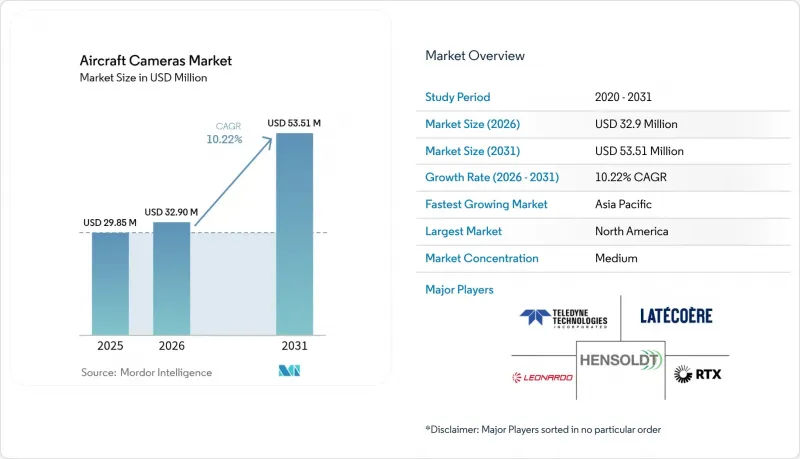
Mordor Intelligence에 의하면, 항공기용 카메라 시장 규모는 2025년 2,985만 달러에서 2026년에는 3,290만 달러로 확대되어 2026년부터 2031년까지 CAGR 10.22%로 성장을 지속하여, 2031년까지 5,351만 달러에 이를 것으로 예측됩니다.
본 보고서는 용도별(민간 항공, 군용 항공 등), 카메라 설치 형태별(내부 카메라, 외부 카메라),유형별(전기광학식, 적외선식 등), 항공기 플랫폼별(고정익, 회전익, 하이브리드), 판매 채널별(OEM 라인 핏 등), 지역별(북미, 유럽 등)로 분류되어 있습니다. 시장 예측은 금액(미 달러) 기준으로 제시되어 있습니다.
전 세계 항공기용 카메라 시장 동향 및 인사이트
4K 객실 감시 시스템으로의 업그레이드를 요구하는 개조 수요 증가
안전 지침의 강화와 보험사의 보다 상세한 사고 증거 요구가 높아지는 가운데, 항공사들은 기내 영상 인프라의 현대화를 가속화하고 있습니다. 에어 캐나다의 A320 및 A321 업그레이드 프로그램은 얼굴 인식 기능을 지원하는 영상을 제공하고, 기존 기내 관리 시스템과 원활하게 통합될 수 있는 고해상도 카메라로의 전환을 부각시키고 있습니다. 설치 기간이 짧기 때문에 모듈식이며 플러그 앤 플레이를 지원하는 설계가 선호되고 있으며, 항공사는 장기간에 걸친 대규모 정비 기간을 기다릴 필요 없이 야간 점검 시간 동안 감시 기능을 갱신할 수 있게 되었습니다. 4K는 빠르게 사실상의 조달 사양으로 자리 잡고 있으며, 확장 가능하고 개방형 아키텍처 솔루션을 제공하는 공급업체들이 사후 개조 예산을 확보하기에 유리한 위치에 있습니다. 규제 당국이 행동 분석 기능의 의무화 범위를 확대하는 방안을 검토하는 가운데, DO-178C를 준수하여 AI 알고리즘 검증을 수행하고 있는 공급업체는 항공기용 카메라 시장에서 선구자로서의 우위를 누릴 수 있을 것입니다.
디지털 트윈 프로그램을 위한 AI 지원형 예측 유지보수 카메라
디지털 트윈 생태계에 데이터를 공급하기 위해 OEM 및 Tier 1 통합업체들은 날개, 엔진, 기체 내부에 비전 센서를 탑재하는 사례가 증가하고 있습니다. 록히드 마틴의 AAIR 플랫폼은 컴퓨터 비전을 활용하여 미세한 균열이나 도장 열화를 감지함으로써, 예정에 없던 유지보수를 최대 15%까지 줄이면서 부품의 수명을 연장하고 있습니다. 엣지 측에서 처리되는 실시간 영상 분석을 통해 지연이 해소됨에 따라, 운영자는 정비 일정을 최적화하고 기체의 높은 가동률을 유지할 수 있게 됩니다. 표준화된 데이터 인터페이스를 지원하는 견고하고 지연 시간이 짧은 카메라에 대한 수요는 기존의 검사용 보어스코프보다 빠르게 증가하고 있습니다. 항공 전자 장비 안전 기준에 따라 엣지 AI 모듈을 인증받은 공급업체는 특히 항공사가 디지털 엔지니어링과 MRO 예산을 통합하는 과정에서 강력한 입지를 구축할 수 있습니다.
새로운 카메라 하드웨어의 높은 DO-178/DO-254 인증 비용
DO-178C 레벨 A에 기반한 종단 간 인증 비용은 제품 라인당 200만 달러를 초과하는 경우가 많으며, 최대 24개월이 소요되기 때문에 많은 신생 기업을 사실상 시장에서 배제하고 있습니다. 이러한 부담에는 철저한 문서화, 소프트웨어 검증 및 환경 적합성 시험이 포함되며, 이는 자금력이 있는 기존 기업만이 감당할 수 있는 것입니다. 그 결과, 획기적인 광학 개념이 상용 항공기에 채택되기까지 시간이 걸리고, 가격 경쟁 압력도 약화되고 있습니다. 이러한 상황은 1차 항공전자 장비 공급업체의 입지를 강화하여, 항공기용 카메라 시장을 소수의 업체로 더욱 집중시키고 있습니다.
부문 분석
군 및 민간 사업자가 국경 감시에서 소포 배송에 이르기까지 임무를 확대함에 따라, UAV(무인 항공기)는 연평균 성장률(CAGR) 12.08%를 나타낼 것으로 예측됩니다. 미 육군의 HADES 심층 감지 프로그램과 아시아의 유사한 이니셔티브에 힘입어, UAV 페이로드용 항공기 카메라 시장 규모는 2031년까지 90억 5,000만 달러에 달할 것으로 예측됩니다. 성장이 성숙기에 접어든 상업용 항공 부문은 안전 기준에 따른 개조 의무화와 와이드바디 항공기에 대한 라인핏 계약으로 인해 2025년에는 38.42%의 점유율을 차지하며, 계속해서 수익의 주축이 될 전망입니다. 군용 항공 분야에서는 유인 ISR 플랫폼을 위한 고동적 범위 EO/IR 터렛 조달이 계속되고 있습니다. 한편, 비즈니스 항공 및 일반 항공 운항 사업자들은 엔진 상태 데이터를 실시간으로 클라우드 분석 시스템에 전송하는 경량 기내 카메라를 도입하고 있습니다.
UAV의 도입으로 인해 광학 설계 로드맵은 가혹한 진동 환경과 고고도에서의 온도 변동을 견딜 수 있는 초경량 및 저전력 어셈블리로 전환되고 있습니다. FPGA 기반의 기내 처리 기능을 통합한 공급업체들은 시야 외(BLOS) 임무에서 중요한 제약 요소인 데이터 링크 대역폭을 줄이고 있습니다. 항공사들은 얼굴 분석 및 기내 서비스 최적화를 지원하기 위해 유인 운항 분야에서 4K 화질의 기내 영상 선명도를 우선시하고 있습니다. 수색 및 구조(SAR)나 의료 후송(Medevac)과 같은 특수 임무를 수행하는 운항 사업자들은 24시간 운영을 가능하게 하는 장파장 적외선과 가시광선 줌을 결합한 듀얼 센서 패키지를 추구하고 있으며, 민간 항공 업계의 침체기에도 안정적인 수요를 유지하고 있습니다.
2025년에는 항공사의 360° 택싱 지원 시스템 도입 의지와 군의 짐벌 탑재형 ISR 터렛에 대한 수요에 힘입어, 외부 장착형 카메라가 항공기용 카메라 시장 점유율의 56.75%를 차지했습니다. 2031년까지의 연평균 성장률(CAGR)은 11.03%로 예측되며, 외부 카메라의 매출액은 약 3,215만 달러에 달할 것으로 전망됩니다. 대수는 적지만, 내부 카메라는 예측 유지보수 아키텍처로의 통합이 진행되고 있어 야간 정비 중 착륙 장치 베이와 항공 전자 장비 랙의 자동 육안 검사가 가능해졌습니다.
외부 하우징은 더 넓은 시야를 확보할 수 있을 뿐만 아니라, 가압 객실 내의 전자기 호환성(EMC) 문제를 회피할 수 있어 인증 절차가 간소화됩니다. 카메라 포드는 주요 구조 보강 없이 기존 하드포인트에 장착할 수 있으므로, 사후 장착 도입 기회가 풍부합니다. 반면, 내부 설치는 객실 레이아웃의 제약과 더 엄격한 가연성 기준에 직면해 있습니다. 따라서 시장 진출기업들은 내부 센서를 기체 상태 모니터링 서비스 구독과 함께 판매하여, 단순한 제품 판매뿐만 아니라 데이터 활용을 통해 수익화를 도모하고 있습니다.
지역별 분석
북미는 2025년 매출의 37.95%를 차지하고 있으며, 그 원동력은 미국의 국방 ISR 예산과 안전성을 위한 개조가 진행 중인 대규모 상용 항공기 함대입니다. 미 육군의 HADES 계약 파이프라인만으로도 향후 10년 동안 10억 달러에 가까운 센서 구매 수요를 흡수할 가능성이 있습니다. 캐나다가 P-8A 해상 순찰기를 위해 WESCAM MX-20 시스템에 투자하고 있다는 사실은 이 지역에서 하이엔드 EO/IR 페이로드에 대한 수요가 여전히 높음을 보여줍니다. 멕시코에서는 국경 경비 감시 및 저가 항공사(LCC)의 기체 수 확대와 관련하여 수요가 중간 수준이긴 하지만 증가 추세를 보이고 있습니다.
아시아태평양은 연평균 성장률(CAGR) 10.31%를 나타낼 것으로 전망되며, 가장 빠르게 성장하는 지역입니다. 중국 내 국산 드론의 보급은 수출 통제를 둘러싼 마찰이 있음에도 불구하고, 현지 카메라 제조 클러스터의 발전을 뒷받침하고 있습니다. 인도, 일본, 한국은 방위 오프셋을 센서 기술 이전에 활용하여 점차 국내 기술력을 구축하고 있습니다. 인도네시아에서 호주에 이르는 민간 항공사들은 국제민간항공기구(ICAO)의 감사 요건 강화에 대응하여 기내 안전 설비의 업그레이드를 가속화하고 있습니다.
유럽에서는 독일의 12억 유로(14억 1,000만 달러) 규모의 ‘PEGASUS’ 신호정보(SIGINT) 기체 편대와 영국의 활주로 침입 방지 의무화 등의 프로그램을 활용해 꾸준한 성장세를 유지하고 있습니다. 프랑스와 이탈리아 국방부는 회전익 항공기 편대의 현대화를 위해 멀티센서 터렛 조달 입찰을 실시했습니다. 한편, 지역 항공사들은 혼잡한 공항에서의 지상 손상 비용을 절감하기 위해 360° 택싱 지원 키트 도입을 우선시하고 있습니다. 동유럽에서는 예산 제약으로 인해 수요가 주춤하고 있습니다. 또한, 제재 조치로 인해 러시아의 서방 국가 카메라 기술 접근이 제한됨에 따라, 스펙트럼 해상도가 낮은 국산 광학 장비로의 대체가 진행되고 있습니다.
기타 혜택:
- 엑셀 형식 시장 예측(ME) 시트
- 3개월간의 애널리스트 지원
자주 묻는 질문
목차
제1장 서론
제2장 조사 방법
제3장 주요 요약
제4장 시장 구도
제5장 시장 규모와 성장 예측
제6장 경쟁 구도
제7장 시장 기회와 향후 전망
JHS 26.08.28According to Mordor Intelligence, the aircraft cameras market size is expected to grow from USD 29.85 million in 2025 to USD 32.9 million in 2026 and is forecast to reach USD 53.51 million by 2031 at 10.22% CAGR over 2026-2031.
This report is Segmented by Application (Commercial Aviation, Military Aviation, and More), Camera Installation Type (Internal Cameras and External Cameras), Type (Electro-Optical, Infrared, and More), Aircraft Platform (Fixed-Wing, Rotary-Wing, and Hybrid), Sales Channel (OEM Linefit, and More), and Geography (North America, Europe, and More). The Market Forecasts are Provided in Terms of Value (USD).
Global Aircraft Cameras Market Trends and Insights
Rising Retrofit Demand for 4K Cabin-Surveillance Upgrades
Airlines are accelerating the modernization of in-cabin video infrastructure as safety guidelines become stricter and insurers seek more granular incident evidence. Air Canada's A320 and A321 upgrade program highlights the pivot toward high-resolution cameras that deliver facial-recognition-ready imagery and integrate seamlessly with existing cabin-management systems. Short installation windows favor modular, plug-and-play designs, enabling carriers to refresh surveillance capability during overnight checks instead of extended heavy-maintenance visits. The 4K baseline has quickly become the de facto procurement specification, positioning vendors with scalable, open-architecture solutions to capture retrofit budgets. As regulators consider broader mandates for behavioral analytics functions, suppliers who validate AI algorithms under DO-178C will likely enjoy an early-mover advantage in the aircraft cameras market.
AI-Assisted Predictive-Maintenance Cameras for Digital-Twin Programs
To feed digital-twin ecosystems, OEMs and tier-one integrators increasingly embed vision sensors inside wings, engines, and airframes. Lockheed Martin's AAIR platform uses computer vision to detect microcracks and paint degradation, trimming unscheduled maintenance by up to 15% while extending component life cycles. Real-time video analytics processed at the edge eliminate latency, enabling operators to optimize maintenance schedules and maintain high fleet availability. Demand for ruggedized, low-latency cameras that support standardized data interfaces is growing faster than legacy inspection borescopes. Vendors who certify edge-AI modules under avionics safety standards gain a compelling foothold, particularly as airlines converge their digital engineering and MRO budgets.
High DO-178/DO-254 Certification Costs for New Camera Hardware
End-to-end certification at DO-178C Level A often exceeds USD 2 million per product line and can consume up to 24 months, effectively locking out many startups. The burden includes exhaustive documentation, software verification, and environmental qualification that only deep-capital incumbents can shoulder. As a result, breakthrough optical concepts take longer to reach commercial airframes, and competitive pricing pressure is muted. This dynamic reinforces the position of tier-one avionics suppliers, further concentrating the aircraft cameras market around a handful of players.
Other drivers and restraints analyzed in the detailed report include:
- Mandatory EASA/FAA Cockpit-Video Recorders from 2028
- Growth in Unmanned and eVTOL Platforms Needing SWaP-Optimized Imaging
- Pilot-Union Privacy Push-Back on Cockpit Video
For complete list of drivers and restraints, kindly check the Table Of Contents.
Segment Analysis
UAVs are forecasted to register a 12.08% CAGR as militaries and civil operators expand their missions, ranging from border surveillance to parcel delivery. The aircraft cameras market size allocated to UAV payloads is projected to reach USD 9.05 billion by 2031, underpinned by the US Army's HADES deep-sensing program and similar initiatives in Asia. Despite maturing growth, commercial aviation remains the revenue anchor with a 38.42% share in 2025, thanks to mandatory safety retrofits and widebody linefit commitments. Military aviation continues to procure high-dynamic-range EO/IR turrets for manned ISR platforms. At the same time, business and general aviation operators adopt lightweight interior cameras that feed real-time engine health data into cloud analytics.
UAV adoption shifts the optical design roadmap toward ultralight, low-power assemblies that can survive harsh vibration profiles and high-altitude temperature swings. Suppliers incorporating FPGA-based onboard processing reduce datalink bandwidth, a critical constraint for beyond-line-of-sight (BLOS) missions. Airlines prioritize 4K cabin clarity in manned segments to support facial analytics and in-flight service optimization. Special-mission operators, notably search and rescue (SAR) and medical evacuation (Medevac), pursue dual-sensor packages that combine long-wave IR with visible zoom for all-hours operations, sustaining stable demand even during commercial down cycles.
External installations captured 56.75% of the aircraft cameras market share in 2025, buoyed by airline appetite for 360° taxi-aid suites and military demand for gimbal-mounted ISR turrets. Growth through 2031 is projected at 11.03% CAGR, raising external-camera revenues to an estimated USD 32.15 million. While smaller in number, internal cameras are increasingly integrated into predictive maintenance architectures, allowing for automatic visual inspections of landing gear bays and avionics racks during overnight turns.
External housings enable broader fields of view and simplify certification, as they avoid electromagnetic compatibility issues within pressurized cabins. Retrofit opportunities abound because camera pods can be attached to existing hard points without requiring primary structural reinforcement. Conversely, internal installations face cabin-layout constraints and stricter flammability standards. Market participants, therefore, bundle interior sensors with health-monitoring subscriptions, monetizing data rather than unit sales alone.
Complete Report Scope:
- By Application
- Commercial Aviation
- Military Aviation
- Business and General Aviation
- Unmanned Aerial Vehicles (UAVs)
- Special Mission Aircraft (ISR, SAR, Medevac)
- By Camera Installation Type
- Internal Cameras
- External Cameras
- By Type
- Electro-Optical (Visible)
- Infrared (LWIR and MWIR)
- Night-Vision/Low-Light
- Multispectral/Hyperspectral
- 360-Degree and Panoramic
- AI-Enabled Smart Cameras
- By Aircraft Platform
- Fixed-Wing
- Rotary-Wing
- Hybrid
- By Sales Channel
- OEM Linefit
- Retrofit/Aftermarket/MRO
- By Geography
- North America
- United States
- Canada
- Mexico
- Europe
- United Kingdom
- France
- Germany
- Russia
- Rest of Europe
- Asia-Pacific
- China
- India
- Japan
- South Korea
- Rest of Asia-Pacific
- South America
- Brazil
- Rest of South America
- Middle East and Africa
- Middle East
- Saudi Arabia
- United Arab Emirates
- Rest of Middle East
- Africa
- South Africa
- Rest of Africa
- Middle East
- North America
Geography Analysis
North America accounted for 37.95% of 2025 revenue, anchored by US defense ISR budgets and a sizable commercial fleet undergoing safety retrofits. The US Army's HADES contract pipeline alone could absorb nearly USD 1 billion in sensor purchases over the next decade. Canada's investment in WESCAM MX-20 systems for P-8A maritime patrol aircraft underscores continued regional appetite for high-end EO/IR payloads. Mexico contributes a moderate but rising demand tied to cross-border security surveillance and low-cost carrier fleet expansions.
The Asia-Pacific region represents the fastest-growing geography, with a 10.31% CAGR outlook. China's proliferation of indigenous drones spurs the development of local camera manufacturing clusters, despite export-control frictions. India, Japan, and South Korea channel defense offsets into sensor technology transfer, gradually building domestic competence. Commercial carriers from Indonesia to Australia accelerate in-cabin safety upgrades in response to tightening ICAO audit requirements.
Europe maintains steady momentum, leveraging programs such as Germany's EUR 1.2 billion (USD 1.41 billion) PEGASUS SIGINT fleet and the UK runway-incursion prevention mandates. The French and Italian defense ministries tender multi-sensor turret purchases to modernize their rotary-wing fleets, while regional airlines prioritize 360° taxi-aid kits to reduce ground-damage costs at congested airports. Eastern European demand lags due to budget constraints, and sanctions limit Russian access to Western camera technology, prompting the substitution of lower-spectral-resolution domestic optics.
- Teledyne Technologies Incorporated
- Collins Aerospace (RTX Corporation)
- Thales Group
- Leonardo S.p.A.
- KID-Systeme GmbH
- LATECOERE S.A
- Cabin Avionics Limited
- Elbit Systems Ltd.
- L3Harris Technologies, Inc.
- Parker-Meggitt Corporation
- HENSOLDT AG
- Trakka Systems
- Curtiss-Wright Corporation
- Honeywell International Inc.
- Aerial View Systems Inc. (NEP Group)
Additional Benefits:
- The market estimate (ME) sheet in Excel format
- 3 months of analyst support
TABLE OF CONTENTS
1 INTRODUCTION
- 1.1 Study Assumptions and Market Definition
- 1.2 Scope of the Study
2 RESEARCH METHODOLOGY
3 EXECUTIVE SUMMARY
4 MARKET LANDSCAPE
- 4.1 Market Overview
- 4.2 Market Drivers
- 4.2.1 Rising retrofit demand for 4K cabin-surveillance upgrades
- 4.2.2 AI-assisted predictive-maintenance cameras for digital-twin programs
- 4.2.3 Mandatory EASA/FAA cockpit-video recorders from 2028
- 4.2.4 Growth in unmanned and eVTOL platforms needing SWaP-optimized imaging
- 4.2.5 Thermal/IR camera integration for wildfire monitoring operations
- 4.2.6 Demand for 360° taxi-aid systems on next-gen widebody aircraft
- 4.3 Market Restraints
- 4.3.1 High DO-178/DO-254 certification costs for new camera hardware
- 4.3.2 Pilot-union privacy push-back on cockpit video
- 4.3.3 Export-control restrictions on dual-use EO/IR sensors
- 4.3.4 Persistent semiconductor supply-chain volatility
- 4.4 Value Chain Analysis
- 4.5 Regulatory Landscape
- 4.6 Technological Outlook
- 4.7 Porter's Five Forces Analysis
- 4.7.1 Threat of New Entrants
- 4.7.2 Bargaining Power of Buyers
- 4.7.3 Bargaining Power of Suppliers
- 4.7.4 Threat of Substitutes
- 4.7.5 Intensity of Competitive Rivalry
5 MARKET SIZE AND GROWTH FORECASTS (VALUE)
- 5.1 By Application
- 5.1.1 Commercial Aviation
- 5.1.2 Military Aviation
- 5.1.3 Business and General Aviation
- 5.1.4 Unmanned Aerial Vehicles (UAVs)
- 5.1.5 Special Mission Aircraft (ISR, SAR, Medevac)
- 5.2 By Camera Installation Type
- 5.2.1 Internal Cameras
- 5.2.2 External Cameras
- 5.3 By Type
- 5.3.1 Electro-Optical (Visible)
- 5.3.2 Infrared (LWIR and MWIR)
- 5.3.3 Night-Vision/Low-Light
- 5.3.4 Multispectral/Hyperspectral
- 5.3.5 360-Degree and Panoramic
- 5.3.6 AI-Enabled Smart Cameras
- 5.4 By Aircraft Platform
- 5.4.1 Fixed-Wing
- 5.4.2 Rotary-Wing
- 5.4.3 Hybrid
- 5.5 By Sales Channel
- 5.5.1 OEM Linefit
- 5.5.2 Retrofit/Aftermarket/MRO
- 5.6 By Geography
- 5.6.1 North America
- 5.6.1.1 United States
- 5.6.1.2 Canada
- 5.6.1.3 Mexico
- 5.6.2 Europe
- 5.6.2.1 United Kingdom
- 5.6.2.2 France
- 5.6.2.3 Germany
- 5.6.2.4 Russia
- 5.6.2.5 Rest of Europe
- 5.6.3 Asia-Pacific
- 5.6.3.1 China
- 5.6.3.2 India
- 5.6.3.3 Japan
- 5.6.3.4 South Korea
- 5.6.3.5 Rest of Asia-Pacific
- 5.6.4 South America
- 5.6.4.1 Brazil
- 5.6.4.2 Rest of South America
- 5.6.5 Middle East and Africa
- 5.6.5.1 Middle East
- 5.6.5.1.1 Saudi Arabia
- 5.6.5.1.2 United Arab Emirates
- 5.6.5.1.3 Rest of Middle East
- 5.6.5.2 Africa
- 5.6.5.2.1 South Africa
- 5.6.5.2.2 Rest of Africa
- 5.6.5.1 Middle East
- 5.6.1 North America
6 COMPETITIVE LANDSCAPE
- 6.1 Market Concentration
- 6.2 Strategic Moves
- 6.3 Market Share Analysis
- 6.4 Company Profiles (includes Global level Overview, Market level overview, Core Segments, Financials as available, Strategic Information, Market Rank/Share, Products and Services, Recent Developments)
- 6.4.1 Teledyne Technologies Incorporated
- 6.4.2 Collins Aerospace (RTX Corporation)
- 6.4.3 Thales Group
- 6.4.4 Leonardo S.p.A.
- 6.4.5 KID-Systeme GmbH
- 6.4.6 LATECOERE S.A
- 6.4.7 Cabin Avionics Limited
- 6.4.8 Elbit Systems Ltd.
- 6.4.9 L3Harris Technologies, Inc.
- 6.4.10 Parker-Meggitt Corporation
- 6.4.11 HENSOLDT AG
- 6.4.12 Trakka Systems
- 6.4.13 Curtiss-Wright Corporation
- 6.4.14 Honeywell International Inc.
- 6.4.15 Aerial View Systems Inc. (NEP Group)
7 MARKET OPPORTUNITIES AND FUTURE OUTLOOK
- 7.1 White-space and Unmet-Need Assessment


