

|
시장보고서
상품코드
2116311
대상포진 백신 시장 : 점유율 분석, 업계 동향과 통계, 성장 예측(2026-2031년)Shingles Vaccine - Market Share Analysis, Industry Trends & Statistics, Growth Forecasts (2026 - 2031) |
||||||
 Mordor Intelligence
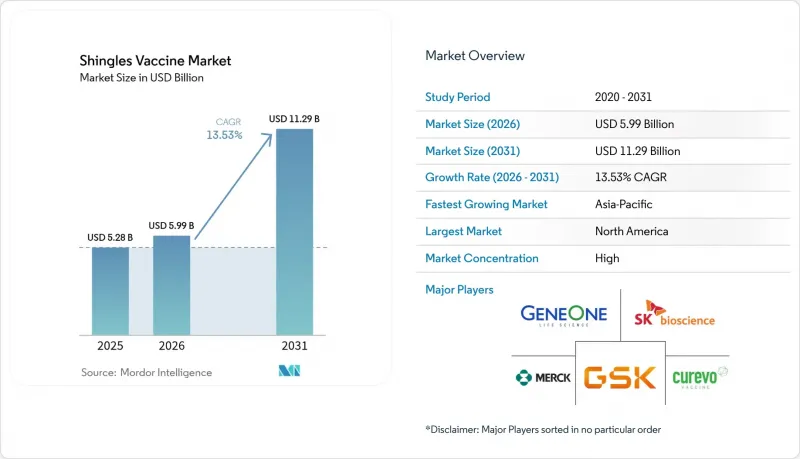
Mordor Intelligence에 의하면, 2026년 대상포진 백신 시장 규모는 59억 9,000만 달러로 추정되며, 2025년 52억 8,000만 달러에서 확대해, 2031년에는 112억 9,000만 달러에 이를 것으로 예측됩니다.
2026년부터 2031년까지 연평균 성장률(CAGR) 13.53%로 성장할 것으로 전망됩니다.
본 보고서는 제품(Shingrix, Zostavax, SKYZoster), 백신 유형(재조합 아단위 백신 및 약독화 생백신), 연령대(50세 이상 및 18-49세), 지역(북미, 유럽, 아시아태평양, 중동 및 아프리카, 남미)별로 분류되어 있습니다. 시장 전망은 금액(달러) 기준으로 제시되어 있습니다.
전 세계 대상포진 백신 시장 동향 및 인사이트
대상포진 백신의 국가 예방접종 일정 임베디드
호주는 2023년 11월, Shingrix를 국가 예방접종 프로그램에 추가하여 65세 이상 성인 및 50세 이상 면역결핍자를 대상으로 했습니다. 이 조치로 인해 약국과 1차 진료 클리닉 전반에 걸쳐 수요가 즉시 증가했습니다. 영국에서는 2023년에 ‘조스타백스’에서 ‘싱그릭스’로 전환되었으며, 접종 대상이 50세 이상의 중증 면역결핍 성인 및 60세 이상의 정상 면역 기능을 가진 성인으로 확대되었습니다. 이러한 공공 자금에 의한 결정은 환자의 비용 부담을 경감하고, 수년에 걸친 입찰 물량을 보장하며, 일괄 조달 시 협상력을 강화합니다. 마찬가지로 중요한 점으로, 세계보건기구(WHO)는 2025년 3월에 대상포진에 관한 최신 권고 사항을 발표할 예정이며, 이 조치는 신흥 시장의 예방접종 로드맵에 영향을 미칠 가능성이 높습니다. 이러한 조치들이 결합됨에 따라, 그동안 산발적이고 본인 부담으로 이루어지던 예방접종이 제도화된 공중보건 서비스로 전환되어, 대상포진 백신 시장 예측 가능한 수익 기반을 뒷받침하게 될 것입니다.
50세 이상 연령층의 발병률 상승과 고령 인구 증가
세계 평균 수명의 연장에 따라 세포성 면역력이 저하되고, 잠복해 있던 수두·대상포진 바이러스가 재활성화되기 쉬운 성인의 수가 구조적으로 증가하고 있습니다. 미국 질병통제예방센터(CDC)의 집계에 따르면, 미국에서는 매년 약 100만 건의 대상포진 사례가 보고되고 있으며, 50세 이상 성인의 99%가 이미 휴면 상태의 바이러스를 보유하고 있습니다. 그 결과, 수요는 거시경제의 경기 순환에 영향을 덜 받으며, 주로 예방 의료 예산을 대상으로 합니다. 백신 접종 후 심혈관 질환 및 치매 위험 감소가 기대된다는 연구 결과는 그 가치 제안의 폭을 넓혀, 대상포진 후 신경통의 즉각적인 예방에 그치지 않고, 성인을 대상으로 한 예방 접종에 대한 보험사의 지원을 뒷받침하고 있습니다.
저·중소득 국가 일반 시민의 인식 부족
중국에서는 조사 대상인 도시 거주자 중 백신 접종 의향을 보인 비율이 고작 27.1%에 그쳤으며, 질환에 대한 지식 부족과 446달러라는 고가가 장벽으로 꼽혔습니다. 라틴아메리카에서도 유사한 과제가 존재하며, 대상포진 발생률에 대한 보고 부족이 정책 수립을 어렵게 하고 있습니다. 지속적인 공중보건 계몽 활동이나 의사를 대상으로 한 연수가 이루어지지 않는 한, 시장 침투율은 낮은 수준을 유지할 것이며, 신흥국 내 대상포진 백신 시장의 성장은 둔화될 것입니다.
부문 분석
재조합 백신 ‘Shingrix’의 대상포진 백신 시장 규모는 2025년에 시장 점유율의 80.56%를 차지하며, 생백신인 선행 제품에 대한 임상적 우월성이 입증되었습니다. 90% 이상의 입증된 유효성과 면역 결핍 환자군에 대한 적응이 가능하다는 점이 접종률 향상에 기여하고 있습니다. 이러한 견고한 기반이 있음에도 불구하고, 개발 중인 mRNA 제제를 둘러싼 기세가 강해지고 있습니다. Moderna사의 mRNA-1468은 강력한 CD4+ T세포 활성과 기존 벤치마크에 필적하거나 이를 능가할 가능성이 있는 내약성 프로파일에 힘입어 3상 임상시험 단계로 진입했습니다. 다이나박스(Dynavax)사의 Z-1018은 자사 고유의 CpG 1018 보조제와 재조합 당단백질 E 항원을 결합하여 동등한 면역원성을 유도하고 있으며, 2025년에 중간 데이터가 발표될 예정입니다. 어느 한 후보 약물이 승인된다면, 경쟁 심화로 인해 싱그릭스가 차지하는 대상포진 백신의 큰 시장 점유율이 서서히 줄어들 가능성이 있습니다. 하지만 기존 제품이 확립한 보험 급여 체계와 7년에 걸친 실제 사용 실적은 높은 진입 장벽이 되고 있습니다.
라이선스 보유 기업이 당초 COVID-19용으로 구축된 RNA 생산 라인을 확장하면, 1회 투여당 비용이 낮아져 경쟁이 심화되거나 자원이 제한된 지역에서의 접근성이 확대될 가능성이 있습니다. 그러나 대상포진 백신 업계는 여전히 이러한 새로운 제형에 대해 현재의 재조합 제형과 동등한 콜드체인 및 부수적인 공급 체계를 확립해야 하는 과제에 직면해 있습니다. 따라서 중기적으로는 mRNA 제제가 의료 제공업체의 선택 폭을 넓히는 한편, 재조합 제제가 여전히 지배적인 위치를 유지할 것으로 예측됩니다.
지역별 분석
2025년에 대상포진 백신 시장 점유율의 42.86%를 차지한 북미는 종합적인 보험 네트워크, 성숙한 소매 약국을 통한 백신 접종 채널, 그리고 재조합 기술의 조기 임상 도입이라는 이점을 누리고 있습니다. 2023년 메디케어가 본인 부담금을 폐지함에 따라 월간 접종 건수가 거의 즉각적으로 증가했으며, 이로 인해 환급 조치의 효과가 부각되었습니다. 그러나 접종률이 포화 상태에 가까워짐에 따라 절대적인 성장세는 둔화되고 있습니다. GSK의 2024년 4분기 미국 내 ‘Shingrix’ 매출은 미접종 고령자 수가 감소하고 소매 체인이 재고 우선순위를 재조정함에 따라 18% 감소했습니다. 따라서 향후 성장 여지는 면역 결핍 상태에 있는 젊은 층으로의 적응증 확대나, 만성 질환 관리 프로그램과 연계된 백신 접종 패키지의 제공에 달려 있습니다.
아시아태평양은 인구 고령화와 성인용 백신 예산의 점진적인 확대에 힘입어 2031년까지 연평균 성장률(CAGR)이 18.12%를 나타낼 것으로 예측되며, 가장 빠르게 성장하는 시장 기회가 되고 있습니다. 호주에서는 2023년 공공 자금 투입 결정에 따라 도입 시작 후 첫 6개월 동안 시장 동향을 상회하는 접종률이 기록되어, 재정적 지원이 촉매제 역할을 했다는 것이 입증되었습니다. 감염자 수가 막대한 중국에서는 높은 정가와 인지도 격차로 인해 접종률이 여전히 낮은 수준에 머물러 있지만, GSK와 Zhifei의 제휴가 2029년까지 연장된 데 더해,창춘 BCHT 바이오테크놀러지의 국산 백신이 현지에서 경쟁을 펼침으로써, 접근성 확대와 본인 부담금 인하로 이어질 것으로 기대됩니다. 일본, 한국, 싱가포르에서는 지역 정책을 형성하고 보험 적용을 뒷받침하는 실세계 데이터가 계속해서 확보되고 있습니다.
유럽에서는 신중한 태도 속에서도 도입 범위가 확대되는 추세가 나타나고 있습니다. 영국이 2023년에 ‘싱그릭스’로 전환하고 연령 제한도 조정한 것은 유사한 조치를 검토 중인 인근 국가들에게 선례가 되었습니다. 스웨덴에서 실시된 전국적인 역학 조사에서는 평생 위험이 36.5%인 것으로 나타나 정책 입안자들에게 비용 대비 효과 검토를 촉구하고 있지만, 최종적인 자금 지원 결정은 아직 보류된 상태입니다. 유럽 대륙에서의 진전에는 수량 할인을 목표로 하는 범유럽적 조달 메커니즘도 영향을 미치고 있으며, 이러한 접근 방식은 이익률을 압박할 가능성은 있으나 잠재적인 총 판매량을 확대시킬 가능성이 있습니다. 전반적으로 지역 간 격차는 여전히 존재하지만, 대상포진 백신 시장의 성장 추세는 꾸준히 상승세를 이어가고 있습니다.
기타 혜택:
- 엑셀 형식 시장 예측(ME) 시트
- 3개월간 애널리스트 지원
자주 묻는 질문
목차
제1장 서론
제2장 조사 방법
제3장 주요 요약
제4장 시장 구도
제5장 시장 규모와 성장 예측
제6장 경쟁 구도
제7장 시장 기회와 향후 전망
JHS 26.08.28According to Mordor Intelligence, shingles vaccine market size in 2026 is estimated at USD 5.99 billion, growing from 2025 value of USD 5.28 billion with 2031 projections showing USD 11.29 billion, growing at 13.53% CAGR over 2026-2031.
This report is Segmented by Product (Shingrix, Zostavax, and SKYZoster), Vaccine Type (Recombinant Subunit and Live-Attenuated), Age Group (>=50 Years and 18-49 Years), and Geography (North America, Europe, Asia-Pacific, Middle East and Africa, and South America). The Market Forecasts are Provided in Terms of Value (USD).
Global Shingles Vaccine Market Trends and Insights
Inclusion of Shingles Vaccines in National Immunization Schedules
Australia added Shingrix to its National Immunisation Program in November 2023, covering adults from 65 years and immunocompromised individuals from 50, a move that immediately lifted demand across pharmacies and primary-care clinics. In the United Kingdom, the 2023 shift from Zostavax to Shingrix extended eligibility to severely immunosuppressed adults aged 50 and immunocompetent adults from 60. Such public-funding decisions lower patient cost hurdles, guarantee multi-year tender volumes, and strengthen bargaining power for bulk procurement. Equally important, the World Health Organization plans to release updated herpes zoster recommendations in March 2025, a step likely to influence immunization roadmaps in emerging markets.Collectively, these actions convert what had been sporadic, self-paid uptake into an institutionalized public-health service, supporting a predictable revenue base for the Shingles vaccine market.
Rising Incidence in >=50-Year Age Group & Growing Elderly Population
Global life expectancy gains spur a structural rise in the number of adults with waning cell-mediated immunity capable of reactivating latent varicella-zoster virus. The CDC counts around 1 million shingles cases in the United States each year, with 99% of adults >50 already harboring dormant virus.Demand is consequently insulated from macroeconomic cycles and aimed mainly at preventive care budgets. Studies noting potential cardiovascular and dementia risk reductions following vaccination broaden the value proposition and encourage payer support for adult immunization beyond the immediate avoidance of post-herpetic neuralgia.
Limited Public Awareness in Low- & Middle-Income Countries
In China, only 27.1% of surveyed urban residents expressed willingness to vaccinate, citing scant disease knowledge and the USD 446 price tag as deterrents. Similar gaps exist in Latin America, where under-reporting of herpes zoster incidence complicates policymaking. Without sustained public-health messaging and physician training, market penetration remains thin, slowing progress for the Shingles vaccine market in emerging economies.
Other drivers and restraints analyzed in the detailed report include:
- Superior Cost-Effectiveness of Vaccination Over Treatment
- Government Reimbursement for Recombinant Adjuvanted Vaccines
- Supply-Chain Complexity for Cold-Chain, Multi-Dose Recombinant Products
For complete list of drivers and restraints, kindly check the Table Of Contents.
Segment Analysis
The Shingles vaccine market size for recombinant Shingrix translating into an 80.56% market share in 2025 and validating its clinical advantage over live-attenuated predecessors. Uptake benefits from proven more than 90% efficacy and eligibility across immunocompromised cohorts. Despite this strong foothold, momentum is building around pipeline mRNA assets. Moderna's mRNA-1468 moved into Phase 3 on the back of robust CD4+ T-cell activity and a tolerability profile that could match or exceed existing benchmarks. Dynavax's Z-1018 combines its proprietary CpG 1018 adjuvant with recombinant glycoprotein E antigen to elicit comparable immunogenicity, with interim data due in 2025. Should either candidate gain approval, competitive forces could chip away at Shingrix's large Shingles vaccine market share, though the incumbent's entrenched reimbursement ties and seven-year real-world performance record form high entry barriers.
Once license holders scale up RNA manufacturing lines originally built for COVID-19, cost per dose could fall, enabling price competition or expanded access in resource-constrained geographies. However, the Shingles vaccine industry still faces the challenge of establishing cold-chain and ancillary-supply capacity for these new formats at parity with current recombinant offerings. For the medium term, therefore, recombinant formulations are expected to retain dominance even as mRNA varieties broaden choice for providers.
Complete Report Scope:
- By Product
- Shingrix
- Zostavax
- SKYZoster
- By Vaccine Type
- Recombinant Subunit
- Live-attenuated
- By Age Group
- >=50 Years
- 18-49 Years
- By Geography
- North America
- United States
- Canada
- Mexico
- Europe
- Germany
- United Kingdom
- France
- Italy
- Spain
- Rest of Europe
- Asia-Pacific
- China
- Japan
- India
- Australia
- South Korea
- Rest of Asia-Pacific
- Middle East & Africa
- GCC
- South Africa
- Rest of Middle East & Africa
- South America
- Brazil
- Argentina
- Rest of South America
- North America
Geography Analysis
North America, holding 42.86% of the Shingles vaccine market share in 2025, benefits from comprehensive insurance networks, mature retail-pharmacy vaccination channels, and early clinical adoption of recombinant technology. Medicare's removal of cost sharing in 2023 caused a near-instant increase in monthly administrations, underscoring the potency of reimbursement levers. Yet absolute growth is moderating as coverage inches toward saturation; GSK's 2024 U.S. Shingrix sales declined 18% in the fourth quarter as the pool of unvaccinated seniors dwindled and retail chains reset inventory priorities. Future upside therefore relies on broadening indications to younger immunocompromised groups and possibly bundling vaccination with chronic-disease management programs.
Asia-Pacific represents the fastest-expanding opportunity with an 18.12% CAGR through 2031, driven by demographic aging and incremental improvements in adult-vaccination budgets. Australia's 2023 public funding decision triggered above-trend uptake within the first six months, validating fiscal commitment as a catalyst. In China, where the incidence pool is massive, uptake remains modest due to high list prices and variable awareness; still, the recent extension of the GSK-Zhifei partnership through 2029 coupled with local competition from Changchun BCHT Biotechnology's domestically produced vaccine is expected to expand access and potentially lower co-pay levels. Japan, South Korea, and Singapore continue to generate supportive real-world data that shape regional policy and encourage reimbursement.
Europe follows a pattern of deliberate but widening adoption. The United Kingdom's 2023 transition to Shingrix, paired with age-threshold adjustments, set a precedent for neighboring countries evaluating similar moves. Sweden's nationwide epidemiological study indicating a 36.5% lifetime risk is pushing policymakers toward a cost-benefit review, though final funding decisions remain pending. Continental progress is also influenced by pan-European procurement mechanisms that seek volume discounts, an approach that could compress margins but enlarge total addressable volume. Overall, regional heterogeneity persists, but the trajectory for the Shingles vaccine market remains firmly upward.
- GlaxoSmithKline
- Merck
- SK bioscience
- Changchun BCHT Biotech
- GeneOne Life Science
- Vaccitech
- CanSinoBIO
- Pfizer
- Curevo Inc.
- Jiangsu Recbio Technology
- Moderna
- BioNTech
- Novavax
- Valneva
- Bavarian Nordic
- Johnson & Johnson
- Daiichi Sankyo
- Bharat Biotech
- Sinovac
- Vaxart
Additional Benefits:
- The market estimate (ME) sheet in Excel format
- 3 months of analyst support
TABLE OF CONTENTS
1 Introduction
- 1.1 Study Assumptions & Market Definition
- 1.2 Scope of the Study
2 Research Methodology
3 Executive Summary
4 Market Landscape
- 4.1 Market Overview
- 4.2 Market Drivers
- 4.2.1 Inclusion of Shingles Vaccines in National Immunisation Schedules
- 4.2.2 Rising Incidence in >=50-Year Age Group & Growing Elderly Population
- 4.2.3 Superior Cost-Effectiveness of Vaccination Over Treatment
- 4.2.4 Government Reimbursement for Recombinant Adjuvanted Vaccines
- 4.2.5 Fast-Tracked Regulatory Pathways for mRNA-Based Shingles Vaccines
- 4.2.6 Government-Led Immunization Programs Targeting Older Adults
- 4.3 Market Restraints
- 4.3.1 Limited Public Awareness in Low- & Middle-Income Countries
- 4.3.2 Supply-Chain Complexity for Cold-Chain, Multi-Dose Recombinant Products
- 4.3.3 Adjuvant-Related Safety Concerns Driving Vaccine Hesitancy
- 4.3.4 Global Bulk-Antigen Capacity Constraints for VZV & Ge Antigens
- 4.4 Regulatory Landscape
- 4.5 Porter's Five Forces Analysis
- 4.5.1 Threat of New Entrants
- 4.5.2 Bargaining Power of Buyers
- 4.5.3 Bargaining Power of Suppliers
- 4.5.4 Threat of Substitute Products
- 4.5.5 Competitive Rivalry
5 Market Size & Growth Forecasts (Value in USD)
- 5.1 By Product
- 5.1.1 Shingrix
- 5.1.2 Zostavax
- 5.1.3 SKYZoster
- 5.2 By Vaccine Type
- 5.2.1 Recombinant Subunit
- 5.2.2 Live-attenuated
- 5.3 By Age Group
- 5.3.1 >=50 Years
- 5.3.2 18-49 Years
- 5.4 By Geography
- 5.4.1 North America
- 5.4.1.1 United States
- 5.4.1.2 Canada
- 5.4.1.3 Mexico
- 5.4.2 Europe
- 5.4.2.1 Germany
- 5.4.2.2 United Kingdom
- 5.4.2.3 France
- 5.4.2.4 Italy
- 5.4.2.5 Spain
- 5.4.2.6 Rest of Europe
- 5.4.3 Asia-Pacific
- 5.4.3.1 China
- 5.4.3.2 Japan
- 5.4.3.3 India
- 5.4.3.4 Australia
- 5.4.3.5 South Korea
- 5.4.3.6 Rest of Asia-Pacific
- 5.4.4 Middle East & Africa
- 5.4.4.1 GCC
- 5.4.4.2 South Africa
- 5.4.4.3 Rest of Middle East & Africa
- 5.4.5 South America
- 5.4.5.1 Brazil
- 5.4.5.2 Argentina
- 5.4.5.3 Rest of South America
- 5.4.1 North America
6 Competitive Landscape
- 6.1 Market Concentration
- 6.2 Market Share Analysis
- 6.3 Company Profiles (includes Global level Overview, Market level overview, Core Segments, Financials as available, Strategic Information, Market Rank/Share for key companies, Products & Services, and Recent Developments)
- 6.3.1 GSK plc
- 6.3.2 Merck & Co., Inc.
- 6.3.3 SK bioscience
- 6.3.4 Changchun BCHT Biotech
- 6.3.5 GeneOne Life Science
- 6.3.6 Vaccitech
- 6.3.7 CanSinoBIO
- 6.3.8 Pfizer Inc.
- 6.3.9 Curevo Inc.
- 6.3.10 Jiangsu Recbio Technology
- 6.3.11 Moderna
- 6.3.12 BioNTech
- 6.3.13 Novavax
- 6.3.14 Valneva
- 6.3.15 Bavarian Nordic
- 6.3.16 Johnson & Johnson
- 6.3.17 Daiichi Sankyo
- 6.3.18 Bharat Biotech
- 6.3.19 Sinovac
- 6.3.20 Vaxart
7 Market Opportunities & Future Outlook
- 7.1 White-space & unmet-need assessment


