|
시장보고서
상품코드
2116322
해양 바이오테크놀러지 시장 : 점유율 분석, 업계 동향과 통계, 성장 예측(2026-2031년)Marine Biotechnology - Market Share Analysis, Industry Trends & Statistics, Growth Forecasts (2026 - 2031) |
||||||
 Mordor Intelligence
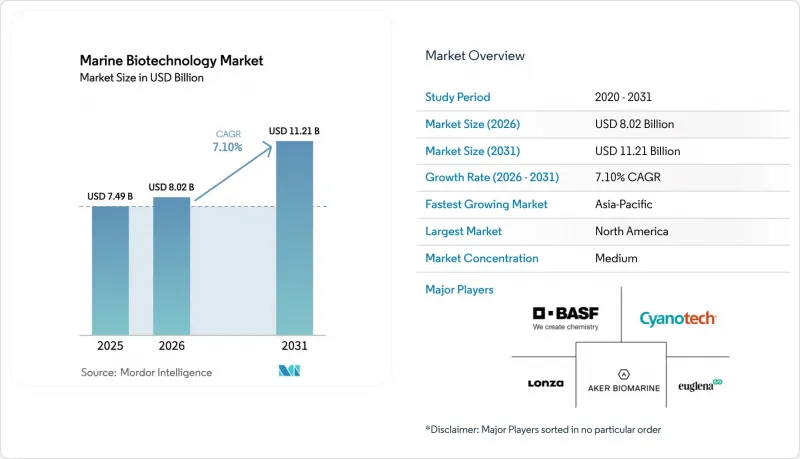
Mordor Intelligence에 의하면, 해양 바이오테크놀러지 시장 규모는 2025년에 74억 9,000만 달러, 2026년에 80억 2,000만 달러되어, 2031년까지 112억 1,000만 달러에 이를 것으로 예측되며, 2026년부터 2031년까지 CAGR 7.10%로 성장할 전망입니다.
본 보고서에서는 업계를 원료별(산호 및 해면, 조류, 해양 바이러스, 해양 균류 등), 용도별(의약품, 뉴트라슈티컬 및 영양 보충제, 화장품 및 퍼스널케어 등), 지역별(북미, 유럽, 아시아태평양, 중동 및 아프리카, 남미)로 분류하고 있습니다. 시장 전망은 금액(달러) 기준으로 제시되어 있습니다.
세계 해양 바이오테크놀러지 시장 동향 및 인사이트
의약품 및 화장품용 해양 유래 유효 성분 증가
육상 유래 천연물 라이브러리가 한계에 도달함에 따라, 임상 파이프라인은 해양 유래 골격 물질로 전환되고 있습니다. PharmaMar사의 해삼 유래 루루비넥테딘은 2024년에 소세포 폐암 치료제로 미국에서 승인을 받았습니다. 현재 클린 뷰티 브랜드들은 다시마 유래 펩타이드와 해면 유래 다당류에 프리미엄 가격을 책정하고 있으며, FDA가 2024년에 발표한 부형제에 관한 지침에 따라 약물 전달 시스템의 승인까지 소요되는 기간이 최대 9개월 단축되었습니다. 이러한 규제 및 효능 측면의 이점이 결합되어, 이 요인이 해양 바이오테크놀러지 시장에 1.2%의 긍정적 영향을 미치고 있습니다.
해양 유래 영양 보충제에 대한 수요 증가
소비자들이 어유를 기피하는 추세가 이어지는 가운데, 미세조류 유래의 비건용 오메가-3 캡슐은 2025년 전 세계 EPA/DHA 부문의 22%를 차지했습니다. 스키조키트리움 유래 DHA는 EU의 ‘신식품(Novel Food)’ 승인을 획득하여 유아용 조제분유 시장에 진출할 수 있게 된 반면, 아스타잔틴 제품은 운동 후 회복 효과에 대한 임상 검증을 거쳐 두 자릿수 성장을 기록했습니다. 규제 측면의 호재와 뛰어난 생체 이용률 덕분에 연평균 성장률(CAGR)은 1.0% 상승세를 유지하고 있습니다.
해양 탐사의 깊이와 시료 채취의 한계
해저 고해상도 매핑이 이루어지고 있는 곳은 전체의 5분의 1에 불과하며, 하달대에서의 시료 채취에는 다이빙 1일당 5만 달러의 비용이 소요되기 때문에 스타트업 기업의 생물 다양성 접근이 제한되고 있습니다. Ocean Infinity사의 자율형 드론 덕분에 2025년에는 비용이 3분의 2로 절감되었지만, 처리 능력은 여전히 육상 조사에 비해 두 자릿수 낮은 수준에 머물러 있습니다. 이러한 병목 현상으로 인해 시장의 CAGR은 0.5% 하락했습니다.
부문 분석
산호와 해면은 2026년부터 2031년까지 연평균 성장률(CAGR) 9.24%를 나타낼 것으로 예측되며, 이는 해양 바이오테크놀러지 시장의 원료 부문 중 가장 빠른 성장률입니다. 여기에 포함된 할로겐이 풍부한 대사 산물은 종양학 및 항바이러스 분야의 획기적인 진전의 기반이 되고 있습니다. 파르마마르(PharmaMar)가 개발한 해삼 유래 프리티덱신은 2025년에 COVID-19에 대한 3상 임상시험을 완료했습니다. GlycoMar사의 해면 라이브러리에서는 혈전증 모델에서 에녹사파린을 능가하는 성능을 보인 헤파란 황산 유사체가 확보되어, 높은 치료 가능성이 입증되었습니다.
조류는 보충제 분야의 스피루리나 단백질, 클로렐라, 아스타잔틴을 주력 제품으로 하여 2025년에도 해양 바이오테크놀러지 시장에서 33.2%의 점유율을 유지했습니다. 그러나 합성 생물학을 통해 대량 생산이 가능한 조류 유래 대사산물이 재현됨에 따라 그 성장세는 둔화되고 있습니다. 해양 바이러스와 균류는 여전히 틈새 시장이지만, 미래 전망은 밝다고 할 수 있습니다. 2024년 북극권에서 분리된 균류로부터 새로운 β-락타마제 억제제가 생산되었습니다.
지역별 분석
2025년, 북미는 해양 바이오테크놀러지 시장 매출의 45.56%를 차지했습니다. 이는 NIH가 해양 천연물 스크리닝 프로그램에 8,500만 달러를 배정하고, NOAA가 보조금 지급을 시작함으로써 메인주에 1,800만 달러의 민간 해조류 투자를 유치한 데 기인합니다. 규제 명확화와 해양 첨가물에 관한 FDA의 지침으로 상용화 주기가 단축되는 한편, 캐나다의 ‘오션 슈퍼클러스터’는 AI를 활용한 유전체 데이터베이스에 공동 투자하고 있습니다.
아시아태평양은 중국의 2억 달러 규모 심해 효소 이니셔티브와,현재 ANA(전일본공수)의 12개월간 시범 운행을 위해 바이오 제트 연료를 공급하고 있는 일본의 500톤 규모 유그레나 시설에 힘입어 8.98%의 지역 연평균 성장률(CAGR)을 기록하며 세계에서 가장 빠른 성장률을 보일 전망입니다. 한국은 2025년에 해양 유래 항암제 파이프라인 개발에 1,200억 원을 배정하고 있으며, 인도는 카라기난 수입 감축을 위해 카파피쿠스 해조류 양식 규모를 확대되고 있습니다.
유럽에서는 EMFAF의 8억 유로 규모의 블루 바이오테크놀러지 보조금과, 조류 유래 바이오플라스틱 수요를 높이는 엄격한 넷제로 정책의 혜택을 받고 있습니다. 노르웨이의 연어 파노유전체 공개는 전 세계 육종 프로그램을 가속화시켰으며, UAE는 해수 담수화 플랜트에서 조류를 이용한 이산화탄소 포집을 시범적으로 실시하고 있고,남아프리카는 전복 사료용으로 다시마를 재배하고 있으며, 브라질의 엠브라파(Embrapa)는 토종 해조류에서 카라기난을 추출하는 실험을 진행하고 있어, 이 모든 것이 다양한 지역 기여를 완성하고 있습니다.
기타 혜택:
- 엑셀 형식 시장 예측(ME) 시트
- 3개월간의 애널리스트 지원
자주 묻는 질문
목차
제1장 서론
제2장 조사 방법
제3장 주요 요약
제4장 시장 구도
제5장 시장 규모와 성장 예측
제6장 경쟁 구도
제7장 시장 기회와 향후 전망
JHS 26.08.28According to Mordor Intelligence, the marine biotechnology market size is projected to be USD 7.49 billion in 2025, USD 8.02 billion in 2026, and reach USD 11.21 billion by 2031, growing at a CAGR of 7.10% from 2026 to 2031.
This report Segments the Industry Into by Source (Corals and Sponges, Algae, Marine Viruses, Marine Fungi, and More), Applications (Pharmaceuticals, Nutraceuticals & Dietary Supplements, Cosmetics & Personal Care, and More), and Geography (North America, Europe, Asia-Pacific, Middle East and Africa, and South America). The Market Forecasts are Provided in Terms of Value (USD).
Global Marine Biotechnology Market Trends and Insights
Increase in Marine-Sourced Actives for Pharmaceuticals & Cosmetics
Clinical pipelines are pivoting toward ocean-derived scaffolds as terrestrial natural-product libraries plateau; PharmaMar's tunicate-origin lurbinectedin gained U.S. approval for small-cell lung cancer in 2024. Clean-beauty brands now command price premiums for kelp peptides and sponge polysaccharides, and the FDA's 2024 excipient guidance has trimmed drug-delivery approval timelines by up to nine months. These combined regulatory and efficacy advantages underpin the driver's 1.2% positive impact on the marine biotechnology market.
Rising Demand for Marine-Derived Nutritional Supplements
Vegan omega-3 capsules from micro-algae captured 22% of the global EPA/DHA segment in 2025 as consumers pivot away from fish oil. Schizochytrium-based DHA earned EU Novel Food clearance, unlocking infant-formula channels, while astaxanthin products posted double-digit growth after clinical validation of sports-recovery benefits. Regulatory tailwinds and superior bioavailability sustain a 1.0% boost to CAGR.
Limited Ocean Exploration Depth & Sample Collection
Only one-fifth of the ocean floor has high-resolution mapping, and hadal-zone sampling costs USD 50,000 per dive day, limiting biodiversity access for start-ups. Autonomous drones from Ocean Infinity trimmed costs by two-thirds in 2025, yet throughput still trails terrestrial surveys by two orders of magnitude. This bottleneck subtracts 0.5% from market CAGR.
Other drivers and restraints analyzed in the detailed report include:
- Advances in Fisheries Genomics & Drug-Discovery Platforms
- AI-Enabled Bioprospecting Accelerates Novel Compound Discovery
- Low Cultivability of Many Marine Micro-Organisms
For complete list of drivers and restraints, kindly check the Table Of Contents.
Segment Analysis
Corals and sponges are projected to advance at a 9.24% CAGR from 2026-2031, the swiftest rate among source categories in the marine biotechnology market. Their halogen-rich metabolites underpin oncology and antiviral breakthroughs; PharmaMar's tunicate-origin plitidepsin finished Phase III COVID-19 trials in 2025. GlycoMar's sponge library yielded a heparan-sulfate analog that outperformed enoxaparin in thrombosis models, confirming high therapeutic potential.
Algae maintained a 33.2% marine biotechnology market share in 2025, anchored by spirulina protein, chlorella, and astaxanthin in supplements. Yet growth is moderating as synthetic biology clones high-volume algal metabolites. Marine viruses and fungi remain niche but promising; a 2024 Arctic fungal isolate produced a novel beta-lactamase inhibitor.
Complete Report Scope:
- By Source
- Corals & Sponges
- Algae
- Marine Viruses
- Marine Fungi
- Other Sources
- By Application
- Pharmaceuticals
- Nutraceuticals & Dietary Supplements
- Cosmetics & Personal Care
- Others
- Geography
- North America
- United States
- Canada
- Mexico
- Europe
- Germany
- United Kingdom
- France
- Italy
- Spain
- Rest of Europe
- Asia-Pacific
- China
- Japan
- India
- Australia
- South Korea
- Rest of Asia-Pacific
- Middle East and Africa
- GCC
- South Africa
- Rest of Middle East and Africa
- South America
- Brazil
- Argentina
- Rest of South America
- North America
Geography Analysis
North America captured 45.56% of the marine biotechnology market revenue in 2025 as NIH allocated USD 85 million to a marine natural-products screening program and NOAA launched grants that drew USD 18 million in private seaweed investment to Maine. Regulatory clarity and FDA guidance on marine excipients shorten commercialization cycles, while Canada's Ocean Supercluster co-funds AI-enabled genomics databases.
Asia-Pacific will post an 8.98% regional CAGR, the fastest globally, underpinned by China's USD 200 million deep-sea enzyme initiative and Japan's 500-t Euglena facility that now supplies biojet fuel for 12-month ANA trials. South Korea earmarked KRW 120 billion in 2025 for marine-derived oncology pipelines, and India scales Kappaphycus seaweed farms to cut carrageenan imports.
Europe benefits from EUR 800 million in EMFAF blue-biotech grants and stringent net-zero policies that elevate algae-bioplastic demand. Norway's public salmon pangenome expedites global breeding programs, the UAE pilots algae carbon-capture at desalination plants, South Africa grows kelp for abalone feed, and Brazil's Embrapa assays native seaweeds for carrageenan, rounding out diversified regional contributions.
- Aker BioMarine ASA
- Algatechnologies Ltd
- Aqua Bio Technology ASA
- AstaReal Co., Ltd.
- BASF
- Bluebiotech International
- CP Kelco U.S., Inc.
- Cyanotech
- Euglena Co., Ltd.
- GlycoMar Ltd.
- Lonza Group
- Marinomed Biotech
- Marinova Pty Ltd
- New England Biolabs
- Nutrex Hawaii Inc.
- PharmaMar S.A.
- Royal DSM-Firmenich N.V.
- Sea Run Holdings Inc.
- SEPPIC
Additional Benefits:
- The market estimate (ME) sheet in Excel format
- 3 months of analyst support
TABLE OF CONTENTS
1 Introduction
- 1.1 Study Assumptions & Market Definition
- 1.2 Scope of the Study
2 Research Methodology
3 Executive Summary
4 Market Landscape
- 4.1 Market Overview
- 4.2 Market Drivers
- 4.2.1 Increase In Marine-Sourced Actives for Pharmaceuticals & Cosmetics
- 4.2.2 Rising Demand for Marine-Derived Nutritional Supplements
- 4.2.3 Advances In Fisheries Genomics & Drug-Discovery Platforms
- 4.2.4 AI-Enabled Bioprospecting Accelerates Novel Compound Discovery
- 4.2.5 Net-Zero Policies Stimulating Algae-Based Bioplastics Investment
- 4.2.6 EU Blue Economy Funds Scaling Early-Stage Blue-Biotech Start-Ups
- 4.3 Market Restraints
- 4.3.1 Limited Ocean Exploration Depth & Sample Collection
- 4.3.2 Low Cultivability of Many Marine Micro-Organisms
- 4.3.3 Forthcoming BBNJ Access-And-Benefit-Sharing Compliance Costs
- 4.3.4 Competition From Terrestrial Synthetic-Biology Alternatives
- 4.4 Supply-Chain Analysis
- 4.5 Technological Outlook
- 4.6 Regulatory Landscape
- 4.7 Porter's Five Forces
- 4.7.1 Bargaining Power of Suppliers
- 4.7.2 Bargaining Power of Buyers/Consumers
- 4.7.3 Threat of New Entrants
- 4.7.4 Threat of Substitute Products
- 4.7.5 Intensity of Competitive Rivalry
5 Market Size & Growth Forecasts (Value, USD)
- 5.1 By Source
- 5.1.1 Corals & Sponges
- 5.1.2 Algae
- 5.1.3 Marine Viruses
- 5.1.4 Marine Fungi
- 5.1.5 Other Sources
- 5.2 By Application
- 5.2.1 Pharmaceuticals
- 5.2.2 Nutraceuticals & Dietary Supplements
- 5.2.3 Cosmetics & Personal Care
- 5.2.4 Others
- 5.3 Geography
- 5.3.1 North America
- 5.3.1.1 United States
- 5.3.1.2 Canada
- 5.3.1.3 Mexico
- 5.3.2 Europe
- 5.3.2.1 Germany
- 5.3.2.2 United Kingdom
- 5.3.2.3 France
- 5.3.2.4 Italy
- 5.3.2.5 Spain
- 5.3.2.6 Rest of Europe
- 5.3.3 Asia-Pacific
- 5.3.3.1 China
- 5.3.3.2 Japan
- 5.3.3.3 India
- 5.3.3.4 Australia
- 5.3.3.5 South Korea
- 5.3.3.6 Rest of Asia-Pacific
- 5.3.4 Middle East and Africa
- 5.3.4.1 GCC
- 5.3.4.2 South Africa
- 5.3.4.3 Rest of Middle East and Africa
- 5.3.5 South America
- 5.3.5.1 Brazil
- 5.3.5.2 Argentina
- 5.3.5.3 Rest of South America
- 5.3.1 North America
6 Competitive Landscape
- 6.1 Market Concentration
- 6.2 Market Share Analysis
- 6.3 Company Profiles (includes Global level Overview, Market level overview, Core Segments, Financials as available, Strategic Information, Market Rank/Share for key companies, Products & Services, and Recent Developments)
- 6.3.1 Aker BioMarine ASA
- 6.3.2 Algatechnologies Ltd
- 6.3.3 Aqua Bio Technology ASA
- 6.3.4 AstaReal Co., Ltd.
- 6.3.5 BASF SE
- 6.3.6 Bluebiotech International GmbH
- 6.3.7 CP Kelco U.S., Inc.
- 6.3.8 Cyanotech Corporation
- 6.3.9 Euglena Co., Ltd.
- 6.3.10 GlycoMar Ltd.
- 6.3.11 Lonza Group Ltd
- 6.3.12 Marinomed Biotech AG
- 6.3.13 Marinova Pty Ltd
- 6.3.14 New England Biolabs Inc.
- 6.3.15 Nutrex Hawaii Inc.
- 6.3.16 PharmaMar S.A.
- 6.3.17 Royal DSM-Firmenich N.V.
- 6.3.18 Sea Run Holdings Inc.
- 6.3.19 SEPPIC
7 Market Opportunities & Future Outlook
- 7.1 White-space & Unmet-Need Assessment