

|
시장보고서
상품코드
2116350
미국의 의약품 3PL : 시장 점유율 분석, 업계 동향 및 통계, 성장 예측(2026-2031년)United States Pharmaceutical 3PL - Market Share Analysis, Industry Trends & Statistics, Growth Forecasts (2026 - 2031) |
||||||
 Mordor Intelligence
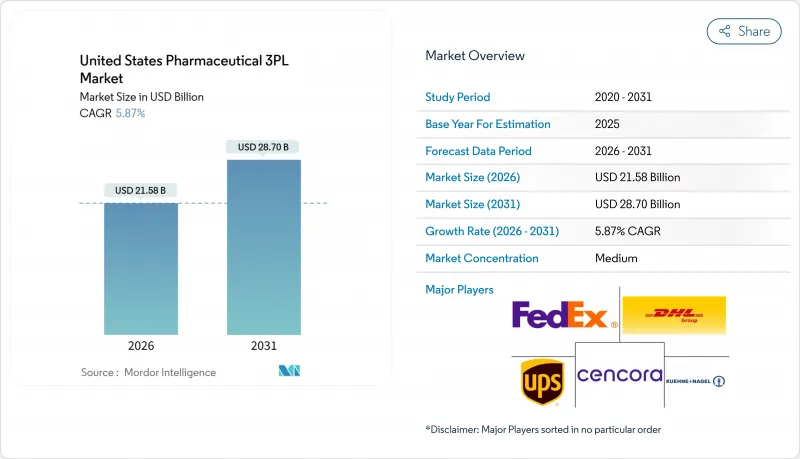
Mordor Intelligence에 의하면, 미국의 의약품 3PL시장 규모는 2026년에 215억 8,000만 달러로 추정되고 예측 기간(2026-2031년) CAGR 5.87%로 성장을 지속하여, 2031년에는 287억 달러에 이를 전망입니다.
본 보고서는 서비스 유형(국내 운송 관리 등), 온도 유형(콜드체인 및 비콜드체인), 최종 사용자(제약 제조업체 등), 제품 유형(처방약, OTC 및 소비자 건강 제품, 바이오의약품 및 바이오시밀러, 세포 및 유전자 치료 등)별로 분류되어 있습니다. 시장 예측은 금액(달러) 기준으로 제시되어 있습니다.
미국의 의약품 3PL 시장 동향 및 인사이트
엄격한 콜드체인 준수가 필요한 특수 바이오의약품의 부상
특수 바이오의약품은 이미 신약 승인의 절반 이상을 차지하고 있으며, 그중 상당수는 온도 편차 발생 후 몇 분 이내에 품질이 저하됩니다. 이에 따라 3PL 기업들은 현재 15초마다 데이터를 기록하고, 즉각적인 시정 조치를 취하기 위해 컨트롤 타워에 경보를 전송하는 센서를 도입하고 있습니다. UPS 헬스케어가 운영하는 루이빌 및 댈러스 시설에서는 이중화된 냉각 장치와 발전기를 대기 상태로 유지하여 정전 시에도 2℃에서 8℃의 온도 관리를 확실하게 유지하고 있습니다. 자가 세포 치료의 경우, 환자 유래 세포를 48시간 이내에 수혈처에 전달해야 하므로 시간적 제약이 따릅니다. 이러한 상황으로 인해 허용되는 운송 시간이 단축되고 전용 택배 서비스에 대한 수요가 증가함에 따라, 병원 종양 센터에게 있어 미국의 의약품 3PL 시장의 전략적 중요성이 커지고 있습니다. 블록체인을 활용해 위조가 불가능한 원장에 온도 이력을 기록하는 공급업체는 FDA 검사관이 보관 이력 기록을 심사할 때 감사상 우위를 점할 수 있습니다. 생물학적 제제의 출시 파이프라인이 계속해서 견조함에 따라, 콜드체인의 성장은 상온 운송 서비스를 상회하고 있으며, 미국의 의약품 3PL 시장에서 규정 준수를 실천하는 사업자에게는 시장 평균을 상회하는 가격 결정력이 유지되고 있습니다.
온라인 약국의 소량 주문 증가가 라스트 마일 온도 관리 수요를 견인
팬데믹 이후 규제 완화로 인해 처방전 통신 판매가 두 자릿수 성장을 기록했고, 2024년 Amazon Pharmacy가 냉장 가정 배송 시장에 진출하면서 수요는 더욱 확대되었습니다. 소포의 평균 중량은 2020년 3.2kg에서 2025년에는 1.8kg으로 감소했으며, 처리량이 급증했음에도 불구하고 단위당 물류 비용은 상승하고 있습니다. 페덱스 헬스케어의 ‘SenseAware ID’ 장치는 현재 모든 전문 의약품 소포에 탑재되어 GPS 정보와 온도 데이터를 실시간으로 전송하고 있습니다. 경로 최적화 알고리즘을 통해 수백 건의 소량 주문을 재구성하여 2시간 이내 배송을 보장하는 고밀도 마이크로 경로를 구축하고 있습니다. 주요 3PL 기업들은 이 기능을 활용하여 통신판매 독점 계약을 확보하고 있습니다. 이러한 동향으로 인해 전자 약국의 운송량은 예측 기간 동안 미국 의약품 3PL 시장의 구조적 성장 동력으로서의 입지를 공고히 하고 있습니다. 하지만 주거 지역으로의 배송 거리 급증은 지속가능성에 대한 우려를 불러일으키고 있으며, 각 운송사는 화주의 ESG 목표를 충족하기 위해 전기 밴과 재사용 가능한 단열 포장재 도입을 시범적으로 추진하고 있습니다.
제약 업계의 입찰 모델로 인한 치열한 비용 압박
제약 제조업체들은 디젤 연료비와 인건비가 상승하고 있는 상황에서도 연간 단위 비용 절감을 요구하는 리버스 옥션을 통해, 다년간의 물류 계약을 체결하는 사례가 늘고 있습니다. 제네릭 의약품의 유통 마진은 2025년에 3% 미만으로 떨어졌으며, 5년 동안 100베이시스포인트 이상 하락했습니다. 또한, 바이오시밀러 화주들은 더 저렴한 저분자 의약품의 배송 경로와 요금을 비교 검토하기 때문에 콜드체인 비용 회수가 제한되고 있습니다. 고정 가격 조항은 비용 전가의 확실성이 없으면 3PL 기업이 시리얼화 업그레이드를 제안하는 것을 주저하게 만들어 혁신을 저해하고 있습니다. 일부 스폰서는 이익 분배 방식을 시범적으로 도입하고 있지만, 조달 팀은 여전히 예산의 확실성을 우선시하고 있습니다. 자금 사정에 어려움을 겪는 운송업체의 경우, 가격 압박은 DSCSA 및 냉매 규정 준수에 할당되는 자금을 감소시켜 향후 계약 자격을 위태롭게 합니다. 이러한 압박은 설비 갱신 주기를 지연시켜, 운송량이 견조하게 증가하고 있음에도 불구하고 미국의 의약품 3PL 시장의 잠재적 연평균 성장률(CAGR)을 억제하고 있습니다.
부문별 분석
2025년에는 국내 운송 관리가 총매출의 42.2%를 차지했으나, DSCSA 규제로 인해 일련번호 부여,집약 및 키트화 업무가 재고 거점 근처에서 이루어지게 됨에 따라, 부가가치형 창고 및 물류 사업은 2026년부터 2031년에 걸쳐 연평균 성장률(CAGR) 8.1%로 성장할 전망입니다. 자동 케이스 포장 암을 도입한 시설 운영 사업자는 바코드 집계를 창고 운영 시스템과 연동하고 있으며, 이를 통해 제조업체는 고정자산을 늘리지 않고도 규정 준수 관련 제반 비용을 외부에 위탁할 수 있게 됩니다. 도어-투-도어 배송망을 확보하는 데 있어 국내 트럭 운송은 여전히 필수적이지만, 주행 거리에 기반한 운임에 대해 지불 측의 반발이 있어, 이에 따라 운송 사업자들은 자산 회전율을 높일 수 있는 드롭 트레일러 프로그램이나 전용 계약 운송으로 전환하고 있습니다. 국제 항공 화물은 취급량이 적고, 통관 절차가 복잡하며 극저온 관리가 필요하기 때문에 1kg당 수익률이 높으며, 이로 인해 미국의 의약품 3PL 시장 전체에서 다모달 다각화 전략이 강화되고 있습니다.
2단계 가치 전환은 운송 계획과 SKU 수준의 가시성, 예상 도착 시간(ETA), 예외 관리를 결합한 ‘컨트롤 타워’ 계약에서 볼 수 있습니다. 네트워크 모델링, IoT 센서, AI 경로 결정 엔진을 결합한 공급업체는 손실로 인한 클레임을 두 자릿수 수준으로 줄이고, 다른 분야의 운임 압박에도 불구하고 서비스 프리미엄을 확보할 수 있습니다. RXO로 대표되는 자산 경량형 브로커 업계는 디지털 화물 플랫폼을 활용하여 규정 준수를 준수하는 운송업체를 시간 엄수가 요구되는 노선에 대규모로 배차하고 있으며, 이는 기술력의 동등성이 창고 규모만큼이나 중요함을 보여줍니다. 따라서 미국의 의약품 3PL 시장에서 경쟁적 차별화는 단순한 트레일러 보유 대수뿐만 아니라 통합된 데이터, 지속적인 품질 보증, 그리고 GDP 지표 준수에 달려 있습니다.
비콜드체인 사업은 2025년 매출의 63.5%를 차지했지만, 치료제 파이프라인이 바이오의약품, GLP-1 주사제, mRNA 백신으로 전환됨에 따라 콜드체인 서비스의 연평균 성장률(CAGR)은 2026년부터 2031년까지 9.8%로 성장할 전망입니다. 냉장 및 초저온 취급을 통한 미국의 의약품 3PL 시장 규모는 2031년까지 120억 달러를 넘어설 전망입니다. 인슐린, 체중 관리제, 전문 종양학용 주입제에 대한 가정 내 수요가 증가함에 따라, 3PL 기업들은 안구건조증스를 사용하지 않고도 72시간 동안 온도를 안정적으로 유지할 수 있는 진공 단열 패널이 장착된 패시브 냉각 소포 시스템 도입을 서두르고 있습니다. -70°C 이하의 극저온 운송은 CAR-T 치료법이나 특정 바이러스 벡터 제제에 액체 질소를 이용한 백업 시스템이 필요하기 때문에 급성장하는 틈새 시장을 형성하고 있습니다.
-80°C 보관실이나 증기 운송 용기를 창고에 사후 설치하는 운송업체들은 이러한 인프라가 고가이며 엄격한 안전 기준의 적용을 받기 때문에 경쟁 우위를 확보하고 있습니다. 그러나 제약사들은 상온에서 안정적인 생물학적 제제 개발을 위한 병행 노력을 진행 중이며, 이는 2030년 이후 콜드체인 시장의 성장을 둔화시킬 가능성이 있어 미국의 의약품 3PL 시장에 대한 장기적인 전망을 보수적으로 만들고 있습니다.
기타 혜택 :
- 엑셀 형식 시장 예측(ME) 시트
- 3개월간의 애널리스트 지원
자주 묻는 질문
목차
제1장 서론
제2장 조사 방법
제3장 개요
제4장 시장 구도
제5장 시장 규모 및 성장 예측
제6장 경쟁 구도
제7장 시장 기회 및 향후 전망
KTH 26.08.31According to Mordor Intelligence, the United States pharmaceutical 3PL market size is estimated at USD 21.58 billion in 2026, and is expected to reach USD 28.70 billion by 2031, at a CAGR of 5.87% during the forecast period (2026-2031).
This report is Segmented by Service Type (Domestic Transportation Management, and More), Temperature Type (Cold Chain and Non-Cold Chain), End User (Pharmaceutical Manufacturers, and More), Product Type (Prescription Drugs, OTC and Consumer Health Products, Biopharmaceuticals and Biosimilars, Cell and Gene Therapies, and More). The Market Forecasts are Provided in Terms of Value (USD).
United States Pharmaceutical 3PL Market Trends and Insights
Rise of Specialty Biologics Requiring Strict Cold-Chain Compliance
Specialty biologics already represent more than half of new drug approvals, and most degrade within minutes of temperature excursion, so 3PLs now deploy sensors that record data every 15 seconds and feed alerts into control towers for immediate corrective action. Facilities in Louisville and Dallas operated by UPS Healthcare keep redundant chillers and generators on standby, ensuring 2 °C to 8 °C integrity even during grid outages. Autologous cell therapies add a time constraint because patient-derived cells must reach infusion sites within 48 hours. These dynamics shorten allowable transit windows, spur demand for dedicated couriers, and elevate the strategic importance of the United States pharmaceutical 3PL market for hospital oncology centers. Providers that document temperature history in immutable ledgers using blockchain gain an audit advantage when FDA inspectors review chain-of-custody records. As biologic launch pipelines remain robust, cold-chain growth outpaces ambient services, sustaining above-market pricing power for compliant operators across the United States pharmaceutical 3PL market.
E-Pharmacy Parcelization Boosting Last-Mile Temperature-Control Needs
Relaxed post-pandemic regulations triggered double-digit prescription mail-order growth, and Amazon Pharmacy's 2024 move into cooled residential delivery further expanded demand. Average parcel weight fell from 3.2 kg in 2020 to 1.8 kg in 2025, pushing per-unit logistics costs higher even as volumes surged. FedEx Healthcare's SenseAware ID devices now travel inside every specialty-drug parcel, broadcasting GPS and temperature telemetry in real time. Routing algorithms recombine hundreds of small orders into densely scheduled micro-routes that meet two-hour delivery promises, a capability that large 3PLs leverage to win exclusive mail-order contracts. The trend positions e-pharmacy traffic as a structural growth engine for the United States pharmaceutical 3PL market through the forecast horizon. Nevertheless, soaring residential mileage raises sustainability concerns, prompting carriers to experiment with electric vans and reusable insulated packs to satisfy shippers' ESG targets.
Intense Cost Pressure from Pharma Tendering Models
Pharmaceutical producers increasingly award multiyear logistics contracts through reverse auctions that demand annual unit-cost cuts even when diesel and labor expenses climb. Generic-drug distribution margins slipped below 3% in 2025, down more than 100 basis points in five years, and biosimilar shippers benchmark rates against cheaper small-molecule corridors, limiting cold-chain cost recovery. Fixed-price clauses stifle innovation because 3PLs hesitate to propose serialization upgrades without cost-pass-through certainty. Some sponsors trial gain-sharing schemes, yet procurement teams still prioritize budget certainty. For cash-constrained carriers, tighter pricing reduces available funds for DSCSA or refrigerant compliance, risking future contract eligibility. This pressure slows capital refresh cycles, restraining the potential CAGR for the United States pharmaceutical 3PL market despite healthy volume growth.
Other drivers and restraints analyzed in the detailed report include:
- Stringent GDP and DSCSA Regulations Driving Real-Time Monitoring Investments
- United States Refrigerant Phase-Down Forcing Rapid Cold-Warehouse Retrofit
- GDP-Trained Labor Shortage Across Warehousing and Trucking
For complete list of drivers and restraints, kindly check the Table Of Contents.
Segment Analysis
In 2025, domestic transportation management contributed 42.2% of total revenue, but value-added warehousing and distribution is on track for an 8.1% CAGR between 2026-2031 as DSCSA mandates push serialization, aggregation, and kitting tasks closer to inventory nodes. Facility operators installing automated case-packing arms tie barcode aggregation into warehouse-execution systems, allowing manufacturers to outsource compliance overhead without increasing their fixed assets. Domestic trucking remains essential for door-to-door reach, yet mileage-based rates face payer pushback, nudging carriers toward drop-trailer programs and dedicated contract carriage that allow higher asset turns. International airfreight, though smaller in volume, carries a premium yield per kilo because of customs-clearance complexity and cryogenic handling needs, reinforcing multimodal diversification strategies across the United States pharmaceutical 3PL market.
Second-level value migration appears in control-tower contracts that bundle transport planning with SKU-level visibility, predictive ETA, and exception management. Providers that combine network modeling, IoT sensors, and AI routing engines can trim spoilage claims by double digits and command service premiums despite rate pressure elsewhere. The asset-light brokerage community, typified by RXO, leverages digital freight platforms to place compliant carriers into time-critical lanes at scale, demonstrating that technology parity matters as much as warehouse footprint. Competitive differentiation within the United States pharmaceutical 3PL market therefore hinges on integrated data, continuous quality assurance, and adherence to GDP metrics rather than raw trailer counts alone.
Non-cold-chain activities still delivered 63.5% of 2025 revenue, yet cold-chain services will compound at 9.8% CAGR (2026-2031) as therapeutic pipelines tilt toward biologics, GLP-1 injectables, and mRNA vaccines. The United States pharmaceutical 3PL market size attributable to refrigerated and cryogenic handling will cross USD 12 billion by 2031. Residential demand for insulin, weight-management drugs, and specialty oncology infusions is pushing 3PLs to adopt passive-cool parcel systems with vacuum-insulated panels that keep temperatures stable for 72 hours without dry ice. Cryogenic shipments below -70 °C form a fast-growing niche because CAR-T therapies and certain viral-vector payloads require liquid nitrogen back-up systems.
Carriers that retrofit warehouses with -80 °C chambers and vapor shippers establish a protective moat because such infrastructure is expensive and subject to strict safety codes. However, a parallel effort is underway among drug makers to engineer room-temperature stable biologics that could soften cold-chain growth beyond 2030, tempering long-term expectations for the United States pharmaceutical 3PL market.
Complete Report Scope:
- By Service Type
- Domestic Transportation Management (DTM)
- Roadways
- Railways
- Airways
- Waterways
- International Transportation Management (ITM)
- Roadways
- Railways
- Airways
- Waterways
- Value-Added Warehousing and Distribution (VAWD)
- Domestic Transportation Management (DTM)
- By Temperature Type
- Cold Chain
- Non-cold Chain
- By End User
- Pharmaceutical Manufacturers
- Biotech and Biosimilar Manufacturers
- Clinical Research and Trial Sponsors
- Hospitals and Retail Pharmacies
- Healthcare Distributors and Wholesalers
- E-pharmacies and Direct-to-Patient Services
- By Product Type
- Prescription Drugs
- OTC and Consumer Health Products
- Biopharmaceuticals and Biosimilars (ex-CGT)
- Cell and Gene Therapies
- Vaccines and Blood-derived Products
- Veterinary Pharmaceuticals and Animal Health Products
- Medical Devices, Diagnostics and Combination Products
- Clinical-trial Materials (Investigational Medicinal Products)
- Others
- By Geography
- Northeast
- Midwest
- Southeast
- Southwest
- West
List of Companies Covered in this Report:
- Almac Group Clinical Services
- Biocair
- Catalent Clinical Supply Services
- CMA CGM Group (Including CEVA Logistics)
- DHL Group
- DSV A/S
- FedEx
- GEODIS
- JAS Worldwide Pharma and Healthcare
- Kerry Logistics Network
- Kuehne+Nagel
- Nippon Express Co., Ltd.
- SF Express (Health)
- United Parcel Service of America, Inc. (UPS)
- World Courier (Cencora)
- XPO Logistics
- Yusen Logistics
Additional Benefits:
- The market estimate (ME) sheet in Excel format
- 3 months of analyst support
TABLE OF CONTENTS
1 Introduction
- 1.1 Study Assumptions and Market Definition
- 1.2 Scope of the Study
2 Research Methodology
3 Executive Summary
4 Market Landscape
- 4.1 Market Overview
- 4.2 Market Drivers
- 4.2.1 Rise of Specialty Biologics Requiring Strict Cold-Chain Compliance
- 4.2.2 E-pharmacy Parcelization Boosting Last-Mile Temperature-Control Needs
- 4.2.3 Stringent GDP and DSCSA Regulations Driving Real-time Monitoring Investments
- 4.2.4 United States' Refrigerant Phase-Down (AIM Act) Forcing Rapid Retrofit of Cold Warehouses
- 4.2.5 VC-Funded Cell and Gene Therapy Start-Ups Locating in Midwest Biohubs
- 4.2.6 Integrated RTSM-3PL Platforms Slashing Clinical Trial Delays for SME Sponsors
- 4.3 Market Restraints
- 4.3.1 Intense Cost-Pressure from Pharma Tendering Models
- 4.3.2 GDP-Trained Labor Shortage Across Warehousing and Trucking
- 4.3.3 Scarcity of Sustainable Packaging Meeting Both ESG and USP 659 Standards
- 4.3.4 Airport Cool-Room Congestion at Tier-2 Cargo Hubs Causing Spoilage Risk
- 4.4 Value / Supply-Chain Analysis
- 4.5 Regulatory Outlook
- 4.6 Technological Trends and Digitalization (IoT, RFID, Control-Tower Platforms etc.)
- 4.7 Packaging Innovations (Smart Data-Loggers, Eco-PCM Boxes)
- 4.8 Impact of Geopolitical Events on the Market
- 4.9 Porter's Five Forces Analysis
- 4.9.1 Bargaining Power of Suppliers
- 4.9.2 Bargaining Power of Customers
- 4.9.3 Threat of New Entrants
- 4.9.4 Threat of Substitutes
- 4.9.5 Intensity of Competitive Rivalry
5 Market Size and Growth Forecasts (Value)
- 5.1 By Service Type
- 5.1.1 Domestic Transportation Management (DTM)
- 5.1.1.1 Roadways
- 5.1.1.2 Railways
- 5.1.1.3 Airways
- 5.1.1.4 Waterways
- 5.1.2 International Transportation Management (ITM)
- 5.1.2.1 Roadways
- 5.1.2.2 Railways
- 5.1.2.3 Airways
- 5.1.2.4 Waterways
- 5.1.3 Value-Added Warehousing and Distribution (VAWD)
- 5.1.1 Domestic Transportation Management (DTM)
- 5.2 By Temperature Type
- 5.2.1 Cold Chain
- 5.2.2 Non-cold Chain
- 5.3 By End User
- 5.3.1 Pharmaceutical Manufacturers
- 5.3.2 Biotech and Biosimilar Manufacturers
- 5.3.3 Clinical Research and Trial Sponsors
- 5.3.4 Hospitals and Retail Pharmacies
- 5.3.5 Healthcare Distributors and Wholesalers
- 5.3.6 E-pharmacies and Direct-to-Patient Services
- 5.4 By Product Type
- 5.4.1 Prescription Drugs
- 5.4.2 OTC and Consumer Health Products
- 5.4.3 Biopharmaceuticals and Biosimilars (ex-CGT)
- 5.4.4 Cell and Gene Therapies
- 5.4.5 Vaccines and Blood-derived Products
- 5.4.6 Veterinary Pharmaceuticals and Animal Health Products
- 5.4.7 Medical Devices, Diagnostics and Combination Products
- 5.4.8 Clinical-trial Materials (Investigational Medicinal Products)
- 5.4.9 Others
- 5.5 By Geography
- 5.5.1 Northeast
- 5.5.2 Midwest
- 5.5.3 Southeast
- 5.5.4 Southwest
- 5.5.5 West
6 Competitive Landscape
- 6.1 Market Concentration
- 6.2 Key Strategic Moves
- 6.3 Market Share Analysis
- 6.4 Company Profiles (includes Global level Overview, Market level overview, Core Segments, Financials as available, Strategic Information, Market Rank/Share for key companies, Products and Services, and Recent Developments)
- 6.4.1 Almac Group Clinical Services
- 6.4.2 Biocair
- 6.4.3 Catalent Clinical Supply Services
- 6.4.4 CMA CGM Group (Including CEVA Logistics)
- 6.4.5 DHL Group
- 6.4.6 DSV A/S
- 6.4.7 FedEx
- 6.4.8 GEODIS
- 6.4.9 JAS Worldwide Pharma and Healthcare
- 6.4.10 Kerry Logistics Network
- 6.4.11 Kuehne+Nagel
- 6.4.12 Nippon Express Co., Ltd.
- 6.4.13 SF Express (Health)
- 6.4.14 United Parcel Service of America, Inc. (UPS)
- 6.4.15 World Courier (Cencora)
- 6.4.16 XPO Logistics
- 6.4.17 Yusen Logistics
7 Market Opportunities and Future Outlook
- 7.1 White-space and Unmet-need Assessment


