

|
시장보고서
상품코드
2116365
셀프 케어 의료기기 : 시장 점유율 분석, 업계 동향 및 통계, 성장 예측(2026-2031년)Global Self Care Medical Devices - Market Share Analysis, Industry Trends & Statistics, Growth Forecasts (2026 - 2031) |
||||||
 Mordor Intelligence
Mordor Intelligence에 의하면, 셀프 케어 의료기기 시장 규모는 2025년 214억 7,000만 달러로 평가되었습니다. 2026년에는 228억 3,000만 달러로 확대되어 2026년부터 2031년에 걸쳐 CAGR 6.32%로 성장을 지속하여, 2031년에는 310억 3,000만 달러에 이를 것으로 예측됩니다.
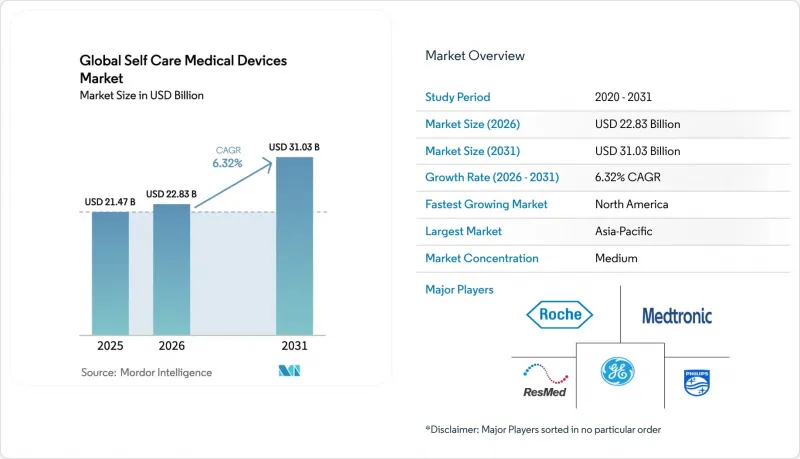
본 보고서는 기기 유형별(혈당 측정기, 혈압계, 체온계, 네뷸라이저, 만보계, 임신·불임 검사 키트, 기타) 및 지역별(북미, 유럽, 아시아태평양, 중동 및 아프리카, 남미)로 분류되어 있습니다. 본 보고서에서는 상기 각 부문 시장 규모(단위 : 백만 달러)를 제시하고 있습니다.
세계의 셀프 케어 의료기기 시장 동향 및 인사이트
만성 질환 및 고령화로 인한 부담
인구 고령화와 만성 질환 유병률 증가로 인해 의료는 일시적인 개입에서 지속적인 재택 모니터링으로 전환되고 있습니다. 전 세계적으로 1,100만 명 이상의 인슐린 의존 환자가 병원 방문 횟수를 줄이면서도 혈당 조절을 유지할 수 있는 자동 혈당 측정기에 의존하고 있습니다. 심혈관 분야에서도 유사한 추세가 나타나고 있으며, 애보트(Abbott)사의 ‘Assert-IQ’와 같이 배터리 효율이 뛰어난 이식형 모니터는 6년에 걸친 심박 리듬 모니터링을 가능하게 하여 부정맥의 조기 발견률을 높이고 있습니다. 보험사들은 이러한 도구들이 응급 입원을 예방한다는 점을 높이 평가하고 있으며, 이러한 추세가 자가 관리 의료기기 시장의 확대 추세를 뒷받침하고 있습니다.
재택 치료 선호도
공중보건 비상사태로 인해 원격 모니터링에 대한 수용이 가속화되었으며, 이러한 경향은 점차 정착되고 있습니다. FDA는 2024년 ‘Home as a Health Care Hub(가정을 의료의 거점으로)’라는 프레임워크를 통해 가정 환경을 의료 제공의 필수 요소로 공식 인정하고, 제조업체들에게 일반 사용자를 위한 사용 편의성, 감염 방지 기능 및 교육 자료의 최적화를 장려하고 있습니다. CMS는 현재 원격 모니터링 기기에 대해 30일마다 최소 16개 항목의 데이터를 전송하도록 의무화하고 있으며, 이를 통해 사실상 성능 기준이 설정되어 기술의 정교화가 촉진되고 있습니다. 여성 건강 분야는 이러한 추세를 여실히 보여주고 있습니다. CMS가 승인한 가정용 호르몬 모니터링 패드는 눈에 띄지 않는 방식으로 정기적인 검사를 가능하게 하여, 의료 서비스가 충분히 제공되지 않는 계층의 의료 접근성을 확대되고 있습니다.
의료기기의 고가와 저렴한 대체품
고가의 커넥티드 기기는 저·중소득 국가에서 예산을 초과하는 수년에 걸친 소유 비용을 수반하는 경우가 많아 시장 침투를 저해하고 있습니다. 주요 관할권 몇 곳에서 검토되고 있는 반도체 관세는 의료기기의 절반 이상이 첨단 칩을 필요로 한다는 점을 고려할 때, 추가적인 가격 상승을 초래할 우려가 있으며, 전체 생산 라인의 부품 비용을 상승시킬 가능성이 있습니다. 각 제조업체는 신흥 시장을 대상으로 비필수 기능을 제외한 단계적 제품 라인업으로 대응하고 있지만, 이러한 접근 방식은 이익률 하락을 초래할 위험이 있습니다.
부문별 분석
혈당 측정기 부문은 2025년 매출의 35.78%를 차지하며, 자가 관리 의료기기 시장의 기반을 이루었습니다. 보험 급여의 안정성과 지속적인 혈당 데이터가 필요한 임상 지침 덕분에 예측 가능한 수요가 유지되고 있습니다. 한편, 마이크로니들을 이용한 스마트 패치는 단순한 센싱에 그치지 않고 온디맨드 약물 투여로 진화하고 있어 연평균 7.78%의 성장이 예상됩니다. 이는 여러 약물을 투여할 수 있는 FDA 승인 스마트폰 제어형 패치의 존재가 뒷받침하고 있습니다. 혈압계는 고혈압 선별 검사 프로그램의 견인 효과로 한 자릿수 중반대의 성장률을 보이고 있는 반면, 웨어러블 체온 센서는 소아의 원격 발열 관리에서 그 중요성이 커지고 있습니다.
FDA 승인을 받은 기도 청소 시스템 ‘SIMEOX 200’ 등 계속 늘어나는 호흡기 솔루션은 맥압파 기술을 활용하여 만성 폐쇄성 폐질환(COPD) 환자의 점액 배출을 지원하고 있습니다. 일반적인 만보계나 피트니스 트래커는 가격 하락에 직면하고 있지만, 심전도 및 혈중 산소 포화도 데이터를 통합한 첨단 모델은 임상 검증을 통해 가격 결정력을 유지하고 있습니다. 불임·임신 검사 키트의 경우, 현재 비색 스트립 대신 정량적인 호르몬 분석이 채택되어 있으며, 데이터에 기반한 상세한 정보를 원하는 여성층으로부터 지지를 받고 있습니다. 코막힘이나 수면 무호흡 증후군을 대상으로 하는 신흥 음향 치료 기기는 비약물 요법을 통한 호흡기 관리의 폭을 넓히며, 자가 관리 의료기기 시장 전체에서 제품 파이프라인의 지속적인 다각화를 보여주고 있습니다.
당뇨병 관리 관련 용도는 2025년 매출의 41.92%를 차지하며, 센서 및 주입 세트에 대한 지속적인 소모품 수요의 기반이 되었습니다. 폐루프 시스템에 통합된 인슐린 투여 알고리즘은 저혈당 위험을 줄이고 생태계의 정착성을 높임으로써, 부가가치 있는 소프트웨어 구독을 통해 당뇨병 자가 관리 의료기기 시장 규모를 6% 확대시키고 있습니다. 여성 건강 분야는 가장 역동적인 성장 영역으로, 지금까지 의료기관에서 진료를 받아야 했던 성병 및 호르몬 검사의 자가 검사가 규제 당국의 승인을 받음에 따라 연평균 성장률(CAGR) 6.87%로 확대될 것으로 예측됩니다. 심혈관 모니터링 분야에서는 수명이 긴 이식형 의료기기의 도입과 퇴원 후 예후를 개선하는 AI 기반 부정맥 감지 기술의 보급이 호재로 작용하고 있습니다.
호흡기 관리의 이용 사례는 간헐적인 네뷸라이저 치료에서 흡입법 및 복약 순응도를 안내하는 유량 센서가 탑재된 스마트 흡입기로 전환되고 있습니다. 통합형 웰니스 플랫폼은 혈당, 혈압, 심박 변이도 등 여러 바이오마커를 하나의 대시보드에 통합하여 소비자가 필요로 하는 개별 기기의 수를 줄여줍니다. 용도에 내장된 예측 분석 엔진은 과거 생체 데이터를 개별 위험 점수로 변환하여, 증상이 나타나기 전에 예방적 알림이 전송되는 미래를 향해 자가 관리 의료기기 산업을 이끌고 있습니다.
지역별 분석
북미는 견고한 보험 환급 제도, 기술 분야의 혁신, 그리고 지원적인 규제가 결합되어 2025년 자가 관리 의료기기 시장 매출의 42.19%를 차지했습니다. ‘고급 1차 진료 관리(Advanced Primary Care Management)’에 관한 CMS 코드 업데이트로 인해 기기가 생성한 데이터 검토에 대한 보상이 이루어지게 되어, 원격 모니터링 대시보드의 경제적 타당성이 향상되고 있습니다. FDA의 품질 시스템 규제와 ISO 13485의 조화는 이중 시장 접근을 가속화하고 중복되는 감사 비용을 절감합니다. 실리콘밸리와 보스턴의 의료 기술 클러스터로 유입되는 벤처 투자는 센서의 소형화, 임상 등급 펌웨어, 그리고 엣지 처리 분야의 획기적인 발전을 뒷받침하고 있습니다. 반도체 관세 도입이 비용 측면에서 역풍으로 우려되고 있지만, 공급을 확보하기 위해 칩 제조의 전략적 국내 복귀가 진행되고 있습니다.
아시아태평양은 가장 빠르게 성장하는 지역으로, 2031년까지 연평균 성장률(CAGR) 8.31%를 유지할 것으로 전망됩니다. 각국 정부는 디지털 헬스 도구에 대한 공적 보험 적용 범위를 확대하고 있으며, 현지 제조 규모의 확대를 통해 가격 경쟁력도 유지되고 있습니다. 중국에서는 개정된 의료기기법에 따라 시판 후 감시 및 표시 요건에 대한 투명성이 향상되어 해외 기업 시장 진입 절차가 간소화되었습니다. 시장 규모 400억 달러에 달하는 일본에서는 ‘건강 장수 비전’의 일환으로 자가 모니터링이 중시되고 있으며, 대형 보험사들이 고령자용 연속 혈당 모니터에 대한 보조금을 지급하고 있습니다. 호주에서는 CE 마크가 부착된 기기에 대한 상호인정 제도가 도입되어 심사 기간이 단축됨에 따라 지역의 경쟁력이 더욱 높아지고 있습니다.
유럽에서는 고령화와 근거에 기반한 웨어러블 기기의 비용을 보상하는 국민건강보험제도의 뒷받침을 받아, 한 자릿수 중반대의 꾸준한 성장이 예상됩니다. ‘유럽 헬스 데이터 스페이스(European Health Data Space)’ 제안은 2026년에 발효될 전망이며, 건강 데이터의 상호 운용성을 표준화하고 높은 암호화 기준을 의무화함으로써, 견고한 보안 실적을 보유한 기업을 우대하게 될 것입니다. 지속가능성에 대한 요구가 높아지는 가운데, 핀란드의 연구 자금으로 개발된 나노셀룰로오스 소재 심전도 패치 등 생분해성 센서 기판에 대한 관심이 높아지고 있습니다. 한편, 신흥 걸프 국가 및 라틴아메리카 시장에서는 인프라 투자와 규제의 근본적인 재검토로 인해 성장 가능성이 있는 인접 분야를 모색하는 다국적 기업들이 진출하면서 관련 수요가 확대되고 있습니다.
기타 혜택 :
- 엑셀 형식 시장 예측(ME) 시트
- 3개월간의 애널리스트 지원
자주 묻는 질문
목차
제1장 서론
제2장 조사 방법
제3장 개요
제4장 시장 구도
제5장 시장 규모 및 성장 예측
제6장 경쟁 구도
제7장 시장 기회 및 향후 전망
KTH 26.08.31According to Mordor Intelligence, the self care medical devices market size is expected to grow from USD 21.47 billion in 2025 to USD 22.83 billion in 2026 and is forecast to reach USD 31.03 billion by 2031 at 6.32% CAGR over 2026-2031.
This report is Segmented by Type (Blood Glucose Monitors, Blood Pressure Monitors, Body Temperature Monitors, Nebulizers, Pedometers, Pregnancy/Fertility Test Kits, and Others), and Geography (North America, Europe, Asia-Pacific, Middle-East and Africa, and South America). The Market Provides the Value (in USD Million) for the Above-Mentioned Segments.
Global Self Care Medical Devices Market Trends and Insights
Chronic-Disease & Geriatric Burden
Population aging and the rising incidence of long-term conditions are steering care from episodic interventions to continuous, home-based monitoring. More than 11 million insulin-dependent individuals worldwide depend on automated glucose monitors that cut clinic visits while safeguarding glycemic control . Similar momentum is unfolding in cardiology, where battery-efficient implantable monitors such as Abbott's Assert-IQ deliver six-year rhythm surveillance and improve early detection of arrhythmia. Payers value these tools because they avert emergency admissions, a dynamic that keeps the self care medical devices market on a widening trajectory.
Home-Based Care Preference
Public-health emergencies accelerated comfort with tele-monitoring, but the behavior has become entrenched. The FDA formally acknowledged domestic settings as integral to care delivery via its "Home as a Health Care Hub" framework in 2024, encouraging manufacturers to tailor usability, infection-control features, and training materials for laypersons. CMS now requires remotely monitored devices to transmit at least 16 data points every 30 days, effectively setting a performance floor that propels technology refinement. Women's health illustrates the trend: at-home hormone-monitoring pads validated by the agency allow discreet, routine testing and broaden engagement for underserved groups.
High Device Cost & Cheaper Alternatives
Premium connected devices often carry multi-year ownership costs that exceed budgets in low- to middle-income economies, hampering penetration. Semiconductor tariffs under discussion in several major jurisdictions threaten additional price rises given that more than half of medical devices require advanced chips, potentially lifting component costs across production lines. Manufacturers are countering with tiered portfolios that strip non-essential features for emerging markets, though the approach risks narrowing margins.
Other drivers and restraints analyzed in the detailed report include:
- Device Miniaturization & Wireless Tech
- Healthcare-Cost Pressure on Payers & Patients
- Data-Privacy Adoption Barriers
For complete list of drivers and restraints, kindly check the Table Of Contents.
Segment Analysis
The segment for blood-glucose monitors generated 35.78% of 2025 revenue, making it the cornerstone of the self care medical devices market. Reimbursement stability and clinical guidelines requiring continuous glucose data sustain predictable demand. At the same time, microneedle-based smart patches are forecast to rise 7.78% annually as they move beyond sensing to on-demand drug delivery, evidenced by an FDA-cleared smartphone-controlled patch able to dispense multiple medications. Blood-pressure monitors show mid-single-digit growth driven by hypertension screening programs, whereas wearable temperature sensors gain relevance in pediatric remote-fever management.
Proliferating respiratory solutions such as the FDA-cleared SIMEOX 200 airway clearance system leverage pulse-pressure wave technology to assist mucus evacuation in chronic obstructive pulmonary disease cohorts. Commodity pedometers and fitness trackers face value erosion, but advanced models integrating ECG and oxygen saturation data retain pricing power through clinical validation. Fertility and pregnancy kits now employ quantitative hormone analytics rather than colorimetric strips, appealing to women seeking data-rich insights. Emerging acoustic-therapy devices targeting nasal congestion and sleep apnea broaden non-pharmaceutical respiratory care, illustrating continuous product-pipeline diversification across the self care medical devices market.
Applications linked to diabetes management captured 41.92% of 2025 revenue and anchor recurring consumable demand for sensors and infusion sets. Insulin dosing algorithms embedded in closed-loop systems reduce hypoglycemia risk and create ecosystem stickiness, enlarging the self care medical devices market size for diabetes by 6% through value-added software subscriptions. Women's health constitutes the most dynamic frontier, expanding at a projected 6.87% CAGR as regulatory agencies green-light home tests for sexually transmitted infections and hormone panels that previously required clinic visits. Cardiovascular monitoring benefits from the roll-out of extended-life implantables and AI arrhythmia detection that improves post-discharge outcomes.
Respiratory-care use cases are shifting from episodic nebulization to smart inhalers equipped with flow sensors that guide technique and adherence. Integrated wellness platforms converge multiple biomarkers-glucose, blood pressure, heart rate variability-into one dashboard, cutting the number of individual devices a consumer needs. Predictive-analytics engines embedded within applications convert historical biometrics into individualized risk scores, positioning the self care medical devices industry for a future where preventive alerts precede symptom onset.
Complete Report Scope:
- By Device Type
- Blood Glucose Monitors
- Blood Pressure Monitors
- Body Temperature Monitors
- Nebulizers
- Pedometers & Activity Trackers
- Pregnancy/Fertility Test Kits
- Smart Wearable Patches
- Others
- By Application
- Diabetes Management
- Cardiovascular Health
- Respiratory Care
- Women's Health & Fertility
- Fitness & Wellness
- By Connectivity
- Connected / IoT-enabled Devices
- Non-connected Devices
- By Distribution Channel
- Pharmacies & Drug Stores
- Online Retail
- Hospital Outpatient & Clinics
- Mass-merchandisers & Others
- By End-user
- Home-care Users
- Ambulatory Care Centres
- Long-term Care Facilities
- By Geography
- North America
- United States
- Canada
- Mexico
- Europe
- Germany
- United Kingdom
- France
- Italy
- Spain
- Rest of Europe
- Asia-Pacific
- China
- Japan
- India
- Australia
- South Korea
- Rest of Asia-Pacific
- Middle East & Africa
- GCC
- South Africa
- Rest of Middle East & Africa
- South America
- Brazil
- Argentina
- Rest of South America
- North America
Geography Analysis
North America secured 42.19% of 2025 self care medical devices market revenue by combining robust reimbursement, tech-sector innovation, and supportive regulation. Updated CMS codes for Advanced Primary Care Management reimburse device-generated data reviews, improving financial justification for remote-monitoring dashboards. The FDA's harmonization of Quality System Regulation with ISO 13485 expedites dual market access and lowers redundant auditing costs. Venture investment channeled into Silicon Valley and Boston med-tech clusters fuels sensor miniaturization, clinical-grade firmware, and edge-processing breakthroughs. Potential semiconductor tariffs loom as a cost headwind, yet strategic on-shoring of chip fabrication is underway to secure supply.
Asia-Pacific is the fastest-growing region, tracking an 8.31% CAGR through 2031. Governments are enlarging public-insurance coverage for digital-health tools, and local manufacturing scale keeps price points attractive. China's updated medical-device law enhances transparency on post-market surveillance and label requirements, simplifying pathways for foreign entrants. Japan, valued at USD 40 billion, leans on self-monitoring as part of its Healthy Life Extension vision, with large payers subsidizing continuous glucose monitors for older adults . Australia's adoption of mutual-recognition schemes for CE-marked devices trims review cycles, further boosting regional competitiveness.
Europe delivers steady mid-single-digit expansion underpinned by aging populations and universal-coverage systems willing to reimburse evidence-based wearables. The European Health Data Space proposal, expected to enter force during 2026, will standardize health-data interoperability while mandating high encryption standards that favor companies with strong security credentials. Sustainability requirements drive interest in biodegradable sensor substrates such as nanocellulose ECG patches developed with Finnish research funding. Meanwhile, emergent Gulf and Latin American markets broaden addressable demand as infrastructure investment and regulatory overhauls attract multinationals looking for growth adjacencies.
- Abbott Laboratories
- Medtronic
- Roche
- Koninklijke Philips
- Dexcom
- OMRON
- Resmed
- Johnson & Johnson (Lifescan)
- Bayer
- Insulet
- GE Healthcare
- Orasure Technologies
- B. Braun
- Garmin
- Fitbit (Google)
- iHealth Labs
- Beurer
- Microlife Corp
- Withings SA
- Nipro
Additional Benefits:
- The market estimate (ME) sheet in Excel format
- 3 months of analyst support
TABLE OF CONTENTS
1 Introduction
- 1.1 Study Assumptions & Market Definition
- 1.2 Scope of the Study
2 Research Methodology
3 Executive Summary
4 Market Landscape
- 4.1 Market Overview
- 4.2 Market Drivers
- 4.2.1 Chronic-Disease & Geriatric Burden
- 4.2.2 Home-Based Care Preference
- 4.2.3 Device Miniaturisation & Wireless Tech
- 4.2.4 Healthcare-Cost Pressure on Payers & Patients
- 4.2.5 AI-Driven Personalised Self-Monitoring
- 4.2.6 Reimbursement-Linnked Remote Monitoring Codes
- 4.3 Market Restraints
- 4.3.1 High Device Cost & Cheaper Alternatives
- 4.3.2 Adverse Events From Implantables
- 4.3.3 Data-Privacy Adoption Barriers
- 4.3.4 Chip-Supply Volatility & Price Spikes
- 4.4 Value / Supply-Chain Analysis
- 4.5 Regulatory Landscape
- 4.6 Technological Outlook
- 4.7 Porter's Five Forces Analysis
- 4.7.1 Threat of New Entrants
- 4.7.2 Bargaining Power of Buyers
- 4.7.3 Bargaining Power of Suppliers
- 4.7.4 Threat of Substitutes
- 4.7.5 Competitive Rivalry
5 Market Size & Growth Forecasts (Value, USD Million)
- 5.1 By Device Type
- 5.1.1 Blood Glucose Monitors
- 5.1.2 Blood Pressure Monitors
- 5.1.3 Body Temperature Monitors
- 5.1.4 Nebulizers
- 5.1.5 Pedometers & Activity Trackers
- 5.1.6 Pregnancy/Fertility Test Kits
- 5.1.7 Smart Wearable Patches
- 5.1.8 Others
- 5.2 By Application
- 5.2.1 Diabetes Management
- 5.2.2 Cardiovascular Health
- 5.2.3 Respiratory Care
- 5.2.4 Women's Health & Fertility
- 5.2.5 Fitness & Wellness
- 5.3 By Connectivity
- 5.3.1 Connected / IoT-enabled Devices
- 5.3.2 Non-connected Devices
- 5.4 By Distribution Channel
- 5.4.1 Pharmacies & Drug Stores
- 5.4.2 Online Retail
- 5.4.3 Hospital Outpatient & Clinics
- 5.4.4 Mass-merchandisers & Others
- 5.5 By End-user
- 5.5.1 Home-care Users
- 5.5.2 Ambulatory Care Centres
- 5.5.3 Long-term Care Facilities
- 5.6 By Geography
- 5.6.1 North America
- 5.6.1.1 United States
- 5.6.1.2 Canada
- 5.6.1.3 Mexico
- 5.6.2 Europe
- 5.6.2.1 Germany
- 5.6.2.2 United Kingdom
- 5.6.2.3 France
- 5.6.2.4 Italy
- 5.6.2.5 Spain
- 5.6.2.6 Rest of Europe
- 5.6.3 Asia-Pacific
- 5.6.3.1 China
- 5.6.3.2 Japan
- 5.6.3.3 India
- 5.6.3.4 Australia
- 5.6.3.5 South Korea
- 5.6.3.6 Rest of Asia-Pacific
- 5.6.4 Middle East & Africa
- 5.6.4.1 GCC
- 5.6.4.2 South Africa
- 5.6.4.3 Rest of Middle East & Africa
- 5.6.5 South America
- 5.6.5.1 Brazil
- 5.6.5.2 Argentina
- 5.6.5.3 Rest of South America
- 5.6.1 North America
6 Competitive Landscape
- 6.1 Market Concentration
- 6.2 Market Share Analysis
- 6.3 Company Profiles (includes Global-level Overview, Market-level Overview, Core Segments, Financials, Strategic Information, Market Rank/Share, Products & Services, Recent Developments)
- 6.3.1 Abbott
- 6.3.2 Medtronic
- 6.3.3 F. Hoffmann-La Roche
- 6.3.4 Koninklijke Philips
- 6.3.5 Dexcom
- 6.3.6 Omron Healthcare
- 6.3.7 ResMed
- 6.3.8 Johnson & Johnson (Lifescan)
- 6.3.9 Bayer
- 6.3.10 Insulet Corporation
- 6.3.11 GE HealthCare
- 6.3.12 OraSure Technologies
- 6.3.13 B. Braun Melsungen
- 6.3.14 Garmin Ltd
- 6.3.15 Fitbit (Google)
- 6.3.16 iHealth Labs
- 6.3.17 Beurer GmbH
- 6.3.18 Microlife Corp
- 6.3.19 Withings SA
- 6.3.20 Nipro Corporation
7 Market Opportunities & Future Outlook
- 7.1 White-space & Unmet-need Assessment


