

|
시장보고서
상품코드
2116411
중국의 윤활유 시장 : 점유율 분석, 업계 동향과 통계, 성장 예측(2026-2031년)China Lubricants - Market Share Analysis, Industry Trends & Statistics, Growth Forecasts (2026 - 2031) |
||||||
 Mordor Intelligence
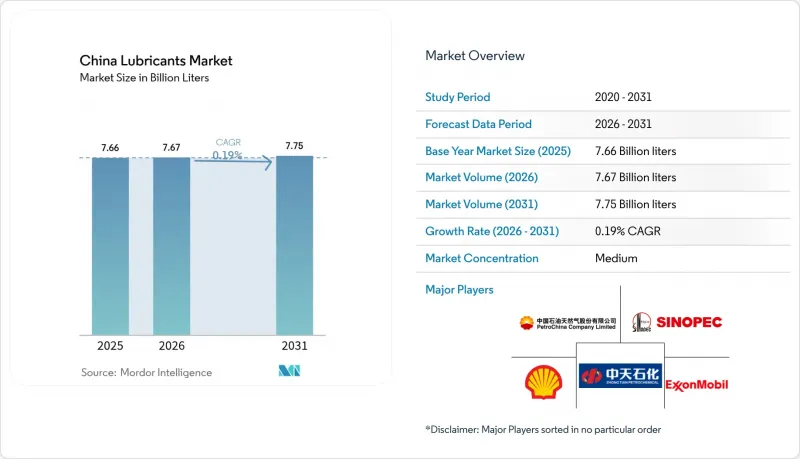
Mordor Intelligence에 의하면, 중국 윤활유 시장 규모는 2025년에 76억 6,000만 리터로 평가되어 2026년 76억 7,000만 리터에서 2031년까지 77억 5,000만 리터에 이를 것으로 예측되며, 예측 기간(2026-2031년) CAGR은 0.19%를 나타낼 전망입니다.
본 보고서는 제품 유형(자동차용 엔진오일, 산업용 엔진오일, 변속기 오일, 기어 오일, 브레이크 오일, 작동유 등), 최종 사용자 산업(자동차, 선박, 항공우주, 중장비, 산업용),및 기유 유형(광물유계, 합성유, 반합성유, 바이오)별로 분류되어 있습니다. 시장 전망은 수량(리터) 기준으로 제시되어 있습니다.
중국 윤활유 시장 동향 및 인사이트
디젤 트럭 보유 대수의 회복에 따라 상업용 윤활유 수요가 안정화
2025년 초, 물류 활동이 정상화됨에 따라 대형 디젤 트럭의 등록 대수가 증가하여 고점도 엔진오일 및 변속기 오일에 대한 안정적인 수요를 뒷받침했습니다. 인프라 프로젝트로 인해 2025년 2월 싱가포르로부터의 기유 수입량은 15% 증가했으며, 이는 건설 활동과 윤활유 소비량 사이에 양의 상관관계가 있음을 여실히 보여주었습니다. 그러나 장거리 화물 운송에서 LNG 트럭이 도입됨에 따라 기존 디젤용 윤활유 소비량은 감소하고 있습니다. 이는 가스 엔진에는 다른 배합과 더 긴 교환 주기가 필요하기 때문입니다. 이러한 수요의 분화로 인해 공급업체들은 디젤 및 대체 연료 구동 시스템 모두에 최적화된 윤활유 개발을 촉진하고 있습니다. 차량 소유주들은 총 소유 비용을 중시하며, 오일 교환 주기를 연장하고 가동 중단 시간을 줄일 수 있는 합성유를 선호하고 있습니다.
국내 기유 생산 재개로 수입 의존도 감소
페트로차이나와 시노펙이 소유한 정유시설에서는 2020년부터 2022년까지 가동을 중단했던 기유 제조 설비의 운영을 재개하여, 싱가포르 및 한국으로부터의 수입 의존도를 낮췄습니다. 국내산 원유 원료는 비용 면에서 우위를 점하고 있어, 현지 블렌더들에게 공급망을 단축하는 효과가 있습니다. 2024년에는 정유시설의 평균 가동률이 75%까지 떨어졌지만, 이는 역설적으로 기유의 마진을 개선하는 결과를 낳았습니다. 원료 경쟁이 완화되면서 가격에 대한 압박이 누그러졌기 때문입니다. 공급 안정성이 향상됨에 따라 중국의 블렌딩 업체들은 수입 재고와 관련된 운전 자본 요건을 줄일 수 있게 되었습니다. 국내 비용의 하락으로 인해 중국의 기유는 동남아시아 시장에서 경쟁력을 갖추게 되어 새로운 수출의 길이 열릴 가능성이 있습니다.
전기차 보급 가속화가 내연기관용 윤활유 수요를 감소시킬 것
2025년 초, 배터리 전기자동차(BEV)가 신차 판매 대수에서 차지하는 비중이 40%를 넘어섬에 따라, 차량 1대당 연간 4-5리터의 엔진오일 소비가 대체되어 휘발유 수요 전망치가 하향 조정되었습니다. 2024년 정제 제품 소비량은 1.7% 감소했는데, 이는 경기 순환적인 침체가 아니라 구조적인 변화를 시사합니다 (SINOLUB.COM). 석유 메이저 각사는 이에 대응하여 주유소를 전기차 충전 기능을 갖춘 복합 에너지 허브로 전환했으나, 이러한 전환만으로는 감소한 윤활유 판매량을 보충할 수 없습니다. 휘발유 생산량 감소는 자동차 이외 분야의 기유 공급을 위축시켜 중국 윤활유 시장 전체의 가격 동향에 영향을 미치고 있습니다.
부문 분석
자동차용 엔진오일은 2025년 중국 윤활유 시장 점유율의 45.05%를 차지했으나, NEV의 보급이 확대됨에 따라 감소 추세를 보이고 있습니다. 변속기 오일은 자동 변속기 및 전용 e-액슬 오일의 보급에 힘입어 연평균 성장률(CAGR) 1.03%를 나타낼 것으로 예측됩니다. 작동유 및 그리스는 건설 기계용이며, 인프라 정비 사업의 혜택을 받고 있습니다. 브레이크 오일은 내연기관(ICE) 및 EV 플랫폼 양쪽에서 안정적인 수요가 나타나고 있지만, 교환 주기가 길어짐에 따라 판매량 증가폭은 제한적입니다. 기어 오일은 극압 사양의 제품이 필요한 광업 및 중장비 분야에서 수요를 얻고 있습니다.
배터리 구동 시스템에는 엔진오일이 아닌 열 관리용 및 유전체용 작동유가 필요하기 때문에 제품 구성은 특수 합성유로 전환되고 있습니다. 산업용 엔진오일은 전동화 진전이 제한적인 발전용 및 선박용 엔진을 대상으로 합니다. 공정 오일 및 금속 가공용 유체는 제조업의 생산량과 상관관계가 있어, 중국의 산업 생산 능력 확충에 따라 완만한 성장세를 보이고 있습니다. 터빈 오일 및 변압기유은 재생에너지 설비의 도입으로 혜택을 받고 있습니다. 이처럼 변화하는 제품 포트폴리오는 중국 윤활유 시장 규모가 감소 추세에 있는 승용차용 엔진오일에서 틈새 시장인 산업용 및 전기차용 윤활유로 재분배되고 있음을 보여줍니다.
기타 혜택:
- 엑셀 형식 시장 예측(ME) 시트
- 3개월간의 애널리스트 지원
자주 묻는 질문
목차
제1장 서론
제2장 조사 방법
제3장 주요 요약
제4장 시장 구도
제5장 시장 규모와 성장 예측
제6장 경쟁 구도
제7장 시장 기회와 향후 전망
제8장 CEO가 직면하는 중요 전략적 과제
JHS 26.08.28According to Mordor Intelligence, the China lubricants market size was valued at 7.66 billion liters in 2025 and estimated to grow from 7.67 billion liters in 2026 to reach 7.75 billion liters by 2031, at a CAGR of 0.19% during the forecast period (2026-2031).
This report is Segmented by Product Type (Automotive Engine Oil, Industrial Engine Oil, Transmission Fluids, Gear Oil, Brake Fluids, Hydraulic Fluids, and More), End-User Industry (Automotive, Marine, Aerospace, Heavy Equipment, Industrial), and Base Stock Type (Mineral Oil-Based, Synthetic, Semi-Synthetic, Bio-Based). The Market Forecasts are Provided in Terms of Volume (Liters).
China Lubricants Market Trends and Insights
Diesel-Truck Parc Recovery Stabilizes Commercial Lubricant Demand
Heavy-duty diesel truck registrations increased in early 2025 as logistics activity returned to normal, underpinning steady demand for high-viscosity engine oils and transmission fluids. Infrastructure projects increased base-oil imports from Singapore by 15% in February 2025, highlighting the positive correlation between construction activity and lubricant consumption. However, the adoption of LNG trucks in long-haul freight reduces conventional diesel lubricant volumes because gas engines require different formulations and longer service intervals. The resulting split encourages suppliers to develop fluids tailored for both diesel and alternative-fuel drivetrains. Fleet owners prioritize total cost of ownership, favoring synthetics that enable extended drains and reduced downtime.
Domestic Base-Oil Production Restart Reduces Import Dependency
Refineries owned by PetroChina and Sinopec restarted their base-oil units, which had been idle during 2020-2022, reducing their reliance on imports from Singapore and South Korea. Domestic crude feedstock offers cost advantages and shortens supply chains for local blenders. Average refinery utilization fell to 75% in 2024, which paradoxically improved base-oil margins because lower competition for feedstock eased price pressure. Enhanced supply stability enables Chinese blenders to reduce working-capital requirements associated with imported inventories. Lower domestic costs may make Chinese base oils competitive in Southeast Asia, opening new export avenues.
Electric Vehicle Adoption Accelerates ICE Lubricant Demand Destruction
Battery electric vehicles surpassed 40% of new car sales in early 2025, displacing annual engine oil consumption by 4-5 liters per vehicle and lowering gasoline demand projections. Refined-product consumption declined 1.7% in 2024, signaling a structural shift rather than a cyclical dip [SINOLUB.COM]. Oil majors responded by converting service stations into mixed-energy hubs with EV charging, but this pivot cannot replace lost lubricant volume. Reduced gasoline production also tightens base-oil supply for non-automotive segments, influencing price dynamics across the China lubricants market.
Other drivers and restraints analyzed in the detailed report include:
- OEM Warranty Extensions Accelerate Synthetic Lubricant Adoption
- E-Commerce Penetration Transforms Distribution While Enabling Counterfeits
- Extended Drain Intervals Compress Service Market Volumes
For complete list of drivers and restraints, kindly check the Table Of Contents.
Segment Analysis
Automotive engine oil held 45.05% of China lubricants market share in 2025, yet faces decline as NEV adoption rises. Transmission Fluids are forecast to grow at a 1.03% CAGR, helped by the wider adoption of automatic gearboxes and dedicated e-axle fluids. Hydraulic Fluids and Greases serve construction machinery, which benefits from infrastructure programs. Brake Fluids show stable demand across ICE and EV platforms, though longer intervals limit volume growth. Gear Oil gains from mining and heavy-duty equipment that require extreme-pressure formulations.
Battery-electric drivetrains require thermal management and dielectric fluids, rather than engine oil, shifting the product mix toward specialty synthetics. Industrial Engine Oil targets power generation and marine engines where electrification remains limited. Process Oils and Metalworking Fluids correlate with manufacturing output, posting moderate gains as China upgrades industrial capacity. Turbine and Transformer Oils benefit from renewable-energy installations. The evolving portfolio indicates how China's lubricants market size redistributes from declining passenger-car engine oils to niche industrial and electric-vehicle fluids.
Complete Report Scope:
- By Product Type
- Automotive Engine Oil
- Industrial Engine Oil
- Transmission Fluids
- Gear Oil
- Brake Fluids
- Hydraulic Fluids
- Greases
- Process Oil (Including Rubber Process Oil and White Oil)
- Metalworking Fluids
- Turbine Oil
- Transformer Oil
- Other Product Types
- By End-user Industry
- Automotive
- Passenger Vehicles
- Commercial Vehicles
- Two-Wheelers
- Marine
- Aerospace
- Heavy Equipment
- Construction
- Mining
- Agriculture
- Industrial
- Power Generation
- Metallurgy and Metalworking
- Textiles
- Oil and Gas
- Other End-Use Industries
- Automotive
- By Base Stock Type
- Mineral Oil-Based Lubricants
- Synthetic Lubricants
- Semi-Synthetic Lubricants
- Bio-Based Lubricants
List of Companies Covered in this Report:
- PetroChina Company Limited
- Sinopec (China Petrochemical Corporation)
- Shell plc
- ExxonMobil Corporation
- BP plc (Castrol)
- TotalEnergies SE
- FUCHS SE
- Valvoline Global
- Idemitsu Kosan
- ENEOS Holdings
- JIANGSU LOPAL TECH CO. LTD
- Qingdao COPTON Technology Co. Ltd
- Jiangsu Gaoke Petrochemical Co. Ltd
- ZHONGTIAN PETROCHEMICAL
- Quaker Houghton
Additional Benefits:
- The market estimate (ME) sheet in Excel format
- 3 months of analyst support
TABLE OF CONTENTS
1 Introduction
- 1.1 Study Assumptions and Market Definition
- 1.2 Scope of the Study
2 Research Methodology
3 Executive Summary
4 Market Landscape
- 4.1 Market Overview
- 4.2 Market Drivers
- 4.2.1 Diesel-truck parc rebound in post-COVID logistics
- 4.2.2 Restart of domestic base-oil projects improves supply stability
- 4.2.3 OEM warranty extension pushes demand for premium long-drain synthetics
- 4.2.4 Explosion of e-commerce channels for HDMO and PCMO
- 4.2.5 Accelerated "dual-carbon" policy drives bio-lube adoption
- 4.3 Market Restraints
- 4.3.1 Rapid BEV penetration shrinks ICE engine-oil pool
- 4.3.2 Longer OEM drain intervals cut service-fill volumes
- 4.3.3 Volatile crude swings squeeze blender margins
- 4.3.4 Persistent counterfeits undermine brand pricing power
- 4.4 Value Chain Analysis
- 4.5 Regulatory Framework
- 4.6 End-User Trends
- 4.6.1 Automotive Industry
- 4.6.2 Manufacturing Industry
- 4.6.3 Power Generation Industry
- 4.7 Porter's Five Forces
- 4.7.1 Bargaining Power of Suppliers
- 4.7.2 Bargaining Power of Buyers
- 4.7.3 Threat of New Entrants
- 4.7.4 Threat of Substitutes
- 4.7.5 Degree of Competition
5 Market Size and Growth Forecasts (Volume)
- 5.1 By Product Type
- 5.1.1 Automotive Engine Oil
- 5.1.2 Industrial Engine Oil
- 5.1.3 Transmission Fluids
- 5.1.4 Gear Oil
- 5.1.5 Brake Fluids
- 5.1.6 Hydraulic Fluids
- 5.1.7 Greases
- 5.1.8 Process Oil (Including Rubber Process Oil and White Oil)
- 5.1.9 Metalworking Fluids
- 5.1.10 Turbine Oil
- 5.1.11 Transformer Oil
- 5.1.12 Other Product Types
- 5.2 By End-user Industry
- 5.2.1 Automotive
- 5.2.1.1 Passenger Vehicles
- 5.2.1.2 Commercial Vehicles
- 5.2.1.3 Two-Wheelers
- 5.2.2 Marine
- 5.2.3 Aerospace
- 5.2.4 Heavy Equipment
- 5.2.4.1 Construction
- 5.2.4.2 Mining
- 5.2.4.3 Agriculture
- 5.2.5 Industrial
- 5.2.5.1 Power Generation
- 5.2.5.2 Metallurgy and Metalworking
- 5.2.5.3 Textiles
- 5.2.5.4 Oil and Gas
- 5.2.5.5 Other End-Use Industries
- 5.2.1 Automotive
- 5.3 By Base Stock Type
- 5.3.1 Mineral Oil-Based Lubricants
- 5.3.2 Synthetic Lubricants
- 5.3.3 Semi-Synthetic Lubricants
- 5.3.4 Bio-Based Lubricants
6 Competitive Landscape
- 6.1 Market Concentration
- 6.2 Strategic Moves
- 6.3 Market Share**(%)/Ranking Analysis
- 6.4 Company Profiles (includes Global level Overview, Market level overview, Core Segments, Financials as available, Strategic Information, Market Rank/Share, Products and Services, Recent Developments)
- 6.4.1 PetroChina Company Limited
- 6.4.2 Sinopec (China Petrochemical Corporation)
- 6.4.3 Shell plc
- 6.4.4 ExxonMobil Corporation
- 6.4.5 BP plc (Castrol)
- 6.4.6 TotalEnergies SE
- 6.4.7 FUCHS SE
- 6.4.8 Valvoline Global
- 6.4.9 Idemitsu Kosan
- 6.4.10 ENEOS Holdings
- 6.4.11 JIANGSU LOPAL TECH CO. LTD
- 6.4.12 Qingdao COPTON Technology Co. Ltd
- 6.4.13 Jiangsu Gaoke Petrochemical Co. Ltd
- 6.4.14 ZHONGTIAN PETROCHEMICAL
- 6.4.15 Quaker Houghton
7 Market Opportunities and Future Outlook
- 7.1 White-space and Unmet-need Assessment


