

|
시장보고서
상품코드
2116437
이동형 의료 영상 서비스 시장 : 점유율 분석, 업계 동향과 통계, 성장 예측(2026-2031년)Mobile Medical Imaging Services - Market Share Analysis, Industry Trends & Statistics, Growth Forecasts (2026 - 2031) |
||||||
 Mordor Intelligence
Mordor Intelligence에 의하면, 이동형 의료 영상 서비스 시장 규모는 2025년 166억 3,000만 달러에서 2026년에는 173억 1,000만 달러로 확대되어 2026년부터 2031년까지 CAGR 4.07%로 성장을 지속하여, 2031년까지 211억 3,000만 달러에 이를 것으로 예측됩니다.
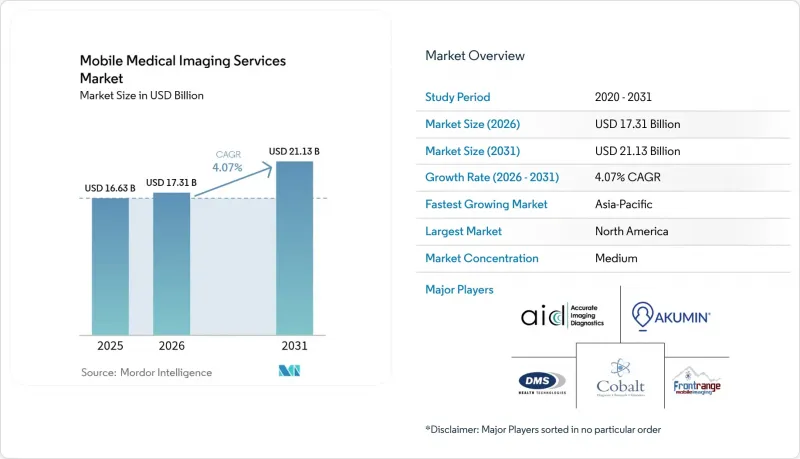
본 보고서는 서비스 유형(X선, 초음파, MRI, PET/CT, 기타), 서비스 제공업체(병원 및 진료소, 재택치료 제공업체, 기타), 지역(북미, 유럽, 아시아태평양, 중동 및 아프리카, 남미)별로 분류되어 있습니다. 시장 전망은 금액(달러) 기준으로 제시되어 있습니다.
세계 이동형 의료 영상 서비스 시장 동향 및 인사이트
휴대용 영상 진단 기술 및 서비스에 대한 수요 증가
현재 휴대용 스캐너는 화질을 저하시키지 않으면서 지방 진료소, 구급차, 중환자실까지 도입되고 있습니다. 2024년에 Positrigo사의 뇌 PET 기기 ‘NeuroLF’와 Hyperfine사의 AI 강화형 MRI 기기 ‘Swoop MRI’가 FDA 승인을 획득한 것은 초소형 형식에 대한 규제 당국의 신뢰를 뒷받침하는 것입니다. Exo Iris와 같은 핸드헬드형 초음파 플랫폼은 카트형 시스템에 비해 최대 80%의 비용 절감을 실현하며, 임상의의 주머니에 들어갈 만한 크기이기 때문에 1차 진료 현장에서의 일상적인 사용을 촉진하고 있습니다. 의료 제공업체들로부터는 환자 이송 시간이 단축되고, 집중 치료 중 발생할 수 있는 유해 사건의 위험이 감소했다는 보고도 있습니다. 현장 진단(Point-of-Care) 기능을 통해 진단 주기가 단축되어 뇌졸중 및 외상 치료 성과가 향상되고 있습니다. 이러한 변화들이 결합되어, 과거에는 접근하기 어려웠던 의료 현장으로의 진출이 가능해졌으며, 이는 이동형 의료 영상 서비스 시장을 확대시키고 있습니다.
만성 질환 부담 증가
심혈관 질환, 암, 당뇨병의 발생률 증가로 인해 검사 건수는 해마다 계속 증가하고 있습니다. PET 심근 관류 영상은 2018년부터 2023년 사이에 25% 증가했는데, 이는 심장 전문의들이 중재를 신속하게 진행하기 위한 현장 평가를 선호하는 경향을 반영한 것입니다. 집단 검진을 대상으로 한 이동식 유방촬영 장치는 고령자의 통원 부담을 경감시키고, 연례 검진 수진율을 향상시킵니다. 또한 휴대용 초음파 장비를 활용한 당뇨병성 발 합병증에 대한 빈번한 영상 진단을 통해 허혈성 조직을 조기에 발견할 수 있게 되어, 절단률을 낮추는 데 기여하고 있습니다. 이러한 임상적 필요성은 특히 고령화가 진행되는 지역에서 이동형 의료 영상 서비스 시장의 구조적 확장을 뒷받침하고 있습니다.
이동식 장비 및 스캐너의 고액 초기 투자 비용
이동식 영상 진단 장비에는 막대한 설비 투자가 필요하며, 이것이 시장 진입 및 사업 확장의 큰 장벽이 되고 있습니다. 이동식 PET/CT의 도입 비용은 150만 달러에서 300만 달러에 달하며, 이동식 MRI는 200만 달러를 초과하는 경우가 많습니다. CT 트레일러의 임대료는 운송비와 차폐비를 제외하더라도 월 3만 미달러에 육박합니다. 리퍼브 제품이라면 20-40%의 비용 절감이 가능하지만, 입수 가능성이 제한적이며 AI 업그레이드 대응이 지연될 가능성이 있습니다. 이러한 재정적 제약은 특히 이동형 의료 영상 서비스가 가장 필요로 하는 반면, 경제적 타당성을 확보하기 가장 어려운 농촌 지역이나 의료 서비스가 미비한 시장에 큰 영향을 미치고 있습니다.
부문 분석
2025년에는 자기공명영상진단(MRI)이 매출의 36.35%를 차지하며, 차폐실이나 고정식 극저온 장치가 필요 없는 휴대용 시스템이 그 기반을 이루고 있습니다. 신경학,정형외과, 심장학에 걸친 이 검사법의 범용성은 이동형 의료 영상 서비스 시장에서 그 압도적인 위상을 확고히 하고 있습니다. 한편, PET/CT는 심장 관류 검사 및 정밀 암 진단의 급증에 힘입어 연평균 성장률(CAGR) 5.61%로 성장세를 보이고 있습니다. 2023년 PET 스캔 실시 건수는 전년 대비 10.2% 증가하여, 외래 진료 현장에서 실시간 대사 영상 진단에 대한 잠재적 수요가 높아지고 있음을 보여줍니다.
초음파 진단은 카트형 시스템 비용의 몇 분의 1 수준에 불과한 핸드헬드형 트랜스듀서의 보급으로 인해 1차 진료 의사들의 접근성이 확대되고 있습니다. 휴대용 X선 장비는 신속성과 낮은 방사선 노출량 덕분에 중환자실이나 요양 시설에서 여전히 주력 장비로서의 지위를 유지하고 있습니다. 틈새 시장인 ‘기타’ 카테고리(광자 계수 CT 및 광간섭 단층 촬영법 등)는 향후 10년 동안 전문 스캔 분야의 이동형 의료 영상 서비스 시장 규모를 확대할 것으로 예상되는 차세대 도구들의 개발 파이프라인을 보여줍니다.
지역별 분석
북미는 조기 FDA 승인, CMS(미국 의료보험서비스센터)의 상환 제도 혁신, 확립된 원격 방사선 진단 네트워크라는 강점을 바탕으로 2025년 매출의 40.18%를 계속 차지했습니다. RadNet 및 RAYUS와 같은 영상 진단 체인에 대한 사모펀드의 자본 유입은 장비 교체 주기를 강화하고 장비 도입을 가속화하고 있습니다. 인력 부족은 역풍으로 작용하고 있지만, 교육 파이프라인을 통해 수련생 규모가 확대되고 있어 향후 인력 공백률을 완화할 전망입니다. 전반적으로, 재택 병원 시범 사업이 주류 서비스 라인으로 전환됨에 따라 북미의 이동형 의료 영상 서비스 시장 규모는 2030년까지 꾸준히 확대될 전망입니다.
아시아태평양은 만성 질환 유병률의 상승과 대규모 인프라 투자에 힘입어 연평균 성장률(CAGR) 5.88%로 가장 빠르게 성장하고 있는 지역입니다. 중국, 인도, 인도네시아 정부는 도시와 농촌 간의 격차를 해소하기 위해 진료 현장용 스캐너를 갖춘 모듈식 진료소에 대한 보조금을 지원하고 있습니다. Hyperfine 및 Positrigo와 같은 기술 라이선스 제공 기업들은 도입 지연을 단축하기 위해 다자간 판매 계약을 체결하고 있습니다. 또한, 국내 제조업체들도 비용 효율이 뛰어난 초음파 진단 장비 및 X선 장비의 생산을 확대하고 있으며, 경쟁력 있는 가격 책정을 통해 저소득 지역의 이동형 의료 영상 서비스 시장 확대를 촉진하고 있습니다.
유럽, 중동 및 아프리카, 남미에서는 보험 환급 환경의 차이와 통화 변동에 따라 시장 동향에 편차가 나타나고 있습니다. 유럽연합(EU)의 새로운 MDR 규정 준수는 제품 인증 주기를 장기화시켰지만, 한편으로는 의료기기의 품질에 대한 신뢰도도 높였습니다. 중동의 ‘헬스 시티’ 프로젝트에서는 영구적인 시설이 갖춰질 때까지 이동식 의료 영상 진단 차량을 임시적인 해결책으로 삼고 있습니다. 라틴아메리카의 도입률은 설비 투자의 장벽을 상쇄하는 민관 협력 자금 조달 파트너십에 달려 있습니다. 이러한 동향은 전반적으로 분산형 진단으로의 세계적 전환을 반영하며, 이동형 의료 영상 서비스 시장의 확장을 뒷받침하고 있습니다.
기타 혜택:
- 엑셀 형식 시장 예측(ME) 시트
- 3개월간의 애널리스트 지원
자주 묻는 질문
목차
제1장 서론
제2장 조사 방법
제3장 주요 요약
제4장 시장 구도
제5장 시장 규모와 성장 예측
제6장 경쟁 구도
제7장 시장 기회와 향후 전망
JHS 26.09.03According to Mordor Intelligence, the mobile medical imaging services market size is expected to grow from USD 16.63 billion in 2025 to USD 17.31 billion in 2026 and is forecast to reach USD 21.13 billion by 2031 at 4.07% CAGR over 2026-2031.
This report is Segmented by Service Type (X-Ray, Ultrasound, Magnetic Resonance Imaging (MRI), PET/CT, Others), Service Provider (Hospitals and Clinics, Home-Healthcare Providers, Others), and Geography (North America, Europe, Asia-Pacific, Middle East and Africa, South America). The Market Forecasts are Provided in Terms of Value (USD).
Global Mobile Medical Imaging Services Market Trends and Insights
Rise in Demand for Portable Imaging Technology and Services
Portable scanners now reach rural clinics, ambulances and intensive-care units without sacrificing image quality. The 2024 FDA clearance of Positrigo's NeuroLF brain PET and Hyperfine's AI-enhanced Swoop MRI confirmed regulatory confidence in ultra-compact formats. Handheld ultrasound platforms such as Exo Iris achieve up to 80% cost savings versus cart-based systems and slip into a clinician's pocket, fostering everyday use in primary care. Providers also note reductions in patient transfer times that cut adverse-event risk during critical care episodes. Point-of-care capabilities shorten diagnostic cycles, improving outcomes for stroke and trauma. Collectively, these shifts enlarge the mobile medical imaging services market by opening settings once considered unreachable.
Growing Burden of Chronic Diseases
Higher incidences of cardiovascular disease, cancer, and diabetes keep scan volumes climbing year after year. PET myocardial perfusion imaging grew 25% between 2018 and 2023, reflecting cardiologists' preference for on-site assessments that speed intervention. Mobile mammography units targeted at population screening reduce travel burdens for seniors and improve compliance with annual checkups. Frequent imaging of diabetic foot complications through portable ultrasound provides early identification of ischemic tissue, lowering amputation rates. These clinical imperatives reinforce the structural expansion of the mobile medical imaging services market, particularly in aging regions.
High Capital Cost of Mobile Set-Ups and Scanners
The substantial capital requirements for mobile imaging equipment create significant barriers to market entry and expansion. Acquiring a mobile PET/CT can cost USD 1.5 million-3 million, while mobile MRI frequently surpasses USD 2 million. Rental fees for CT trailers approach USD 30,000 per month, excluding transport and shielding expenses. Refurbished units offer savings of 20-40% but availability is limited and may lag on AI upgrades. Financial constraints particularly impact rural and underserved markets where mobile imaging services are most needed, but economic viability is most challenging.
Other drivers and restraints analyzed in the detailed report include:
- Technological Advancements
- Expansion of "Hospital-At-Home" Reimbursement Codes
- Shortage of Certified Mobile Technologists
For complete list of drivers and restraints, kindly check the Table Of Contents.
Segment Analysis
Magnetic resonance imaging retained 36.35% of revenue in 2025, underpinned by portable systems that bypass the need for shielded rooms and fixed cryogens. The modality's versatility across neurology, orthopedics and cardiology cements its commanding role within the mobile medical imaging services market. PET/CT, however, is gaining momentum at a 5.61% CAGR, buoyed by surging cardiac perfusion studies and precision oncology diagnostics. PET scan volumes rose 10.2% year on year in 2023, indicating pent-up demand for real-time metabolic imaging in outpatient settings.
Ultrasound benefits from handheld transducers that cost a fraction of cart-based systems, democratizing access for primary-care physicians. Portable X-ray remains a workhorse in critical-care wards and nursing homes due to its speed and low radiation dose. A niche "Others" cohort-covering photon-counting CT and optical coherence tomography-illustrates the pipeline of next-generation tools set to enlarge the mobile medical imaging services market size for specialized scans over the next decade.
Complete Report Scope:
- By Service Type
- X-ray
- Ultrasound
- Magnetic Resonance Imaging (MRI)
- PET/CT
- Others
- By Service Provider
- Hospitals and Clinics
- Home-Healthcare Providers
- Others
- By Geography
- North America
- United States
- Canada
- Mexico
- Europe
- Germany
- United Kingdom
- France
- Italy
- Spain
- Rest of Europe
- Asia-Pacific
- China
- Japan
- India
- Australia
- South Korea
- Rest of Asia-Pacific
- Middle East and Africa
- GCC
- South Africa
- Rest of Middle East and Africa
- South America
- Brazil
- Argentina
- Rest of South America
- North America
Geography Analysis
North America retained 40.18% of 2025 revenue on the strength of early FDA clearances, CMS reimbursement innovation and established teleradiology networks. Capital inflows from private equity into imaging chains such as RadNet and RAYUS have reinforced equipment refresh cycles and accelerated fleet acquisitions. Workforce shortages pose headwinds, yet educational pipelines are expanding cohort sizes to moderate future vacancy rates. Overall, the mobile medical imaging services market size in North America is set to increase steadily through 2030 as hospital-at-home pilots transition into mainstream service lines.
Asia-Pacific represents the fastest-growing region at 5.88% CAGR, driven by rising chronic disease prevalence and large-scale infrastructure spending. Governments in China, India and Indonesia are subsidizing modular clinics equipped with point-of-care scanners to bridge urban-rural divides. Technology licensors such as Hyperfine and Positrigo have signed multi-country distribution agreements that shorten adoption lags. Domestic manufacturers are also scaling production of cost-effective ultrasound and X-ray units, fostering competitive pricing that broadens the mobile medical imaging services market across lower-income provinces.
Europe, the Middle East and Africa, and South America display mixed trajectories tied to differing reimbursement climates and currency volatility. European Union adherence to new MDR rules has lengthened product certification cycles but also instilled confidence in device quality. Middle Eastern health-city projects position mobile fleets as interim solutions while permanent facilities rise. Latin American adoption rates hinge on public-private financing partnerships that offset capex barriers. Collectively, these developments echo a global pivot toward decentralized diagnostics that amplifies the footprint of the mobile medical imaging services market.
- Akumin Inc (Alliance HealthCare Services)
- TridentCare
- DMS Health Technologies
- Cobalt Imaging Center
- Accurate Imaging
- InHealth Group Ltd
- RAYUS Radiology
- Star Equity Holdings (Digirad)
- Front Range Mobile Imaging
- Interim Diagnostic Imaging
- Atlantic Mobile Imaging
- MD Laboratory
- Shared Medical Services
- RadNet Mobile Solutions
- Mobile xUSA
- OnSite Imaging (US)
Additional Benefits:
- The market estimate (ME) sheet in Excel format
- 3 months of analyst support
TABLE OF CONTENTS
1 Introduction
- 1.1 Study Assumptions & Market Definition
- 1.2 Scope of the Study
2 Research Methodology
3 Executive Summary
4 Market Landscape
- 4.1 Market Overview
- 4.2 Market Drivers
- 4.2.1 Rise in Demand for Portable Imaging Technology and Services
- 4.2.2 Growing Burden of Chronic Diseases
- 4.2.3 Technological Advancements
- 4.2.4 Expansion of "Hospital-At-Home" Reimbursement Codes
- 4.2.5 Healthcare Infrastructure Expansion
- 4.2.6 Rising Adoption of Telemedicine and Teleradiology
- 4.3 Market Restraints
- 4.3.1 High Capital Cost of Mobile Set-Ups and Scanners
- 4.3.2 Radiation-Exposure Compliance Hurdles
- 4.3.3 Cyber-Security Mandates for Mobile Endpoints
- 4.3.4 Shortage of Certified Mobile Technologists
- 4.4 Regulatory Landscape
- 4.5 Technological Outlook
- 4.6 Porter's Five Forces Analysis
- 4.6.1 Threat of New Entrants
- 4.6.2 Bargaining Power of Buyers
- 4.6.3 Bargaining Power of Suppliers
- 4.6.4 Threat of Substitutes
- 4.6.5 Intensity of Competitive Rivalry
5 Market Size & Growth Forecasts (Value)
- 5.1 By Service Type
- 5.1.1 X-ray
- 5.1.2 Ultrasound
- 5.1.3 Magnetic Resonance Imaging (MRI)
- 5.1.4 PET/CT
- 5.1.5 Others
- 5.2 By Service Provider
- 5.2.1 Hospitals and Clinics
- 5.2.2 Home-Healthcare Providers
- 5.2.3 Others
- 5.3 By Geography
- 5.3.1 North America
- 5.3.1.1 United States
- 5.3.1.2 Canada
- 5.3.1.3 Mexico
- 5.3.2 Europe
- 5.3.2.1 Germany
- 5.3.2.2 United Kingdom
- 5.3.2.3 France
- 5.3.2.4 Italy
- 5.3.2.5 Spain
- 5.3.2.6 Rest of Europe
- 5.3.3 Asia-Pacific
- 5.3.3.1 China
- 5.3.3.2 Japan
- 5.3.3.3 India
- 5.3.3.4 Australia
- 5.3.3.5 South Korea
- 5.3.3.6 Rest of Asia-Pacific
- 5.3.4 Middle East and Africa
- 5.3.4.1 GCC
- 5.3.4.2 South Africa
- 5.3.4.3 Rest of Middle East and Africa
- 5.3.5 South America
- 5.3.5.1 Brazil
- 5.3.5.2 Argentina
- 5.3.5.3 Rest of South America
- 5.3.1 North America
6 Competitive Landscape
- 6.1 Market Concentration
- 6.2 Market Share Analysis
- 6.3 Company Profiles (includes Global level Overview, Market level overview, Core Segments, Financials as available, Strategic Information, Market Rank/Share for key companies, Products & Services, and Recent Developments)
- 6.3.1 Akumin Inc (Alliance HealthCare Services)
- 6.3.2 TridentCare
- 6.3.3 DMS Health Technologies
- 6.3.4 Cobalt Imaging Center
- 6.3.5 Accurate Imaging Inc
- 6.3.6 InHealth Group Ltd
- 6.3.7 RAYUS Radiology
- 6.3.8 Star Equity Holdings (Digirad)
- 6.3.9 Front Range Mobile Imaging
- 6.3.10 Interim Diagnostic Imaging Inc
- 6.3.11 Atlantic Mobile Imaging
- 6.3.12 MD Laboratory
- 6.3.13 Shared Medical Services
- 6.3.14 RadNet Mobile Solutions
- 6.3.15 Mobile xUSA
- 6.3.16 OnSite Imaging (US)
7 Market Opportunities & Future Outlook
- 7.1 White-space & Unmet-Need Assessment


