

|
시장보고서
상품코드
2116440
중공사 여과 시장 : 점유율 분석, 업계 동향과 통계, 성장 예측(2026-2031년)Hollow Fiber Filtration - Market Share Analysis, Industry Trends & Statistics, Growth Forecasts (2026 - 2031) |
||||||
 Mordor Intelligence
Mordor Intelligence에 의하면, 중공사 여과 시장 규모는 2025년 9억 4,000만 달러에서 2026년에는 10억 7,000만 달러로 확대되어 2026년부터 2031년까지 CAGR 14.28%로 성장을 지속하여, 2031년에는 20억 9,000만 달러에 이를 것으로 예측됩니다.
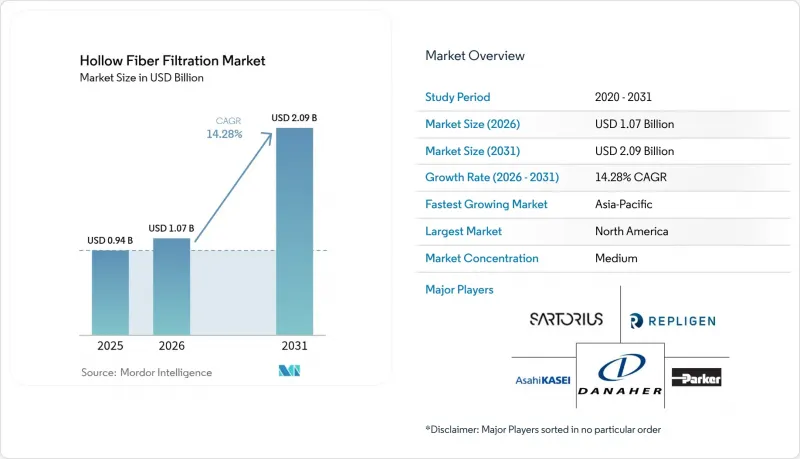
본 보고서는 소재(합성 폴리머 및 세라믹), 기술(정밀 여과 및 초여과), 최종 사용자(제약·바이오기술 등), 용도(단백질 농축 및 투석 여과 등), 지역(북미, 유럽, 아시아태평양, 중동 및 아프리카, 남미)별로 분류되어 있습니다. 시장 예측은 금액(달러) 기준으로 제시되어 있습니다.
전 세계 중공사 여과 시장 동향 및 인사이트
전 세계 생물학적 제제 파이프라인의 급속한 확대
2025년에는 6,500종 이상의 단일클론 항체가 임상 개발 단계에 있을 것으로 예상되며, 이는 2024년 시판된 360종의 분자와 비교할 때 여과 처리량 및 개발 배치 수에 획기적인 변화를 가져오고 있습니다. 각 치료 후보 물질에는 임상 단계부터 상용화 단계에 이르기까지 확장 가능한 여과 솔루션이 필요하며, 개발 규모에 따라 신속하게 전환할 수 있는 유연성이 높은 중공사 모듈에 대한 수요가 증가하고 있습니다. 이중 특이성 항체나 항체-약물 복합체(ADC)와 같은 복잡한 형식의 경우, 기존의 미세여과로는 일관되게 충족할 수 없는 선택성이 요구되어 한외여과의 도입이 진행되고 있습니다. 현재 파이프라인 성장의 대부분은 아시아태평양의 스폰서에 의해 주도되고 있으며, 공급업체는 경쟁력을 유지하기 위해 현지 기술 지원 체계와 막 제조 거점을 구축해야 하는 상황에 직면해 있습니다. 이에 따라 기술 제공업체들은 막 모듈과 인라인 센싱을 결합한 통합 시스템을 우선시하며, 전 세계 거점에서의 공정 검증 및 비교 가능성을 지원하고 있습니다.
일회용 바이오프로세스 장비의 채택 확대
2019년부터 2024년까지 전 세계 일회용 시스템 매출은 연평균 성장률(CAGR) 10% 이상으로 확대되고 있으며, 일회용에 최적화된 중공사 카트리지가 이러한 성장을 주도하고 있습니다. CIP(정지 세척) 사이클을 제거함으로써 설비 투자 및 검증 비용이 절감되어, 신생 바이오기술 기업이나 세포 치료 개발 기업도 첨단 여과 기술을 합리적인 가격에 도입할 수 있게 되었습니다. Cytiva와 Pall이 총 15억 달러를 투자한 것(이 중 3억 달러는 일회용 제품 라인에 배정됨)은 사전 멸균 처리되고 감마선 조사에 내성이 있는 막 어셈블리에 대한 공급업체들의 노력을 여실히 보여줍니다. 아시아의 신규 공장에서는 가동 첫날부터 일회용 구조를 지정할 수 있기 때문에 도입이 가속화되고 있습니다. 그러나 플라스틱 폐기물에 대한 환경적 감시가 엄격해지는 가운데, 재활용 가능한 하우징과 퇴비화 가능한 폴리머에 대한 연구 개발이 촉진되고 있으며, 조달 결정에 지속가능성 기준이 반영되고 있습니다.
엄격한 규제상 검증 및 문서화 요건
FDA 및 EMA 지침에서는 모든 막 구성에 대해 종합적인 성능 증명을 의무화하고 있으며, 복잡한 생물학적 제제의 경우 공정당 100만 달러가 넘는 검증 비용이 발생하고 있습니다. 소규모 혁신 기업은 전문 인력이 부족하여 실적이 입증된 CDMO에 의존하는 경우가 많기 때문에 장비의 직접 판매는 주춤하고 있습니다. 지역별 규제 차이-특히 사용 전 무결성 시험과 관련된 사항-로 인해 중복 시험이 불가피해져 일정이 최대 18개월까지 연장되고 있습니다. 감사 대응이 완료된 데이터 패키지를 보유한 벤더는 현재 우선 공급업체로서의 지위를 누리고 있으나, 이러한 자료 작성에는 막대한 자원이 필요하여 신규 시장 진출기업에게는 진입 장벽이 되고 있습니다.
부문 분석
2025년, 중공사 여과 시장에서 합성 폴리머는 성숙한 공급망과 매력적인 단가로 77.88%의 시장 점유율을 차지했습니다. 이 범주 내에서 폴리에테르설폰은 4.52 L/m2·h·atm의 정수 투과성과 안정적인 pH 내성을 갖추고 있어 항체 정제 분야에서 여전히 선호되고 있습니다. 폴리비닐리덴 플루오라이드(PVDF)는 용매를 많이 포함하는 원료에서 점유율을 확대하고 있는 반면, 폴리설폰은 고압 공정에 대응하고 있습니다. 폴리프로필렌은 단백질 흡착 위험이 낮은 상황에서 계속해서 사용되고 있습니다. 세라믹 막은 여전히 틈새 시장으로 남아 있지만, 플랜트 측에서 더 긴 수명과 강력한 세척 내성을 요구함에 따라 연평균 성장률(CAGR) 16.48%로 확대되고 있습니다. 알루미나 및 지르코니아의 변형 제품은 부식성 조건과 백펄스 처리를 견딜 수 있어 퍼퓨전 라인의 가동 중단 시간을 줄여줍니다. 연속 처리가 확대됨에 따라, 수년에 걸친 캠페인 기간 동안의 비용 상각으로 인해 세라믹 막의 매력이 점점 더 높아지고 있으며, 이러한 추세로 인해 2031년까지 중공사 여과 시장에서 세라믹 막의 매출 점유율은 크게 상승할 것으로 전망됩니다.
2025년에는 0.1-0.45μm의 컷오프 범위에 적합한 세포 회수 및 배양액 정화 작업에 힘입어, 미세여과가 매출의 61.72%를 차지했습니다. 접선류 미세여과(TFF)는 데드엔드 방식보다 높은 처리량과 규제상 실적이 확립되어 있어 대규모 항체 제조 플랜트에서 주류를 이루고 있습니다. 그러나 한외여과로의 전환 추세는 분명합니다. 연평균 성장률(CAGR) 16.55%의 속도로, 사업자들은 완충액 교환 및 농축을 위해 10-100 kDa 막을 점점 더 많이 활용하고 있으며, 99.75% 이상의 보유율을 달성하면서 다이아필트레이션의 처리량을 줄이고 있습니다. 완전 연속형 플랫폼에 통합된 싱글 패스 구성은 체류 시간을 대폭 단축하고 배치 릴리스 테스트를 가속화하기 때문에 한외여과는 차세대 플랜트 레이아웃의 핵심이 되고 있습니다. 각 공급업체는 오염이 적은 화학 조성 및 실시간으로 기공 무결성을 검증하는 인라인 분석 기능을 통해 차별화를 꾀하고 있습니다.
지역별 분석
2025년, 북미는 중공사 여과 시장의 40.88%를 차지했습니다. 이는 보스턴, 샌프란시스코, 리서치 트라이앵글에서 수십 년에 걸친 투자가 정교한 공급업체 및 사용자 생태계를 강화했기 때문입니다. 미생물 보유, 추출물 및 무결성 시험에 대한 명확한 지침을 제시하는 FDA의 지침에 따라, 새로운 막 화학 물질의 적합성 평가가 가속화되고 있습니다. 후지필름이 노스캐롤라이나주에 12억 달러를 투자해 바이오리액터 용량을 16만 리터 증설한 것은 이 지역의 생산 능력이 지속적으로 확대되고 있음을 상징합니다.
유럽은 독일의 엔지니어링 역량과 영국의 세포 및 유전자 치료 클러스터를 견인력으로 삼아 여전히 큰 존재감을 유지하고 있습니다. EMA(유럽의약품청)의 환경 중시 자세는 세라믹 막과 재사용 가능한 하우징을 뒷받침하고 있으며, 한편 ‘호라이즌 유럽’ 자금 지원 프로그램을 통해 저탄소 바이오프로세스 기술에 자본이 투입되고 있습니다. 이러한 정책 프레임워크는 공급업체의 주장을 적절히 관리하는 동시에, 지속가능성 지표에 따른 기술적 차별화를 촉진하고 있습니다.
아시아태평양은 연평균 성장률(CAGR) 15.42%를 기록하며 여전히 가장 빠르게 성장하는 지역입니다. 중국의 바이오의약품 시장은 2029년까지 1조 4,000억 위안을 넘어설 것으로 예상되며, 국가 보조금을 통해 국내 막 제조 규모가 확대되고, 현지 바이오테크 스타트업의 리드타임이 단축되고 있습니다. 한국은 이 지역의 수출 거점으로 부상하고 있으며, 밀리포아 시그마(Millipore Sigma)가 3억 유로를 투자하여 대전(Daejeon)에 건설한 공장이 더 광범위한 아시아 고객층에 무균 여과용 소모품을 공급하고 있다는 사실이 이러한 배경을 뒷받침하고 있습니다. 일본은 정밀 세라믹 분야의 전문 지식을 활용하여 연속 생산 라인에 적합한 매우 매끄러운 내강 표면을 공급하고 있습니다. 한편, 싱가포르는 신속한 승인 절차를 통해 ‘최초의’ 여과 소재를 위한 규제 샌드박스로서의 입지를 확고히 하고 있습니다. 이러한 동향들이 맞물리면서, 2030년까지 중공사 여과 시장에서의 세계 매출 점유율 균형이 점차 재조정될 전망입니다.
기타 혜택:
- 엑셀 형식 시장 예측(ME) 시트
- 3개월간의 애널리스트 지원
자주 묻는 질문
목차
제1장 서론
제2장 조사 방법
제3장 주요 요약
제4장 시장 구도
제5장 시장 규모와 성장 예측
제6장 경쟁 구도
제7장 시장 기회와 향후 전망
JHS 26.08.28According to Mordor Intelligence, the hollow fiber filtration market size is expected to grow from USD 0.94 billion in 2025 to USD 1.07 billion in 2026 and is forecast to reach USD 2.09 billion by 2031 at 14.28% CAGR over 2026-2031.
This report is Segmented by Material (Synthetic Polymer and Ceramic), Technique (Microfiltration and Ultrafiltration), End User (Pharmaceutical & Biotechnology, and More), Application (Protein Concentration & Diafiltration, and More), and Geography (North America, Europe, Asia-Pacific, Middle East & Africa, South America). The Market Forecasts are Provided in Terms of Value (USD).
Global Hollow Fiber Filtration Market Trends and Insights
Rapid Expansion of Global Biologic Drug Pipeline
More than 6,500 monoclonal antibodies were in clinical development in 2025 versus 360 commercialized molecules in 2024, triggering a step-change in filtration run volumes and development batches. Each therapeutic candidate requires scalable filtration solutions through clinical and commercial phases, intensifying orders for flexible hollow fiber modules that switch quickly between development scales. Complex formats-bispecifics and antibody-drug conjugates-raise selectivity needs that conventional microfiltration cannot meet consistently, prompting ultrafiltration adoption. Most pipeline growth now stems from Asia-Pacific sponsors, driving suppliers to build local technical support and membrane production hubs to stay competitive. Technology providers therefore prioritize integrated systems combining membrane modules with in-line sensing to support process validation and comparability across global sites.
Rising Adoption of Single-Use Bioprocess Equipment
Global single-use system sales expanded at more than 10% CAGR between 2019-2024, and hollow fiber cartridges optimized for disposability are capturing the upside. Eliminating clean-in-place cycles lowers capital outlay and validation costs, making advanced filtration affordable for emerging biotechs and cell therapy developers. Investments by Cytiva and Pall totaling USD 1.5 billion-including USD 300 million earmarked for single-use lines-demonstrate supplier commitment to pre-sterilized, gamma-stable membrane assemblies. Uptake accelerates in greenfield Asian plants that can specify single-use architectures from day one. Environmental scrutiny over plastic waste, however, is spurring R&D into recyclable housings and compostable polymers, inserting sustainability criteria into procurement decisions.
Stringent Regulatory Validation and Documentation Requirements
FDA and EMA guidelines mandate exhaustive performance evidence for every membrane configuration, driving validation spend beyond USD 1 million per step on complex biologics. Smaller innovators lack specialized teams and often defer to CDMOs with proven filings, which slows direct equipment sales. Divergent regional rules-particularly around pre-use integrity testing-force dual studies, lengthening timelines by up to 18 months. Vendors with audit-ready data packages now enjoy preferential supplier status, but generating those dossiers is resource-intensive and raises barriers for new entrants.
Other drivers and restraints analyzed in the detailed report include:
- Shift Toward Continuous and Perfusion Manufacturing
- Surge in Advanced Therapy Commercialization
- Membrane Fouling Leading to Recurrent Replacement Costs
For complete list of drivers and restraints, kindly check the Table Of Contents.
Segment Analysis
Synthetic polymers held 77.88% of hollow fiber filtration market share in 2025 thanks to mature supply chains and attractive unit costs. Within this cohort, polyethersulfone remains preferred for antibody purification owing to 4.52 L/m2*h*atm clean-water permeability and stable pH tolerance. Polyvinylidene fluoride gains in solvent-rich feeds, while polysulfone supports higher-pressure steps. Polypropylene persists where protein adsorption risk is low. Ceramic membranes, although still niche, are scaling at a 16.48% CAGR as plants seek longer life cycles and aggressive cleaning compatibility. Alumina and zirconia variants withstand caustic regimes and back-pulse procedures, reducing downtime in perfusion lines. Cost amortization over multi-year campaigns makes ceramics increasingly attractive as continuous processing expands, a trend that should raise their revenue share materially within the hollow fiber filtration market by 2031.
Microfiltration kept 61.72% revenue in 2025, driven by cell harvest and broth clarification tasks that fit its 0.1-0.45 µm cut-off range. Tangential-flow microfiltration (TFF) reigns in large-scale antibody plants, offering higher throughput than dead-end modes and proven regulatory lineage. The pivot to ultrafiltration, however, is unmistakable: at 16.55% CAGR, operators increasingly rely on 10-100 kDa membranes for buffer exchange and concentration, achieving >99.75% retention while trimming diafiltration volume. Single-pass configurations embedded in fully continuous platforms slash hold times and accelerate batch release testing, making ultrafiltration central to next-gen plant layouts. Suppliers differentiate via low-fouling chemistries and inline analytics that certify pore integrity in real time.
Complete Report Scope:
- By Material
- Synthetic Polymer
- Polyethersulfone (PES)
- Polyvinylidene Fluoride (PVDF)
- Polysulfone (PS)
- Polypropylene (PP)
- Ceramic
- Alumina
- Zirconia
- Synthetic Polymer
- By Technique
- Microfiltration
- Dead-end
- Tangential Flow (TFF)
- Ultrafiltration
- Dead-end
- Tangential Flow (TFF)
- Microfiltration
- By End User
- Pharmaceutical & Biotechnology
- Contract/Clinical Research Organizations
- Academic & Research Institutes
- By Application
- Protein Concentration & Diafiltration
- Cell Clarification / Harvest
- Virus / VLP Production
- Raw Material Filtration
- Other Applications
- Geography
- North America
- United States
- Canada
- Mexico
- Europe
- Germany
- United Kingdom
- France
- Italy
- Spain
- Rest of Europe
- Asia-Pacific
- China
- Japan
- India
- Australia
- South Korea
- Rest of Asia-Pacific
- Middle East & Africa
- GCC
- South Africa
- Rest of Middle East & Africa
- South America
- Brazil
- Argentina
- Rest of South America
- North America
Geography Analysis
North America accounted for 40.88% of hollow fiber filtration market share in 2025 as decades of investment in Boston, San Francisco, and the Research Triangle reinforced a sophisticated supplier-user ecosystem. FDA guidance-clear on microbial retention, extractables, and integrity testing-speeds qualification of novel membrane chemistries. Fujifilm's USD 1.2 billion expansion in North Carolina adding 160,000 L of bioreactor volume exemplifies continued regional capacity growth.
Europe sustains a sizeable presence led by Germany's engineering strength and the United Kingdom's cell-and-gene therapy cluster. The EMA's environmental leanings promote ceramic membranes and reusable housings, while Horizon Europe funding channels pour capital into low-carbon bioprocess technologies. This policy framework both disciplines supplier claims and cultivates technology differentiation in sustainability metrics.
Asia-Pacific remains the fastest-growing area at 15.42% CAGR. China's biopharma market is forecast to exceed 1.4 trillion yuan by 2029, and state grants favor domestic membrane manufacturing scale-ups, trimming lead times for local biotech startups. South Korea emerges as a regional export hub, underscored by MilliporeSigma's EUR 300 million Daejeon plant that delivers sterile filtration consumables to a wider Asian customer base. Japan leverages precision ceramics expertise to supply ultra-smooth lumen surfaces for continuous lines, whereas Singapore positions itself as a regulatory sandbox for first-in-class filtration materials through fast-track approvals. Together these dynamics will gradually rebalance global revenue shares in the hollow fiber filtration market before 2030.
- Repligen
- Sartorius
- Danaher
- Asahi Kasei
- Parker Hannifin
- Koch Separation Solutions
- Meissner Filtration Products
- Merck Millipore (MilliporeSigma)
- 3M
- Alfa Laval
- Microdyn-Nadir
- Fresenius
- W. L. Gore & Associates
- Pentair
- Toyobo Co., Ltd.
- Sumitomo Electric Industries
- Antylia Scientific
- Mar Cor
- Biotree
Additional Benefits:
- The market estimate (ME) sheet in Excel format
- 3 months of analyst support
TABLE OF CONTENTS
1 Introduction
- 1.1 Study Assumptions & Market Definition
- 1.2 Scope of the Study
2 Research Methodology
3 Executive Summary
4 Market Landscape
- 4.1 Market Overview
- 4.2 Market Drivers
- 4.2.1 Rapid Expansion of Global Biologic Drug Pipeline
- 4.2.2 Rising Adoption of Single-Use Bioprocess Equipment
- 4.2.3 Shift Toward Continuous and Perfusion Manufacturing
- 4.2.4 Growing Outsourcing to Contract Development and Manufacturing Organizations
- 4.2.5 Surge in Advanced Therapy Medicinal Product Commercialization
- 4.2.6 Emerging Demand for High-Purity Plant And Cultured Protein Processing
- 4.3 Market Restraints
- 4.3.1 Stringent Regulatory Validation and Documentation Requirements
- 4.3.2 Membrane Fouling Leading to Recurrent Replacement Costs
- 4.3.3 High Capital Expenditure for Large-Scale Filtration Skids
- 4.3.4 Performance Limitations with High-Viscosity Gene Vector Solutions
- 4.4 Regulatory Landscape
- 4.5 Porter's Five Forces Analysis
- 4.5.1 Threat of New Entrants
- 4.5.2 Bargaining Power of Buyers
- 4.5.3 Bargaining Power of Suppliers
- 4.5.4 Threat of Substitutes
- 4.5.5 Competitive Rivalry
5 Market Size & Growth Forecasts (Value, USD)
- 5.1 By Material
- 5.1.1 Synthetic Polymer
- 5.1.1.1 Polyethersulfone (PES)
- 5.1.1.2 Polyvinylidene Fluoride (PVDF)
- 5.1.1.3 Polysulfone (PS)
- 5.1.1.4 Polypropylene (PP)
- 5.1.2 Ceramic
- 5.1.2.1 Alumina
- 5.1.2.2 Zirconia
- 5.1.1 Synthetic Polymer
- 5.2 By Technique
- 5.2.1 Microfiltration
- 5.2.1.1 Dead-end
- 5.2.1.2 Tangential Flow (TFF)
- 5.2.2 Ultrafiltration
- 5.2.2.1 Dead-end
- 5.2.2.2 Tangential Flow (TFF)
- 5.2.1 Microfiltration
- 5.3 By End User
- 5.3.1 Pharmaceutical & Biotechnology
- 5.3.2 Contract/Clinical Research Organizations
- 5.3.3 Academic & Research Institutes
- 5.4 By Application
- 5.4.1 Protein Concentration & Diafiltration
- 5.4.2 Cell Clarification / Harvest
- 5.4.3 Virus / VLP Production
- 5.4.4 Raw Material Filtration
- 5.4.5 Other Applications
- 5.5 Geography
- 5.5.1 North America
- 5.5.1.1 United States
- 5.5.1.2 Canada
- 5.5.1.3 Mexico
- 5.5.2 Europe
- 5.5.2.1 Germany
- 5.5.2.2 United Kingdom
- 5.5.2.3 France
- 5.5.2.4 Italy
- 5.5.2.5 Spain
- 5.5.2.6 Rest of Europe
- 5.5.3 Asia-Pacific
- 5.5.3.1 China
- 5.5.3.2 Japan
- 5.5.3.3 India
- 5.5.3.4 Australia
- 5.5.3.5 South Korea
- 5.5.3.6 Rest of Asia-Pacific
- 5.5.4 Middle East & Africa
- 5.5.4.1 GCC
- 5.5.4.2 South Africa
- 5.5.4.3 Rest of Middle East & Africa
- 5.5.5 South America
- 5.5.5.1 Brazil
- 5.5.5.2 Argentina
- 5.5.5.3 Rest of South America
- 5.5.1 North America
6 Competitive Landscape
- 6.1 Market Concentration
- 6.2 Market Share Analysis
- 6.3 Company Profiles {(includes Global level Overview, Market level overview, Core Segments, Financials as available, Strategic Information, Market Rank/Share for key companies, Products & Services, and Recent Developments)}
- 6.3.1 Repligen Corporation
- 6.3.2 Sartorius AG
- 6.3.3 Danaher Corporation
- 6.3.4 Asahi Kasei Co Ltd
- 6.3.5 Parker Hannifin
- 6.3.6 Koch Separation Solutions
- 6.3.7 Meissner Filtration Products
- 6.3.8 Merck Millipore (MilliporeSigma)
- 6.3.9 3M Company
- 6.3.10 Alfa Laval
- 6.3.11 Microdyn-Nadir
- 6.3.12 Fresenius Medical Care
- 6.3.13 W. L. Gore & Associates
- 6.3.14 Pentair
- 6.3.15 Toyobo Co., Ltd.
- 6.3.16 Sumitomo Electric Industries
- 6.3.17 Antylia Scientific
- 6.3.18 Mar Cor
- 6.3.19 Biotree
7 Market Opportunities & Future Outlook
- 7.1 White-space & Unmet-Need Assessment


