

|
시장보고서
상품코드
2116442
초음파 프로브 소독 시장 : 점유율 분석, 업계 동향과 통계, 성장 예측(2026-2031년)Ultrasound Probe Disinfection - Market Share Analysis, Industry Trends & Statistics, Growth Forecasts (2026 - 2031) |
||||||
 Mordor Intelligence
Mordor Intelligence에 의하면, 2026년 초음파 프로브 소독 시장 규모는 8억 2,000만 달러로 추정되고 있어 2025년 7억 2,900만 달러에서 확대해, 2031년에는 14억 4,000만 달러에 이를 것으로 예측됩니다.
2026년부터 2031년까지 연평균 성장률(CAGR) 11.93%로 성장할 것으로 전망됩니다.
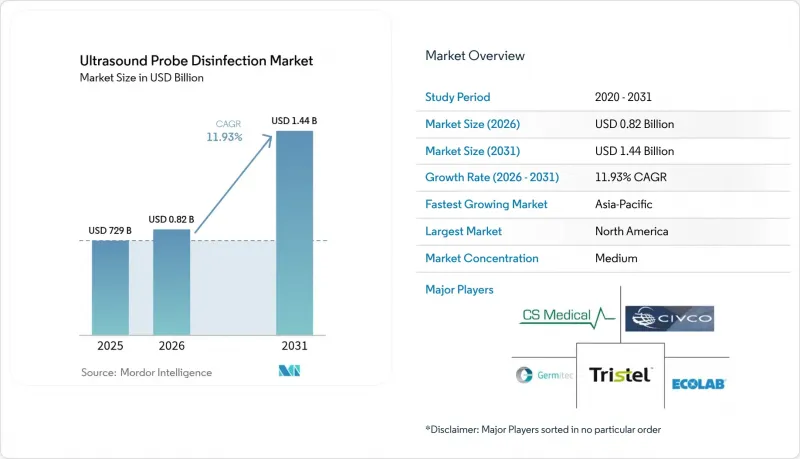
본 보고서는 제품(장비, 소모품, 서비스), 공정(중간/저수준 소독 및 고수준 소독), 기술(과산화수소 미스트, UV-C 광선 등), 프로브 유형(선형 변환기 등), 최종 사용자(병원 및 진단실험실 등) 및 지역별로 분류되어 있습니다. 시장 전망은 금액(달러) 기준으로 제시되어 있습니다.
세계 초음파 프로브 소독 시장 동향 및 인사이트
초음파 영상 진단 검사 건수 증가
의사들이 응급, 중환자 치료, 근골격계 등 각 분야에서 초음파의 적용 범위를 넓혀감에 따라, 전 세계 초음파 이용은 계속해서 급증하고 있습니다. 포인트 오브 케어(Point-of-Care) 도입으로 임상의는 병상에서 스캔을 수행할 수 있게 되어, 진단까지 걸리는 시간을 단축하고 검사 건수를 늘리고 있습니다. 저·중소득 국가에서는 조사 대상 의료 제공업체의 80%가 초음파 접근성을 의료 서비스 품질 향상에 필수적인 요소로 평가했습니다. 휴대용 배터리 구동 스캐너는 지역 의료 클리닉의 서비스 범위를 확대하지만, 이동 중 소독이라는 과제도 발생하고 있으며, 그 결과 짧은 시간 내에 소독 주기가 가능한 탁상형 장치에 대한 수요가 증가하고 있습니다. 각국의 보건부는 선진국과 동등한 감염 관리 수준을 확보하기 위해 국가 차원의 영상 진단 시스템 갱신 계획에 프로브 재처리 장치를 포함시키고 있습니다. 검사 건수가 증가함에 따라 검사가 1건 늘어날 때마다 교차 오염 위험이 높아지며, 이는 초음파 프로브 소독 시장의 성장세를 더욱 뒷받침하고 있습니다.
병원 내 감염(HAI) 발생률과 처벌 강화
정부와 민간 보험사는 HAI 기준치를 초과한 시설에 대해 금전적 제재를 가하고 있으며, 오염된 프로브는 여전히 입증된 감염 경로로 남아 있습니다. 다기관 공동 연구에 따르면, 저수준의 닦아내기 처리 후에도 경질 프로브의 90% 이상에서 병원체가 검출되어, 기존의 세척 워크플로우에 미비한 점이 있음이 밝혀졌습니다. CDC가 2025년에 발령한 젤을 매개로 하는 Paraburkholderia fungorum 감염증에 관한 건강 경보로 인해 초음파 검사실에 대한 감시가 다시 강화되었습니다. 현재 병원에서는 자동 세척 캐비닛 예산을 책정할 때 잠재적인 벌금뿐만 아니라 평판 저하로 인한 손해도 고려하고 있습니다. 비용 분석에 따르면, 경식도 프로브 파손으로 인한 수리 비용은 1,800-9,000달러에 달할 수 있으며, 그 대부분은 부적절한 수동 세척으로 인해 발생합니다. 그 결과, 의료 기관에서는 소독 주기를 표준화하고 규정 준수 증명을 기록할 수 있는 시스템에 대한 투자를 서둘러 진행하고 있습니다.
자동 재처리 장치의 높은 초기 비용
자동 재처리 장비는 대당 2만 5,000달러를 초과하기도 하여, 지방 병원이나 예산이 제한된 진료소에게는 장벽이 되고 있습니다. 나노소닉스(Nanosonics)에 따르면, 자본 예산의 부족으로 인해 2024 회계연도 초반에는 신규 도입이 주춤했으나, 구매 주기가 정상화된 하반기에는 수주가 14% 회복되었습니다. 총 소유 비용에는 소모품인 카트리지와 연간 유지보수 계약 비용도 포함되므로, 한정된 예산을 압박하게 됩니다. 감염 예방에 대한 투자에 직접적인 환원이 없는 시장의 의료 기관은 초기 비용과 병원 내 감염 감소 및 인건비 절감을 통한 장기적인 절감 효과를 저울질해야 합니다. 자금 조달 프로그램이나 예방에 대한 인센티브가 성숙되기 전까지는 자금 사정이 어려운 환경에서 도입이 지연되어, 초음파 프로브 소독 시장의 성장 여력을 억제할 가능성이 있습니다.
부문 분석
의료기관에서는 소독용 카트리지, 프로브 커버, 필터를 매일 보충하고 있기 때문에 2025년 매출의 48.62%를 소모품이 차지하고 있습니다. 그러나 병원이 유지보수, 교정, 규정 준수 감사를 외부에 위탁함에 따라, 서비스 부문은 2031년까지 연평균 성장률(CAGR) 13.76%로 초음파 프로브 소독 시장을 견인할 것으로 예측됩니다. 이러한 변화는 공급업체들이 개별 키트를 판매하는 대신, 가동 시간 및 인증 요건 준수를 보장하는 ‘성과 기반 계약’으로 전환하는 의료 업계 전반의 동향을 반영하고 있습니다.
일부 의료 시스템에서는 교육, 소프트웨어 업데이트, 원격 진단을 다년간의 서비스 플랜에 포함시켜 비용을 분산시키는 동시에 내부 직원의 부담을 줄이고 있습니다. 나노소닉스(Nanosonics)는 2024 회계연도에 2,340대를 추가하여 전 세계 도입 대수가 3만 4,790대에 달했습니다. 이를 통해 소모품 및 디지털 모니터링 요금으로 인한 지속적인 수익원이 창출되고 있습니다. 의료 서비스 제공업체들은 검사 취소를 방지하기 위한 신속한 지원을 중요하게 여기고 있으며, 이는 초음파 프로브 소독 업계 전반에 걸쳐 서비스 이용 확대를 촉진하고 있습니다.
2025년 시점에서 초음파 프로브 소독 시장 규모의 60.05%를 차지한 고수준 소독은 규제 당국이 준중요 기기에 관한 규정을 강화함에 따라 연평균 성장률(CAGR) 12.98%로 다른 처리 방법을 앞지르는 속도로 성장할 전망입니다. 스폴딩(Spalding) 분류에 따르면, 중공 프로브는 명확하게 고수준 소독 범주에 속하며, 규정 준수 감사에서 이 기준에 대한 편차가 점점 더 많이 지적되고 있습니다.
중간 및 저수준 소독용 물티슈는 손상되지 않은 피부 표면 스캔에 계속 사용이 허용되지만, 많은 병원에서는 직원 교육을 간소화하고 실수를 줄이기 위해 고수준 소독 주기를 표준화하고 있습니다. 온도, 농도 및 노출 시간을 기록하는 자동 로그 기능은 임상의가 FDA 및 CE 지침을 준수하고 있음을 입증하는 데 도움이 됩니다. 예측 기간 동안, 다단계 프로토콜은 모든 환자를 동등하게 보호하는 단일 고수준 기준으로 대체될 가능성이 있으며, 이는 이 부문의 꾸준한 성장을 뒷받침할 것입니다.
지역별 분석
북미는 FDA 규제, 병원 내 감염(HAI)에 대한 보험사의 제재, 그리고 자동화된 고수준 소독(HLD) 캐비닛을 우선시하는 자본 예산에 힘입어 2025년에는 전 세계 매출의 36.45%를 차지하며 초음파 프로브 소독 시장을 주도했습니다. 병원에서는 RFID 지원 재처리 장치를 전자 의료 기록과 일상적으로 연동하고 있으며, 이를 통해 조인트 커미션(Joint Commission)의 감사가 효율화되고, 지역 전체에 모범 사례가 확산되고 있습니다. 성숙한 보험 환급 환경이 기기의 높은 비용을 상쇄하고 있기 때문에 의료 시스템은 화학 약품을 사용하지 않는 고급 기종을 신속하게 도입할 수 있게 되었습니다.
유럽은 계속해서 큰 기여 원천이 되고 있으며, CE 규격의 조화를 활용하여 회원국 간 기술 보급을 가속화하고 있습니다. 환경 규제로 인해 화학 약품 폐기를 피할 수 있는 UV-C 시스템으로의 전환이 촉진되고 있으며, 조달 체계에서도 수명 주기 전반에 걸친 지속가능성 지표가 점점 더 중요시되고 있습니다. 국경을 초월한 병원 그룹은 우선 공급업체 목록을 표준화하고 있으며, 이에 따라 기준을 충족하는 공급업체는 지역 전체에서 사업 규모를 확대되고 있습니다. 한편, 각국의 감염 예방 행동 계획에 따라 소규모 진료소도 주요 대학 병원의 기준을 따르도록 요구받고 있어, 이로 인해 총 잠재 시장이 확대되고 있습니다.
아시아태평양에서는 중국, 인도, 동남아시아 국가들이 영상 진단 역량 확충 및 감염 관리 현대화에 자금을 투입하고 있어 연평균 성장률(CAGR) 14.22%를 나타낼 것으로 예측됩니다. 정부의 보험 제도는 농촌 지역에 초음파 진단 장비 도입을 지원하고 있으며, 교차 감염 위험을 억제하기 위해 고도의 소독 기능을 필수 요건으로 규정하는 사례가 많이 관찰됩니다. 중국과 한국의 국내 제조업체들은 가성비가 뛰어난 과산화수소 소독 캐비닛을 시장에 출시하고 있어 경쟁이 치열해지고 있습니다. 중동 및 아프리카(MEA) 및 라틴아메리카와 같은 신흥 지역에서는 기본적인 소독 인프라 구축이 진행되고 있으나, 자금 조달 부족과 공급망의 불안정성으로 인해 단기적인 성장세가 주춤하고 있습니다.
기타 혜택:
- 엑셀 형식 시장 예측(ME) 시트
- 3개월간의 애널리스트 지원
자주 묻는 질문
목차
제1장 서론
제2장 조사 방법
제3장 주요 요약
제4장 시장 구도
제5장 시장 규모와 성장 예측
제6장 경쟁 구도
제7장 시장 기회와 향후 전망
JHS 26.08.28According to Mordor Intelligence, ultrasound probe disinfection market size in 2026 is estimated at USD 820 million, growing from 2025 value of USD 729 million with 2031 projections showing USD 1.44 billion, growing at 11.93% CAGR over 2026-2031.
This report is Segmented by Product (Instruments, Consumables, and Services), Process (Intermediate/Low-level Disinfection and High-Level Disinfection), Technology (Hydrogen-Peroxide Mist, UV-C Light, and More), Probe Type (Linear Transducers, and More), End User (Hospitals & Diagnostic Laboratories, and More), and Geography. The Market Forecasts are Provided in Terms of Value (USD).
Global Ultrasound Probe Disinfection Market Trends and Insights
Rising Ultrasound Imaging Procedure Volumes
Global ultrasound utilization continues to soar as physicians broaden applications across emergency, critical-care, and musculoskeletal disciplines. Point-of-care adoption allows clinicians to scan at the bedside, compressing diagnostic timelines and lifting procedural counts. In low- and middle-income countries, 80% of providers surveyed rated ultrasound access as essential to improving care quality.Portable, battery-powered scanners expand outreach clinics but introduce mobile disinfection challenges, thereby magnifying demand for quick-cycling, countertop units. Health ministries are bundling probe reprocessors into national imaging upgrades to guarantee infection control parity with advanced economies. As procedure volumes climb, every incremental scan increases the risk of cross-contamination, reinforcing the ultrasound probe disinfection market's growth trajectory.
Escalating Incidence & Penalties For Hospital-Acquired Infections (HAIs)
Governments and private insurers impose financial penalties on facilities that exceed HAI benchmarks, and contaminated probes remain a documented vector. A multicenter study showed over 90% of transvaginal probes harbored pathogens after low-level wipes, evidencing shortfalls in legacy cleaning workflows. The CDC's 2025 health alert on gel-borne Paraburkholderia fungorum infections renewed scrutiny of sonography suites. Hospitals now calculate potential fines plus reputational damage when budgeting for automated cabinets. Cost analyses reveal damaged transesophageal probes can add USD 1,800-USD 9,000 in repair charges, often precipitated by improper manual cleaning. Consequently, facilities fast-track investments that standardize disinfection cycles and log proof of compliance.
High Capital Cost Of Automated Reprocessors
Automated cabinets can exceed USD 25,000 each, a hurdle for rural hospitals and budget-constrained clinics. Nanosonics noted that tight capital budgets slowed new placements early in fiscal 2024, although second-half orders rebounded 14% as purchasing cycles normalized. Total cost of ownership extends to consumable cartridges and annual service contracts, stretching limited budgets. Facilities in markets where infection-prevention investments lack direct reimbursement must reconcile the up-front outlay with longer-term savings from fewer HAIs and lower labor costs. Until financing programs or pay-for-prevention incentives mature, adoption may lag in cash-strapped settings, tempering the ultrasound probe disinfection market's upside.
Other drivers and restraints analyzed in the detailed report include:
- Regulatory Mandates For High-Level Disinfection Of Semi-Critical Probes
- Rapid Adoption Of Automated HLD Systems & UV-C Cabinets
- Low Awareness & Training Gaps In Low- And Mid-Income Facilities
For complete list of drivers and restraints, kindly check the Table Of Contents.
Segment Analysis
Consumables controlled 48.62% of 2025 revenue as facilities restock disinfectant cartridges, probe covers, and filters daily. Services, however, are projected to pace the ultrasound probe disinfection market at a 13.76% CAGR through 2031 as hospitals outsource maintenance, calibration, and compliance audits. The shift mirrors broader healthcare moves toward outcome-based contracting, where vendors guarantee uptime and accreditation readiness rather than selling stand-alone kits.
Some health systems bundle training, software updates, and remote diagnostics into multiyear service plans that spread cost and free internal staff. Nanosonics added 2,340 units in fiscal 2024, reaching 34,790 global installations, which feed a recurring revenue stream of consumables and digital monitoring fees. Providers value rapid support that avoids exam cancellations, reinforcing service uptake across the ultrasound probe disinfection industry.
High-level disinfection accounted for 60.05% share of the ultrasound probe disinfection market size in 2025 and will outpace other processes at a 12.98% CAGR as regulators tighten rules on semi-critical devices. Spaulding classification places endocavitary probes squarely in the high-level category, and compliance audits increasingly flag any deviation.
Intermediate and low-level wipes remain permissible for surface scans on intact skin, but many hospitals standardize on high-level cycles to simplify staff training and limit error. Automated logs that record temperature, concentration, and exposure times help clinicians demonstrate adherence to FDA and CE guidance. Over the forecast horizon, multi-tiered protocols may give way to single high-level standards that protect all patients equally, driving steady gains for the segment.
Complete Report Scope:
- By Product
- Instruments
- Consumables
- Services
- By Process
- Intermediate / Low-level Disinfection
- High-level Disinfection
- By Technology
- Hydrogen-Peroxide Mist
- UV-C Light
- Ozone-based
- Chlorine-Dioxide & Other Chemicals
- By Probe Type
- Linear Transducers
- Convex Transducers
- Phased-Array Transducers
- By End User
- Hospitals & Diagnostic Laboratories
- Ambulatory Care Centers
- Research & Academic Institutes
- By Geography
- North America
- United States
- Canada
- Mexico
- Europe
- Germany
- United Kingdom
- France
- Italy
- Spain
- Rest of Europe
- Asia-Pacific
- China
- Japan
- India
- Australia
- South Korea
- Rest of Asia-Pacific
- Middle East and Africa
- GCC
- South Africa
- Rest of Middle East and Africa
- South America
- Brazil
- Argentina
- Rest of South America
- North America
Geography Analysis
North America led the ultrasound probe disinfection market with 36.45% of global revenue in 2025, underpinned by FDA mandates, insurer penalties for HAIs, and capital budgets that prioritize automated HLD cabinets. Hospitals routinely integrate RFID-enabled reprocessors with electronic health records, streamlining Joint Commission audits and reinforcing best-practice diffusion across the region. The mature reimbursement climate offsets high device costs, allowing health systems to adopt premium chemical-free units rapidly.
Europe remains a substantial contributor, leveraging CE harmonization to expedite technology circulation across member states. Environmental regulations encourage migration to UV-C systems that avoid chemical disposal, and procurement frameworks increasingly weigh life-cycle sustainability metrics. Cross-border hospital groups standardize preferred vendor lists, giving compliant suppliers pan-regional scale. Meanwhile, national infection-prevention action plans push smaller clinics to match the standards of flagship university hospitals, enriching the total addressable market.
Asia Pacific is forecast to post a 14.22% CAGR as China, India, and Southeast Asian nations pour funds into imaging capacity and infection-control modernization. Government insurance schemes finance rural ultrasound deployment, frequently stipulating high-level disinfection capabilities to curb cross-infection risks. Domestic manufacturers in China and South Korea introduce cost-effective peroxide cabinets, raising competitive stakes. Emerging regions in MEA and Latin America continue to upgrade basic disinfection infrastructure, but financing gaps and supply-chain volatility temper near-term momentum.
- Nanosonics
- CIVCO Medical solutions
- Tristel
- Germitec
- Ecolab
- Advanced Sterilization Products (ASP)
- CS Medical LLC
- Metrex Research
- Soluscope
- Virox Technologies
- Parker Laboratories
- Cantel Medical
- Steris plc
- Whiteley Corporation
- Borer Chemie
- Lanxess AG
- TSO3 Inc.
- BluLine Solutions
- Cleanis SAS
Additional Benefits:
- The market estimate (ME) sheet in Excel format
- 3 months of analyst support
TABLE OF CONTENTS
1 Introduction
- 1.1 Study Assumptions and Market Definition
- 1.2 Scope of the Study
2 Research Methodology
3 Executive Summary
4 Market Landscape
- 4.1 Market Overview
- 4.2 Market Drivers
- 4.2.1 Rising Ultrasound Imaging Procedure Volumes
- 4.2.2 Escalating Incidence & Penalties For Hospital-Acquired Infections (Hais)
- 4.2.3 Regulatory Mandates For High-Level Disinfection Of Semi-Critical Probes
- 4.2.4 Rapid Adoption Of Automated HLD Systems & UV-C Cabinets
- 4.2.5 Expiry Of Core HLD Device Patents Opening Mid-Tier Competition
- 4.2.6 Integration Of RFID/Iot Traceability Boosting Purchasing Decisions
- 4.3 Market Restraints
- 4.3.1 High Capital Cost Of Automated Reprocessors
- 4.3.2 Low Awareness & Training Gaps In Low- And Mid-Income Facilities
- 4.3.3 Hydrogen-Peroxide-Supply Chain Constraints In Emerging Nations
- 4.3.4 Threat Of Single-Use Sterile Probe Covers Substituting Reprocessing
- 4.4 Value / Supply-Chain Analysis
- 4.5 Regulatory Landscape
- 4.6 Technology Outlook
- 4.7 Porter's Five Forces Analysis
- 4.7.1 Bargaining Power of Suppliers
- 4.7.2 Bargaining Power of Buyers
- 4.7.3 Threat of New Entrants
- 4.7.4 Threat of Substitutes
- 4.7.5 Intensity of Competitive Rivalry
5 Market Size and Growth Forecasts (Value-USD)
- 5.1 By Product
- 5.1.1 Instruments
- 5.1.2 Consumables
- 5.1.3 Services
- 5.2 By Process
- 5.2.1 Intermediate / Low-level Disinfection
- 5.2.2 High-level Disinfection
- 5.3 By Technology
- 5.3.1 Hydrogen-Peroxide Mist
- 5.3.2 UV-C Light
- 5.3.3 Ozone-based
- 5.3.4 Chlorine-Dioxide & Other Chemicals
- 5.4 By Probe Type
- 5.4.1 Linear Transducers
- 5.4.2 Convex Transducers
- 5.4.3 Phased-Array Transducers
- 5.5 By End User
- 5.5.1 Hospitals & Diagnostic Laboratories
- 5.5.2 Ambulatory Care Centers
- 5.5.3 Research & Academic Institutes
- 5.6 By Geography
- 5.6.1 North America
- 5.6.1.1 United States
- 5.6.1.2 Canada
- 5.6.1.3 Mexico
- 5.6.2 Europe
- 5.6.2.1 Germany
- 5.6.2.2 United Kingdom
- 5.6.2.3 France
- 5.6.2.4 Italy
- 5.6.2.5 Spain
- 5.6.2.6 Rest of Europe
- 5.6.3 Asia-Pacific
- 5.6.3.1 China
- 5.6.3.2 Japan
- 5.6.3.3 India
- 5.6.3.4 Australia
- 5.6.3.5 South Korea
- 5.6.3.6 Rest of Asia-Pacific
- 5.6.4 Middle East and Africa
- 5.6.4.1 GCC
- 5.6.4.2 South Africa
- 5.6.4.3 Rest of Middle East and Africa
- 5.6.5 South America
- 5.6.5.1 Brazil
- 5.6.5.2 Argentina
- 5.6.5.3 Rest of South America
- 5.6.1 North America
6 Competitive Landscape
- 6.1 Market Concentration
- 6.2 Market Share Analysis
- 6.3 Company profiles (includes Global level Overview, Market level overview, Core Segments, Financials as available, Strategic Information, Market Rank/Share for key companies, Products and Services, and Recent Developments)
- 6.3.1 Nanosonics
- 6.3.2 CIVCO Medical Solutions
- 6.3.3 Tristel plc
- 6.3.4 Germitec
- 6.3.5 Ecolab
- 6.3.6 Advanced Sterilization Products (ASP)
- 6.3.7 CS Medical LLC
- 6.3.8 Metrex Research LLC
- 6.3.9 Soluscope
- 6.3.10 Virox Technologies
- 6.3.11 Parker Laboratories
- 6.3.12 Cantel Medical
- 6.3.13 Steris plc
- 6.3.14 Whiteley Corporation
- 6.3.15 Borer Chemie AG
- 6.3.16 Lanxess AG
- 6.3.17 TSO3 Inc.
- 6.3.18 BluLine Solutions
- 6.3.19 Cleanis SAS
7 Market Opportunities and Future Outlook
- 7.1 White-Space and Unmet-Need Assessment


