

|
시장보고서
상품코드
2116443
간질 모니터링 기기 시장 : 점유율 분석, 업계 동향과 통계, 성장 예측(2026-2031년)Epilepsy Monitoring Devices - Market Share Analysis, Industry Trends & Statistics, Growth Forecasts (2026 - 2031) |
||||||
 Mordor Intelligence
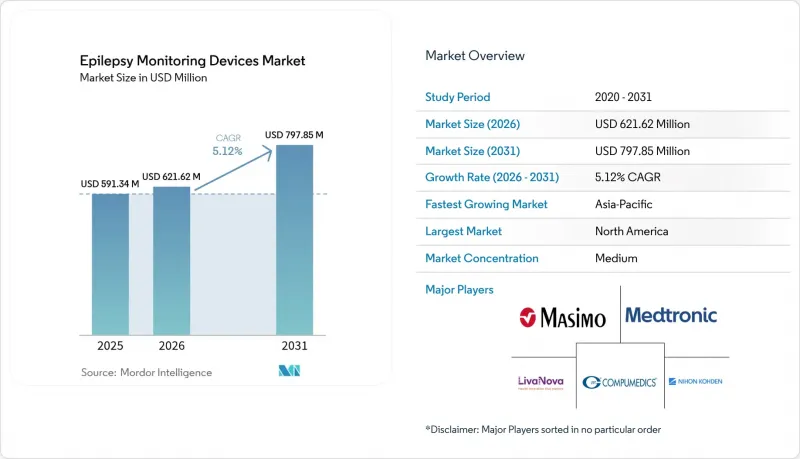
Mordor Intelligence에 의하면, 2026년 간질 모니터링 기기 시장 규모는 6억 2,162만 달러로 추정되고 있어 2025년 5억 9,134만 달러에서 성장하여 2031년에는 7억 9,785만 달러에 이를 것으로 예측됩니다.
2026년부터 2031년까지의 연평균 성장률(CAGR)은 5.12%가 될 것으로 전망됩니다.
본 보고서는 제품별(기존 기기 및 웨어러블 기기), 기술별(미주신경 자극, 심부 뇌 자극 등), 감지 방식별(뇌파, 두개내 뇌파 등), 최종 사용자별(병원·외래수술센터(ASC), 신경과 센터 등), 지역별(북미 등)로 분류되어 있습니다. 시장 전망은 금액(달러) 기준으로 제시되어 있습니다.
전 세계 간질 모니터링 기기 시장 동향 및 인사이트
웨어러블 발작 감지 기기의 보급 확대
눈에 띄지 않는 헬스 테크놀로지에 대한 소비자의 열의로 인해, 뇌파(EEG), 근전도(EMG) 및 동작 신호를 실시간으로 측정하는 손목·머리·귀에 착용하는 모니터의 보급이 가속화되고 있습니다. 검증 연구에 따르면, 민감도는 97.7%였으며, 일일 위양성률은 불과 0.4건에 불과했습니다. 입원 없이도 이러한 임상 수준의 정확도를 얻을 수 있기 때문에 의사들은 약물 치료에도 불구하고 발작이 지속되는 환자(추정 30%)에게 웨어러블 기기 사용을 권장하고 있습니다. 수천 대의 기기에서 수집된 데이터는 페더레이티드 러닝 모델에 입력되어 집단 차원의 발작 예측을 정교화함으로써, 환자의 개인정보를 보호하는 동시에 예측의 전반적인 신뢰성을 높이고 있습니다.
EEG 및 AI를 활용한 분석의 기술적 진보
시계열 컨볼루션 신경망 및 자기 주의 층을 포함한 딥러닝 아키텍처는 97.37%라는 자동 발작 감지 정확도를 달성하여 기존의 신호 처리 벤치마크를 능가하고 있습니다. 클라우드 플랫폼은 익명화된 데이터를 활용한 지속적인 모델 재학습을 통해 성능을 더욱 향상시키고 있습니다. 그 결과, 뇌파(EEG) 시스템은 수동적인 모니터링 기기에서 발작 전에 신경 자극이나 복약 알림을 작동시키는 지능형 치료 허브로 전환되고 있으며, 이를 통해 기기의 높은 가격이 정당화되고 간질 모니터링 기기 시장이 활성화되고 있습니다.
기기의 높은 비용
엔트리 레벨 뇌파(EEG) 장치와 AI 탑재 플랫폼 간에 300%가 넘는 가격 차이가 있어, 비용에 민감한 의료 시스템에서는 구매를 주저하고 있습니다. 저소득 지역의 관리자들은 예산 한도 내에서 맞추기 위해 예측 분석 기능을 희생한, 채널 수가 제한된 휴대용 기기를 선택하는 경우가 많습니다. 이러한 단계적 도입은 고수익률 시스템의 보급을 저해하고 있으며, 공급업체들은 선진국 시장을 위한 프리미엄 라인을 유지하면서도 대량 판매 시장을 겨냥한 기능이 축소된 제품을 출시할 수밖에 없는 상황에 몰리고 있습니다.
부문 분석
2025년에는 기존 시스템이 매출의 51.72%를 차지하여 병원 진단 분야에서 확고한 입지를 반영할 것으로 보입니다. 기존 기기를 이용한 간질 모니터링 기기 시장 규모는 교체 주기에 따라 완만하게 확대될 것으로 예상되지만, 소프트웨어 기능이 표준화됨에 따라 경쟁사와의 차별화는 점차 좁혀지고 있습니다. 대조적으로, 웨어러블 기기는 입원이 필요 없는 환자 중심의 설계를 바탕으로 2031년까지 연평균 성장률(CAGR) 9.61%를 나타낼 것으로 전망됩니다. 귀용 뇌파(EEG) 헤드셋은 현재 임상 등급의 성능에 도달하여, 다중 채널 두피 어레이에 필적하는 발작 감지 정확도를 실현하고 있습니다. 간질 모니터링 기기 시장은 병원 등급의 기준선 검사와 장시간 착용형 웨어러블 기기를 결합한 하이브리드형 솔루션의 혜택을 받아, 임상의의 업무 부담을 늘리지 않으면서 모니터링 범위를 확대되고 있습니다.
외래 진료 분야에서는 원격 환자 모니터링에 대한 진료비 보상 코드와의 연계로 인해 미국 의료 기관에서의 웨어러블 기기 도입이 가속화되고 있습니다. 공급업체들은 이상을 감지하고 경고하는 클라우드 대시보드를 통합하고 있으며, 이를 통해 신경과 전문의는 고위험 사례에 집중할 수 있게 되었습니다. 한편, 기존 시스템 제조업체들은 시장 내 입지를 유지하기 위해 하드웨어에 AI 모듈을 추가하고 있습니다. 이러한 병행 전략을 통해 두 제품 카테고리 모두 종합적인 치료 경로에서 필수적인 존재로 남아 있지만, 성장은 분명히 웨어러블 기기 쪽으로 기울고 있습니다.
2025년에는 미주신경자극(VNS)이 매출의 36.05%를 차지하며 시장을 주도했습니다. 이는 20년에 걸친 안전성 실적과 폭넓은 임상 적응증에 힘입은 결과입니다. VNS(미주신경자극요법) 기반 간질 모니터링 기기 시장 규모는 소아용 승인을 배경으로 꾸준히 확대될 것으로 예측됩니다. 반응형 신경 자극(RNS)은 비정상적인 활동이 감지되는 순간 정확하게 자극을 전달하는 폐쇄 루프 알고리즘에 힘입어 연평균 성장률(CAGR) 8.28%라는 뛰어난 성장률을 보이고 있습니다. 병원 측은 RNS를 약물 치료에 반응하지 않는 환자를 위한 고수익 솔루션으로 간주하는 반면, 보험사는 발작 감소를 통해 비용을 상쇄할 수 있는 가능성을 인식하고 있습니다.
심부 뇌 자극 및 가속도계만 탑재한 기기는 틈새 적응증을 대상으로 하지만, 임상적으로는 여전히 필수적입니다. 경쟁의 축은 하드웨어 성능에서 소프트웨어의 고도화로 이동하고 있으며, 알고리즘의 정확도가 치료 성과를 좌우하고 있습니다. 독자적인 데이터 세트와 머신러닝 전문 지식을 결합한 기업들은 견고한 경쟁 우위를 구축하며, 간질 모니터링 기기 시장에서 장기적인 리더십의 패러다임을 재정의하고 있습니다.
지역별 분석
북미는 메디케어(Medicare)의 장기 모니터링 보험 적용과 Epiminder사의 ‘Minder’ 기기 등 FDA 승인을 받은 이식형 기기의 급속한 보급에 힘입어, 2025년에는 전 세계 매출의 39.31%를 차지하며 여전히 주도적인 위치를 유지하고 있습니다. 병원 시스템은 뇌파(EEG) 데이터 검토 주기와 정확히 일치하는 RPM(원격 환자 모니터링) 청구 코드를 활용하여 설비 투자에 대한 즉각적인 경제적 타당성을 창출하고 있습니다. 캐나다와 멕시코는 원격 의료의 확대와 국경을 초월한 기술 제휴를 통해 추가적인 성장에 기여하고 있습니다.
아시아태평양은 2031년까지 7.62%라는 가장 높은 연평균 성장률(CAGR)을 나타낼 전망입니다. 중국에서는 의약품과 의료기기 모두에 대한 승인이 가속화되고 있으며, 2024년 ‘Fycompa’의 승인은 종합적인 관리에 대한 임상적 관심을 확대시킨 좋은 사례입니다. 일본과 한국에서는 충실한 보험 적용 범위와 높은 디지털 헬스 리터러시를 활용하여 RNS 및 웨어러블 EEG의 조기 도입이 진행되고 있습니다. 인도에서는 신경과 전문의 부족이 여전히 이용 건수 증가를 저해하고 있지만, 전국적인 원격의료 네트워크가 접근 장벽을 완화하기 시작하면서 인프라가 성숙된 후 보급이 가속화될 것으로 예측됩니다.
유럽에서는 완만한 확대가 관찰되지만, GDPR(EU 개인정보보호규정) 준수에 따른 비용으로 인해 On-Premise 분석 시스템 도입이 불가피하여 그 성장세가 억제되고 있습니다. 독일과 영국은 AI 알고리즘의 유효성을 검증하는 조사를 주도하며, 벤더 시장 진입을 뒷받침하고 있습니다. 남유럽 국가들은 간질 센터의 현대화에 EU 구조기금을 활용하고 있으며, 완만하기는 하지만 지역에 따라 편차가 있는 성장이 나타나고 있습니다.
중동 및 아프리카 전역에서는 의료기기의 현지 조립이나 대상별 맞춤형 교육 프로그램과 같은 노력이 미래 수요를 위한 기반을 마련하고 있지만, 현재의 실제 수요는 인구 규모에 비해 여전히 소규모에 그치고 있습니다.
기타 혜택:
- 엑셀 형식 시장 예측(ME) 시트
- 3개월간의 애널리스트 지원
자주 묻는 질문
목차
제1장 서론
제2장 조사 방법
제3장 주요 요약
제4장 시장 구도
제5장 시장 규모와 성장 예측
제6장 경쟁 구도
제7장 시장 기회와 향후 전망
JHS 26.08.28According to Mordor Intelligence, the epilepsy monitoring devices market size in 2026 is estimated at USD 621.62 million, growing from 2025 value of USD 591.34 million with 2031 projections showing USD 797.85 million, growing at 5.12% CAGR over 2026-2031.
This report is Segmented by Product (Conventional Devices and Wearable Devices), Technology (Vagus Nerve Stimulation, Deep Brain Stimulation, and More), Detection Modality (Electroencephalogram, Intracranial EEG, and More), End User (Hospitals & Ambulatory Surgery Centers, Neurology Centers and More), and Geography (North America and More). The Market Forecasts are Provided in Terms of Value (USD).
Global Epilepsy Monitoring Devices Market Trends and Insights
Growing Adoption of Wearable Seizure-Detection Devices
Consumer eagerness for unobtrusive health technology has accelerated uptake of wrist-, head- and ear-worn monitors that capture EEG, electromyography (EMG) and motion signals in real time. Validation studies reported 97.7% sensitivity with merely 0.4 false positives per day. This clinical-grade accuracy-delivered without hospital admission-has motivated physicians to recommend wearables to the estimated 30% of patients whose seizures persist despite medication. Data from thousands of devices feed federated-learning models that refine population-level seizure forecasts, raising overall predictive reliability while guarding patient privacy.
Technological Advances in EEG & AI-Enabled Analytics
Deep-learning architectures including temporal convolutional networks and self-attention layers reach automated seizure-detection accuracy of 97.37%, surpassing classical signal processing benchmarks. Cloud platforms further upgrade performance through continuous model retraining using de-identified data. As a result, EEG systems transition from passive monitors to intelligent therapeutic hubs that trigger neurostimulation or medication reminders pre-ictally, thus justifying higher device prices and bolstering the epilepsy monitoring devices market.
High Cost of Equipment
Price gaps exceeding 300% between entry-level EEG units and AI-enabled platforms deter purchases in cost-sensitive health systems. Administrators in lower-income regions often select portable, channel-limited devices that sacrifice predictive analytics to meet budget ceilings. This tiered adoption stalls penetration of high-margin systems, pressing suppliers to launch stripped-down variants aimed at volume markets while preserving premium lines for developed economies.
Other drivers and restraints analyzed in the detailed report include:
- Integration of Seizure-Forecasting Algorithms into Tele-Neurology Platforms
- Expansion of US RPM CPT Codes to Epilepsy Monitoring
- Stringent Data-Privacy Rules Hindering Cloud-Based EEG Analytics
For complete list of drivers and restraints, kindly check the Table Of Contents.
Segment Analysis
Conventional systems generated 51.72% of revenue in 2025, reflecting their entrenched role in hospital diagnostics. The epilepsy monitoring devices market size for conventional equipment is projected to expand modestly alongside replacement cycles, yet competitive differentiation narrows as software features become standard. Wearables, in contrast, post a 9.61% CAGR by 2031 on the back of patient-centric design that eliminates inpatient stays. Ear-EEG headsets now hit clinical-grade performance, achieving seizure detection accuracy comparable to multi-channel scalp arrays. The epilepsy monitoring devices market benefits from hybrid offerings that pair hospital-grade baseline studies with long-duration wearables, extending monitoring coverage without inflating clinician workload.
In ambulatory care, reimbursement alignment with remote-patient-monitoring codes accelerates wearable uptake across United States practices. Suppliers integrate cloud dashboards that flag anomalies, freeing neurologists to focus on high-risk cases. Meanwhile, conventional system makers retrofit hardware with AI modules to preserve market relevance. These parallel strategies keep both product classes integral to comprehensive care pathways, although growth clearly tilts toward wearables.
Vagus nerve stimulation led revenue at 36.05% in 2025, underpinned by a two-decade safety record and broad clinical indications. The epilepsy monitoring devices market size for VNS is expected to rise steadily, supported by pediatric approvals. Responsive neurostimulation excels with an 8.28% CAGR, driven by closed-loop algorithms that deliver stimulation precisely when abnormal activity is sensed. Hospitals view RNS as a high-margin solution for medication-refractory patients, while payers recognize its cost-offset potential through seizure reduction.
Deep brain stimulation and accelerometry-only devices cover niche indications yet remain clinically essential. The competitive axis shifts from hardware prowess to software sophistication, with algorithm accuracy dictating therapeutic outcomes. Companies that couple proprietary datasets with machine-learning expertise erect defensible moats, reshaping long-term leadership in the epilepsy monitoring devices market.
Complete Report Scope:
- By Product
- Conventional Devices
- Wearable Devices
- By Technology
- Vagus Nerve Stimulation (VNS)
- Deep Brain Stimulation (DBS)
- Accelerometry
- Responsive Neuro-stimulation (RNS)
- By Detection Modality
- Electroencephalogram (EEG)
- Intracranial EEG (iEEG)
- Surface Electromyography (sEMG)
- Video Detection Systems
- By End User
- Hospitals & Ambulatory Surgery Centers
- Neurology Centers
- Diagnostic Centers
- By Geography
- North America
- United States
- Canada
- Mexico
- Europe
- Germany
- United Kingdom
- France
- Italy
- Spain
- Rest of Europe
- Asia-Pacific
- China
- Japan
- India
- Australia
- South Korea
- Rest of Asia-Pacific
- Middle East and Africa
- GCC
- South Africa
- Rest of Middle East and Africa
- South America
- Brazil
- Argentina
- Rest of South America
- North America
Geography Analysis
North America retains primacy with 39.31% of global revenue in 2025, anchored by Medicare-backed reimbursement of long-term monitoring and rapid adoption of FDA-cleared implants such as Epiminder's Minder device. Hospital systems capitalize on RPM billing codes that align precisely with EEG data review intervals, producing immediate financial justification for capital purchases. Canada and Mexico contribute incremental gains through tele-health expansion and cross-border technology partnerships.
Asia Pacific records the highest CAGR at 7.62% through 2031. China accelerates approvals of both drugs and devices, exemplified by Fycompa's 2024 clearance that broadened clinical interest in comprehensive management. Japan and South Korea showcase early adoption of RNS and wearable EEG, leveraging robust insurance coverage and high digital-health literacy. India's neurologist shortage continues to hold back volume growth, yet national telemedicine networks begin to offset access barriers, hinting at accelerating uptake post-infrastructure maturation.
Europe shows moderate expansion, tempered by GDPR compliance costs that force on-premise analytics deployments. Germany and the United Kingdom lead research trials that validate AI algorithms, aiding vendor market entry. Southern European states rely on EU structural funds to modernize epilepsy centers, fostering gradual but uneven growth.
Across the Middle East and Africa, initiatives to localize medical device assembly and targeted training programs lay groundwork for future demand, though present volumes remain small relative to population need.
- Medpage
- Boston Scientific
- Cadwell Industries
- Compumedics
- Emfit Corp.
- Empatica
- GE Healthcare
- Koninklijke Philips
- Masimo Corp.
- Neurosoft Ltd
- Neurowave Systems
- Nihon Kohden Corp.
- Nonin Medical
- Medtronic
- LivaNova plc
- Natus Medical
- NeuroPace
- Seer Medical
- SeizAlarm LLC
- BrainScope Co. Inc.
Additional Benefits:
- The market estimate (ME) sheet in Excel format
- 3 months of analyst support
TABLE OF CONTENTS
1 Introduction
- 1.1 Study Assumptions and Market Definition
- 1.2 Scope of the Study
2 Research Methodology
3 Executive Summary
4 Market Landscape
- 4.1 Market Overview
- 4.2 Market Drivers
- 4.2.1 Increasing Incidence Of Epilepsy
- 4.2.2 Rising Awareness Of Neuro-Degenerative Disorders
- 4.2.3 Growing Adoption Of Wearable Seizure-Detection Devices
- 4.2.4 Technological Advances In EEG & AI-Enabled Analytics
- 4.2.5 Integration Of Seizure-Forecasting Algorithms Into Tele-Neurology Platforms
- 4.2.6 Expansion Of US RPM CPT Codes To Epilepsy Monitoring
- 4.3 Market Restraints
- 4.3.1 High Cost Of Equipment
- 4.3.2 Unfavourable Reimbursement Policies In Several Countries
- 4.3.3 Shortage Of Trained Neurophysiologists In Emerging Markets
- 4.3.4 Stringent Data-Privacy Rules Hindering Cloud-Based EEG Analytics
- 4.4 Value / Supply-Chain Analysis
- 4.5 Regulatory Landscape
- 4.6 Technology Outlook
- 4.7 Porter's Five Forces Analysis
- 4.7.1 Bargaining Power of Suppliers
- 4.7.2 Bargaining Power of Buyers
- 4.7.3 Threat of New Entrants
- 4.7.4 Threat of Substitutes
- 4.7.5 Intensity of Competitive Rivalry
5 Market Size and Growth Forecasts (Value-USD)
- 5.1 By Product
- 5.1.1 Conventional Devices
- 5.1.2 Wearable Devices
- 5.2 By Technology
- 5.2.1 Vagus Nerve Stimulation (VNS)
- 5.2.2 Deep Brain Stimulation (DBS)
- 5.2.3 Accelerometry
- 5.2.4 Responsive Neuro-stimulation (RNS)
- 5.3 By Detection Modality
- 5.3.1 Electroencephalogram (EEG)
- 5.3.2 Intracranial EEG (iEEG)
- 5.3.3 Surface Electromyography (sEMG)
- 5.3.4 Video Detection Systems
- 5.4 By End User
- 5.4.1 Hospitals & Ambulatory Surgery Centers
- 5.4.2 Neurology Centers
- 5.4.3 Diagnostic Centers
- 5.5 By Geography
- 5.5.1 North America
- 5.5.1.1 United States
- 5.5.1.2 Canada
- 5.5.1.3 Mexico
- 5.5.2 Europe
- 5.5.2.1 Germany
- 5.5.2.2 United Kingdom
- 5.5.2.3 France
- 5.5.2.4 Italy
- 5.5.2.5 Spain
- 5.5.2.6 Rest of Europe
- 5.5.3 Asia-Pacific
- 5.5.3.1 China
- 5.5.3.2 Japan
- 5.5.3.3 India
- 5.5.3.4 Australia
- 5.5.3.5 South Korea
- 5.5.3.6 Rest of Asia-Pacific
- 5.5.4 Middle East and Africa
- 5.5.4.1 GCC
- 5.5.4.2 South Africa
- 5.5.4.3 Rest of Middle East and Africa
- 5.5.5 South America
- 5.5.5.1 Brazil
- 5.5.5.2 Argentina
- 5.5.5.3 Rest of South America
- 5.5.1 North America
6 Competitive Landscape
- 6.1 Market Concentration
- 6.2 Market Share Analysis
- 6.3 Company profiles (includes Global level Overview, Market level overview, Core Segments, Financials as available, Strategic Information, Market Rank/Share for key companies, Products and Services, and Recent Developments)
- 6.3.1 Medpage Ltd
- 6.3.2 Boston Scientific Corp.
- 6.3.3 Cadwell Industries
- 6.3.4 Compumedics Ltd
- 6.3.5 Emfit Corp.
- 6.3.6 Empatica Inc.
- 6.3.7 GE HealthCare
- 6.3.8 Koninklijke Philips N.V.
- 6.3.9 Masimo Corp.
- 6.3.10 Neurosoft Ltd
- 6.3.11 Neurowave Systems
- 6.3.12 Nihon Kohden Corp.
- 6.3.13 Nonin Medical
- 6.3.14 Medtronic plc
- 6.3.15 LivaNova plc
- 6.3.16 Natus Medical Inc.
- 6.3.17 NeuroPace Inc.
- 6.3.18 Seer Medical
- 6.3.19 SeizAlarm LLC
- 6.3.20 BrainScope Co. Inc.
7 Market Opportunities & Future Outlook
- 7.1 White-space & Unmet-Need Assessment


