

|
시장보고서
상품코드
2116448
척추 압박 골절(VCF) 치료 기기 : 시장 점유율 분석, 업계 동향 및 통계, 성장 예측(2026-2031년)Vertebral Compression Fracture Devices - Market Share Analysis, Industry Trends & Statistics, Growth Forecasts (2026 - 2031) |
||||||
 Mordor Intelligence
Mordor Intelligence에 의하면, 2026년 척추 압박 골절(VCF) 치료 기기 시장 규모는 14억 4,000만 달러로 추정되고 2025년 13억 3,000만 달러에서 확대해, 2031년에는 21억 1,000만 달러에 이를 것으로 예측됩니다.
2026년부터 2031년까지 연평균 성장률(CAGR) 7.99%로 성장할 것으로 전망됩니다.
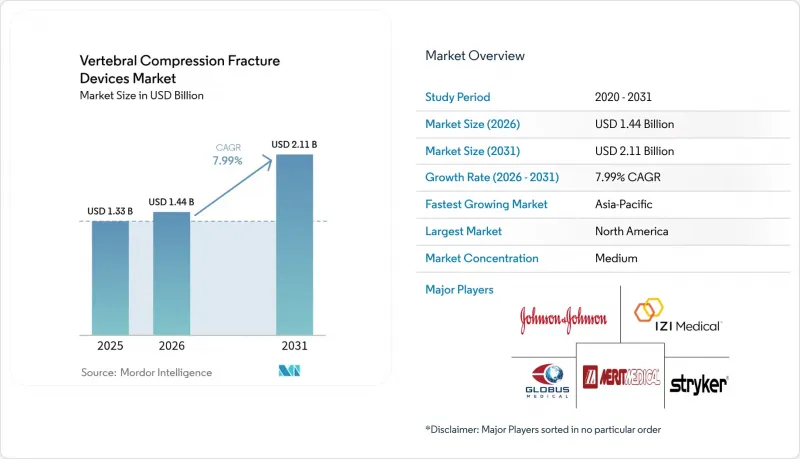
본 보고서는 제품 유형(BKP용 기기, VP용 기기 등), 소재(PMMA 골시멘트, 생체활성/생체흡수성 시멘트 등), 수술(척추 개방 수술 등), 최종 사용자(병원, 외래수술센터(ASC) 등), 지역(북미 등)별로 분류되어 있습니다. 시장 전망은 금액(달러) 기준으로 제시되어 있습니다.
세계의 척추 압박 골절(VCF) 치료 기기 시장 동향 및 인사이트
골다공증과 관련된 VCF 유병률 증가
2034년까지 전 세계적으로 2억 6,320만 명이 골다공증에 걸릴 것으로 예측되며, 이로 인해 훨씬 더 많은 사람들이 척추 압박 골절의 위험에 노출될 것입니다. 각국의 연구 결과도 이러한 추세를 뒷받침하고 있으며, 베트남 도시 지역의 골절 유병률은 12.2%에 달하고, 한국의 폐경 후 여성들 사이에서도 위험이 높아지고 있습니다. 연령 조정 유병률은 감소 추세를 보이고 있으나, 인구 고령화에 따라 절대적인 골절 건수는 증가하고 있으며, 이러한 경향은 국제적인 질병 부담 분석을 통해서도 확인되고 있습니다. 선별 검사의 미비함이 이 문제를 더욱 심각하게 만들고 있습니다. 일본의 고령 척추 질환 환자 중 수술 전에 골밀도 검사를 받는 비율은 고작 25.7%에 그치고 있어, 취약한 척추를 안정화시키는 의료기기에 대한 미충족 수요가 존재함을 시사하고 있습니다. 이러한 요인들로 인해 척추 압박 골절(VCF) 치료 기기 시장에서 지속적인 수요가 확실시되고 있습니다.
저침습 척추 수술의 보급 확대
메디케어 데이터에 따르면, ASC(외래수술센터(ASC))에서의 시술은 병원 외래 진료와 동등한 안전성을 확보하면서도 비용을 낮게 억제하고 있어, 의료 제공업체에게 명확한 인센티브가 되고 있습니다. 척추체 보강술의 경우, 보존적 치료의 평균 입원 일수 10.8일에 비해 입원 일수의 중앙값이 2.4일로 단축되며, 직접 비용도 7,250달러에서 4,737달러로 절감됩니다. 코로나19 기간 동안 입증된 ‘당일 퇴원 프로토콜’은 164건의 최소 침습 수술에서 100%의 성공률을 달성했습니다. 정확도도 지속적으로 향상되고 있으며, 새로운 2D 내비게이션 시스템은 척추 모델에서 0.54mm의 정확도를 달성했습니다. 이러한 데이터는 임상의들이 점점 더 최소 침습적 치료를 선호하는 이유를 뒷받침하며, 척추 압박 골절(VCF) 치료 기기 시장의 성장을 가속화하고 있습니다.
수술 후 합병증(시멘트 누출, 색전증)
메타분석에 따르면, 키포플라스티는 골 보강술 중 가장 안전함에도 불구하고, 사례의 46.2%에서 시멘트 누출이 확인되었습니다. 드물기는 하지만 심각한 후유증으로는 심막 탐포네이드를 동반한 우심방 천공, 급성 호흡곤란으로 나타나는 폐 시멘트 색전증 등이 있습니다. PMMA의 중합 온도가 70°C를 초과하면 뼈와의 경계면에서 열성 괴사를 유발할 가능성이 있습니다. 개량형 시멘트나 흡입 기술을 사용하면 누출률은 13%까지 낮아지지만, 이에 대한 훈련과 설비 투자가 필요합니다. 이러한 위험 요인들은 척추 압박 골절(VCF) 치료 기기 시장의 단기적인 성장을 저해할 가능성이 있습니다.
부문별 분석
풍선 카이포플라스티는 보험사 측의 높은 인지도, 간편한 워크플로우, 그리고 풍부한 임상적 근거 덕분에 2025년에는 VCF용 디바이스 시장의 44.02% 점유율을 확보했습니다. 한편, 확장형 척추체 내 임플란트는 연평균 성장률(CAGR) 11.19%로 성장하고 있으며, SpineJack 시스템의 무작위 대조 시험에서 입증된 바와 같이 척추체 높이를 보다 효과적으로 회복시킴으로써 기존 치료법에 도전하고 있습니다. 기존의 척추체 성형술은 비용이 저렴하고 자원이 제한된 환경에서도 쉽게 습득할 수 있어 시장에서 입지를 유지하고 있습니다. 고주파 증강 요법이나 혈관 성형술과 같은 틈새 시장 부문은 복잡한 해부학적 과제를 해결하며, 척추 압박 골절(VCF) 치료 기기 시장에서 외과의사의 치료 선택지를 확대되고 있습니다.
확장형 임플란트의 기술적 진보로 인해 종판에 가해지는 하중이 균등하게 분산되어 장기적인 생체역학적 특성이 향상되고 있습니다. SPICO 연구에서는 초기 기기 비용은 높았으나, 입원 기간 단축과 조기 직장 복귀가 확인되었습니다. 외과의들이 정확성을 중시함에 따라, 골시멘트 주입 보조 시스템도 점차 보급되고 있습니다. Tripod-Fix 기기의 수납식 암은 초기 임상 사용 과정에서 누출을 거의 해소했습니다. 신규 진출기업들은 척추 압박 골절(VCF) 치료 기기 시장에서 입지를 다지기 위해 하드웨어와 통합형 내비게이션 소프트웨어를 결합해야 합니다.
PMMA는 비용 면에서의 우위와 수십 년에 걸친 수술 실적을 바탕으로 VCF용 디바이스 시장 규모의 55.98%를 차지하며 계속해서 지배적인 위치를 유지하고 있습니다. 그러나 임상의들이 골유착과 장기적인 이물질 잔류 감소를 추구하고 있기 때문에 생체활성 시멘트 및 생체흡수성 시멘트는 연평균 성장률(CAGR) 12.49%로 급속히 확대되고 있습니다. 인산칼슘 충전재와 세라믹 하이브리드는 중간 정도의 기계적 성능을 갖추고 있으며 자연적으로 흡수됩니다. 한편, 개량형 PMMA에는 나노 탄탈 카바이드가 배합되어 있어 더 높은 방사선 불투과성과 골형성 능력을 발휘합니다.
인산칼슘 시멘트에 대한 3년간의 추적 조사에서는 안정성을 해치지 않으면서 부피 감소가 확인되었습니다. 하이드록시아파타이트/콜라겐 복합재료는 장골능 이식편과 동등한 골유합률을 보이며, 수술에 따른 외상이 적어 척추 분야에서 더 폭넓은 응용이 기대됩니다. 특히 보험사들의 장기적인 치료 성과에 대한 면밀한 검토가 진행되는 가운데, 소재의 연구 개발은 척추 압박 골절(VCF) 치료 기기 업계 전체에서 차별화를 꾀하기 위한 결정적인 요인이 될 것입니다.
지역별 분석
2025년에는 북미가 38.90%의 점유율로 1위를 차지했습니다. 이는 성숙한 보험 환급 제도와 첨단 척추 치료 인프라를 활용한 결과입니다. 메디케어에서는 척추체 보강술 비용을 4,737달러로 산정하는 반면, 보존적 치료는 7,250달러로 책정되어 있어 그 비용 대비 효과가 입증되고 있습니다. ASC(외래수술센터(ASC))의 보험 환급 개혁으로 승인까지의 기간이 단축되어, 의료 제공업체가 병원의 외래 부서에서 사례를 이관하는 움직임이 촉진되었습니다. 캐나다의 보편적 의료 모델과 멕시코의 에피소드별 지불 시범 사업도 수요를 확대하고 있으며, 이 모두 지역별 연수와 NIH가 지원하는 임상시험에 의해 뒷받침되어 척추 압박 골절(VCF) 치료 기기 시장의 혁신을 촉진하고 있습니다.
아시아태평양은 인구 동태의 변화와 의료의 현대화에 힘입어 2031년까지 연평균 성장률(CAGR)이 10.31%로 가장 빠르게 성장하는 시장입니다. 일본의 골다공증 선별 검사 부족(고령 척추 고정술 환자 중 수술 전 스캔을 받는 비율은 고작 25.7%)은 잠재적 수요를 여실히 드러내고 있습니다. 중국에서는 국가의약품감독관리국(NMPA)의 패스트트랙 제도를 통해 의료기기 승인이 신속화되고 있는 반면, 인도의 고령층은 수술 후 기능 개선 효과가 입증된 혜택을 누리고 있습니다. 호주와 한국은 AI 내비게이션의 조기 도입을 선도하고 있으며, 동남아시아 국가들에서는 최소 침습 척추 수술에 대한 종합적 지급 제도가 도입되어, 이러한 요소들이 합쳐져 척추 압박 골절(VCF) 치료 기기 시장 규모를 확대되고 있습니다.
유럽에서는 근거 기반 의료와 EU 전역에 걸친 규제 조화를 배경으로 꾸준한 진전이 나타나고 있습니다. 경제 모델에 따르면, 골다공증 진단률이 향상되면 2040년까지 28억 유로의 잠재적 비용 절감이 예상됩니다. 독일, 영국, 프랑스가 다기관 공동 임상시험을 주도하는 한편, 남유럽 국가들은 민관 협력 이니셔티브를 통해 도입을 가속화하고 있습니다. 러시아는 EU의 연구 네트워크를 활용하여 시술 기준을 향상시키고, 지방 척추 치료 센터의 현대화를 추진하고 있습니다. 남미, 중동 및 아프리카는 뒤처져 있지만, 비용 효율성이 뛰어난 경피적 접근법에 대한 관심이 높아지고 있어 척추 압박 골절(VCF) 치료 기기 시장에 장기적으로 기여할 것으로 기대됩니다.
기타 혜택 :
- 엑셀 형식 시장 예측(ME) 시트
- 3개월간의 애널리스트 지원
자주 묻는 질문
목차
제1장 서론
제2장 조사 방법
제3장 주요 요약
제4장 시장 구도
제5장 시장 규모 및 성장 예측
제6장 경쟁 구도
제7장 시장 기회 및 향후 전망
KTH 26.09.04According to Mordor Intelligence, vertebral compression fracture devices market size in 2026 is estimated at USD 1.44 billion, growing from 2025 value of USD 1.33 billion with 2031 projections showing USD 2.11 billion, growing at 7.99% CAGR over 2026-2031.
This report is Segmented by Product Type (Balloon Kyphoplasty Devices, Vertebroplasty Devices, and More), Material (PMMA Bone Cement, Bio-active/Bioresorbable Cement, and More), Surgery (Open Spine Surgery and More), End User (Hospitals, Ambulatory Surgical Centers, and More), and Geography (North America and More). The Market Forecasts are Provided in Terms of Value (USD).
Global Vertebral Compression Fracture Devices Market Trends and Insights
Rising prevalence of osteoporosis-linked VCFs
Global osteoporosis is forecast to affect 263.2 million people by 2034, exposing a much larger cohort to vertebral compression fractures. National studies echo the trend-12.2% fracture prevalence in urban Vietnam and heightened risk among Korean postmenopausal women. Even as age-standardized rates ease, absolute fracture counts climb because populations are aging, a pattern confirmed by international burden analyses. Screening gaps exacerbate the issue: only 25.7% of elderly Japanese spinal patients receive pre-operative bone mineral density tests, indicating untapped need for devices that stabilize fragile vertebrae.These factors ensure sustained demand for the vertebral compression fracture devices market.
Growing adoption of minimally invasive spinal procedures
Medicare data show ASC procedures cost less than hospital outpatient departments while delivering equivalent safety, a clear incentive for providers. Vertebral augmentation reduces median stays to 2.4 days compared with 10.8 days for conservative management, trimming direct costs to USD 4,737 versus USD 7,250. Same-day discharge protocols, stress-tested during COVID-19, achieved 100% success across 164 minimally invasive cases Precision keeps improving: a novel 2D navigation system reached 0.54 mm accuracy in spine models. Together these data points underline why clinicians increasingly prefer minimally invasive options, accelerating the vertebral compression fracture devices market.
Post-surgical complications (cement leakage, embolism)
Meta-analysis shows leakage in 46.2% of kyphoplasty cases, despite being the safest among augmentation options. Rare but severe sequelae include right-atrial perforation with pericardial tamponade and pulmonary cement embolism presenting as acute dyspnea. PMMA polymerization temperatures exceeding 70 °C can induce thermal necrosis at the bone interface. Modified cements and aspiration techniques drop leakage to 13% but require training and capital. These risks may curb near-term growth in the vertebral compression fracture devices market.
Other drivers and restraints analyzed in the detailed report include:
- Increasing healthcare expenditure in emerging markets
- Robust clinical evidence validating balloon kyphoplasty
- Stringent regulatory & reimbursement hurdles
For complete list of drivers and restraints, kindly check the Table Of Contents.
Segment Analysis
Balloon kyphoplasty secured 44.02% of vertebral compression fracture devices market share in 2025 due to payer familiarity, straightforward workflows, and ample clinical proof. Expandable intravertebral implants, however, are growing at an 11.19% CAGR and challenge the incumbent modality by restoring vertebral height more effectively, as demonstrated in randomized trials of the SpineJack system. Conventional vertebroplasty retains market presence because of its lower cost and quick learning curve in resource-limited settings. Niche segments such as radio-frequency augmentation and vesselplasty solve complex anatomic challenges, expanding surgeon toolkits within the vertebral compression fracture devices market.
Engineering advances in expandable implants distribute endplate loads evenly, improving long-term biomechanics. The SPICO study confirmed shorter hospital stays and faster work resumption despite higher upfront device costs. Ancillary bone-cement delivery systems are also proliferating as surgeons prioritize precision; the Tripod-Fix device's retractable arms nearly eliminated leakage in early clinical use. New entrants must now pair hardware with integrated navigation software to gain traction in the vertebral compression fracture devices market.
PMMA continues to dominate with 55.98% share of vertebral compression fracture devices market size due to cost advantages and decades-long surgical familiarity. Yet bio-active and bioresorbable cements are accelerating at 12.49% CAGR because clinicians aim for osteointegration and reduced long-term foreign-body presence. Calcium-phosphate fillers and ceramic hybrids provide intermediate mechanical performance and resorb naturally, while enhanced PMMA variants integrate nano-tantalum carbide for higher radiopacity and osteogenic potential.
Three-year follow-up on calcium-phosphate cement shows volume reduction without loss of stability. Hydroxyapatite/collagen composites deliver fusion rates comparable to iliac crest grafts but with less surgical trauma, hinting at broader spinal application. Material R&D will be a decisive lever for differentiation across the vertebral compression fracture devices industry, especially as payers scrutinize long-term outcomes.
Complete Report Scope:
- By Product Type
- Balloon Kyphoplasty Devices
- Vertebroplasty Devices
- Expandable Intravertebral Implants
- Radio-frequency Augmentation Systems
- Vesselplasty & Mesh-containment Systems
- Bone-cement Delivery Systems & Accessories
- By Material
- PMMA Bone Cement
- Bio-active / Bioresorbable Cement
- Calcium-phosphate & Ceramic Fillers
- Others
- By Surgery
- Open Spine Surgery
- Minimally-Invasive (Percutaneous) Surgery
- By End User
- Hospitals
- Ambulatory Surgical Centers
- Trauma Centers
- Specialty Spine Clinics
- Others
- By Geography
- North America
- United States
- Canada
- Mexico
- Europe
- Germany
- United Kingdom
- France
- Italy
- Spain
- Rest of Europe
- Asia-Pacific
- China
- Japan
- India
- Australia
- South Korea
- Rest of Asia-Pacific
- Middle East and Africa
- GCC
- South Africa
- Rest of Middle East and Africa
- South America
- Brazil
- Argentina
- Rest of South America
- North America
Geography Analysis
North America led with 38.90% share in 2025, leveraging mature reimbursement systems and sophisticated spine-care infrastructure. Medicare compares vertebral augmentation at USD 4,737 against USD 7,250 for conservative therapy, validating cost-effectiveness. ASC reimbursement reform shortened approval timelines, encouraging providers to transfer cases out of hospital outpatient departments. Canada's universal model and Mexico's episodic payment pilots also expand demand, each supported by regional training and NIH-sponsored clinical trials that power innovation in the vertebral compression fracture devices market.
Asia-Pacific is the fastest-growing theater at 10.31% CAGR through 2031, propelled by demographic shifts and healthcare modernization. Japan's osteoporosis screening deficit-only 25.7% of elderly fusion patients receive pre-operative scans-underscores latent demand. China speeds device approvals through its National Medical Products Administration fast-track, while India's elder cohorts benefit from proven post-surgical functional gains. Australia and South Korea pioneer early adoption of AI navigation, and Southeast Asian nations introduce bundled payments for minimally invasive spine surgery, collectively widening the vertebral compression fracture devices market footprint.
Europe advances steadily on the back of evidence-based medicine and pan-EU regulatory harmonization. Economic modeling projects EUR 2.8 billion in potential savings by 2040 if osteoporosis diagnosis rates improve. Germany, the United Kingdom, and France spearhead multicenter trials, while Southern Europe accelerates adoption through public-private partnership initiatives. Russia modernizes rural spine centers, tapping into EU research networks to upgrade procedural standards. South America and the Middle East & Africa lag but display growing interest in cost-optimized percutaneous approaches, indicating long-term contribution to the vertebral compression fracture devices market.
- Medtronic
- Stryker
- Johnson & Johnson
- Globus Medical
- Merit Medical Systems
- Orthofix Interventional
- ZimVie
- Spirit Spine Holdings
- Spine Wave
- Zavation
- Joimax
- IZI Medical Products
- CareFusion / BD
- Osseon LLC
- VEXIM SA
- Alphatec Holdings
- SpineArt SA
- Seawon Meditech
- Icotec AG
Additional Benefits:
- The market estimate (ME) sheet in Excel format
- 3 months of analyst support
TABLE OF CONTENTS
1 Introduction
- 1.1 Study Assumptions and Market Definition
- 1.2 Scope of the Study
2 Research Methodology
3 Executive Summary
4 Market Landscape
- 4.1 Market Overview
- 4.2 Market Drivers
- 4.2.1 Rising Prevalence Of Osteoporosis-Linked Vcfs
- 4.2.2 Growing Adoption Of Minimally-Invasive Spinal Procedures
- 4.2.3 Increasing Healthcare Expenditure In Emerging Markets
- 4.2.4 Robust Clinical Evidence Validating Balloon Kyphoplasty
- 4.2.5 Reimbursement Shift Toward ASC-Performed Augmentation
- 4.2.6 AI-Enabled Navigation Lowering Cement-Leakage Risk
- 4.3 Market Restraints
- 4.3.1 Post-Surgical Complications (Cement Leakage, Embolism)
- 4.3.2 Stringent Regulatory & Reimbursement Hurdles
- 4.3.3 Price Erosion Of Commoditized PMMA Bone Cement
- 4.3.4 Limited Long-Term Evidence For Bio-Active Cements
- 4.4 Value / Supply-Chain Analysis
- 4.5 Regulatory Landscape
- 4.6 Technology Outlook
- 4.7 Porter's Five Forces Analysis
- 4.7.1 Bargaining Power of Suppliers
- 4.7.2 Bargaining Power of Buyers
- 4.7.3 Threat of New Entrants
- 4.7.4 Threat of Substitutes
- 4.7.5 Intensity of Competitive Rivalry
5 Market Size and Growth Forecasts (Value-USD)
- 5.1 By Product Type
- 5.1.1 Balloon Kyphoplasty Devices
- 5.1.2 Vertebroplasty Devices
- 5.1.3 Expandable Intravertebral Implants
- 5.1.4 Radio-frequency Augmentation Systems
- 5.1.5 Vesselplasty & Mesh-containment Systems
- 5.1.6 Bone-cement Delivery Systems & Accessories
- 5.2 By Material
- 5.2.1 PMMA Bone Cement
- 5.2.2 Bio-active / Bioresorbable Cement
- 5.2.3 Calcium-phosphate & Ceramic Fillers
- 5.2.4 Others
- 5.3 By Surgery
- 5.3.1 Open Spine Surgery
- 5.3.2 Minimally-Invasive (Percutaneous) Surgery
- 5.4 By End User
- 5.4.1 Hospitals
- 5.4.2 Ambulatory Surgical Centers
- 5.4.3 Trauma Centers
- 5.4.4 Specialty Spine Clinics
- 5.4.5 Others
- 5.5 By Geography
- 5.5.1 North America
- 5.5.1.1 United States
- 5.5.1.2 Canada
- 5.5.1.3 Mexico
- 5.5.2 Europe
- 5.5.2.1 Germany
- 5.5.2.2 United Kingdom
- 5.5.2.3 France
- 5.5.2.4 Italy
- 5.5.2.5 Spain
- 5.5.2.6 Rest of Europe
- 5.5.3 Asia-Pacific
- 5.5.3.1 China
- 5.5.3.2 Japan
- 5.5.3.3 India
- 5.5.3.4 Australia
- 5.5.3.5 South Korea
- 5.5.3.6 Rest of Asia-Pacific
- 5.5.4 Middle East and Africa
- 5.5.4.1 GCC
- 5.5.4.2 South Africa
- 5.5.4.3 Rest of Middle East and Africa
- 5.5.5 South America
- 5.5.5.1 Brazil
- 5.5.5.2 Argentina
- 5.5.5.3 Rest of South America
- 5.5.1 North America
6 Competitive Landscape
- 6.1 Market Concentration
- 6.2 Market Share Analysis
- 6.3 Company profiles (includes Global level Overview, Market level overview, Core Segments, Financials as available, Strategic Information, Market Rank/Share for key companies, Products and Services, and Recent Developments)
- 6.3.1 Medtronic
- 6.3.2 Stryker Corporation
- 6.3.3 Johnson & Johnson (DePuy Synthes)
- 6.3.4 Globus Medical
- 6.3.5 Merit Medical Systems
- 6.3.6 Orthofix Interventional
- 6.3.7 ZimVie
- 6.3.8 Spirit Spine Holdings
- 6.3.9 Spine Wave
- 6.3.10 Zavation
- 6.3.11 joimax GmbH
- 6.3.12 IZI Medical Products
- 6.3.13 CareFusion / BD
- 6.3.14 Osseon LLC
- 6.3.15 VEXIM SA
- 6.3.16 Alphatec Holdings
- 6.3.17 SpineArt SA
- 6.3.18 Seawon Meditech
- 6.3.19 Icotec AG
7 Market Opportunities and Future Outlook
- 7.1 White-Space and Unmet-Need Assessment


