

|
시장보고서
상품코드
2116477
특수 의약품 : 시장 점유율 분석, 업계 동향 및 통계, 성장 예측(2026-2031년)Specialty Pharmaceuticals - Market Share Analysis, Industry Trends & Statistics, Growth Forecasts (2026 - 2031) |
||||||
 Mordor Intelligence
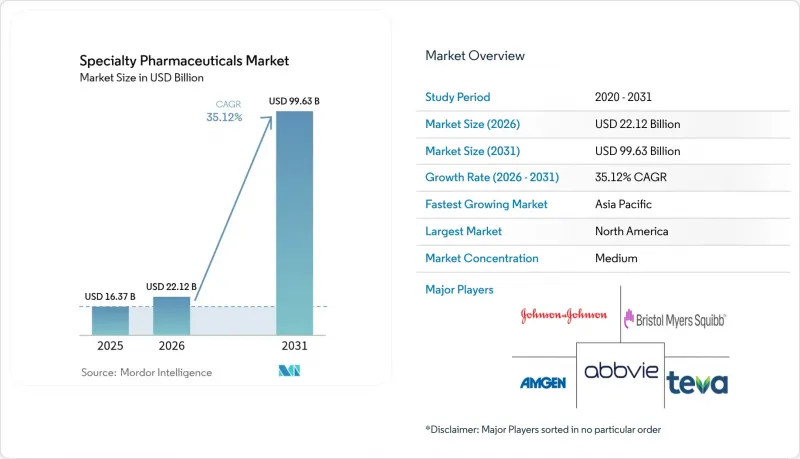
Mordor Intelligence에 의하면, 특수 의약품 시장 규모는 2025년에 163억 7,000만 달러로 평가되었습니다. 2026년 221억 2,000만 달러에서 2031년까지 996억 3,000만 달러에 이를 것으로 예상되며, 예측 기간(2026-2031년) CAGR은 35.12%를 나타낼 전망입니다.
본 보고서는 용도별(종양학, 면역학, 내분비학, 신경학 등), 약제 분류별(생물학적 제제 등), 투여 경로별(주사제/비경구, 경구 등),유통 채널별(병원 약국 등), 지역별(북미, 유럽, 아시아태평양, 남미, 중동 및 아프리카)로 분류되어 있습니다. 시장 예측은 금액(달러) 기준으로 제시되어 있습니다.
세계의 특수 의약품 시장 동향 및 인사이트
만성 질환 및 희귀질환 유병률 증가
약 5,500종의 인정된 희귀질환 중 적어도 하나를 앓고 있는 사람은 3억 명 이상에 달하지만, 많은 저·중소득 국가에서는 진단율이 여전히 50% 미만에 머물고 있습니다. 차세대 염기서열 분석 비용은 현재 유전체당 1,000달러를 훨씬 밑돌고 있으며, 이로 인해 단일 유전자 질환의 조기 식별이 가능해져 효소 보충 요법 및 유전자 치료의 적용 범위가 확대되고 있습니다. 만성 질환의 유병률도 상승하고 있습니다. 미국 성인의 10명 중 6명이 적어도 하나의 만성 질환을 앓고 있어, 종양학, 면역학, 내분비학 분야의 장기 치료법에 대한 수요가 증가하고 있습니다. 2024년, FDA는 앙겔만 증후군 및 임신 합병증을 대상으로 한 유전자 치료를 포함한 46건의 희귀질환 의약품 지정을 승인하여, 극히 드문 적응증에 대한 제약사의 관심이 지속되고 있음을 입증했습니다. 2025년 신규 승인 건수의 72%가 의존하고 있는 ‘신속 승인’ 제도는 시장 진입을 앞당기는 한편, 제조업체에게 시판 후 증거 제시라는 부담을 부과하고 있습니다.
생물학적 제제 및 바이오시밀러 파이프라인의 급속한 확대
2024년에는 7개의 희귀질환용 바이오의약품이 FDA 심사를 통과했습니다. 그중 가장 대표적인 것은 최초의 유전자 변형 T세포 수용체 치료법과 백질 이영양증에 대한 유전자 편집 치료법입니다. 바이오시밀러도 빠르게 추격하고 있으며, 미국의 아달리무맙 유사약은 2024년 4분기까지 90% 이상 시장 침투율을 달성하여 210억 달러 규모의 프랜차이즈 시장을 잠식하고 있습니다. 유럽에서는 처방 할당 제도로 인해 유사한 확산이 가속화되고 있지만, 호환성에 관한 규정은 국가마다 달라 유럽 전역에서의 출시를 복잡하게 만들고 있습니다. 중국에서는 2024년에 82개의 혁신적 생물학적 제제가 승인된 반면, 주요 CDMO 기업들은 리드타임을 18개월에서 12개월 가까이 단축할 수 있는 벡터 제조 시설 설립을 서두르고 있습니다. 자가 CAR-T 제조에는 여전히 환자 1인당 22-28일이 소요되고 있어, 혁신 제약사들은 기성(오프 더 쉘프) 동종 이식용 플랫폼 개발을 서둘러야 하는 상황에 놓여 있습니다.
치료비 급등과 지불 주체의 비용 억제
메디케어의 첫 번째 가격 협상 결과, 평균 79%의 가격 인하가 실현되어 엠브렐의 월 가격은 2,355달러, 임브루비카의월가격은 9,319달러로 대폭 인하되었습니다. 2025년 이후 본인 부담금 상한선 2,000달러가 철폐됨에 따라, 보험 플랜과 제약사는 더 큰 비용 부담을 떠안게 되었으며, 처방약 목록에서 제외되거나 단계적 치료(step therapy) 규정의 적용이 가속화되고 있습니다. 민간 PBM(의약품 혜택 관리 회사)은 현재 GLP-1 제제의 보험 적용 전에 메트포르민 사용을 의무화하고 있으며, 유나이티드 헬스케어는 더 높은 리베이트를 활용하기 위해 제프바운드를 보험 적용 대상에서 제외하고 웨고비를 채택했습니다. 유전자 치료제의 가격 책정은 여전히 논란의 대상입니다. 카스게비의 220만 달러라는 가격 책정은 20년간의 유효성에 대해 면밀한 검토를 받고 있지만, 주요 임상 데이터는 단 31명의 환자만을 대상으로 하고 있습니다. 독일 및 기타 EU 시장의 국제 기준 가격 제도는 출시 첫해의 이익률을 더욱 압박하고 있습니다.
부문별 분석
2025년, 종양학 분야는 체크포인트 억제제, 항체-약물 복합체(ADC), CAR-T 요법에 힘입어 전문 의약품 시장 점유율 35.55%를 유지했습니다. 희귀질환 치료제는 규모는 작지만, FDA가 초희귀질환 후보 약물을 신속 심사하고 있기 때문에 2031년까지 연평균 성장률(CAGR) 36.85%로 성장할 전망입니다. 종양학 분야의 전문의약품 시장 규모는 2031년까지 400억 달러를 넘어설 것으로 예상되는 반면, 희귀질환 분야의 매출액은 같은 기간 동안 6배로 증가할 가능성이 있습니다. 새로운 PD-1/TIGIT 병용 요법 및 이중 특이성 항체가 기존 제품에 도전함에 따라 경쟁은 격화되고 있습니다.
성장의 방향은 서로 다릅니다. 종양학 분야의 파이프라인에서는 종양 비특이적 적응증이 우선시되는 반면, 희귀질환 분야의 스폰서들은 퍼스트-인-클래스 유전자 대체 요법에 주력하고 있습니다. 보상 관련 장벽도 다릅니다. 종양학 분야의 가치 기반 계약은 전체 생존 기간(OS)이라는 평가 지표에 의존하는 반면, 희귀질환 치료제의 경우 환자 1인당 가격이 고가이기 때문에 단일 지불자와의 가격 협상에 직면하는 경우가 많습니다. 이러한 차이는 시장 내 참여자 구성에도 반영되어 있습니다. 종양학 분야에서는 대형 제약사가 지배적인 반면, 전 세계 환자 수가 1만 명 미만인 질환의 경우 벤처 캐피털의 지원을 받는 생명공학 기업이 주도적인 위치를 유지하고 있습니다.
2025년 전문의약품 시장에서 생물학적 제제는 단일클론 항체, 융합 단백질, 재조합 효소에 힘입어 시장의 60.53%를 차지했습니다. 유전자·세포 치료제는 매출이 5% 미만이지만, 제조상의 병목 현상이 완화됨에 따라 2031년까지 연평균 성장률(CAGR) 37.75%로 성장할 것으로 전망됩니다. 저분자 의약품 분야에서는 표적형 키나아제 억제제가 여전히 확고한 입지를 유지하고 있지만, 초기 제네릭 의약품에 의한 시장 잠식을 겪고 있습니다.
상업적 동향으로는 만성 질환용 바이오의약품이 유리합니다. 재처방 빈도가 높아 매출이 유지되는 반면, 일회성 유전자 치료는 수백만 달러에 달하는 가격에 대한 지불자의 수용 여부에 달려 있습니다. 제조 규모가 결정적인 요인이 됩니다. 2,000리터 규모의 바이오리액터 1기를 가동하면 5억 달러 상당의 단일클론 항체를 공급할 수 있는 반면, 자가 세포 치료제의 생산 능력은 여전히 환자마다 다릅니다. CRISPR 기반의 기성(오프 더 셸프) 유전자 편집과 같은 플랫폼의 발전은 이러한 상황을 일변시킬 가능성이 있습니다.
지역별 분석
북미는 2025년 매출의 46.62%를 차지했습니다. 이는 IRA(인플레이션 억제법)에 따른 협상으로 명목 가격이 인하되기 전부터 메디케어 파트 D의 전문의약품 지출이 1,330억 달러를 초과했기 때문입니다. 미국은 더 높은 단가를 통해 이 지역을 주도하고 있습니다. ‘키트루다’의 연간 치료비는 20만 달러를 초과하며, 주사 센터 네트워크도 촘촘하게 구축되어 있습니다. 캐나다는 국제 가격의 중앙값을 기준으로 가격 책정을 의무화하고 있어, 이로 인해 일부 유전자 치료제의 출시가 지연되고 있습니다. 한편, 멕시코에서는 사회보장 제도의 확대로 생물학적 제제에 대한 접근성이 확대되고 있지만, 보험 미가입자인 방대한 인구는 여전히 보호 대상에서 제외되어 있습니다.
유럽은 매출액 면에서는 뒤처지고 있지만, 바이오시밀러 보급률에서는 선두를 달리고 있습니다. 독일에서는 조기 혜택 평가와 AMNOG 협상을 통해 출시 후 1년 이내에 정가가 최대 50% 인하됩니다. 프랑스, 이탈리아, 스페인에서는 EU의 2025년 공동 평가 규정이 적용되더라도 병행하여 HTA 심사를 진행하고 있어, 시장 진입까지의 기간이 12-18개월 연장되고 있습니다. 영국의 QALY 기반 가격 상한제 때문에 많은 유전자 치료제가 ‘관리 접근’ 제도의 대상이 되고 있습니다.
아시아태평양은 연평균 성장률(CAGR) 36.22%라는 가장 급격한 성장 궤도를 그리고 있으며, 2031년까지 북미와 동등한 매출 규모에 도달할 가능성이 있습니다. 중국은 2024년에 82개의 신규 치료법을 승인했으며, 베이징의 수량 기준 조달로 인해 가격은 하락하는 반면 판매량은 확대되고 있습니다. 인도의 바이오시밀러 수출 붐은 FDA와의 상호사찰의 혜택을 받고 있습니다. Biocon사와 Dr. Reddy’s사는 데노스맙 및 아프리벨셉트의 아날로그에 대해 ‘퍼스트 투 파일(First-to-File)’ 지위를 확보했습니다. 일본의 ‘선도’ 제도는 심사를 신속화하고 있지만, 2년마다 이루어지는 가격 인하로 인해 5년간의 매출 성장세가 둔화되고 있습니다. 호주, 한국 및 GCC 국가들은 환급 범위를 확대하고 있으나, 여전히 엄격한 위험 분담 계약을 협상 중이어서 상향 여지가 제한되고 있습니다.
기타 혜택 :
- 엑셀 형식 시장 예측(ME) 시트
- 3개월간의 애널리스트 지원
자주 묻는 질문
목차
제1장 서론
제2장 조사 방법
제3장 개요
제4장 시장 구도
제5장 시장 규모 및 성장 예측
제6장 경쟁 구도
제7장 시장 기회 및 향후 전망
KTH 26.08.31According to Mordor Intelligence, the specialty pharmaceuticals market size was valued at USD 16.37 billion in 2025 and estimated to grow from USD 22.12 billion in 2026 to reach USD 99.63 billion by 2031, at a CAGR of 35.12% during the forecast period (2026-2031).
This report is Segmented by Application (Oncology, Immunology, Endocrinology, Neurology, and More), Drug Class (Biologics, and More), Mode of Administration (Injectable/Parenteral, Oral, and More), Distribution Channel, (hospital Pharmacies, and More), and Geography (North America, Europe, Asia-Pacific, South America, Middle East and Africa). The Market Forecasts are Provided in Terms of Value (USD).
Global Specialty Pharmaceuticals Market Trends and Insights
Rising Prevalence of Chronic & Rare Diseases
More than 300 million people live with one of roughly 5,500 recognized rare diseases, yet diagnostic rates remain under 50% in many low- and middle-income countries.Next-generation sequencing now costs well below USD 1,000 per genome, enabling earlier identification of monogenic disorders and widening the treatment pool for enzyme-replacement and gene therapies. Chronic disease incidence is also climbing; six in ten U.S. adults live with at least one chronic condition, intensifying demand for long-term oncology, immunology, and endocrine regimens. In 2024, the FDA granted 46 orphan-drug designations, including gene therapies targeting Angelman syndrome and pregnancy complications, underscoring sustained sponsor interest in ultra-rare indications. Accelerated-approval corridors, relied on for 72% of 2025 novel approvals, enable faster market entry but place post-marketing evidence burdens on manufacturers.
Rapid Expansion of Biologics & Biosimilars Pipeline
Seven orphan biologics cleared FDA review in 2024, headlined by the first engineered T-cell receptor therapy and a gene-edited treatment for leukodystrophy. Biosimilars are catching up; U.S. adalimumab analogs captured over 90% penetration by Q4 2024, eroding a USD 21 billion franchise. Europe's prescribing quotas accelerate similar uptake, although interchangeable rules differ by country, complicating pan-European launches. China approved 82 innovative biologics in 2024, while CDMO majors are racing to open vector suites that reduce lead times from 18 months to near 12 months. Autologous CAR-T manufacture still needs 22-28 days per patient, pressuring innovators to develop off-the-shelf allogeneic platforms.
Escalating Treatment Costs & Payer Cost-Containment
Medicare's first round of negotiated prices delivered mean discounts of 79%, slashing Enbrel to USD 2,355 and Imbruvica to USD 9,319 per month. Without out-of-pocket caps at USD 2,000 from 2025, plans and manufacturers shoulder greater cost, accelerating formulary exclusions and step-therapy rules. Private PBMs now require metformin trials before GLP-1 coverage, and UnitedHealthcare excluded Zepbound in favor of Wegovy to leverage higher rebates. Gene-therapy pricing remains contentious; Casgevy's USD 2.2 million tag faces scrutiny over 20-year durability, yet pivotal data cover only 31 patients. International reference pricing in Germany and other EU markets further compresses launch-year margins.
Other drivers and restraints analyzed in the detailed report include:
- Growth of Integrated Specialty-Pharmacy Networks
- Orphan-Drug Incentives & Favorable Reimbursement
- Complex Cold-Chain & Handling Logistics
For complete list of drivers and restraints, kindly check the Table Of Contents.
Segment Analysis
Oncology retained 35.55% of the specialty pharmaceuticals market share in 2025, driven by checkpoint inhibitors, antibody-drug conjugates, and CAR-T therapies. Rare-disease therapies, while smaller, are set to grow at a 36.85% CAGR through 2031 as the FDA fast-tracks ultra-orphan candidates. The specialty pharmaceuticals market size for oncology is projected to surpass USD 40 billion by 2031, while rare-disease revenue could multiply six-fold on the same horizon. Competitive intensity rises as new PD-1/TIGIT combinations and bispecific antibodies challenge incumbents.
Growth vectors differ. Oncology pipelines prioritize tumor-agnostic indications, whereas rare-disease sponsors focus on first-in-class gene-replacement approaches. Reimbursement hurdles diverge as well: value-based oncology contracts hinge on overall survival endpoints, while orphan therapies often face single-payer negotiations over ultra-high per-patient prices. The player mix reflects that divergence: big pharma dominates oncology, whereas venture-backed biotech maintains leadership positions in diseases with <10,000 patients globally.
Biologics accounted for 60.53% of the 2025 specialty pharmaceutical market, buoyed by monoclonal antibodies, fusion proteins, and recombinant enzymes. Gene and cell therapies, though <5% revenue, are set for a 37.75% CAGR to 2031 as manufacturing bottlenecks ease. Within small molecules, targeted kinase inhibitors remain entrenched but face earlier generic erosion.
Commercial dynamics favor biologics for chronic diseases, with high refill frequency sustaining revenue, while one-time gene therapies rely on payer acceptance of multi-million-dollar price tags. Manufacturing scale is the swing factor; a single 2,000-liter bioreactor run can generate USD 500 million of monoclonal antibody supply, whereas autologous cell-therapy capacity remains patient-specific. Platform advances such as CRISPR-based off-the-shelf edits could shift that calculus.
Complete Report Scope:
- By Application
- Oncology
- Immunology
- Endocrinology
- Infectious Diseases
- Neurology
- Rare & Orphan Disorders
- Cardiovascular
- Ophthalmology
- By Drug Class
- Biologics
- Small-molecule specialty drugs
- Gene & Cell Therapies
- Peptide Therapeutics
- By Mode of Administration
- Injectable/ Parenteral
- Oral
- Intravitreal / Ocular
- Others
- By Distribution Channel
- Hospital Pharmacies
- Specialty Pharmacies
- Online Pharmacies
- By Geography
- North America
- United States
- Canada
- Mexico
- Europe
- Germany
- United Kingdom
- France
- Italy
- Spain
- Rest of Europe
- Asia-Pacific
- China
- India
- Japan
- Australia
- South Korea
- Rest of Asia-Pacific
- Middle East and Africa
- GCC
- South Africa
- Rest of Middle East and Africa
- South America
- Brazil
- Argentina
- Rest of South America
- North America
Geography Analysis
North America generated 46.62% of 2025 revenue as Medicare Part D specialty spend exceeded USD 133 billion, even before IRA negotiations trimmed headline prices. The United States commands the region through higher unit prices. Keytruda exceeds USD 200,000 annually and dense infusion-center networks. Canada enforces median international pricing, delaying several gene-therapy launches, while Mexico's social-security expansion broadens biologic access but leaves large uninsured populations exposed.
Europe trails in revenue but leads in biosimilar penetration. Germany's early benefit assessment and AMNOG negotiations cut list prices by up to 50% within 1 year of launch. France, Italy, and Spain pursue parallel HTA reviews even under the EU's 2025 joint-assessment regulation, extending market-access timelines by 12-18 months. The United Kingdom's QALY-based pricing cap keeps many gene therapies in "managed access" schemes.
Asia-Pacific delivers the steepest growth trajectory at a 36.22% CAGR and could match North America's revenue by 2031. China green-lit 82 novel therapies in 2024, and Beijing's volume-based procurement lowers prices yet expands volumes. India's biosimilar export boom benefits from FDA mutual inspections; Biocon and Dr. Reddy's secure first-to-file slots for denosumab and aflibercept analogs. Japan's Sakigake pathway speeds review, but biennial price cuts erode five-year revenue curves. Australia, South Korea, and GCC states broaden reimbursement but still negotiate aggressive risk-sharing deals, limiting upside.
- Abbvie
- Amgen
- AstraZeneca
- Bayer
- Biogen
- BioMarin
- Boehringer Ingelheim
- Bristol-Myers Squibb
- CSL Behring
- Eli Lilly and Company
- Gilead Sciences
- GlaxoSmithKline
- Horizon Therapeutics
- Johnson & Johnson
- Merck
- Moderna
- Novartis
- Novo Nordisk
- Pfizer
- Regeneron
- Roche
- Sanofi
- Sarepta Therapeutics
- Takeda Pharmaceuticals
- Teva Pharmaceutical Industries
- UCB
- Vertex Pharmaceuticals
Additional Benefits:
- The market estimate (ME) sheet in Excel format
- 3 months of analyst support
TABLE OF CONTENTS
1 Introduction
- 1.1 Study Assumptions & Market Definition
- 1.2 Scope of the Study
2 Research Methodology
3 Executive Summary
4 Market Landscape
- 4.1 Market Overview
- 4.2 Market Drivers
- 4.2.1 Rising Prevalence of Chronic & Rare Diseases
- 4.2.2 Rapid Expansion of Biologics & Biosimilars Pipeline
- 4.2.3 Growth of Integrated Specialty-Pharmacy Networks
- 4.2.4 Orphan-Drug "Priority Review Voucher" Arbitrage
- 4.2.5 Pay-For-Performance Contracts Unlocking Niche Access
- 4.3 Market Restraints
- 4.3.1 Escalating Treatment Costs & Payer Cost-Containment
- 4.3.2 Complex Cold-Chain & Handling Logistics
- 4.3.3 Fragmented Real-World-Evidence Standards Slowing Uptake
- 4.3.4 Sustainability Pressure on Single-Use Delivery Devices
- 4.4 Supply-Chain Analysis
- 4.5 Regulatory Landscape
- 4.6 Technological Outlook
- 4.7 Porter's Five Forces
- 4.7.1 Threat of New Entrants
- 4.7.2 Bargaining Power of Suppliers
- 4.7.3 Bargaining Power of Buyers
- 4.7.4 Threat of Substitutes
- 4.7.5 Competitive Rivalry
5 Market Size & Growth Forecasts (Value, USD)
- 5.1 By Application
- 5.1.1 Oncology
- 5.1.2 Immunology
- 5.1.3 Endocrinology
- 5.1.4 Infectious Diseases
- 5.1.5 Neurology
- 5.1.6 Rare & Orphan Disorders
- 5.1.7 Cardiovascular
- 5.1.8 Ophthalmology
- 5.2 By Drug Class
- 5.2.1 Biologics
- 5.2.2 Small-molecule specialty drugs
- 5.2.3 Gene & Cell Therapies
- 5.2.4 Peptide Therapeutics
- 5.3 By Mode of Administration
- 5.3.1 Injectable/ Parenteral
- 5.3.2 Oral
- 5.3.3 Intravitreal / Ocular
- 5.3.4 Others
- 5.4 By Distribution Channel
- 5.4.1 Hospital Pharmacies
- 5.4.2 Specialty Pharmacies
- 5.4.3 Online Pharmacies
- 5.5 By Geography
- 5.5.1 North America
- 5.5.1.1 United States
- 5.5.1.2 Canada
- 5.5.1.3 Mexico
- 5.5.2 Europe
- 5.5.2.1 Germany
- 5.5.2.2 United Kingdom
- 5.5.2.3 France
- 5.5.2.4 Italy
- 5.5.2.5 Spain
- 5.5.2.6 Rest of Europe
- 5.5.3 Asia-Pacific
- 5.5.3.1 China
- 5.5.3.2 India
- 5.5.3.3 Japan
- 5.5.3.4 Australia
- 5.5.3.5 South Korea
- 5.5.3.6 Rest of Asia-Pacific
- 5.5.4 Middle East and Africa
- 5.5.4.1 GCC
- 5.5.4.2 South Africa
- 5.5.4.3 Rest of Middle East and Africa
- 5.5.5 South America
- 5.5.5.1 Brazil
- 5.5.5.2 Argentina
- 5.5.5.3 Rest of South America
- 5.5.1 North America
6 Competitive Landscape
- 6.1 Market Concentration
- 6.2 Market Share Analysis
- 6.3 Company Profiles (includes Global level Overview, Market level overview, Core Segments, Financials as available, Strategic Information, Market Rank/Share for key companies, Products & Services, Recent Developments)
- 6.3.1 AbbVie
- 6.3.2 Amgen
- 6.3.3 AstraZeneca
- 6.3.4 Bayer AG
- 6.3.5 Biogen
- 6.3.6 BioMarin
- 6.3.7 Boehringer Ingelheim
- 6.3.8 Bristol Myers Squibb
- 6.3.9 CSL Behring
- 6.3.10 Eli Lilly
- 6.3.11 Gilead Sciences
- 6.3.12 GSK plc
- 6.3.13 Horizon Therapeutics
- 6.3.14 Johnson & Johnson (Janssen)
- 6.3.15 Merck & Co.
- 6.3.16 Moderna
- 6.3.17 Novartis
- 6.3.18 Novo Nordisk
- 6.3.19 Pfizer
- 6.3.20 Regeneron
- 6.3.21 Roche
- 6.3.22 Sanofi
- 6.3.23 Sarepta Therapeutics
- 6.3.24 Takeda
- 6.3.25 Teva
- 6.3.26 UCB Pharma
- 6.3.27 Vertex Pharmaceuticals
7 Market Opportunities & Future Outlook
- 7.1 White-space & Unmet-need Assessment


