

|
시장보고서
상품코드
2116483
어버트먼트 임플란트 시장 : 점유율 분석, 업계 동향과 통계, 성장 예측(2026-2031년)Abutment Implants - Market Share Analysis, Industry Trends & Statistics, Growth Forecasts (2026 - 2031) |
||||||
 Mordor Intelligence
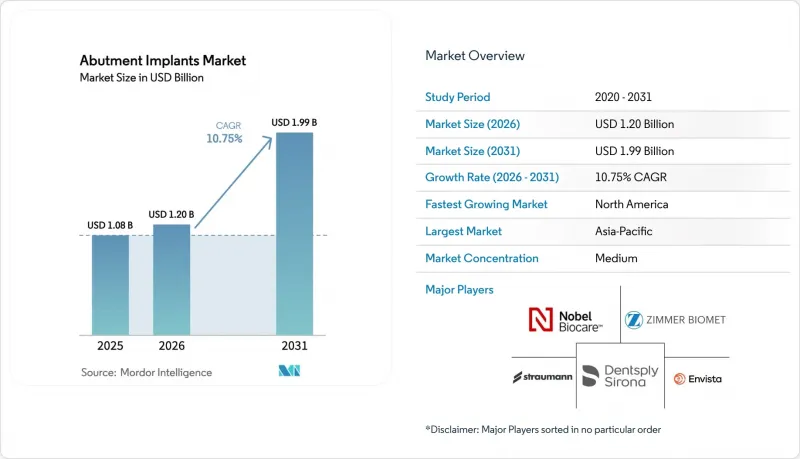
Mordor Intelligence에 의하면, 어버트먼트 임플란트 시장 규모는 2025년에 10억 8,000만 달러로 평가되었고 2026년 12억 달러에서 2031년까지 19억 9,000만 달러에 이를 것으로 추정되고 있습니다.
예측 기간(2026-2031년) 동안 연평균 성장률(CAGR)은 10.75%를 나타낼 것으로 전망됩니다.
본 보고서는 소재(티타늄, 지르코니아 등), 어버트먼트 유형(기성품, 맞춤형,힐링, 멀티 유닛), 최종 사용자 시설(학술·연구 기관, 치과 병원, 치과 기공소, 병원·외과 센터), 지역(북미, 유럽, 아시아태평양, 중동 및 아프리카, 남미)별로 분류되어 있습니다. 시장 예측은 금액(달러) 기준으로 제시되어 있습니다.
전 세계 어버트먼트 임플란트 시장 동향 및 인사이트
고령화 사회로의 인구 동향 변화
세계 65세 이상 고령자 인구는 2050년까지 16억 명에 달할 것으로 예측되며, 이 연령층의 무치악 비율이 15%-25%에 그치고 있는 점을 고려할 때, 고정식 보철물에 대한 수요가 지속적으로 증가할 것으로 전망됩니다. 중국에서는 이미 60세 이상 인구가 2억 8,000만 명에 달하는 반면, 일본의 초고령 사회에서는 1인당 임플란트 사용 수가 세계 평균의 3배에 달할 전망입니다. 고령 환자들은 즉각적인 기능 회복과 내원 횟수 감소를 가능하게 하는 멀티 유닛 솔루션을 점점 더 선호하고 있으며, 이는 어버트먼트 임플란트 시장의 프리미엄 가격 책정을 뒷받침하고 있습니다. 연소득 3만 달러를 초과하는 도시 지역 가구는 특히 여러 개의 어버트먼트가 필요한 전악 수복 분야에서 선택적 지출을 더욱 가속화하고 있습니다. 제조업체들은 운동 기능에 제한이 있는 고령자를 위해 보철물 장착을 간소화하는 각도 조절이 가능한 멀티 유닛 설계로 이에 대응하고 있습니다.
심미적 수복에 대한 수요 증가
미국 내 심미 치과 매출액은 2024년에 180억 달러를 넘어섰으며, 환자들이 미소의 심미성을 중시함에 따라 전치부 임플란트가 그 중 35%를 차지하고 있습니다. 티타늄 제품보다 40%-60% 더 비싼 지르코니아 어버트먼트는 얇은 잇몸 사이로 비치는 금속의 회색빛을 없애줌으로써 그 인기가 높아지고 있습니다. 소셜 미디어 인플루언서들이 미소 변신 과정을 공개적으로 공유함에 따라 밀레니얼 세대와 Z세대 사이에서 임플란트 치료가 일상화되고 있으며, 대량 할인을 협상할 수 있는 대규모 치과 병원으로 새로운 수요가 유입되고 있습니다. 한편, 어버트먼트 임플란트 시장에서는 평균 판매 가격이 여전히 상승하고 있습니다. 현재 전치부 사례에서는 에머전시 프로파일을 조정한 맞춤형 어버트먼트가 주류를 이루며, 치은 유두의 재생과 연조직의 지지력을 향상시키고 있습니다.
개발도상 지역의 고액 치료비와 제한된 보험 환급
선진국 시장에서는 임플란트 치료의 총 비용이 2,500-5,000달러인 반면, 인도나 튀르키예에서는 불과 600-1,200달러에 그치고 있어, 1인당 소득이 2,000달러 미만인 광범위한 인구층에게는 여전히 감당하기 어려운 금액입니다. 브라질과 남아프리카공화국의 공적 의료 제도에서는 임플란트가 보장 대상에서 제외되어 있어, 그 도입은 본인 부담금이 가능한 도시 지역의 엘리트 계층으로 한정되어 있습니다. 소액 대출이라는 선택지가 존재하기는 하지만, 8%-12%에 달하는 연체율이 광범위한 보급을 저해하고 있어, 저소득 국가에서 어버트먼트 임플란트 업계의 잠재적 수요를 제한하고 있습니다.
부문 분석
지르코니아는 연평균 성장률(CAGR) 12.65%로 성장하여, 전체 어버트먼트 임플란트 시장을 상회하는 속도를 보일 것으로 전망됩니다. 이는 환자들이 스마일 존에서 티타늄의 회색 광택을 없애주는 반투명성을 위해 40%-60%의 추가 비용을 기꺼이 지불하고 있기 때문입니다. 티타늄은 후방 치아 부위에 가해지는 하중에 대한 수십 년간의 실적이 입증되었으며, 기존 보철물과의 호환성 덕분에 2025년 시점에서 65.76%의 시장 점유율을 유지했습니다. PEEK는 특히 인도와 동남아시아의 저소득층의 요구를 충족시키고 있지만, 장기적인 증거가 부족하여 여전히 틈새 시장에 머물러 있습니다. 하이브리드 금속·세라믹 적층 소재는 강도와 심미성을 모두 충족시키는 것을 목표로 하고 있지만, 어버트먼트 임플란트 시장에 영향을 미치기 위해서는 수년에 걸친 규제상의 장벽을 극복해야 합니다.
티타늄의 연성은 토크 하에서 파절을 방지함으로써, 스크류 고정식 풀 아치 프로토콜에서 여전히 주류를 이루고 있습니다. 한편, 지르코니아는 연조직의 건강을 중시하는 전치부 시멘트리스 워크플로우에서 널리 채택되고 있습니다. 폴리머의 채택은 합리적인 가격과 방사선 투과성이라는 장점을 모두 갖추고 있지만, 색상 선택의 폭이 제한적이어서 심미성이 요구되지 않는 부위로만 국한되어 있습니다. 각 제조업체는 세균 부착을 줄이는 표면 텍스처에 대한 연구 개발을 계속하고 있지만, 아무리 획기적인 기술이라 하더라도 어버트먼트 임플란트 시장 점유율을 재편하기 위해서는 엄격한 생체적합성 시험을 통과해야 합니다.
지역별 분석
2025년, 북미는 전 세계 매출의 43.54%를 차지했으며, 그 원동력은 미국에서 연간 약 550만 건의 임플란트 시술 건수였습니다. 현재 미국 치과 진료소 수익의 64%를 차지하는 치과 서비스 조직(DSO)의 통합으로 대량 구매를 통한 리베이트 계약이 가능해진 반면, 공급업체의 이익률은 압박을 받고 있습니다. ACA(환자 보호 및 의료비 부담 적정화법)에 따른 성인 대상 치과 혜택이 2027년에 도입되면, 임플란트 적격 후보자가 최대 2,000만 명 증가하여 메디케어 적격층을 대상으로 한 다중 유닛에 대한 수요가 확대될 가능성이 있습니다(2). 캐나다는 공적 보험 환급이 제한적이어서 뒤처지고 있지만, 멕시코 국경 인근의 클리닉은 미국에서 온 국경 넘어 환자로 인해 호황을 누리고 있습니다. 다만, 많은 환자가 수복 단계를 위해 본국으로 돌아가기 때문에 현지에서의 어버트먼트 보급은 제한적입니다.
아시아태평양은 연평균 성장률(CAGR) 11.54%로 성장을 주도하고 있으며, 중국의 2억 8,000만 명에 달하는 고령층과 인도의 급성장하는 중산층이 선택적 의료 지출을 끌어올리고 있습니다. 일본의 임플란트 보급률은 세계 평균의 3배이지만, 시장이 성숙기에 접어들었기 때문에 향후 성장은 완만해질 전망입니다. 한국에서는 CAD/CAM 보급률이 70%를 넘어 당일 어버먼트 장착이 가능해졌으며, 디지털 분야에서의 리더십을 보여주고 있습니다. 국내 브랜드인 오스템(Osstem)과 메가젠(MegaGen)은 유럽 및 미국 제조업체의 가격보다 30%-40% 저렴하며, 이에 따라 스트라우만(Straumann)은 2026년에 브라질에 네오덴트(Neodent) 시설을 개설해 지역 차원에서 비용 우위를 재현하려 하고 있지만, 아시아태평양 전체에서는 여전히 치열한 현지 경쟁에 직면해 있습니다.
유럽은 매출액 기준 2위를 차지하고 있으며, 독일에서만 2024년에 130만 개의 임플란트가 식립되었습니다. 독일에서는 표준 보철물의 50%를 보장하는 본인 부담 제도가 도입되어 있지만, 피처와 어버트먼트는 대상에서 제외되어 있습니다. EU의 의료기기 규정은 엄격한 시판 후 감시를 의무화하고 있어, 규정 준수 비용을 감당할 수 있는 유서 깊은 제조업체들에게 유리하게 작용하고 있습니다. 동유럽은 할인된 치료를 원하는 예산 중심의 서유럽인들을 끌어들이고 있지만, 언어 장벽과 품질 편차로 인해 국경 지역으로의 유입은 제한적이며, 어버트먼트·임플란트 시장의 성장에는 제동이 걸려 있습니다.
중동 및 아프리카 및 남미 시장은 여전히 발전 단계에 있으며, 무치악 인구에서의 보급률은 5% 미만에 그치고 있습니다. GCC 국가에서는 고급 클리닉이 지원받고 있지만, 판매량은 미미한 수준입니다. 남미에서는 브라질이 시장을 주도하고 있으며, 스트로만(Straumann)사의 브라질 공장은 현지 통화 변동에도 불구하고 공급망의 견고성과 가격 경쟁력을 확보할 것으로 전망됩니다. 남아프리카의 민간 클리닉은 지역 관광객을 대상으로 하고 있으나, 정세의 불안정성이 어버트먼트 임플란트 시장에 대한 대규모 자본 투자를 저해하고 있습니다.
기타 혜택:
- 엑셀 형식 시장 예측(ME) 시트
- 3개월간의 애널리스트 지원
자주 묻는 질문
목차
제1장 서론
제2장 조사 방법
제3장 주요 요약
제4장 시장 구도
제5장 시장 규모와 성장 예측
제6장 경쟁 구도
제7장 시장 기회와 향후 전망
JHS 26.08.28According to Mordor Intelligence, the abutment implants market size was valued at USD 1.08 billion in 2025 and is estimated to grow from USD 1.20 billion in 2026 to reach USD 1.99 billion by 2031, at a CAGR of 10.75% during the forecast period (2026-2031).
This report is Segmented by Material (Titanium, Zirconia, and More), Abutment Type (Prefabricated, Customized, Healing, and Multi-Unit), End-User Facility (Academic & Research Institutes, Dental Clinics, Dental Laboratories, and Hospitals & Surgery Centers), and Geography (North America, Europe, Asia-Pacific, Middle East & Africa, and South America). The Market Forecasts are Provided in Terms of Value (USD).
Global Abutment Implants Market Trends and Insights
Demographic Shift Toward Older Population
The global cohort aged 65 plus is expected to reach 1.6 billion by 2050, driving a sustained need for fixed restorations as edentulism rates remain 15%-25% in this group. China already hosts 280 million citizens aged 60 and over, while Japan's super-aged society translates into per-capita implant use triple the world average. Older patients increasingly prefer multi-unit solutions that offer immediate function and fewer surgical visits, supporting premium pricing in the abutment implants market. Urban households earning above USD 30,000 annually further accelerate elective spending, particularly on full-arch restorations that require multiple abutments. Manufacturers respond with angulated multi-unit designs that simplify prosthesis delivery for mobility-impaired seniors.
Rising Demand for Aesthetic Restorations
Cosmetic dentistry revenue in the United States exceeded USD 18 billion in 2024, with anterior implants representing 35% of volume as patients prioritize smile esthetics. Zirconia abutments, priced 40%-60% above titanium, have gained momentum by eliminating gray metal shine through thin gingiva. Social-media influencers openly documenting smile makeovers normalize implant procedures for Millennials and Generation Z, channeling new demand into high-volume practices that negotiate bulk discounts while still growing average selling prices in the abutment implants market. Custom abutments that tailor emergence profiles now dominate anterior cases, improving papilla regeneration and soft-tissue support.
High Treatment Cost and Limited Reimbursement in Developing Regions
Complete implant therapy costs USD 2,500-5,000 in developed markets but only USD 600-1,200 in India and Turkey, still unaffordable for vast populations earning below USD 2,000 per capita. Public schemes in Brazil and South Africa exclude implants, confining adoption to self-pay urban elites. Micro-credit options exist yet default rates of 8%-12% deter widespread rollout, constraining addressable demand for the abutment implants industry in lower-income nations.
Other drivers and restraints analyzed in the detailed report include:
- Rapid Adoption of Digital Dentistry Technologies
- Expansion of Insurance Coverage for Implant Procedures
- Insufficient Skilled Dental Implant Workforce
For complete list of drivers and restraints, kindly check the Table Of Contents.
Segment Analysis
Zirconia will grow at a 12.65% CAGR, outpacing the broader abutment implants market as patients accept 40%-60% premiums for translucency that eliminates the gray shine of titanium in the smile zone. Titanium retained 65.76% share in 2025 due to decades of posterior load success and compatibility with the installed base. PEEK addresses low-income needs, especially in India and Southeast Asia, yet remains a niche area with scant long-term evidence. Hybrid metal-ceramic laminates aim to combine strength and esthetics but face multi-year regulatory hurdles before influencing the abutment implants market.
Titanium's ductility still dominates screw-retained full-arch protocols by preventing fracture under torque, while zirconia thrives in anterior cementless workflows that favor soft-tissue health. Polymer uptake sits at the intersection of affordability and radiolucency advantages although limited color options confine it to non-esthetic sites. Manufacturers continue R&D into surface textures that reduce bacterial adhesion, yet any breakthrough faces strict biocompatibility trials before reshaping the abutment implants market share.
Complete Report Scope:
- By Material
- Titanium
- Zirconia
- Peek & High-Performance Polymers
- Hybrid/Composite Alloys
- By Abutment Type
- Prefabricated
- Customized
- Healing
- Multi-Unit
- By End-User Facility
- Academic & Research Institutes
- Dental Clinics
- Dental Laboratories
- Hospitals & Surgery Centers
- Geography
- North America
- United States
- Canada
- Mexico
- Europe
- Germany
- United Kingdom
- France
- Italy
- Spain
- Rest of Europe
- Asia-Pacific
- China
- Japan
- India
- Australia
- South Korea
- Rest of Asia-Pacific
- Middle East & Africa
- GCC
- South Africa
- Rest of Middle East & Africa
- South America
- Brazil
- Argentina
- Rest of South America
- North America
Geography Analysis
North America accounted for 43.54% of global revenue in 2025, driven by about 5.5 million annual placements in the United States. Consolidation of Dental Service Organizations, now controlling 64% of U.S. practice revenue, unlocks volume-rebate deals but squeezes supplier margins. The 2027 rollout of adult dental benefits under ACA could add up to 20 million eligible implant candidates, expanding multi-unit demand targeted at the Medicare-eligible segment[2]. Canada lags due to limited public reimbursement, whereas Mexican border clinics thrive on U.S. cross-border traffic, though many patients return home for restorative stages, limiting local abutment uptake.
Asia-Pacific leads growth at 11.54% CAGR as China's 280 million seniors and India's burgeoning middle class boost elective care spending. Japan's implant density is triple the global average, yet mature penetration tempers incremental growth. South Korea's >70% CAD/CAM penetration enables same-day abutments, exemplifying digital leadership. Domestic brands Osstem and MegaGen undercut Western prices by 30%-40%, prompting Straumann to open its 2026 Neodent facility in Brazil to replicate cost advantages regionally, but it still faces fierce local competition across Asia-Pacific.
Europe ranks second by value, with Germany alone placing 1.3 million implants in 2024 under a co-payment regime that covers 50% of standard prosthetics but excludes fixtures and abutments. The EU Medical Device Regulation imposes strict post-market surveillance, favoring established manufacturers who can absorb compliance costs. Eastern Europe attracts budget-minded Western Europeans for discounted treatments, yet language and quality variability limit the flow to border regions, capping gains in the abutment implants market.
The Middle East & Africa and South America remain nascent, with penetration under 5% among edentulous populations. GCC states support premium clinics but generate modest unit volumes. Brazil dominates South America; Straumann's Brazilian plant should secure supply chain resilience and price competitiveness despite local currency swings. South African private clinics cater to regional tourists, yet political volatility deters large-scale capital investment in the abutment implants market.
- Anthogyr (Straumann)
- Bicon
- BioHorizons
- Camlog Biotechnologies
- Dentium Co., Ltd.
- Dentsply Sirona
- Envista (Nobel Biocare)
- Henry Schein
- Straumann Group
- MegaGen Implant
- MIS Implants Technologies
- Neoss Ltd.
- Osstem Implant Co., Ltd.
- Planmeca
- Southern Implants
- Sweden & Martina SpA
- Thommen Medical
- Zimmer Biomet
- ZimVie
Additional Benefits:
- The market estimate (ME) sheet in Excel format
- 3 months of analyst support
TABLE OF CONTENTS
1 Introduction
- 1.1 Study Assumptions & Market Definition
- 1.2 Scope of the Study
2 Research Methodology
3 Executive Summary
4 Market Landscape
- 4.1 Market Overview
- 4.2 Market Drivers
- 4.2.1 Demographic Shift Toward Older Population
- 4.2.2 Rising Demand for Aesthetic Restorations
- 4.2.3 Rapid Adoption of Digital Dentistry Technologies
- 4.2.4 Expansion of Insurance Coverage for Implant Procedures
- 4.2.5 Integration of Artificial Intelligence in Custom Abutment Design
- 4.2.6 Proliferation of Low-Cost Polymer and Peek Abutments in Emerging Markets
- 4.3 Market Restraints
- 4.3.1 High Treatment Cost and Limited Reimbursement in Developing Regions
- 4.3.2 Insufficient Skilled Dental Implant Workforce
- 4.3.3 Increasing Incidence of Peri-Implant Diseases
- 4.3.4 Supply Chain and Sustainability Challenges for Titanium and Zirconia
- 4.4 Value / Supply-Chain Analysis
- 4.5 Regulatory Landscape
- 4.6 Technological Outlook
- 4.7 Porter's Five Forces Analysis
- 4.7.1 Threat Of New Entrants
- 4.7.2 Threat Of Substitutes
- 4.7.3 Bargaining Power Of Suppliers
- 4.7.4 Bargaining Power Of Buyers
- 4.7.5 Industry Rivalry
5 Market Size & Growth Forecasts (Value, USD)
- 5.1 By Material
- 5.1.1 Titanium
- 5.1.2 Zirconia
- 5.1.3 Peek & High-Performance Polymers
- 5.1.4 Hybrid/Composite Alloys
- 5.2 By Abutment Type
- 5.2.1 Prefabricated
- 5.2.2 Customized
- 5.2.3 Healing
- 5.2.4 Multi-Unit
- 5.3 By End-User Facility
- 5.3.1 Academic & Research Institutes
- 5.3.2 Dental Clinics
- 5.3.3 Dental Laboratories
- 5.3.4 Hospitals & Surgery Centers
- 5.4 Geography
- 5.4.1 North America
- 5.4.1.1 United States
- 5.4.1.2 Canada
- 5.4.1.3 Mexico
- 5.4.2 Europe
- 5.4.2.1 Germany
- 5.4.2.2 United Kingdom
- 5.4.2.3 France
- 5.4.2.4 Italy
- 5.4.2.5 Spain
- 5.4.2.6 Rest of Europe
- 5.4.3 Asia-Pacific
- 5.4.3.1 China
- 5.4.3.2 Japan
- 5.4.3.3 India
- 5.4.3.4 Australia
- 5.4.3.5 South Korea
- 5.4.3.6 Rest of Asia-Pacific
- 5.4.4 Middle East & Africa
- 5.4.4.1 GCC
- 5.4.4.2 South Africa
- 5.4.4.3 Rest of Middle East & Africa
- 5.4.5 South America
- 5.4.5.1 Brazil
- 5.4.5.2 Argentina
- 5.4.5.3 Rest of South America
- 5.4.1 North America
6 Competitive Landscape
- 6.1 Market Concentration
- 6.2 Market Share Analysis
- 6.3 Company Profiles {(Includes Global Level Overview, Market Level Overview, Core Segments, Financials As Available, Strategic Information, Market Rank/Share For Key Companies, Products & Services, And Recent Developments)}
- 6.3.1 Anthogyr (Straumann)
- 6.3.2 Bicon LLC
- 6.3.3 BioHorizons Implant Systems
- 6.3.4 Camlog Biotechnologies
- 6.3.5 Dentium Co., Ltd.
- 6.3.6 Dentsply Sirona Inc.
- 6.3.7 Envista (Nobel Biocare)
- 6.3.8 Henry Schein Inc.
- 6.3.9 Institut Straumann AG
- 6.3.10 MegaGen Implant
- 6.3.11 MIS Implants Technologies
- 6.3.12 Neoss Ltd.
- 6.3.13 Osstem Implant Co., Ltd.
- 6.3.14 Planmeca Oy
- 6.3.15 Southern Implants
- 6.3.16 Sweden & Martina SpA
- 6.3.17 Thommen Medical AG
- 6.3.18 Zimmer Biomet Holdings Inc.
- 6.3.19 ZimVie Inc.
7 Market Opportunities & Future Outlook
- 7.1 White-Space & Unmet-Need Assessment


