

|
시장보고서
상품코드
2116484
스마트 콘택트렌즈 시장 : 점유율 분석, 업계 동향과 통계, 성장 예측(2026-2031년)Smart Contact Lenses - Market Share Analysis, Industry Trends & Statistics, Growth Forecasts (2026 - 2031) |
||||||
 Mordor Intelligence
Mordor Intelligence에 의하면, 스마트 콘택트렌즈 시장 규모는 2025년 514만 달러에서 2026년에는 552만 달러로 확대되어 2026년부터 2031년까지 CAGR 7.39%로 성장을 지속하여, 2031년에는 788만 달러에 이를 것으로 예측됩니다.
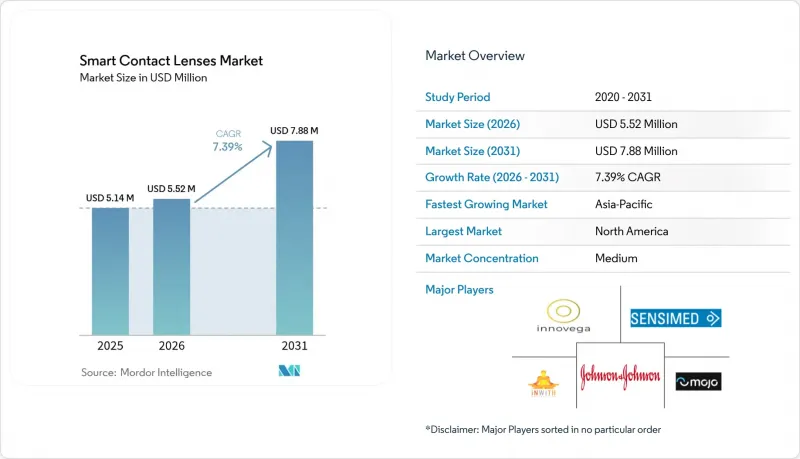
본 보고서는 용도별(안구 모니터링 및 녹내장 치료, 시각 장애), 최종 사용자별(병원 및 안과 클리닉, 재택 간호/자가 모니터링을 수행하는 소비자, 기타), 지역별(북미, 유럽, 아시아태평양, 기타 지역)로 분류되어 있습니다. 시장 예측은 금액(미 달러)으로 제시되어 있습니다.
세계 스마트 콘택트렌즈 시장 동향 및 인사이트
렌즈에 탑재된 소형 바이오센서가 서브 μW 수준의 전력 소비량에 도달
서브 μW급 바이오센서는 플렉서블 태양전지와 금속-공기 전지를 결합함으로써 3.3V에서 약 150μW의 전력을 회수할 수 있게 되어, 부피가 큰 배터리 팩 없이도 자율적인 작동이 가능해졌습니다. Ti3C2Tx MXene 센서는 안압(IOP)에 대해 12.52 mV/mmHg의 감도를 보여, 자극을 최소화하면서 고정밀 안압 측정이 가능함을 입증했습니다. 이러한 비약적인 발전으로 인해 연구용 프로토타입에서 스마트 콘택트렌즈 시장에서 가장 큰 점유율을 차지하는 이용 사례인 ‘연속 혈당 모니터링’이 가능한 상용 기기로의 전환이 가능해졌습니다. 전력 소비 감소로 인해 열 관리도 간소화되어, 장시간 착용 중에도 각막에 대한 편안함이 유지됩니다. 이러한 진전들이 결합되어 핵심적인 기술적 병목 현상이 멀티 센서 제품의 로드맵을 향한 출발점으로 전환되었습니다.
안압 및 눈물 포도당 모니터링에 대한 보험 급여 코드 도입
2025년, 메디케어는 지속적 눈물 포도당 모니터링을 위한 카테고리 III CPT 코드를 발행하여 미국 내 의료 제공업체의 경제성을 대폭 개선했습니다. 이에 앞서 FDA는 케토티펜이 함유된 ‘아큐뷰 테라비전(Acuvue Theravision)’을 승인함으로써, 안과용 복합 기기의 실현 가능한 길을 제시했습니다. 보험사의 승인으로 만성 질환 환자의 본인 부담 비용이 경감되었으며, 처방 확대를 위한 인센티브가 마련되었습니다. EU의 보험사들도 디지털 치료제 프레임워크 하에서 유사한 코드를 시범적으로 도입하고 있으며, 일본의 국민건강보험 제도에서도 적용 기준 재검토가 진행되고 있습니다. 보험 급여의 확대 추세는 보급을 가속화하고 있으며, 특히 당뇨병 관리 분야에서는 연속 모니터링을 통해 장기적인 합병증과 관련 비용을 억제할 수 있기 때문에 이러한 경향이 두드러집니다.
신축성 안테나의 장기적인 생체 적합성은 불투명
현재의 ISO 10993 안과 프로토콜에서는 안테나로 사용되는 구불구불한 은-그래핀 트레이스에서 발생하는 나노 규모의 금속 용출에 대해 충분히 검토되지 않았습니다. 초기 26주간의 토끼를 대상으로 한 시험에서는 안구 후부 조직에 미량의 은 이온이 축적되어 있는 것이 밝혀졌으며, FDA는 연속 착용 적응증을 승인하기 전에 수년에 걸친 추적 조사를 요청했습니다. 현재 각 제조업체는 용출 위험을 줄이기 위해 생분해성 폴리-L-젖산 기판이나 파릴렌으로 캡슐화된 인터포저를 검토하고 있습니다. 장기적인 안전성 데이터가 확립될 때까지는 녹내장이나 당뇨병 등 만성 질환 분야에서 시장 침투가 제한된 상태로 남아 있으며, 이것이 연평균 성장률(CAGR)의 상승을 억제하는 요인이 되고 있습니다.
부문 분석
혈당 모니터링 기기는 2025년 매출의 58.55%를 차지했습니다. 이는 전 세계적으로 5억 4,000만 명을 넘는 당뇨병 환자 수와, 눈물과 혈당 수치 사이에 입증된 임상적 상관관계(최근 인체 실험에서 R2>0.87)를 배경으로 합니다. 180일간의 다기관 공동 연구에서 연속 혈당 추적기는 손가락 채혈을 통한 모니터링에 비해 저혈당 발작을 28% 감소시켜 보험 적용을 정당화하는 결과를 가져왔습니다. 안압 모니터링은 8,000만 명의 녹내장 환자를 대상으로 하며, 진료소에서는 간과되기 쉬운 야간 안압 상승을 감지할 수 있게 해줍니다. 증강현실(AR) 오버레이는 여전히 상용화 전 단계이지만, 마이크로 LED의 효율이 향상됨에 따라 장기적인 성장 가능성을 높이고 있습니다.
연평균 성장률(CAGR) 7.72%로 가장 빠르게 성장하고 있는 용도인 약물 전달용 렌즈는 비타민 E 장벽과 마이크로 리저버를 채택하여 며칠 동안 치료 용량을 유지함으로써, 알레르기성 결막염 등의 질환에서 만성적인 복약 순응도 문제를 해결하고 있습니다. 케토티펜 방출형 렌즈의 FDA 승인은 규제 승인 경로의 타당성을 입증함과 동시에, 프로스타글란딘 유사체의 파이프라인 개발을 촉진하고 있습니다. 진단 기능과 치료 기능을 겸비한 다기능 렌즈 모델은 플랫폼으로서의 차별화를 약속하며, 스마트 콘택트렌즈 시장의 확장을 뒷받침하고 있습니다.
지역별 분석
북미는 2025년 스마트 콘택트렌즈 시장에서 58.54%의 점유율을 유지했습니다. 이는 FDA 승인과 300달러가 넘는 가격대를 상쇄하는 견실한 보험 환급에 힘입은 결과입니다. 미국에는 마이크로 LED 및 바이오센서 생산 거점이 있어 공급망의 기반이 되고 있으며, 안과용 바이오전자 분야에서의 산학 컨소시엄 형성을 촉진하고 있습니다. 캐나다의 단일 지불자 제도 하에서 2025년에 눈물 내 포도당 측정 시범 프로그램이 시작되어 공적 보험의 적용 범위가 확대되었습니다. 멕시코는 마킬라도라(수출가공구)의 우대 조치를 활용하여 렌즈 조립 라인을 유치하고, 지역 내 물류 주기를 단축하고 있습니다. 이러한 동향들이 맞물려 높은 인건비에도 불구하고 북미의 리더십이 유지되고 있습니다.
아시아태평양은 한국의 식품의약품안전처(MFDS) 신속 승인 제도 적용 확대, 일본의 의료연구개발기구(AMED)의 바이오센서화 지원금, 그리고 중국의 대량 생산을 원동력으로 하는 부품 생태계의 뒷받침을 받아 8.19%라는 가장 높은 연평균 성장률(CAGR)을 기록하고 있습니다. 중국에서는 1억 4,100만 명의 당뇨병 환자 수가 혈당 측정용 렌즈 수요를 끌어올리고 있으며, 국내 디스플레이 제조업체들은 Mini-LED 기술을 렌즈 프로젝트에 활용하고 있습니다. 인도의 ‘아유슈만 바라트’ 제도가 원격 안압 모니터링에 대한 보험 적용을 시작하면서 농촌 지역 수요를 활성화시키고 있습니다. 이러한 요인들이 복합적으로 작용하여 아시아태평양은 스마트 콘택트렌즈 시장의 성장 엔진으로서의 입지를 확고히 하고 있습니다.
유럽에서는 MDR(의료기기 규정)이 명확해짐에 따라 꾸준한 보급이 진행되고 있습니다. 독일의 DIGA(디지털 안과 치료법) 체계에서는 디지털 안과 치료법에 대한 보험 급여가 시행되고 있으며, 프랑스의 Haute Autorite de Sante(보건고등청)는 지속적인 안구 모니터링에 관한 2025년 지침을 발표했습니다. 영국에서는 맨체스터 대학교에서 분사된 기업이 NHS 사이버 보안 툴킷 기준에 부합하는 그래핀 안테나 개발을 추진하고 있습니다. 남유럽 및 북유럽 국가들에서는 지역 병원에 스마트 렌즈 진단 기기를 도입하기 위해 EU 구조 기금의 활용이 추진되고 있습니다. CE 마크 획득까지의 기간이 제품 출시 주기를 연장하는 한편, 유럽이 안전성과 데이터 프라이버시를 중시하고 있다는 점은 사용자의 신뢰를 키워주며, 완만하지만 꾸준한 보급을 뒷받침하고 있습니다.
기타 혜택:
- 엑셀 형식 시장 예측(ME) 시트
- 3개월간의 애널리스트 지원
자주 묻는 질문
목차
제1장 서론
제2장 조사 방법
제3장 주요 요약
제4장 시장 구도
제5장 시장 규모와 성장 예측
제6장 경쟁 구도
제7장 시장 기회와 향후 전망
JHS 26.08.28According to Mordor Intelligence, the smart contact lenses market size is expected to grow from USD 5.14 million in 2025 to USD 5.52 million in 2026 and is forecast to reach USD 7.88 million by 2031 at 7.39% CAGR over 2026-2031.
This report is Segmented by Application (Ocular Monitoring & Glaucoma Treatment, Vision Impairment), by End User (Hospitals & Ophthalmology Clinics, Home-care/Self-monitoring Consumers, Others), and Geography (North America, Europe, Asia-Pacific, Rest of the World). The Market Forecasts are Provided in Terms of Value (USD).
Global Smart Contact Lenses Market Trends and Insights
Miniaturised On-Lens Biosensors Reach Sub-µW Power Levels
Sub-µW biosensors now harvest ~150 µW at 3.3 V from combined flexible solar and metal-air sources, allowing autonomous operation without bulky battery packs. Ti3C2Tx MXene sensors demonstrate 12.52 mV/mmHg sensitivity for IOP, validating high-accuracy ocular measurements with minimal irritation. This leap enables a shift from research prototypes to commercial devices capable of continuous glucose monitoring, a use-case that commands the largest share of the smart contact lenses market. Lower power budgets also simplify thermal management, preserving corneal comfort during extended wear. Collectively, these advances convert a core technical bottleneck into a launchpad for multi-sensor product roadmaps.
Reimbursement Codes Emerging for IOP & Glucose Tear Monitoring
In 2025, Medicare issued a category III CPT code for continuous tear glucose monitoring, greatly improving provider economics in the United States. Earlier, FDA cleared Acuvue Theravision with Ketotifen, illustrating a feasible path for ophthalmic combination devices. Payer recognition lowers out-of-pocket costs for chronic-disease patients, aligning incentives for wider prescription. EU payers are piloting similar codes under digital therapeutics frameworks, and Japan's universal coverage system is reviewing inclusion criteria. Reimbursement momentum accelerates volume adoption, particularly in diabetes care where continuous monitoring curbs long-term complications and associated costs.
Long-Term Biocompatibility of Stretchable Antennas Uncertain
Current ISO 10993 ocular protocols do not fully address nano-scale metal dissolution from serpentine silver-graphene traces used as antennas. Early 26-week rabbit trials revealed trace silver ion accumulation in retro-bulbar tissues, prompting the FDA to request multi-year follow-ups before approving continuous-wear indications. Manufacturers now explore biodegradable poly-L-lactic acid substrates and parylene-encapsulated interposers to curb leaching risks. Until long-term safety data matures, market penetration in chronic-use segments such as glaucoma and diabetes remains gated, restraining CAGR.
Other drivers and restraints analyzed in the detailed report include:
- 5G/LTE-M eSIM Modules Enable Continuous Lens Connectivity
- Silicon-Hydrogel Nanocomposites Slash Manufacturing Rejects
- High BOM Keeps Low ASP per Lens in 2025
For complete list of drivers and restraints, kindly check the Table Of Contents.
Segment Analysis
Glucose-monitoring devices accounted for 58.55% of 2025 revenues, capitalizing on a diabetic population exceeding 540 million worldwide and the demonstrated clinical correlation between tear and blood glucose (R2 > 0.87 in recent human trials). Continuous glucose trackers reduce hypoglycemic events by 28% compared with finger-stick monitoring in a 180-day multi-center study, justifying payer coverage. Intraocular pressure monitoring serves 80 million glaucoma patients, enabling detection of nocturnal IOP spikes missed in clinic. Augmented reality overlays remain pre-commercial but fuel long-term upside as micro-LED efficiency improves.
Drug-delivery lenses, the fastest-growing application at 7.72% CAGR, employ vitamin E barriers or micro-reservoirs to sustain therapeutic dosing over days, addressing chronic adherence gaps in conditions like allergic conjunctivitis. FDA clearance of ketotifen-eluting lenses validates the regulatory pathway and spurs pipelines for prostaglandin analogs. The multi-functional lens archetype-diagnostic plus therapeutic-promises platform differentiation, reinforcing expansion of the smart contact lenses market.
Complete Report Scope:
- By Application
- Ocular Monitoring & Glaucoma Treatment
- Vision Impairment
- By End User
- Hospitals & Ophthalmology Clinics
- Home-care / Self-monitoring Consumers
- Others (Academic Institutes, Rehabilitation Centers, among others)
- By Geography
- North America
- Europe
- Asia-Pacific
- Rest of the World
Geography Analysis
North America maintained 58.54% smart contact lenses market share in 2025, underpinned by FDA clearances and robust reimbursement that cushion USD 300+ price points. The United States hosts production hubs for micro-LEDs and biosensors, anchoring supply chains and sparking university-industry consortia for ocular bioelectronics. Canada's single-payer system began pilot tear-glucose programs in 2025, broadening public coverage. Mexico leverages maquiladora incentives to attract lens assembly lines, compressing regional logistics cycles. Together, these dynamics preserve North America's leadership despite high labor costs.
Asia-Pacific delivers the fastest CAGR at 8.19%, buoyed by South Korea's expedited MFDS fast-track designations, Japan's AMED grants for bio-sensorization, and China's volume-driven component ecosystem. In China, a diabetic base of 141 million boosts demand for glucose lenses, while domestic display makers channel Mini-LED expertise into lens projects. India's Ayushman Bharat scheme begins covering remote IOP monitoring, activating rural demand. This confluence positions Asia-Pacific as the growth engine of the smart contact lenses market.
Europe records steady uptake as MDR clarity improves. Germany's DIGA framework now reimburses digital ophthalmic therapeutics, and France's Haute Autorite de Sante released 2025 guidelines for continuous ocular monitoring. United Kingdom spin-outs from University of Manchester advance graphene antennas compliant with NHS Cybersecurity Toolkit standards. Southern Europe and the Nordics pursue EU Structural Funds to equip regional hospitals with smart lens diagnostics. While CE-marking timelines extend launch cycles, Europe's emphasis on safety and data privacy cultivates user trust, reinforcing gradual but resilient adoption.
- Innovega
- SEED Co., Ltd. (Sensimed SA)
- Smartlens, Inc.
- Azalea Vision
- InWith Corp
- XPANCEO
- Cylensee Inc.
- BVS Sight Inc.
- Samsung Group
- Google LLC
- Sony
- PHI BIOMED
Additional Benefits:
- The market estimate (ME) sheet in Excel format
- 3 months of analyst support
TABLE OF CONTENTS
1 Introduction
- 1.1 Study Assumptions & Market Definition
- 1.2 Scope of the Study
2 Research Methodology
3 Executive Summary
4 Market Landscape
- 4.1 Market Overview
- 4.2 Market Drivers
- 4.2.1 Miniaturised on-lens biosensors reach sub-µW power levels
- 4.2.2 Reimbursement codes emerging for IOP & glucose tear monitoring
- 4.2.3 5 G / LTE-M eSIM modules enable continuous lens connectivity
- 4.2.4 Silicon-hydrogel nanocomposites slash manufacturing rejects
- 4.2.5 Pharma-device bundle deals for ocular drug-delivery lenses
- 4.2.6 Big-Tech licensing of AR micro-display IP to lens makers
- 4.3 Market Restraints
- 4.3.1 Long-term biocompatibility of stretchable antennas uncertain
- 4.3.2 High BOM keeps ASP > US$300 per lens in 2025
- 4.3.3 Fragmented global approval pathways (FDA, MDR, MFDS, NMPA)
- 4.3.4 Supply of medical-grade micro-LEDs <5 µm remains constrained
- 4.4 Value / Supply-Chain Analysis
- 4.5 Regulatory Landscape
- 4.6 Technological Outlook
- 4.7 Porter's Five Forces
- 4.7.1 Bargaining Power of Suppliers
- 4.7.2 Bargaining Power of Buyers
- 4.7.3 Threat of New Entrants
- 4.7.4 Threat of Substitutes
- 4.7.5 Competitive Rivalry
5 Market Size & Growth Forecasts (Value)
- 5.1 By Application
- 5.1.1 Ocular Monitoring & Glaucoma Treatment
- 5.1.2 Vision Impairment
- 5.2 By End User
- 5.2.1 Hospitals & Ophthalmology Clinics
- 5.2.2 Home-care / Self-monitoring Consumers
- 5.2.3 Others (Academic Institutes, Rehabilitation Centers, among others)
- 5.3 By Geography
- 5.3.1 North America
- 5.3.2 Europe
- 5.3.3 Asia-Pacific
- 5.3.4 Rest of the World
6 Competitive Landscape
- 6.1 Market Concentration
- 6.2 Market Share Analysis
- 6.3 Company Profiles (includes Global level Overview, Market level overview, Core Segments, Financials as available, Strategic Information, Market Rank/Share for key companies, Products & Services, and Recent Developments)
- 6.3.1 Innovega
- 6.3.2 SEED Co., Ltd. (Sensimed SA)
- 6.3.3 Smartlens, Inc.
- 6.3.4 Azalea Vision
- 6.3.5 InWith Corp
- 6.3.6 XPANCEO
- 6.3.7 Cylensee Inc.
- 6.3.8 BVS Sight Inc.
- 6.3.9 Samsung Electronics Co Ltd
- 6.3.10 Google LLC
- 6.3.11 Sony Corporation
- 6.3.12 PHI BIOMED
7 Market Opportunities & Future Outlook
- 7.1 White-Space & Unmet-Need Assessment


