

|
시장보고서
상품코드
2116490
의료 분야 5G : 세계 시장 점유율 분석, 업계 동향 및 통계, 성장 예측(2026-2031년)Global 5G In Healthcare - Market Share Analysis, Industry Trends & Statistics, Growth Forecasts (2026 - 2031) |
||||||
 Mordor Intelligence
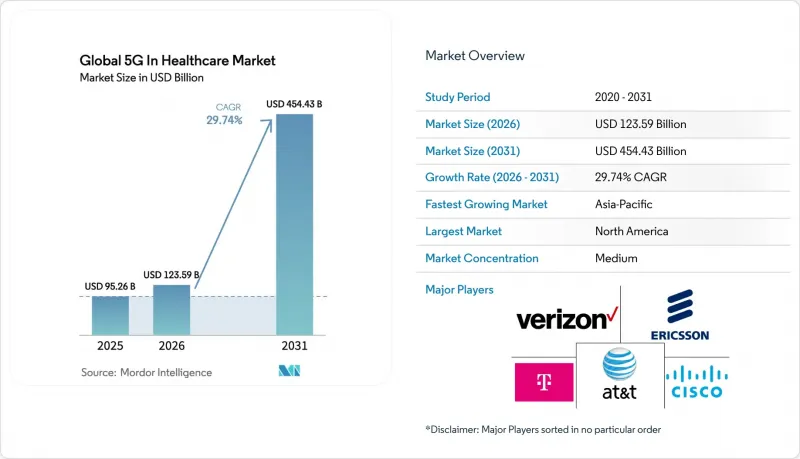
Mordor Intelligence에 의하면, 의료 분야 5G 시장 규모는 2025년에 952억 6,000만 달러로 평가되었습니다. 2026년 1,235억 9,000만 달러에서 2031년까지 4,544억 3,000만 달러에 이를 것으로 예상되며, 예측 기간(2026-2031년) CAGR은 29.74%를 나타낼 전망입니다.
본 보고서는 구성 요소(하드웨어, 서비스), 통신 유형(eMBB, URLLC, MMTC), 용도(원격 의료, RPM, AR/VR 치료, 커넥티드 구급차, 스마트 웨어러블, 로봇 수술), 최종 사용자(병원, 진료소, 재택치료, 연구 기관),및 지역(북미, 유럽, 아시아태평양, 남미, 중동 및 아프리카)별로 분류되어 있습니다. 시장 예측은 금액(달러) 기준으로 제시되어 있습니다.
세계의 의료 분야 5G 시장 동향 및 인사이트
급증하는 원격 중환자실(ICU) 및 원격 수술 시범 사업
의료 시스템이 전문의 부족에 직면한 가운데, 원격 중환자실(ICU) 프로그램이 급증하고 있습니다. 브라질의 국가 이니셔티브에서는 2022년부터 2023년에 걸쳐 15개 중환자실에서 5,471명의 환자를 치료했으며, 5G가 10밀리초 미만의 지연 시간을 유지했기 때문에병상에서의 의사 결정과 동등한 품질을 유지한 3,971건의 가상 회진을 실시했습니다. 이어 중국에서는 5G 회선(지연 99밀리초 미만)을 통해 1,700킬로미터 떨어진 곳에서 갑상선 절제술을 성공적으로 수행함으로써, 국경을 초월한 로봇 수술의 실현을 입증하고 거리에 구애받지 않는 외과 의료의 새로운 시대를 열었습니다. Apstar-6D 플랫폼을 통해 수행된 위성 지원 수술과 더불어, 이러한 획기적인 성과는 대륙 규모의 임상적 신뢰성을 입증하고 있으며, 전국적인 5G 외과 수술 회랑에 대한 투자를 가속화하여 의료 분야 5G 잠재 시장을 확대되고 있습니다.
통신 사업자가 추진하는 병원용 프라이빗 5G 네트워크
통신 사업자들은 현재 병원을 기업 고객으로 유치하기 위해 노력하고 있으며, 생명을 좌우하는 업무 부하에 대해 서비스 품질(QoS)을 보장하는 사설 5G 독립형(SA) 시스템을 구축하고 있습니다. Boldyn Networks는 핀란드 오울루 대학병원에서 유럽 최초의 병원용 SA 네트워크를 가동하여 생체 센서 데이터의 실시간 전송과 AR을 활용한 수술을 가능하게 했습니다. 버라이즌은 클리블랜드 클리닉의 멘토 시설에 엔드투엔드 5G 캠퍼스 네트워크를 도입하고, 접수 키오스크와 원격 측정 대시보드를 통합함으로써 행정 처리 지연을 줄였습니다. 스웨덴의 3,500만 달러 규모 ‘VGR-5G’ 프로그램에서는 이 모델을 500개 이상의 병원에 확대 적용할 예정이며, 이는 의료 분야의 광범위한 5G 시장에서 관리형 프라이빗 네트워크 계약에 대한 수요가 단순한 하드웨어 수요를 능가할 가능성이 있음을 시사합니다.
의료 시스템의 주파수 대역 라이선스 비용 부담
전국 규모의 통신 사업자에게 주파수 사용료는 종종 10억 달러를 초과하며, 그 자본적 부담은 전용 주파수를 필요로 하는 의료시설로도 파급되고 있습니다. 주파수 비용 대 수익 비율이 10포인트 상승하면 5G 커버리지는 6포인트 하락하고 통신 속도는 8% 저하되므로, 인구 밀집 도시에서 원격 수술의 신뢰성이 저하될 수 있습니다. 기지국 1기당 도입 비용이 10만-20만 달러이며, mm파(mmWave)의 경우 그 1.5-2배에 달하기 때문에 자금 사정이 어려운 병원들은 도입을 미룰 수밖에 없어, 의료 분야 5G 시장 단기적 성장을 저해하고 있습니다.
부문별 분석
2025년, 의료 분야 5G 시장 점유율의 50.12%를 하드웨어 솔루션이 차지했습니다. 이는 기지국, 스몰 셀, 안테나, 엣지 서버에 막대한 설비 투자가 필요함을 반영합니다. 조기 도입 기관들은 연결 환경 구축을 건설 프로젝트로 간주하여, 수술실, 영상진단실, 중환자실을 지원하는 캠퍼스 전체에 걸쳐 수년에 걸친 개보수 공사에 자금을 투자해 왔습니다. 그러나 병원 측에서는 주파수 대역, 소프트웨어, 규정 준수 서비스를 패키지화한 턴키 방식의 구독 서비스를 선호하기 때문에 서비스 분야의 성장률은 더 빠르며, 연평균 성장률(CAGR)은 32.07%에 달할 전망입니다. ZTE가 쑤저우 대학 병원을 위해 구축한 통합형 5G IoT 네트워크는 3,000대의 기기를 연결하고, 구축 기간을 90% 단축하며, 총 소유 비용(TCO)을 30% 절감했습니다. 이와 유사한 ‘네트워크-어-서비스(Network-as-a-Service)’ 모델은 의료 분야 5G 시장 리스크를 병원의 대차대조표에서 분리하고, 단계적 도입을 촉진하며, 생태계 혁신을 뒷받침하고 있습니다.
이러한 전환으로 인해 벤더 간의 세력 구도가 재편되고 있습니다. 인프라 OEM 기업들은 이익률을 지키기 위해 클라우드 하이퍼스케일러 및 사이버 보안 기업과 제휴하는 한편, 통합 업체들은 라이프사이클 관리를 통해 수익 창출을 도모하고 있습니다. 병원 측은 예측 가능한 운영 비용, 온디맨드 네트워크 슬라이싱, 그리고 내장형 위협 모니터링의 혜택을 누리고 있습니다. 2026년부터 2031년에 걸쳐 매니지드 서비스의 연간 지출액이 하드웨어 출하액을 넘어설 가능성이 있으며, 이는 의료 분야 5G 시장의 구조적 전환점을 나타내는 것이 될 것입니다.
eMBB(Enhanced Mobile Broadband)는 4K 이미지, 고화질 화상 회의, 클라우드 PACS 백업을 지원함으로써 2025년 의료 분야 5G 시장 규모의 51.85%를 차지했습니다. 방사선과가 8K 워크플로로 전환하고, 의과대학이 원격 연수를 위해 대용량 동영상을 스트리밍함에 따라 수요는 견조한 추세를 보이고 있습니다. 초고신뢰성·저지연 통신(URLLC)은 연평균 성장률(CAGR) 32.12%로 급성장하고 있으며, 정밀 로봇 공학, AI를 활용한 마취 관리, 그리고 여러 거점에 걸친 뇌졸중 치료 유닛을 실현하고 있습니다. 싱가포르 국립대학교 의료 시스템(NUHS)에서는 3.5GHz 대역의 주파수 대역을 이용하여 20건의 혼합 현실(MR) 수술에서 하향 1 Gbps, 상향 150 Mbps, 지연 10밀리초 미만의 실적을 기록했습니다. 대규모 머신 유형 통신(mMTC)은 의약품용 냉장고부터 커넥티드 웨어러블에 이르기까지 수십억 개의 저전력 센서를 지원하며, 지속적인 케어 루프의 기반을 형성하고 있습니다.
슬라이스 간 오케스트레이션이 경쟁의 핵심 요소로 부상하고 있습니다. eMBB를 통한 진단 데이터 전송과 URLLC를 통한 수술 세션 사이에서 대역폭을 원활하게 조정할 수 있는 공급업체가 기업용 계약을 따낼 것입니다. 규제 당국은 현재 서비스 품질(QoS) 기준을 표준화하고 있으며, 공급업체들에게 복잡한 병원 평면도 전반에 걸친 지연 및 지터 검증을 요구하고 있습니다. 이러한 진전은 차세대 워크로드가 성숙해짐에 따라 의료 시장에서 5G의 부상을 뒷받침하고 있습니다.
지역별 분석
북미는 초기 사설 네트워크 투자, 유리한 환급 제도, 그리고 강력한 벤더 생태계 덕분에 2025년 의료 분야 5G 시장에서 39.78%의 점유율을 유지했습니다. 클리블랜드 클리닉의 멘토 캠퍼스는 빠른 투자 회수(ROI)를 입증하고 있습니다. 5G 키오스크로 인해 입원 대기 시간이 단축되고, 원격 측정 기능이 탑재된 웨어러블 기기로 간호 인력의 업무 부담이 줄어든 덕분에, 미국 및 캐나다 전역의 동종 업계 기업들에게 기업 도입의 유효성이 입증되었습니다. 화상 진료 및 원격 환자 모니터링(RPM)에 대한 체계적인 지불 제도는 도입 장벽을 더욱 낮추고 단기적인 수익을 견인하고 있습니다.
중국이 주파수 대역 할당, 인프라 보조금, 디지털 헬스 지원금을 국가 정책으로 통합한 결과, 아시아태평양은 2031년까지 연평균 성장률(CAGR) 34.08%라는 가장 높은 성장률을 달성할 전망입니다. 싱가포르의 NUHS와 Singtel은 수술 계획 기간 단축으로 이어지는 원격 홀로그래픽 시각화 기술인 ‘Holomedicine’ 프로그램을 뒷받침하는 하이브리드 기업 네트워크를 도입했습니다. 한편, 한국의 삼성의료원에서는 수련의들을 위해 3D CT 스캔 이미지를 AR 헤드셋으로 스트리밍하고 있습니다. 규모의 경제와 탄탄한 제조거점 덕분에 아시아태평양은 비용 효율적인 하드웨어 거점으로 자리매김하며, 이 지역의 성장세를 더욱 강화하고 있습니다.
유럽의 진전은 다소 더딘 임베디드니다. 2024년 기준, 5G SA 커버리지를 갖춘 병원은 불과 2%에 그쳤으며, 이는 중국의 80%나 미국의 24%와 대조적입니다. 그 원인 중 하나로 규제 분절화와 보안 심사를 계기로 한 공급업체 교체가 꼽힙니다. 독일은 지역 내 도입을 주도하고 있으며, 핀란드 오울루 대학병원은 유럽에서 가장 성숙한 민간 의료용 5G SA 네트워크를 운영하고 있습니다. 유럽연합 집행위원회의 ‘디지털 나침반(Digital Compass)’은 2030년까지 5G의 보편화를 목표로 하고 있습니다. 이를 성공적으로 실현하기 위해서는 주파수 사용료의 통일, 허가 절차의 간소화, 그리고 지방에서의 보급을 촉진하기 위한 공공 부문의 앵커 프로젝트가 필요합니다. 이러한 요소들은 유럽 내 의료 분야 5G 시장 점유율에 영향을 미칠 것입니다.
중동 및 아프리카는 절대적인 지출 규모에서는 뒤처져 있지만, 혁신의 조짐이 보입니다. UAE의 e&엔터프라이즈와 버질 홀딩스는 5G를 활용한 원격 의료 클리닉을 개설했으며, 남아프리카의 의료 제공업체는 실시간 초음파 검사 기능을 갖춘 커넥티드 구급차 시범 사업을 실시했습니다. 브라질과 멕시코가 주도하는 라틴아메리카에서는 전문의 부족 문제를 해결하기 위해 원격 중환자실(ICU) 네트워크를 확대하고 있으며, 이 네트워크의 서비스 범위 확대는 비용 대비 효율이 높은 중파 대역 주파수 경매 결과에 달려 있습니다. 신흥 시장에서 이루어지는 이러한 사례 하나하나가 전 세계 비즈니스 기회의 폭을 넓혀 주며, 의료 분야 5G 시장을 지속적인 급성장 궤도에 올려놓고 있습니다.
기타 혜택 :
- 엑셀 형식 시장 예측(ME) 시트
- 3개월간의 애널리스트 지원
자주 묻는 질문
목차
제1장 서론
제2장 조사 방법
제3장 개요
제4장 시장 구도
제5장 시장 규모 및 성장 예측
제6장 경쟁 구도
제7장 시장 기회 및 향후 전망
KTH 26.08.31According to Mordor Intelligence, the 5G in healthcare market size was valued at USD 95.26 billion in 2025 and estimated to grow from USD 123.59 billion in 2026 to reach USD 454.43 billion by 2031, at a CAGR of 29.74% during the forecast period (2026-2031).
This report is Segmented by Component (Hardware, Services), Communication Type (eMBB, URLLC, MMTC), Application (Telemedicine, RPM, AR/VR Therapy, Connected Ambulance, Smart Wearables, Robotic Surgery), End User (Hospitals, Clinics, Home Healthcare, Research Institutes), and Geography (North America, Europe, Asia-Pacific, South America, MEA). The Market Forecasts are Provided in Terms of Value (USD).
Global 5G In Healthcare Market Trends and Insights
Surging Tele-ICU and Remote Surgery Pilots
Tele-ICU programs are multiplying as health systems confront specialist shortages; Brazil's national initiative treated 5,471 patients across 15 ICUs in 2022-2023, conducting 3,971 virtual rounds that matched bedside decision-making quality because 5G sustained sub-10 ms latency. China then validated cross-country robotic surgery by completing a 1,700 km thyroidectomy over 5G links with <99 ms latency, opening a new era of distance-neutral surgical care. Together with satellite-backed operations performed via the Apstar-6D platform, these milestones demonstrate clinical reliability at continental ranges, accelerating investment in nationwide 5G surgical corridors and expanding the addressable 5G in healthcare market.
Telecom-Provider Push for Private 5G Networks in Hospitals
Operators now court hospitals as enterprise customers, building private 5G stand-alone (SA) systems that guarantee quality-of-service for life-critical workloads. Boldyn Networks switched on Europe's first hospital-grade SA network in Finland's Oulu University Hospital, powering live biosensor data feeds and AR-guided procedures. Verizon installed an end-to-end 5G campus at Cleveland Clinic's Mentor facility, integrating check-in kiosks and telemetry dashboards that trimmed administrative delays. Sweden's USD 35 million VGR-5G program will replicate that model across 500+ hospitals, signalling that managed private-network contracts could outpace raw hardware demand within the wider 5G in healthcare market.
Spectrum-Licensing Cost Burden on Healthcare Systems
Spectrum fees often exceed USD 1 billion for national operators, and that capital burden filters down to medical campuses seeking dedicated frequencies. A 10-point jump in the spectrum-cost-to-revenue ratio can trim 5G coverage 6 points and drop speeds 8%, curbing tele-surgery reliability in densely populated cities. When deployment costs per base station run USD 100,000-200,000-and mmWave sits 1.5-2x higher-cash-constrained hospitals delay rollouts, slowing the near-term progress of the 5G in healthcare market.
Other drivers and restraints analyzed in the detailed report include:
- Reimbursement Expansion for Video Visits & RPM
- mMTC-Enabled Asset Tracking Cuts Hospital Opex
- Cyber-Physical Security Vulnerabilities in Connected Devices
For complete list of drivers and restraints, kindly check the Table Of Contents.
Segment Analysis
Hardware solutions commanded 50.12% of the 5G in healthcare market share in 2025, reflecting the heavy capital requirements of base stations, small cells, antennas, and edge servers. Early adopters treated connectivity as a construction project, funding multiyear campus overhauls that underpin surgical suites, imaging labs, and intensive-care units. Yet the services slice is scaling faster-32.07% CAGR-because hospitals prefer turnkey subscriptions that bundle spectrum, software, and compliance services. ZTE's integrated 5G IoT network for Soochow University Hospital connected 3,000 devices, trimmed build time 90%, and cut total cost of ownership 30%. Similar "network-as-a-service" models shift 5G in healthcare market risk off hospital balance sheets, encourage phased adoption, and spur ecosystem innovation.
That migration reshuffles vendor power. Infrastructure OEMs partner with cloud hyperscalers and cybersecurity firms to defend margins, while integrators monetise lifecycle management. Hospitals gain predictable opex, on-demand network slices, and embedded threat monitoring. Over 2026-2031, managed services could eclipse hardware shipments in annual spend, marking a structural pivot within the 5G in healthcare market.
Enhanced Mobile Broadband (eMBB) secured 51.85% share of the 5G in healthcare market size in 2025 by supporting 4K imaging, high-definition conferencing, and cloud PACS back-ups. Demand remains sticky as radiology departments shift to 8K workflows and medical schools stream volumetric video for remote training. Ultra-Reliable Low-Latency Communications (URLLC) races ahead at 32.12% CAGR, enabling precision robotics, AI-guided anaesthesia, and multi-site stroke intervention units. Singapore's National University Health System recorded 1 Gbps downlink, 150 Mbps uplink, and sub-10 ms latency across 20 mixed-reality surgeries on 3.5 GHz spectrum. Massive Machine-Type Communications (mMTC) underpins billions of low-power sensors, from drug refrigerators to connected wearables, forming the glue for continuous care loops.
Inter-slice orchestration is emerging as the competitive pivot: vendors that seamlessly flex bandwidth between eMBB diagnostic transfers and URLLC surgical sessions will win enterprise contracts. Regulators now standardise quality-of-service thresholds, pushing suppliers to validate latency and jitter across complex hospital floorplans. These advances reinforce the climb of the 5G in healthcare market as next-generation workloads mature.
Complete Report Scope:
- By Component (Value)
- Hardware
- Solutions & Platforms
- Services
- By Communication Type (Value)
- Enhanced Mobile Broadband (eMBB)
- Ultra-Reliable Low-Latency Comm. (URLLC)
- Massive Machine-Type Comm. (mMTC)
- By Application (Value)
- Telemedicine & Virtual Consultation
- Remote Patient Monitoring
- AR/VR Assisted Therapy & Training
- Connected Ambulance & Emergency Care
- Smart Wearables & In-Hospital IoT
- Robotic & Telesurgery
- By End User (Value)
- Hospitals & Surgical Centers
- Ambulatory & Specialty Clinics
- Home Healthcare Providers
- Academic & Research Institutes
- By Geography (Value)
- North America
- United States
- Canada
- Mexico
- Europe
- Germany
- United Kingdom
- France
- Italy
- Spain
- Rest of Europe
- Asia-Pacific
- China
- India
- Japan
- South Korea
- Australia
- Rest of Asia-Pacific
- South America
- Brazil
- Argentina
- Rest of South America
- Middle East and Africa
- GCC
- South Africa
- Rest of Middle East and Africa
- North America
Geography Analysis
North America retained 39.78% share of the 5G in healthcare market in 2025 thanks to early private-network investments, favourable reimbursement, and strong vendor ecosystems. Cleveland Clinic's Mentor campus illustrates rapid ROI: 5G kiosks cut admission waits and telemetry wearables freed nursing time, validating enterprise cases for peers across the US and Canada. Structured payment for video visits and RPM further lowers adoption barriers, driving near-term revenue.
Asia-Pacific delivers the fastest 34.08% CAGR through 2031 as China's national policy aligns spectrum allocation, infrastructure subsidies, and digital-health grants. Singapore's NUHS and Singtel deployed a hybrid enterprise network that underpins the Holomedicine program-remote holographic visualisation that shortens surgical planning-while South Korea's Samsung Medical Centre streams 3D CT scans onto AR headsets for trainee surgeons. Economies of scale and manufacturing depth make Asia-Pacific a cost-efficient hardware base, further amplifying regional momentum.
Europe advances more gradually. Only 2% of hospitals had 5G SA coverage in 2024 compared with 80% in China and 24% in the US, due in part to fragmented regulation and vendor swap-outs prompted by security reviews. Germany leads regional deployments, and Finland's Oulu University Hospital hosts Europe's most mature private medical 5G SA network. The European Commission's Digital Compass seeks ubiquitous 5G by 2030; success will require harmonised spectrum fees, streamlined permits, and public-sector anchor projects to spur rural uptake-factors that will influence the continental slice of the 5G in healthcare market.
The Middle East and Africa trail on absolute spend but show pockets of innovation: the UAE's e& enterprise and Burjeel Holdings launched 5G telemedicine clinics, and South African providers pilot connected ambulances with real-time sonography. Latin America, led by Brazil and Mexico, extends tele-ICU grids to address specialist deficits, with coverage gains hinging on cost-effective mid-band spectrum auctions. Each emerging-market proof point enlarges the global opportunity pool, keeping the 5G in healthcare market on its steep upward trajectory.
- Huawei Technologies
- Ericsson
- Nokia
- Qualcomm
- Samsung Electronics
- AT&T
- Verizon Communications
- China Mobile
- Deutsche Telekom
- SK Telecom
- KT Corporation
- Telstra
- Cisco Systems
- ZTE Corporation
- NEC
- Fujitsu
- Siemens Healthineers
- Koninklijke Philips
- GE Healthcare
- Medtronic
Additional Benefits:
- The market estimate (ME) sheet in Excel format
- 3 months of analyst support
TABLE OF CONTENTS
1 Introduction
- 1.1 Study Assumptions & Market Definition
- 1.2 Scope of the Study
2 Research Methodology
3 Executive Summary
4 Market Landscape
- 4.1 Market Overview
- 4.2 Market Drivers
- 4.2.1 Surging tele-ICU and remote surgery pilots
- 4.2.2 Telecom-provider push for private 5G networks in hospitals
- 4.2.3 Reimbursement expansion for video visits & RPM
- 4.2.4 mMTC-enabled asset tracking cuts hospital opex
- 4.2.5 Hyper-converged edge datacenters in smart hospitals (under-the-radar)
- 4.2.6 AI-assisted network slicing for clinical QoS (under-the-radar)
- 4.3 Market Restraints
- 4.3.1 Spectrum-licensing cost burden on healthcare systems
- 4.3.2 Cyber-physical security vulnerabilities in connected devices
- 4.3.3 Inter-vendor interoperability gaps (under-the-radar)
- 4.3.4 Clinician unions' latency-liability concerns (under-the-radar)
- 4.4 Value / Supply-Chain Analysis
- 4.5 Regulatory Landscape
- 4.6 Technological Outlook
- 4.7 Porter's Five Forces
- 4.7.1 Threat of New Entrants
- 4.7.2 Bargaining Power of Suppliers
- 4.7.3 Bargaining Power of Buyers
- 4.7.4 Threat of Substitutes
- 4.7.5 Industry Rivalry
5 Market Size & Growth Forecasts
- 5.1 By Component (Value)
- 5.1.1 Hardware
- 5.1.2 Solutions & Platforms
- 5.1.3 Services
- 5.2 By Communication Type (Value)
- 5.2.1 Enhanced Mobile Broadband (eMBB)
- 5.2.2 Ultra-Reliable Low-Latency Comm. (URLLC)
- 5.2.3 Massive Machine-Type Comm. (mMTC)
- 5.3 By Application (Value)
- 5.3.1 Telemedicine & Virtual Consultation
- 5.3.2 Remote Patient Monitoring
- 5.3.3 AR/VR Assisted Therapy & Training
- 5.3.4 Connected Ambulance & Emergency Care
- 5.3.5 Smart Wearables & In-Hospital IoT
- 5.3.6 Robotic & Telesurgery
- 5.4 By End User (Value)
- 5.4.1 Hospitals & Surgical Centers
- 5.4.2 Ambulatory & Specialty Clinics
- 5.4.3 Home Healthcare Providers
- 5.4.4 Academic & Research Institutes
- 5.5 By Geography (Value)
- 5.5.1 North America
- 5.5.1.1 United States
- 5.5.1.2 Canada
- 5.5.1.3 Mexico
- 5.5.2 Europe
- 5.5.2.1 Germany
- 5.5.2.2 United Kingdom
- 5.5.2.3 France
- 5.5.2.4 Italy
- 5.5.2.5 Spain
- 5.5.2.6 Rest of Europe
- 5.5.3 Asia-Pacific
- 5.5.3.1 China
- 5.5.3.2 India
- 5.5.3.3 Japan
- 5.5.3.4 South Korea
- 5.5.3.5 Australia
- 5.5.3.6 Rest of Asia-Pacific
- 5.5.4 South America
- 5.5.4.1 Brazil
- 5.5.4.2 Argentina
- 5.5.4.3 Rest of South America
- 5.5.5 Middle East and Africa
- 5.5.5.1 GCC
- 5.5.5.2 South Africa
- 5.5.5.3 Rest of Middle East and Africa
- 5.5.1 North America
6 Competitive Landscape
- 6.1 Market Concentration
- 6.2 Market Share Analysis
- 6.3 Company Profiles (includes Global level Overview, Market level overview, Core Segments, Financials as available, Strategic Information, Market Rank/Share for key companies, Products & Services, and Recent Developments)
- 6.3.1 Huawei Technologies
- 6.3.2 Ericsson
- 6.3.3 Nokia
- 6.3.4 Qualcomm
- 6.3.5 Samsung Electronics
- 6.3.6 AT&T
- 6.3.7 Verizon Communications
- 6.3.8 China Mobile
- 6.3.9 Deutsche Telekom
- 6.3.10 SK Telecom
- 6.3.11 KT Corporation
- 6.3.12 Telstra
- 6.3.13 Cisco Systems
- 6.3.14 ZTE Corporation
- 6.3.15 NEC Corporation
- 6.3.16 Fujitsu
- 6.3.17 Siemens Healthineers
- 6.3.18 Philips Healthcare
- 6.3.19 GE Healthcare
- 6.3.20 Medtronic
7 Market Opportunities & Future Outlook
- 7.1 White-space & Unmet-need Assessment


