|
시장보고서
상품코드
2116528
대장암 치료제 시장 : 점유율 분석, 업계 동향과 통계, 성장 예측(2026-2031년)Global Colorectal Cancer Therapeutics - Market Share Analysis, Industry Trends & Statistics, Growth Forecasts (2026 - 2031) |
||||||
 Mordor Intelligence
세계의 대장암 치료제 시장 규모는 2025년 136억 1,000만 달러에서 2026년에는 142억 5,000만 달러로 확대되어 2026년부터 2031년까지 CAGR 4.67%로 성장을 지속하여, 2031년까지 179억 달러에 이를 것으로 예측됩니다.
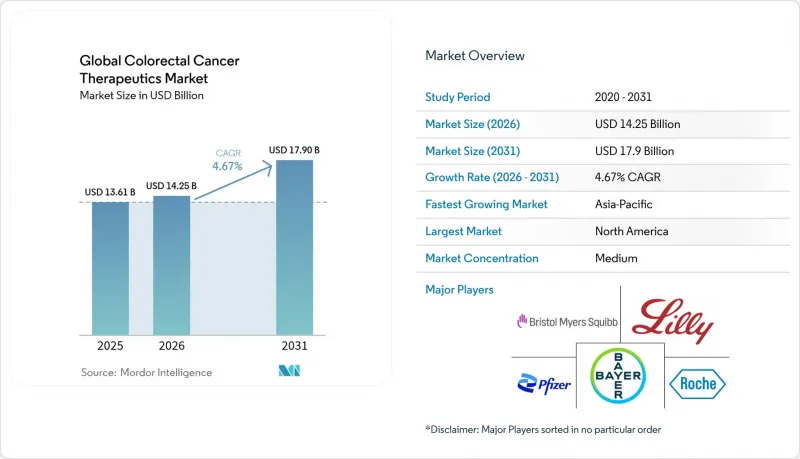
본 보고서는 치료법별(면역요법, 화학요법 등), 최종 사용자별(병원, 진료소 등), 지역별(북미, 유럽, 아시아태평양 등)로 분류되어 있습니다. 시장 규모 및 전망은 금액(달러)으로 표시되어 있습니다.
전 세계 대장암 치료제 시장 동향 및 인사이트
대장암 발병률 및 유병률의 상승
2040년까지 전 세계 발병률은 남성의 경우 약 10%, 여성의 경우 12% 상승할 것으로 예측되며, 사망률은 25% 이상 증가할 가능성이 있습니다. 아시아에서는 이미 인구 10만 명당 23.88이라는 가장 높은 연령 조정 발병률이 보고되고 있어, 해당 지역은 향후 중요한 수익원이 될 전망입니다. 대장암 치료제 시장의 성장은 정부 주도의 검진 확대와 발맞추고 있지만, 여전히 상당수의 인구가 검진을 받지 않고 있어 이로 인해 진행 단계에서의 진단과 의약품 수요가 증가하고 있습니다. 뿌리 깊은 생활 습관과 관련된 위험 요인과 고령화가 진행되는 인구 동향으로 인해 장기적인 치료 수요가 뒷받침되고 있으며, 대장암 치료제 시장은 안정적인 환자 기반에 힘입고 있습니다.
표적 치료 및 면역종양학 치료 분야의 획기적인 발전
니볼루맙과 이필리무맙의 병용 요법은 dMMR 전이성 질환에서 24개월 무악화 생존율 72%를 달성한 반면, 화학요법은 14%에 그쳤습니다. 도스탈리맙 단독 요법은 국소 진행성 dMMR 직장암에서 임상적 완전 반응률 100%를 달성하여, 주요 임상시험에서 치료를 받은 모든 환자의 수술을 불필요하게 만들었습니다. 아다그라시브와 세툭시맙 병용 요법 등 KRAS G12C 치료 요법은 난치성 사례에서 34%의 전체 반응률을 보였습니다. 이러한 데이터는 치료 알고리즘을 혁신하고 높은 가격 책정 여지를 유지함으로써 대장암 치료제 시장의 혁신 주기를 가속화하고 있습니다.
신규 생물학적 제제 및 면역관문억제제(IO) 병용 요법의 높은 비용
체크포인트 억제제를 이용한 치료 요법의 연간 비용은 종종 10만 달러를 초과하여, 가격에 민감한 의료 시스템에서 지불자의 예산에 부담을 주고 있습니다. 면역매개성 대장염은 치료를 받은 환자의 최대 8.6%에서 발생하며, 예상치 못한 지지 요법 비용 증가를 초래하고 있습니다. 지불을 치료 성과와 연계하는 ‘가치 기반 계약’이 확산되고 있으며, 이러한 추세로 인해 대장암 치료제 시장의 단기적인 수익 성장이 억제될 가능성이 있습니다.
부문 분석
2025년 시점에서 화학요법은 대장암 치료제 시장에서 47.55%의 점유율을 유지했으나, 면역요법은 2031년까지 연평균 성장률(CAGR) 14.21%를 기록하며 상당한 증가액를 얻을 것으로 전망됩니다. dMMR 직장암에서 도스탈리맙의 100% 반응률은 증거가 진료 지침을 재정의하고 있음을 상징합니다. 소트라시브나 아다그라시브와 같은 표적 억제제는 MSI-H 종양을 넘어 적용 범위를 확대하고 있으며, 바이오마커의 발견이 직접적인 수익으로 이어지고 있습니다. 바이오마커로 정의된 코호트에서 병용 요법이 1차 치료법으로 인정됨에 따라, 대장암 치료제 시장에서 면역요법 시장 규모는 2031년까지 2배 이상으로 증가할 것으로 예측됩니다.
파이프라인의 폭은 현재 세포 치료와 이중 특이성 항체에 의해 뒷받침되고 있습니다. GCC19-CART는 다제 내성 전이성 사례에서 40%의 객관적 반응률을 기록하며, 세포 면역 요법이 마이크로위성 안정형 질환에서 생존율을 향상시킬 가능성을 보여주고 있습니다. 순환 종양 DNA(ctDNA) 검사를 통한 미세 잔류 병변의 검출 정확도가 향상됨에 따라, 적응형 투여 모델을 통해 치료 기간이 연장되고, 대장암 치료제 시장의 지출이 유지될 것으로 전망됩니다.
지역별 분석
북미는 2025년 매출의 42.35%를 차지하며, 이는 CMS(미국 의료보험센터)의 고급 선별 검사 보험 적용 및 검사에서 임상 적용까지의 시간을 단축하는 FDA(미국 식품의약국)의 신속 승인이 뒷받침하고 있습니다. 지역 내 보험사들은 바이오마커 검사를 장려하며, 정밀 의학을 표준 치료에 통합함으로써 대장암 치료제 시장에서 북미의 리더십을 강화하고 있습니다. 학술 기관들의 탄탄한 임상시험 포트폴리오가 퍼스트-인-클래스(First-in-Class) 약물의 보급을 촉진하여, 이 지역을 세계 진출의 교두보로 삼고 있습니다.
아시아태평양은 연평균 성장률(CAGR) 9.46%를 기록하며 가장 빠르게 성장하고 있는 지역입니다. 발병률 상승, 도시화에 따른 위험 요인, 그리고 점진적인 헬스케어 투자가 검사 건수 확대를 뒷받침하고 있습니다. 중국에서 개정된 대장암 진료 지침은 서유럽의 정밀의료 기준을 반영하고 있으며, 이러한 일관성 덕분에 대장암 치료제 시장에서 수십억 달러 규모의 잠재 수요가 창출될 것으로 예측됩니다. 그러나 선별 검사의 보급률은 여전히 낮은 상황입니다. 태국의 보고에 따르면, 대상 성인의 58.8%가 한 번도 선별 검사를 받은 적이 없으며, 이는 진단약과 치료제 모두에서 미개척 수요가 존재함을 보여줍니다.
유럽에서는 유럽의약품청(EMA)의 승인을 바탕으로 꾸준한 성장이 예상됩니다. 2024년에는 28종의 항암제가 승인되었으며, 그중에는 난치성 질환에서 플루퀸티닙의 무악화 생존 기간 우월성을 입증한 제품도 포함되어 있습니다. 의료비 억제 정책에 따라 바이오시밀러 도입이 촉진되고 있으며, 예산이 혁신적인 치료법으로 재분배되고 있습니다. 한편, 중동 및 아프리카 및 남미에서는 바이오시밀러와 필수 의약품을 우선시하는 민관 파트너십을 통해 체계 정비가 진행되고 있어, 대장암 치료제 시장에서 점차 입지를 넓혀가고 있습니다.
기타 혜택:
- 엑셀 형식 시장 예측(ME) 시트
- 3개월간 애널리스트의 지원
목차
제1장 서론
제2장 조사 방법
제3장 주요 요약
제4장 시장 구도
제5장 시장 규모와 성장 예측
제6장 경쟁 구도
제7장 시장 기회와 향후 전망
JHSAccording to Mordor Intelligence, the colorectal cancer therapeutics market size is expected to grow from USD 13.61 billion in 2025 to USD 14.25 billion in 2026 and is forecast to reach USD 17.9 billion by 2031 at 4.67% CAGR over 2026-2031.
This report is Segmented by Therapy (Immunotherapy, Chemotherapy, and More), by End User (Hospital, Clinics, and More), and Geography (North America, Europe, Asia-Pacific, and More). The Market Sizes and Forecasts are Provided in Terms of Value (USD).
Global Colorectal Cancer Therapeutics Market Trends and Insights
Rising Incidence & Prevalence of Colorectal Cancer
Global incidence is projected to climb nearly 10% in men and 12% in women by 2040, while mortality could rise more than 25%. Asia already reports the highest age-standardized rate at 23.88 per 100,000 population, positioning the region as a vital future revenue pool. Growth in the colorectal cancer therapeutics market aligns with government-led screening expansion, yet sizable populations remain unscreened, sustaining late-stage diagnoses and drug demand. Persistent lifestyle risk factors and aging demographics reinforce long-haul therapy volumes, anchoring the colorectal cancer therapeutics market to a durable patient base.
Breakthroughs in Targeted & Immune-Oncology Modalities
Nivolumab plus ipilimumab delivered 72% 24-month progression-free survival in dMMR metastatic disease versus 14% for chemotherapy. Dostarlimab monotherapy achieved a 100% clinical complete response in locally advanced dMMR rectal cancer, eliminating surgery for every treated patient in a pivotal trial. KRAS G12C regimens such as adagrasib plus cetuximab showed a 34% overall response in refractory settings. These data are resetting treatment algorithms and maintaining premium pricing latitude, intensifying innovation cycles inside the colorectal cancer therapeutics market.
High Cost of Novel Biologics & IO Combinations
Checkpoint regimens frequently exceed USD 100,000 annually, straining payer budgets in price-sensitive systems. Immune-mediated colitis affects up to 8.6% of treated patients, adding unplanned supportive-care outlays. Value-based contracting is gaining traction to align payment with outcomes, a trend that may temper near-term revenue growth for the colorectal cancer therapeutics market.
Other drivers and restraints analyzed in the detailed report include:
- Expanded Reimbursement for Biomarker-Guided Therapies
- Microbiome-Modulating Adjuvants Boosting Drug Response
- Severe Toxicity & QoL Trade-Offs Limiting Compliance
For complete list of drivers and restraints, kindly check the Table Of Contents.
Segment Analysis
Chemotherapy sustained a 47.55% colorectal cancer therapeutics market share in 2025, yet immunotherapy is set to capture outsized incremental value through a 14.21% CAGR to 2031. Dostarlimab's 100% response in dMMR rectal cancer is emblematic of evidence rewriting practice guidelines. Targeted inhibitors such as sotorasib and adagrasib are broadening applicability beyond MSI-H tumors, translating biomarker discovery directly into revenue. The colorectal cancer therapeutics market size for immunotherapy is forecast to more than double by 2031 as combination protocols earn first-line status in biomarker-defined cohorts.
Pipeline breadth is now anchored in cell-based modalities and bispecific antibodies. GCC19CART recorded 40% objective responses in heavily pre-treated metastatic cases, illustrating how cellular immunotherapies could lift survival in microsatellite-stable disease. As assays for circulating tumor DNA sharpen minimal-residual-disease detection, adaptive dosing models will extend treatment duration, sustaining spending inside the colorectal cancer therapeutics market.
Complete Report Scope:
- By Therapy
- Immunotherapy
- Chemotherapy
- Targeted Therapy
- Combination Therapy
- By End User
- Hospitals and Clinics
- Cancer Research Centers
- Others
- By Geography
- North America
- United States
- Canada
- Mexico
- Europe
- Germany
- United Kingdom
- France
- Italy
- Spain
- Rest of Europe
- Asia Pacific
- China
- Japan
- India
- South Korea
- Australia
- Rest of Asia Pacific
- Middle East and Africa
- GCC
- South Africa
- Rest of Middle East and Africa
- South America
- Brazil
- Argentina
- Rest of South America
- North America
Geography Analysis
North America accounted for 42.35% of 2025 revenue, supported by CMS coverage of advanced screenings and rapid FDA approvals that compress time from lab to clinic. Regional payers champion biomarker testing, embedding precision therapy into standard of care and reinforcing North American leadership within the colorectal cancer therapeutics market. Academic centers' dense trial portfolios catalyze first-in-class uptake, turning the region into a launchpad for global rollouts.
Asia Pacific is the fastest-growing territory with a 9.46% CAGR. Rising incidence, urbanization-linked risk factors, and stepwise healthcare investment fuel volume expansion. China's updated colorectal guidelines mirror Western precision-medicine standards, an alignment expected to unlock multi-billion-dollar potential in the colorectal cancer therapeutics market. Yet screening penetration remains low; Thailand reports that 58.8% of eligible adults have never undergone a screening test, representing untapped demand for both diagnostics and therapies.
Europe delivers steady growth underpinned by EMA approvals; 28 oncology products gained clearance in 2024, including fruquintinib's progression-free survival advantage in refractory disease. Cost-containment frameworks encour-age biosimilar adoption, redistributing budgets toward high-innovation regimens. Meanwhile, Middle East & Africa and South America build capacity through public-private partnerships that prioritize biosimilars and essential medicines, gradually enlarging their presence in the colorectal cancer therapeutics market.
List of Companies Covered in this Report:
- Roche
- Pfizer
- Bayer
- Bristol-Myers Squibb
- Eli Lilly and Company
- Merck
- Amgen
- Takeda Pharmaceuticals
- Sanofi
- Teva Pharmaceutical Industries
- Regeneron Pharmaceuticals
- Genentech
- Merck
- Novartis
- Abbvie
- AstraZeneca
Additional Benefits:
- The market estimate (ME) sheet in Excel format
- 3 months of analyst support
TABLE OF CONTENTS
1 Introduction
- 1.1 Study Assumptions & Market Definition
- 1.2 Scope of the Study
2 Research Methodology
3 Executive Summary
4 Market Landscape
- 4.1 Market Overview
- 4.2 Market Drivers
- 4.2.1 Rising Incidence & Prevalence Of Colorectal Cancer
- 4.2.2 Breakthroughs In Targeted & Immune-Oncology Modalities
- 4.2.3 Expanded Reimbursement For Biomarker-Guided Therapies
- 4.2.4 Microbiome-Modulating Adjuvants Boosting Drug Response
- 4.2.5 AI-Enabled Early Detection Accelerating Therapy Starts
- 4.2.6 Biosimilar MAbs Price-Led Adoption In Emerging Markets
- 4.3 Market Restraints
- 4.3.1 High Cost Of Novel Biologics & IO Combinations
- 4.3.2 Severe Toxicity & QoL Trade-Offs Limiting Compliance
- 4.3.3 Narrow MSI-H Pool Curbing Checkpoint-Inhibitor
- 4.3.4 API Supply-Chain Fragility For Key Chemo Agents
- 4.4 Supply-Chain Analysis
- 4.5 Regulatory Landscape
- 4.6 Technological Outlook
- 4.7 Porter's Five Forces Analysis
- 4.7.1 Threat of New Entrants
- 4.7.2 Bargaining Power of Buyers
- 4.7.3 Bargaining Power of Suppliers
- 4.7.4 Threat of Substitutes
- 4.7.5 Intensity of Competitive Rivalry
5 Market Size & Growth Forecasts (Value)
- 5.1 By Therapy
- 5.1.1 Immunotherapy
- 5.1.2 Chemotherapy
- 5.1.3 Targeted Therapy
- 5.1.4 Combination Therapy
- 5.2 By End User
- 5.2.1 Hospitals and Clinics
- 5.2.2 Cancer Research Centers
- 5.2.3 Others
- 5.3 By Geography
- 5.3.1 North America
- 5.3.1.1 United States
- 5.3.1.2 Canada
- 5.3.1.3 Mexico
- 5.3.2 Europe
- 5.3.2.1 Germany
- 5.3.2.2 United Kingdom
- 5.3.2.3 France
- 5.3.2.4 Italy
- 5.3.2.5 Spain
- 5.3.2.6 Rest of Europe
- 5.3.3 Asia Pacific
- 5.3.3.1 China
- 5.3.3.2 Japan
- 5.3.3.3 India
- 5.3.3.4 South Korea
- 5.3.3.5 Australia
- 5.3.3.6 Rest of Asia Pacific
- 5.3.4 Middle East and Africa
- 5.3.4.1 GCC
- 5.3.4.2 South Africa
- 5.3.4.3 Rest of Middle East and Africa
- 5.3.5 South America
- 5.3.5.1 Brazil
- 5.3.5.2 Argentina
- 5.3.5.3 Rest of South America
- 5.3.1 North America
6 Competitive Landscape
- 6.1 Market Concentration
- 6.2 Market Share Analysis
- 6.3 Company Profiles (includes Global level Overview, Market level overview, Core Segments, Financials as available, Strategic Information, Market Rank/Share for key companies, Products & Services, and Recent Developments)
- 6.3.1 F. Hoffmann-La Roche Ltd
- 6.3.2 Pfizer Inc.
- 6.3.3 Bayer AG
- 6.3.4 Bristol-Myers Squibb Co.
- 6.3.5 Eli Lilly and Company
- 6.3.6 Merck & Co., Inc.
- 6.3.7 Amgen Inc.
- 6.3.8 Takeda Pharmaceutical Co. Ltd
- 6.3.9 Sanofi
- 6.3.10 Teva Pharmaceutical Industries Ltd
- 6.3.11 Regeneron Pharmaceuticals Inc.
- 6.3.12 Genentech Inc.
- 6.3.13 Merck KGaA
- 6.3.14 Novartis AG
- 6.3.15 AbbVie Inc.
- 6.3.16 AstraZeneca plc
7 Market Opportunities & Future Outlook
- 7.1 White-space & Unmet-need Assessment