

|
시장보고서
상품코드
2116531
주의력결핍 과잉행동장애(ADHD) : 시장 점유율 분석, 업계 동향 및 통계, 성장 예측(2026-2031년)Attention Deficit Hyperactivity Disorder - Market Share Analysis, Industry Trends & Statistics, Growth Forecasts (2026 - 2031) |
||||||
 Mordor Intelligence
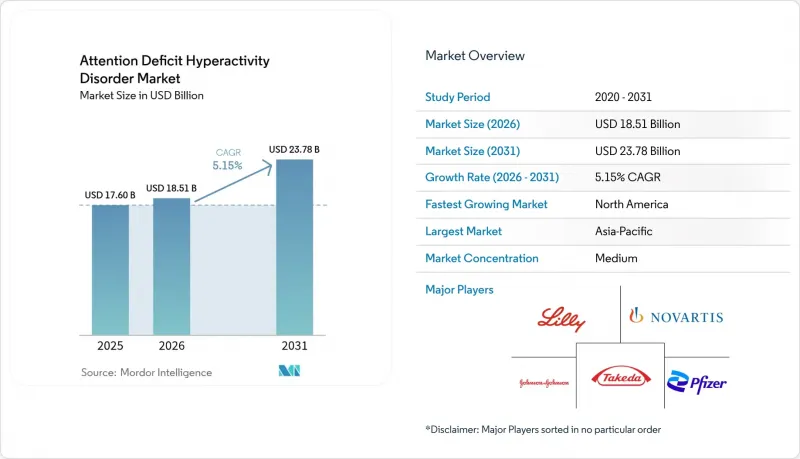
주의력결핍 과잉행동장애(ADHD) 시장 규모는 2025년에 176억 달러로 평가되었습니다. 2026년 185억 1,000만 달러에서 2031년까지 237억 8,000만 달러에 이를 것으로 예상되며, 예측 기간(2026-2031년) CAGR은 5.15%를 나타낼 전망입니다.
본 보고서는 약물 유형(자극제 및 비자극제), 연령대(소아(17세 이하) 및 성인(18세 이상)), 유통 채널(소매 약국, 병원 약국, 온라인 약국), 지역(북미, 유럽, 아시아태평양, 중동 및 아프리카, 남미)별로 분류되어 있습니다. 시장 전망은 금액(달러) 기준으로 제시되어 있습니다.
세계의 주의력결핍 과잉행동장애(ADHD) 시장 동향 및 인사이트
전 세계 ADHD 유병률 상승
세계 유병률은 계속 증가하고 있습니다. 2023년에는 미국 3-17세 소아의 12.0%가 ADHD로 진단받았으나, 이러한 증가는 급격한 병리학적 변화에 기인한 것이 아니라 진단 기준의 정교화에 기인한 것입니다. 미국의 성인 진단 건수는 1,550만 명을 넘어섰으며, 그 절반은 18세 이후에 확인된 것으로, 오랜 기간 동안 인식이 부족했음을 여실히 보여줍니다. 중국의 학령기 유병률은 6.4%에 달하며, 모델 예측에 따르면 2029년에 환자 수가 정점에 달할 것으로 예상되어 신흥 경제국에서 상당한 잠재 수요가 있음을 시사합니다. 유병률의 상승은 처방량과 연동되어 있으며, 미국의 각성제 처방 건수는 2012년부터 2022년까지 57.9% 증가하여, 모든 치료제 범주에 걸쳐 수요가 지속되고 있습니다.
인식 제고 및 선별 검사 노력
1차 진료 임상의들은 검증된 선별 도구를 점점 더 많이 활용하고 있으며, 전문의에게 의뢰하는 데 걸리는 시간을 단축하고 있습니다. 미국 ADHD 및 관련 장애 전문의 협회(American Professional Society for ADHD and Related Disorders)는 미국 최초의 성인용 지침을 최종 조정 중이며, 이는 표준화된 평가 과정에서 오랫동안 존재해 온 공백을 메울 것입니다. 원격 의료는 접근성을 확대되고 있습니다. 2024년에는 진단을 받은 성인의 46%가 온라인 진료를 이용했으며, 30.5%가 온라인으로 처방전을 받았습니다. 캐나다의 보험 청구 데이터에 따르면, 2024년 ADHD 치료제에 대한 보험 환급액은 20% 증가했으며, 이는 ADHD에 대한 인식이 가속화되고 있음을 보여주는 지표입니다.
진단상의 과제와 인식 부족
주관적인 증상 평가나 불안 장애·기분 장애와의 중복으로 인해 명확한 진단이 어려워지고 있습니다. 바이오마커가 존재하지 않기 때문에 임상의는 여러 정보원에 기반한 평가 척도에 의존할 수밖에 없으며, 그 결과 위음성이나 위양성이 발생하고 있습니다. miR-140-3p 등 순환 마이크로RNA에 관한 연구는 진전되고 있으나, 일상적인 사용까지는 아직 수년이 소요될 것으로 예측됩니다. 특히 자원이 제한된 환경에 있는 1차 의료 제공업체들은 성인 환자에 대한 평가에 대한 자신감이 낮다고 보고하고 있으며, 이로 인해 미충족 의료 수요가 장기화되고 있습니다. 아시아태평양에서는 문화적 낙인이 지원을 구하려는 태도를 더욱 저해하고 있으며, 인식 제고 활동이 진행되고 있음에도 불구하고 주의력결핍 과잉행동장애(ADHD) 치료제 시장 침투를 지연시키고 있습니다.
부문별 분석
2025년 매출의 67.88%를 자극제 제품이 차지하고 있으며, 이는 이 제품들의 확고한 효능과 처방 의사의 높은 인지도를 보여줍니다. 반면, 안전성을 중시하는 임상의들이 오용 위험이 낮은 약물을 찾는 가운데, 비자극제는 연평균 성장률(CAGR) 7.32%를 기록하며 주의력결핍 과잉행동장애(ADHD) 시장 전체의 성장률을 상회했습니다. 2024년 리스덱스암페타민의 특허 만료로 인해 제네릭 의약품과의 경쟁이 본격화되었습니다. Granules India사와 Lupin사는 FDA 승인을 획득하여 비용을 중시하는 구매자들에게 제품을 공급하고 있습니다. DEA의 생산 제한이 암페타민 공급에 압박을 가하면서, 처방 의사들은 비록사진이나 구안파신과 같은 대체 약물로 눈을 돌리고 있습니다.
슈퍼나스 파마슈티컬스(Supernas Pharmaceuticals)는 2024년 ‘켈브리(Qelbree)’의 매출이 전년 대비 72% 증가한 2억 4,130만 달러에 달했다고 보고했으며, 이는 새로운 비자극제 작용기전이 견조하게 받아들여지고 있음을 보여줍니다. 아토목세틴의 사용은 다른 지역에서의 로트 리콜에도 불구하고 안정적인 양상을 보였으며, 이는 1일 1회 투여 옵션에 대한 지속적인 수요가 있음을 여실히 보여주었습니다. 액상 클로니딘(오니다 XR)은 소아 보호자들에게 등교 시간대의 투약이라는 어려움을 피할 수 있는 야간 투여 요법을 제공합니다. 그 결과, 주의력결핍 과잉행동장애(ADHD) 치료제 시장에서 비자극제 시장 규모는 2031년까지 모든 하위 카테고리 중 가장 빠른 속도로 확대될 것으로 예측됩니다.
지역별 분석
북미는 2025년 매출의 42.02%를 차지했으며 계속해서 핵심 지역으로 남아 있을 것입니다. 2023년, 미국 약국에서는 4,500만 건의 자극제 처방전이 조제되었으며, 이는 2019년의 3,550만 건에서 증가한 것으로, 임상 현장에서 광범위하게 채택되고 있음을 보여줍니다. 캐나다에서는 각 주가 보험 적용 범위를 확대하고 접근성을 강화한 결과, 2024년 보험 청구 건수가 20% 증가했습니다. 이 지역의 혁신 수준은 특히 주목할 만하며, 퍼스트-인-클래스 승인 제품(Onyda XR, 소리암페톨, CTx-1301)의 대부분이 이곳에서 개발되었거나 임상시험이 진행된 것으로, 파이프라인의 우위를 입증하고 있습니다.
유럽은 구조적으로는 성숙한 시장이지만, 규제가 엄격한 환경입니다. 팬데믹 이후 2022년까지 처방량은 코로나19 이전의 예측치를 16.4% 상회하여, 약물 치료에 대한 사회적 수용도가 높아지고 있음을 보여주었습니다. EMA의 ‘Paxneury’ 및 ‘Tuzulby’ 승인으로, 소아 치료 알고리즘에 구안파신 및 서방형 메틸페니데이트가 선택지로 추가되었습니다. 독일은 디지털 치료제 분야를 주도하고 있으며, EndeavorRx는 CE 마크와 보험 환급 코드를 획득하여 도입 과정을 가속화하고 있습니다.
아시아태평양은 정책 자유화와 인구 도시화에 힘입어 6.42%라는 가장 높은 연평균 성장률(CAGR)을 기록하고 있습니다. 일본 정부가 지원하는 생명공학에 대한 우대 조치는 신경과학 분야의 스타트업을 활성화하고 임상시험 수용 능력을 확대되고 있습니다. 중국의 소아 유병률은 6.4%이며, 전국적으로 선별 검사가 확대됨에 따라 수천만 명에 달하는 잠재적 환자 수에 해당합니다. 인도의 제약 기업들은 제네릭 의약품 ‘Vyvanse’ 등의 FDA 승인을 활용하여 전 세계적으로 저렴한 대안을 공급함으로써, 해당 지역의 치료에 따른 경제적 부담을 경감시키고 있습니다. 남아 있는 과제로는 농촌 지역의 의료 격차와 뿌리 깊은 사회적 편견 등이 꼽히지만, 디지털 문해력 향상을 통해 일부 장벽은 완화되고 있으며, 주의력결핍 과잉행동장애(ADHD) 치료 시장은 우선 대도시권에서 착실히 보급된 후, 이후 지방 도시로 확대될 것으로 예측됩니다.
기타 혜택 :
- 엑셀 형식 시장 예측(ME) 시트
- 3개월간의 애널리스트 지원
자주 묻는 질문
목차
제1장 서론
제2장 조사 방법
제3장 개요
제4장 시장 구도
제5장 시장 규모 및 성장 예측
제6장 경쟁 구도
제7장 시장 기회 및 향후 전망
KTH 26.08.31According to Mordor Intelligence, the attention deficit hyperactivity disorder market size was valued at USD 17.60 billion in 2025 and estimated to grow from USD 18.51 billion in 2026 to reach USD 23.78 billion by 2031, at a CAGR of 5.15% during the forecast period (2026-2031).
This report is Segmented by Drug Type (Stimulant and Non-Stimulant), Age Group (Children (<=17 Years) and Adults (>=18 Years)), Distribution Channel (Retail Pharmacy, Hospital Pharmacy, and Online Pharmacy), Geography (North America, Europe, Asia-Pacific, The Middle East and Africa, and South America). The Market Forecasts are Provided in Terms of Value (USD).
Global Attention Deficit Hyperactivity Disorder Market Trends and Insights
Rising ADHD Prevalence Worldwide
Global prevalence continues climbing: 12.0% of U.S. children aged 3-17 had an ADHD diagnosis in 2023, an uptick that stems from refined diagnostic criteria rather than sudden pathological change. Adult diagnoses pass 15.5 million in the United States, half confirmed after age 18, underscoring long-standing underrecognition. China's school-age prevalence reached 6.4%, with modelling indicating a peak caseload in 2029, signalling sizeable latent demand in emerging economies. Climbing prevalence syncs with prescription volumes; U.S. stimulant scripts rose 57.9% from 2012-2022, sustaining demand across therapeutic classes.
Growing Awareness and Screening Initiatives
Primary-care clinicians increasingly deploy validated screeners, trimming referral delays. The American Professional Society for ADHD and Related Disorders is finalising the first U.S. adult guideline, closing a long-standing gap in standardised assessment pathways. Telehealth broadens access: 46% of diagnosed adults used virtual consultations in 2024 and 30.5% secured prescriptions online. Canadian claims data show a 20% jump in ADHD medication reimbursements during 2024, an indicator of accelerated recognition.
Diagnostic Challenges and Underrecognition
Subjective symptom scoring and overlap with anxiety or mood disorders complicate clear-cut diagnosis. Absence of a biomarker forces clinicians to rely on multi-informant scales, generating both false negatives and false positives. Research on circulating micro-RNAs such as miR-140-3p advances but is years from routine use. Primary-care providers, especially in resource-limited settings, report low confidence in adult assessment, perpetuating unmet need. Cultural stigma further depresses help-seeking in Asia-Pacific, slowing attention deficit hyperactivity disorder market penetration despite public awareness drives.
Other drivers and restraints analyzed in the detailed report include:
- Advancements in Pharmacotherapy and Formulations
- Expanding Adult Patient Segment via Telehealth
- High Abuse Liability and Safety Concerns of Stimulants
For complete list of drivers and restraints, kindly check the Table Of Contents.
Segment Analysis
Stimulant products generated 67.88% of 2025 revenue, illustrating entrenched efficacy and prescriber familiarity. Yet non-stimulants logged a 7.32% CAGR, exceeding total attention deficit hyperactivity disorder market growth as safety-minded clinicians search for lower diversion risk. Lisdexamfetamine's patent expiry in 2024 unlocked generic competition; Granules India and Lupin secured FDA approvals, supplying cost-sensitive buyers. DEA production caps pressured amphetamine supply, nudging prescribers toward alternatives such as viloxazine and guanfacine.
Supernus Pharmaceuticals reported Qelbree sales of USD 241.3 million in 2024, a 72% jump year-on-year, signalling robust uptake of novel non-stimulant mechanisms. Atomoxetine use remained steady despite batch recalls elsewhere, underlining persistent need for once-daily options. Liquid clonidine (Onyda XR) now offers paediatric caregivers a nocturnal regimen that circumvents school-time dosing hurdles. Consequently, the attention deficit hyperactivity disorder market size for non-stimulants is forecast to expand faster than any subcategory through 2031.
Complete Report Scope:
- By Drug Type
- Stimulant
- Amphetamine
- Methylphenidate
- Dextroamphetamine
- Dexmethylphenidate
- Lisdexamfetamine Dimesylate
- Non-Stimulant
- Atomoxetine
- Bupropion
- Guanfacine
- Clonidine
- Stimulant
- By Age Group
- Children (<17 Years)
- Adults (>18 Years)
- By Distribution Channel
- Retail Pharmacy
- Hospital Pharmacy
- Online Pharmacy
- Geography
- North America
- United States
- Canada
- Mexico
- Europe
- Germany
- United Kingdom
- France
- Italy
- Spain
- Rest of Europe
- Asia-Pacific
- China
- Japan
- India
- Australia
- South Korea
- Rest of Asia-Pacific
- Middle East & Africa
- GCC
- South Africa
- Rest of Middle East & Africa
- South America
- Brazil
- Argentina
- Rest of South America
- North America
Geography Analysis
North America, with 42.02% 2025 revenue, remains the anchoring geography. In 2023, U.S. pharmacies dispensed 45 million stimulant prescriptions, up from 35.5 million in 2019, indicating pervasive clinical adoption. Canada's claim volumes climbed 20% in 2024 after provinces widened coverage, reinforcing access. Regional innovation depth is notable: most first-in-class approvals-Onyda XR, solriamfetol, CTx-1301-originated or were trialled here, underscoring a pipeline advantage.
Europe offers a structurally mature but controlled environment. Post-pandemic, prescription volumes ran 16.4% above pre-COVID forecasts by 2022, signalling greater societal comfort with pharmacologic care. The EMA's green lights for Paxneury and Tuzulby added guanfacine and extended-release methylphenidate choices to paediatric algorithms. Germany spearheads digital therapeutics; EndeavorRx secured CE marking and a reimbursement code, accelerating adoption pathways.
Asia-Pacific delivers the fastest 6.42% CAGR, lifted by policy liberalisation and urbanising populations. Japan's government-backed biotech incentives catalyse neuroscience start-ups, widening clinical trial capacity. China's 6.4% paediatric prevalence equates to tens of millions of potential patients as screening scales nationally. India's manufacturers leverage FDA approvals-such as generic Vyvanse-to supply lower-priced options globally, reinforcing regional affordability. Remaining hurdles include rural service gaps and persisting stigma, but rising digital literacy mitigates some obstacles, suggesting the attention deficit hyperactivity disorder market will experience steady diffusion across megacities first, then into secondary centres.
- Takeda Pharmaceutical Co. (Shire)
- Novartis
- Johnson & Johnson
- Eli Lilly and Company
- Pfizer
- Mallinckrodt plc
- Supernus Pharmaceuticals
- Aytu BioPharma (NEOS Therapeutics)
- Ironshore Pharmaceuticals
- KemPharm Inc. (Corium)
- Tris Pharma
- Aurobindo Pharma
- Lupin
- Otsuka
- Hisamitsu Pharma (Noven)
- Purdue Pharma (Adlon)
- Corium
- Sun Pharmaceutical Inds.
- Amneal Pharmaceuticals
- H. Lundbeck
- Shionogi & Co. Ltd.
- Rhodes Pharmaceuticals
Additional Benefits:
- The market estimate (ME) sheet in Excel format
- 3 months of analyst support
TABLE OF CONTENTS
1 Introduction
- 1.1 Study Assumptions & Market Definition
- 1.2 Scope of the Study
2 Research Methodology
3 Executive Summary
4 Market Landscape
- 4.1 Market Overview
- 4.2 Market Drivers
- 4.2.1 Rising ADHD Prevalence Worldwide
- 4.2.2 Growing Awareness and Screening Initiatives
- 4.2.3 Advancements in Pharmacotherapy and Formulations
- 4.2.4 Supportive Reimbursement and Coverage Policies
- 4.2.5 Expanding Adult Patient Segment Via Telehealth
- 4.2.6 Integration of Digital Therapeutics with Medication
- 4.3 Market Restraints
- 4.3.1 Diagnostic Challenges and Underrecognition
- 4.3.2 High Abuse Liability and Safety Concerns of Stimulants
- 4.3.3 Strict Regulatory Controls on Controlled Substances
- 4.3.4 Cost Containment Pressures from Healthcare Payers
- 4.4 Regulatory Landscape
- 4.5 Porter's Five Forces Analysis
- 4.5.1 Threat Of New Entrants
- 4.5.2 Bargaining Power Of Buyers
- 4.5.3 Bargaining Power Of Suppliers
- 4.5.4 Threat Of Substitutes
- 4.5.5 Competitive Rivalry Intensity
5 Market Size & Growth Forecasts (Value, USD)
- 5.1 By Drug Type
- 5.1.1 Stimulant
- 5.1.1.1 Amphetamine
- 5.1.1.2 Methylphenidate
- 5.1.1.3 Dextroamphetamine
- 5.1.1.4 Dexmethylphenidate
- 5.1.1.5 Lisdexamfetamine Dimesylate
- 5.1.2 Non-Stimulant
- 5.1.2.1 Atomoxetine
- 5.1.2.2 Bupropion
- 5.1.2.3 Guanfacine
- 5.1.2.4 Clonidine
- 5.1.1 Stimulant
- 5.2 By Age Group
- 5.2.1 Children (<17 Years)
- 5.2.2 Adults (>18 Years)
- 5.3 By Distribution Channel
- 5.3.1 Retail Pharmacy
- 5.3.2 Hospital Pharmacy
- 5.3.3 Online Pharmacy
- 5.4 Geography
- 5.4.1 North America
- 5.4.1.1 United States
- 5.4.1.2 Canada
- 5.4.1.3 Mexico
- 5.4.2 Europe
- 5.4.2.1 Germany
- 5.4.2.2 United Kingdom
- 5.4.2.3 France
- 5.4.2.4 Italy
- 5.4.2.5 Spain
- 5.4.2.6 Rest of Europe
- 5.4.3 Asia-Pacific
- 5.4.3.1 China
- 5.4.3.2 Japan
- 5.4.3.3 India
- 5.4.3.4 Australia
- 5.4.3.5 South Korea
- 5.4.3.6 Rest of Asia-Pacific
- 5.4.4 Middle East & Africa
- 5.4.4.1 GCC
- 5.4.4.2 South Africa
- 5.4.4.3 Rest of Middle East & Africa
- 5.4.5 South America
- 5.4.5.1 Brazil
- 5.4.5.2 Argentina
- 5.4.5.3 Rest of South America
- 5.4.1 North America
6 Competitive Landscape
- 6.1 Market Concentration
- 6.2 Market Share Analysis
- 6.3 Company Profiles (includes Global level Overview, Market level overview, Core Business Segments, Financials, Headcount, Key Information, Market Rank, Market Share, Products and Services, and analysis of Recent Developments)
- 6.3.1 Takeda Pharmaceutical Co. (Shire)
- 6.3.2 Novartis AG
- 6.3.3 Johnson & Johnson (Janssen)
- 6.3.4 Eli Lilly & Co.
- 6.3.5 Pfizer Inc.
- 6.3.6 Mallinckrodt plc
- 6.3.7 Supernus Pharmaceuticals
- 6.3.8 Aytu BioPharma (NEOS Therapeutics)
- 6.3.9 Ironshore Pharmaceuticals
- 6.3.10 KemPharm Inc. (Corium)
- 6.3.11 Tris Pharma
- 6.3.12 Aurobindo Pharma
- 6.3.13 Lupin Ltd.
- 6.3.14 Otsuka Holdings
- 6.3.15 Hisamitsu Pharma (Noven)
- 6.3.16 Purdue Pharma (Adlon)
- 6.3.17 Corium Inc.
- 6.3.18 Sun Pharmaceutical Inds.
- 6.3.19 Amneal Pharmaceuticals
- 6.3.20 H. Lundbeck A/S
- 6.3.21 Shionogi & Co. Ltd.
- 6.3.22 Rhodes Pharmaceuticals
7 Market Opportunities & Future Outlook
- 7.1 White-space & Unmet-need Assessment


