

|
시장보고서
상품코드
2116536
의치 시장 : 점유율 분석, 업계 동향과 통계, 성장 예측(2026-2031년)Dentures - Market Share Analysis, Industry Trends & Statistics, Growth Forecasts (2026 - 2031) |
||||||
 Mordor Intelligence
Mordor Intelligence에 의하면, 세계의 의치 시장 규모는 2025년에 24억 4,000만 달러로 평가되었고 2026년 26억 달러에서 2031년까지 35억 6,000만 달러에 이를 것으로 예측되며, 예측 기간(2026-2031년) CAGR은 6.49%를 나타낼 전망입니다.
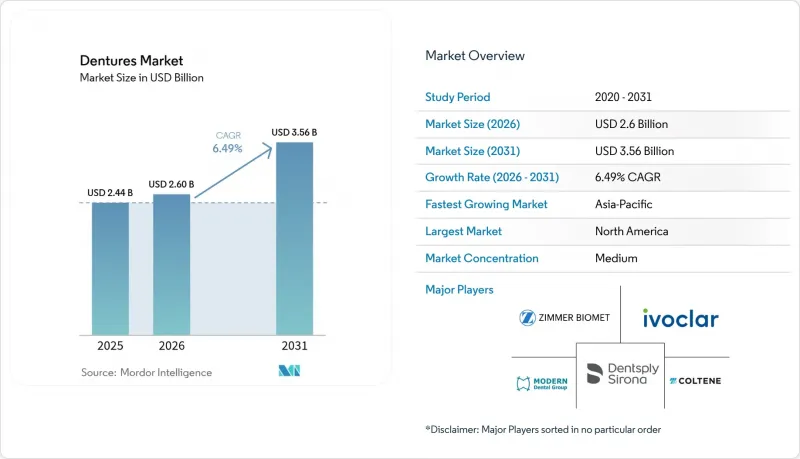
본 보고서는 제품 유형(전체 의치 등), 용도(고정식 및 탈착식), 제조 기술(기존 성형 방식 등), 소재(아크릴 수지 등), 최종 사용자(치과·병원 등), 지역(북미, 유럽, 아시아태평양, 중동 및 아프리카, 남미)별로 분류되어 있습니다. 시장 예측은 금액(달러) 기준으로 제시되어 있습니다.
전 세계 의치 시장 동향 및 인사이트
구강 질환 유병률 증가
만성 치주질환이나 치료되지 않은 충치로 인해 매년 수백만 명의 사람들이 계속해서 치아를 잃고 있으며, 예방 관리에 대한 투자가 이루어지고 있음에도 불구하고 무치악 상태가 여전히 광범위하게 퍼져 있기 때문에 의치 시장은 지지를 받고 있습니다. ‘세계 질병 부담(GBD)’ 평가에 따르면, 2050년까지 무치악 유병률이 계속해서 높은 수준을 유지할 것으로 예측되어, 의치 치료의 장기적인 중요성이 부각되고 있습니다. 현재 고령자 대상 구강 보건 프로그램에서는 복잡한 보철 치료의 필요성을 조기에 파악하는 다직종 협력을 통한 평가 모델이 채택되어, 더 많은 환자를 틀니 치료 과정으로 이끌고 있습니다. 또한, 구강 상태의 악화가 당뇨병이나 심혈관 질환 등 만성 질환과 관련이 있다는 증거도 있어, 적시 보철 치료의 시급성이 높아지고 있습니다. 일반적인 인식도 변화하고 있어, 성인의 91%가 치과 방문을 연 1회 건강검진과 동등하게 중요하다고 평가하고 있으며, 구강 치료가 예방 의학으로서 주목받고 있습니다. 아이러니하게도, 보다 광범위한 예방적 선별 검사를 통해 충족되지 않은 치아 보철 수요가 드러나면서, 환자를 의치를 통한 해결책으로 이끌고 있습니다.
고령 인구의 급격한 증가
65세 이상 성인은 의치의 주요 소비자층이며, 그 수는 다른 어떤 인구층보다 빠르게 증가하고 있습니다. 연구에 따르면, 부분 의치를 사용하는 고령자는 인지 기능 저하가 완만한 것으로 나타나, 치료에 의학적 의의가 더해지고 있습니다. 현재의 고령자들은 자연치를 더 오랫동안 유지하고 있지만, 일단 치아를 상실하면 삶의 질과 식사 자유에 대한 기대감으로 인해 디지털 기술을 활용해 제작된 고품질 틀니에 대한 수요가 높아지고 있습니다. 정책 입안자들도 틀니 치료를 단순한 미용 서비스가 아닌 필수적인 건강 유지 수단으로 인식하고 있으며, 이를 통해 보험 급여 체계 개선을 위한 길이 열리고 있습니다. 평균 수명이 늘어남에 따라 고령자가 기능적인 구강 재활을 필요로 하는 누적 기간도 길어지고 있으며, 의치 시장은 인구 고령화에 따른 구조적인 혜택을 받는 분야가 되고 있습니다.
높은 치료비와 제품 비용
제조 기술의 발전에도 불구하고, 진료 시간, 영상 진단, 경과 관찰을 포함한 총 치료비는 특히 보험 보급률이 낮은 지역에서 여전히 장벽으로 작용하고 있습니다. 기존의 메디케어에서는 여전히 일상적인 보철 치료가 보장 대상에서 제외되어 있어, 많은 고령자가 자비로 의치 치료를 받아야 하는 상황입니다. 메디케이드의 확대에 따라 미국의 특정 주에서는 접근성이 개선되었지만, 다른 주에서는 고정 소득을 가진 퇴직자들이 치료를 미루거나 아예 포기할 수밖에 없는 상황이 계속되고 있습니다. 소규모 치과 병원 역시 디지털 장비에 대한 설비 투자를 정당화하는 데 어려움을 겪고 있어, 첨단 치과 기공소와 기존 시설 간의 비용 격차를 더욱 확대시키고 있습니다. 유럽의 사회주의적 의료 제도에서도 예산 제약으로 인해 대기 명단이 발생하고 있으며, 환자들은 더 저렴하고 본인 부담금이 적은 해외 대안을 찾도록 내몰리고 있습니다.
부문 분석
2025년에는 전악 의치가 전 세계 매출의 63.72%를 차지했습니다. 이는 전악 수복이 필요한 다수의 무치악 환자층에 힘입은 결과입니다. 체계적 임상 검토에 따르면, 이 카테고리의 제품은 착용 후 1년 이내에 구강 건강과 관련된 삶의 질을 9% 이상 향상시킵니다. 디지털 워크플로우를 통해 확립된 교합 방식을 정확하게 재현할 수 있게 되면서, 치과의사와 환자들 사이에서 수용도가 높아지고 있습니다. ‘기타 유형’ 부문(주로 임플란트 지지형 오버덴처 및 고정식 하이브리드 보철물)은 임플란트 수술 비용이 저렴해짐에 따라 연평균 성장률(CAGR) 8.25%로 확대되고 있습니다. 뛰어난 안정성과 구토 반사의 완화가 주요 판매 포인트이며, 특히 높은 기능성을 추구하는 젊은 연령대의 무치악 환자에게 중요합니다. 전반적으로 환자의 기대 변화와 전문 분야를 초월한 협력을 통해 보철물 유형에 대한 선호도는 앞으로도 재편될 것으로 보이지만, 2031년까지는 총의치가 의치 시장에서 압도적인 지위를 유지할 것으로 예측됩니다.
하이브리드 솔루션의 수용 확대는 기존의 매출을 완전히 잠식하는 것은 아닙니다. 오히려, 그동안 탈착식 보철물에 회의적이었던 환자층을 흡수함으로써 의치 시장 규모를 확대되고 있습니다. 현재 많은 임상의들은 조직 컨디셔닝을 위해 완전 틀니로 시작하여, 골 리모델링이 안정된 후 임플란트 지지형으로 전환하는 2단계 치료 경로를 제공합니다. 이러한 단계적 접근 방식은 비용, 수술 위험 및 적응증 간의 균형을 맞추어 모든 소득 계층에 걸쳐 틀니 시장의 지속성을 보장하고 있습니다.
2025년에는 탈착식 보철물이 시장 점유율의 70.58%를 차지하며, 이는 비침습성과 즉각적인 가역성 덕분에 지지를 받고 있습니다. 디지털 인상 시스템은 구토 반사의 발생률을 낮추고 정확도를 높임으로써 환자의 주요 우려 사항을 해소하고 있습니다. 단가가 낮기 때문에 탈착식 의치는 보험 환급 제도의 주축이 되어, 공적 및 민간 의료 환경 모두에서 중요한 위치를 계속 차지하고 있습니다. 주로 임플란트 피처에 의존하는 고정식 치료는 새로운 미니 임플란트 프로토콜로 인해 적응증 환자층이 확대되고 있어 연평균 성장률(CAGR) 7.72%로 성장하고 있습니다. 저작 효율에 관한 연구에서는 고정식 보철물이 탈착식 의치보다 우수한 성능을 보인다는 점이 일관되게 보고되고 있지만, 정밀 어태치먼트와 소프트 라이너 소재의 개량을 통해 탈착식 의치의 안정성이 향상되면서 그 격차는 점차 좁혀지고 있습니다.
하이브리드 오버덴처는 이러한 융합을 상징합니다. 바나 로케이터 어태치먼트에 클립으로 고정되면서도, 위생 관리를 위해 매일 탈착할 수 있습니다. 이 모델은 고정식 시스템과 동등한 안정성을 확보하면서도, 탈착식 치료의 비용 대비 효과를 유지하고 있습니다. 임상의들이 체어사이드 CAD/CAM 시스템을 도입함에 따라 환자는 가상 착용 시뮬레이션을 체험할 수 있게 되었으며, 의치 시장 전반에서 두 유형 모두에 대한 신뢰도와 수용도가 높아지고 있습니다.
지역별 분석
북미는 보험 제도 개혁과 체어사이드 디지털 치과의 광범위한 도입에 힘입어 2025년에는 매출 점유율 42.11%로 의치 시장을 독점했습니다. 2025년에 시행되는 메디케어 규정 변경에 따라 전신 치료와 관련된 의학적으로 필요한 보철 치과 서비스가 환급 대상이 되어 경제적 장벽이 낮아질 것입니다. 마찬가지로, 9개 주에서 시행된 메디케이드의 성인 치과 혜택 확대도 접근성 확대에 기여하고 있습니다. 의치 제조업체들은 시스템 전반에 걸쳐 기술 업그레이드를 신속하게 전개하는 치과 지원 조직의 긴밀한 네트워크의 혜택을 누리며, 지역 내 주도적 입지를 강화하고 있습니다.
아시아태평양은 2031년까지 연평균 성장률(CAGR)이 7.74%로 가장 빠르게 성장하는 지역입니다. 중국에서는 급속한 고령화와 중산층 소득 증가가 판매량의 견조한 성장을 뒷받침하고 있는 반면, 현지 제조업체들은 국내 치과에 서비스를 제공하기 위해 구강 내 스캐너와 UV 경화형 레진의 도입을 가속화하고 있습니다. 스트라우만 그룹은 2024년 초, 스캐너 및 임플란트 지지형 오버덴처에 대한 수요 급증에 힘입어 해당 지역에서 전년 대비 82%의 성장을 기록했습니다. 동남아시아 국가들은 낮은 인건비를 활용하여 서유럽권 환자를 유치하기 위해 ‘관광과 틀니 치료를 결합한 패키지’를 추진하고 있습니다. 이러한 국경을 초월한 환자 왕래는 최첨단 치과 기공소 설비에 대한 투자를 촉진하고 있으며, 이는 지역 틀니 시장의 확대로 이어지는 선순환을 가져오고 있습니다.
유럽에서는 공적 의료보험 제도와 치과의사의 높은 기술 수준에 힘입어, 기술 주도형의 꾸준한 성장이 이어지고 있습니다. 2024년, 스트라우만(Straumann)사의 EMEA 부문에서 두 자릿수 유기적 성장을 이끈 것은 독일과 스페인의 치과 진료소였습니다. 유럽연합(EU)의 명확한 ‘의료기기 규정(MDR)’은 새로운 의치 재료의 승인 절차를 투명하게 하여 시장 출시를 가속화하고 있습니다. 한편, 남유럽 및 동유럽의 경제적 제약으로 인해 치료 결정까지의 기간이 길어지면서 아시아태평양에 비해 지역 전체의 연평균 성장률(CAGR)은 둔화되고 있지만, 디지털 치과의 보급률은 높은 수준을 유지하고 있습니다.
중동 및 아프리카 및 남미는 현재 시점에서 총 시장 점유율은 작지만, 도시화와 가처분 소득 증가를 통해 기회가 확대되고 있습니다. 서유럽 대학과의 치과대학 제휴를 통해 임상의의 역량이 향상되고 있으며, 장기적인 의치 시장 발전을 위한 기반이 마련되고 있습니다. 걸프협력회의(GCC) 회원국들의 정부 주도의 건강보험 시범 사업에서는 고정식 및 가철식 보철 치료가 대상에 포함되기 시작하여, 새로운 보험 적용 수요의 흐름을 시사하고 있습니다.
기타 혜택:
- 엑셀 형식 시장 예측(ME) 시트
- 3개월간의 애널리스트 지원
자주 묻는 질문
목차
제1장 서론
제2장 조사 방법
제3장 주요 요약
제4장 시장 구도
제5장 시장 규모와 성장 예측
제6장 경쟁 구도
제7장 시장 기회와 향후 전망
JHS 26.08.28According to Mordor Intelligence, the global dentures market size was valued at USD 2.44 billion in 2025 and estimated to grow from USD 2.6 billion in 2026 to reach USD 3.56 billion by 2031, at a CAGR of 6.49% during the forecast period (2026-2031).
This report is Segmented by Product Type (Complete Dentures, and More), Usage (Fixed and Removable), Manufacturing Technology (Conventional Molding, and More), Material (Acrylic Resin, and More), End User (Dental Clinics & Hospitals, and More), Geography (North America, Europe, Asia-Pacific, The Middle East and Africa, and South America). The Market Forecasts are Provided in Terms of Value (USD).
Global Dentures Market Trends and Insights
Increasing Prevalence of Oral Health Disorders
Chronic periodontal disease and untreated caries continue to push millions toward tooth loss each year, sustaining the dentures market as edentulism remains widespread despite preventive care investments. A Global Burden of Disease assessment projected persistent high edentulism prevalence through 2050, underscoring denture therapy's long-term relevance. Geriatric oral-health programs now use multidisciplinary assessment models that flag complex prosthodontic needs earlier, channeling more candidates into denture workflow. Evidence also links poor oral status with chronic conditions such as diabetes and cardiovascular disease, adding urgency for timely prosthetic rehabilitation. Public perception is shifting 91% of adults rate dental visits as vital as annual physical exams, spotlighting oral treatment as preventive medicine. Ironically, broader preventive screenings reveal unmet tooth-replacement requirements, redirecting patients toward denture solutions.
Rapid Growth of Aging Population
Adults aged 65 and older represent the core consumer base for dentures, and their numbers are expanding faster than any other demographic group. Studies show that older adults who receive partial dentures experience slower cognitive decline, adding medical impetus to treatment. The current generation of seniors retains natural teeth longer, but once loss occurs, expectations for quality of life and dietary freedom drive demand for premium, digitally fabricated prostheses. Policymakers are likewise recognizing denture therapy as essential health maintenance rather than a cosmetic service, paving the way for improved reimbursement frameworks. As life expectancy rises, so does the cumulative period during which seniors require functional oral rehabilitation, making the dentures market a structural beneficiary of demographic aging.
High Treatment and Product Costs
Despite manufacturing advances, total treatment costs-including clinical time, imaging, and follow-up-remain a barrier, especially where insurance penetration is low. Traditional Medicare still excludes routine prosthodontics, leaving many seniors to self-fund denture therapy. Although Medicaid expansion has improved access in select U.S. states, fixed-income retirees in others continue to delay or forgo treatment. Smaller practices also struggle to justify capital outlays for digital equipment, reinforcing a cost gap between high-tech laboratories and conventional facilities. Even in Europe's socialized systems, budget constraints create waiting lists that push patients toward cheaper, out-of-pocket international alternatives.
Other drivers and restraints analyzed in the detailed report include:
- Technological Advancements in Digital Denture Manufacturing
- Rising Demand for Aesthetic Dental Solutions
- Expansion of Dental Insurance Coverage
- Availability of Alternative Tooth Replacement Options
For complete list of drivers and restraints, kindly check the Table Of Contents.
Segment Analysis
Complete dentures represented 63.72% of global revenue in 2025, anchored by a large edentulous population that demands full-arch rehabilitation. This category improves oral-health quality of life by more than 9% within a year of wear, according to systematic clinical reviews. Digital workflows now permit precise duplication of established occlusal schemes, boosting acceptance among practitioners and patients. Partial dentures remain important for mixed-dentition cases, serving as a conservative, tooth-preserving option. The Other Types segment-primarily implant-retained overdentures and fixed hybrid prostheses-advances at an 8.25% CAGR as implant surgery becomes more affordable. Superior stability and reduced gag reflex are key selling points, particularly for younger edentulous patients who demand higher functionality. Overall, shifting patient expectations and cross-specialty collaboration will continue to realign type preference, yet complete dentures are expected to retain a commanding role in the dentures market through 2031.
Growing acceptance of hybrid solutions does not cannibalize traditional sales fully; instead, it extends the dentures market size by drawing in candidates previously skeptical of removable appliances. Many clinicians now offer a two-phase treatment pathway, starting with complete dentures for tissue conditioning and progressing to implant-supported configurations once bone remodeling stabilizes. This staged approach balances cost, surgical risk, and adaptation, ensuring dentures market continuity across all income brackets.
Removable appliances captured 70.58% share in 2025, favored for their non-invasive nature and immediate reversibility. Digital impression systems reduce gag reflex incidence and improve accuracy, alleviating key patient objections. Lower unit costs make removable dentures the mainstay in insurance reimbursement schedules, keeping them relevant in both public and private healthcare environments. Fixed options, largely dependent on implant fixtures, are growing at a 7.72% CAGR as new mini-implant protocols expand the eligible patient base. Chewing-efficiency studies consistently show fixed restorations outperforming removable variants, but the gap is narrowing as precision attachments and soft-liner materials improve removable stability.
Hybrid overdentures illustrate convergence: they clip onto bar or locator attachments while retaining daily removability for hygiene. This model delivers much of the stability of a fixed system while preserving the affordability of removable therapy. As clinicians integrate chairside CAD/CAM systems, patients can trial virtual setups, boosting confidence and uptake of both usage types across the dentures market.
Complete Report Scope:
- By Type
- Complete Dentures
- Partial Dentures
- Other Types
- By Usage
- Fixed
- Removable
- By Material
- Acrylic Resin
- Porcelain
- Metal-Ceramic
- Flexible (Nylon-Based)
- 3-D Printed Photopolymer
- By Manufacturing Technology
- Conventional Molding
- CAD/CAM Milled
- 3-D Printed Additive
- By End User
- Dental Clinics & Hospitals
- Dental Laboratories
- Academic & Research Institutes
- Geography
- North America
- United States
- Canada
- Mexico
- Europe
- Germany
- United Kingdom
- France
- Italy
- Spain
- Rest of Europe
- Asia-Pacific
- China
- Japan
- India
- Australia
- South Korea
- Rest of Asia-Pacific
- Middle East & Africa
- GCC
- South Africa
- Rest of Middle East & Africa
- South America
- Brazil
- Argentina
- Rest of South America
- North America
Geography Analysis
North America dominated the dentures market with 42.11% revenue share in 2025, propelled by insurance reforms and broad adoption of chairside digital dentistry. Medicare rule changes taking effect in 2025 will reimburse medically necessary prosthodontic services linked to systemic treatments, lowering financial barriers. Medicaid's adult dental benefit extensions in nine states have likewise widened access. Denture manufacturers benefit from a thick network of dental-support organizations that quickly roll out technology upgrades system-wide, reinforcing regional leadership.
Asia-Pacific is the fastest-growing geography with a 7.74% CAGR to 2031. China's rapidly aging demographic and rising middle-class income underpin strong volume growth, while local manufacturers accelerate adoption of intraoral scanners and UV-cured resins to serve domestic clinics. Straumann Group recorded 82% year-on-year regional growth in early 2024, citing surging demand for scanners and implant-supported overdentures. Southeast Asian nations promote bundled tourism-plus-denture packages, leveraging lower labor costs to attract Western patients. Such cross-border traffic stimulates investment in advanced laboratory equipment, feeding back into regional dentures market expansion.
Europe sustains steady, technology-driven growth underpinned by mandatory health insurance and high practitioner skill levels. German and Spanish clinics led double-digit organic growth for Straumann's EMEA segment in 2024. The European Union's well-defined Medical Device Regulation fosters transparent approval pathways for new denture materials, encouraging faster market entry. Meanwhile, economic constraints in Southern and Eastern Europe extend case acceptance timelines, slowing overall regional CAGR relative to Asia-Pacific but preserving high digital-dentistry penetration.
The Middle East & Africa and South America collectively capture a smaller share today but exhibit expanding opportunities through urbanization and rising disposable income. Dental-school partnerships with Western universities are improving clinician capacity, laying groundwork for long-term dentures market development. Government-backed health-insurance pilots in the Gulf Cooperation Council are beginning to include fixed and removable prosthodontics, hinting at new reimbursable demand streams.
- Dentsply Sirona
- Zimmer Biomet
- Ivoclar Vivadent
- Modern Dental Group
- Coltene Holding
- Amann Girrbach
- VITA Zahnfabrik H. Rauter GmbH & Co. KG
- Shofu Inc.
- Kulzer
- GC Corporation
- Panthera Dental
- 3M Company (Dental Solutions)
- VOCO
- Mitsui Chemicals (Sun Medical)
- Aspen Dental
- Candulor AG
- Huge Dental Material Co. Ltd.
- Thommen Medical
- DIO
- Straumann Group
- Iverson Dental Laboratories
- Lazarus 3D
- SprintRay
- Formlabs Inc.
- Corus Dental
Additional Benefits:
- The market estimate (ME) sheet in Excel format
- 3 months of analyst support
TABLE OF CONTENTS
1 Introduction
- 1.1 Study Assumptions & Market Definition
- 1.2 Scope of the Study
2 Research Methodology
3 Executive Summary
4 Market Landscape
- 4.1 Market Overview
- 4.2 Market Drivers
- 4.2.1 Increasing Prevalence Of Oral Health Disorders
- 4.2.2 Rapid Growth Of Aging Population
- 4.2.3 Technological Advancements In Digital Denture Manufacturing
- 4.2.4 Rising Demand For Aesthetic Dental Solutions
- 4.2.5 Expansion Of Dental Insurance Coverage
- 4.2.6 Growing Dental Tourism In Emerging Economies
- 4.3 Market Restraints
- 4.3.1 High Treatment And Product Costs
- 4.3.2 Availability Of Alternative Tooth Replacement Options
- 4.3.3 Limited Skilled Workforce For Advanced Denture Technologies
- 4.3.4 Stringent Regulatory Approval Processes
- 4.4 Regulatory Landscape
- 4.5 Porter's Five Forces Analysis
- 4.5.1 Threat Of New Entrants
- 4.5.2 Bargaining Power Of Buyers / Consumers
- 4.5.3 Bargaining Power Of Suppliers
- 4.5.4 Threat Of Substitute Products
- 4.5.5 Intensity Of Competitive Rivalry
5 Market Size & Growth Forecasts (Value, USD)
- 5.1 By Type
- 5.1.1 Complete Dentures
- 5.1.2 Partial Dentures
- 5.1.3 Other Types
- 5.2 By Usage
- 5.2.1 Fixed
- 5.2.2 Removable
- 5.3 By Material
- 5.3.1 Acrylic Resin
- 5.3.2 Porcelain
- 5.3.3 Metal-Ceramic
- 5.3.4 Flexible (Nylon-Based)
- 5.3.5 3-D Printed Photopolymer
- 5.4 By Manufacturing Technology
- 5.4.1 Conventional Molding
- 5.4.2 CAD/CAM Milled
- 5.4.3 3-D Printed Additive
- 5.5 By End User
- 5.5.1 Dental Clinics & Hospitals
- 5.5.2 Dental Laboratories
- 5.5.3 Academic & Research Institutes
- 5.6 Geography
- 5.6.1 North America
- 5.6.1.1 United States
- 5.6.1.2 Canada
- 5.6.1.3 Mexico
- 5.6.2 Europe
- 5.6.2.1 Germany
- 5.6.2.2 United Kingdom
- 5.6.2.3 France
- 5.6.2.4 Italy
- 5.6.2.5 Spain
- 5.6.2.6 Rest of Europe
- 5.6.3 Asia-Pacific
- 5.6.3.1 China
- 5.6.3.2 Japan
- 5.6.3.3 India
- 5.6.3.4 Australia
- 5.6.3.5 South Korea
- 5.6.3.6 Rest of Asia-Pacific
- 5.6.4 Middle East & Africa
- 5.6.4.1 GCC
- 5.6.4.2 South Africa
- 5.6.4.3 Rest of Middle East & Africa
- 5.6.5 South America
- 5.6.5.1 Brazil
- 5.6.5.2 Argentina
- 5.6.5.3 Rest of South America
- 5.6.1 North America
6 Competitive Landscape
- 6.1 Market Concentration
- 6.2 Market Share Analysis
- 6.3 Company Profiles (includes Global level Overview, Market level overview, Core Business Segments, Financials, Headcount, Key Information, Market Rank, Market Share, Products and Services, and analysis of Recent Developments)
- 6.3.1 DENTSPLY SIRONA Inc.
- 6.3.2 Zimmer Biomet Holdings Inc.
- 6.3.3 Ivoclar Vivadent AG
- 6.3.4 Modern Dental Group Ltd.
- 6.3.5 COLTENE Holding AG
- 6.3.6 Amann Girrbach AG
- 6.3.7 VITA Zahnfabrik H. Rauter GmbH & Co. KG
- 6.3.8 Shofu Inc.
- 6.3.9 Kulzer GmbH
- 6.3.10 GC Corporation
- 6.3.11 Panthera Dental
- 6.3.12 3M Company (Dental Solutions)
- 6.3.13 VOCO GmbH
- 6.3.14 Mitsui Chemicals (Sun Medical)
- 6.3.15 Aspen Dental
- 6.3.16 Candulor AG
- 6.3.17 Huge Dental Material Co. Ltd.
- 6.3.18 Thommen Medical AG
- 6.3.19 DIO Corporation
- 6.3.20 Straumann Group
- 6.3.21 Iverson Dental Laboratories
- 6.3.22 Lazarus 3D
- 6.3.23 SprintRay Inc.
- 6.3.24 Formlabs Inc.
- 6.3.25 Corus Dental
7 Market Opportunities & Future Outlook
- 7.1 White-Space & Unmet-Need Assessment


