

|
시장보고서
상품코드
2116537
보완 및 대체 의학 : 시장 점유율 분석, 업계 동향 및 통계, 성장 예측(2026-2031년)Complementary And Alternative Medicines - Market Share Analysis, Industry Trends & Statistics, Growth Forecasts (2026 - 2031) |
||||||
 Mordor Intelligence
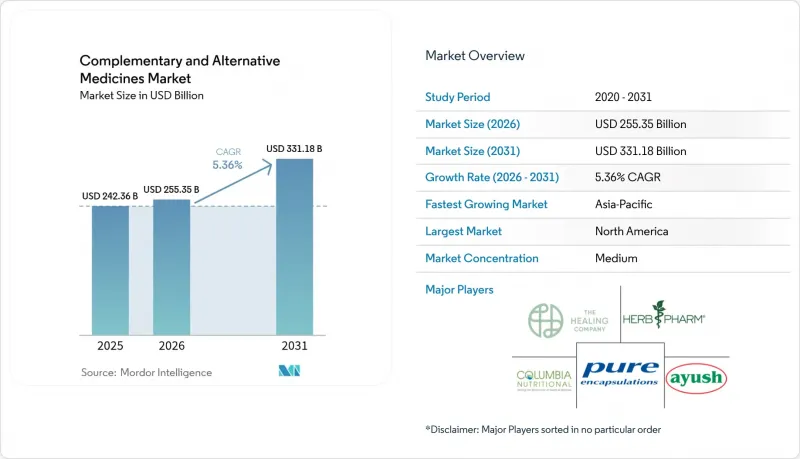
보완 및 대체 의학 시장 규모는 2025년에 2,423억 6,000만 달러로 평가되었습니다. 2026년 2,553억 5,000만 달러에서 2031년까지 3,311억 8,000만 달러에 이를 것으로 예상되며, 예측 기간(2026-2031년) CAGR은 5.36%를 나타낼 전망입니다.
본 보고서는 유형(전통적 대체 요법 등), 용도(관절염·근골격계, 암 치료 지원 등), 판매 채널(직접 판매/의료 종사자 대상 판매 등), 최종 사용자(병원 및 전문 클리닉 등), 지역(북미, 유럽, 아시아태평양 등)별로 분류되어 있습니다. 시장 예측은 금액(달러) 기준으로 제시되어 있습니다.
세계의 보완 및 대체 의학 시장 동향 및 인사이트
만성 질환 유병률 증가
만성 대사성 질환은 비용 대비 효과가 높은 예방 의료에 대한 환자의 지속적인 수요를 견인하고 있습니다. 당뇨병과 비만은 전 세계 의료비를 상승시키고 있으며, 한방, 아유르베다, 그리고 증거 기반 허브 영양 보충제가 기존 치료에 대한 매력적인 보조 요법으로 자리 잡고 있습니다. 미국인들은 이미 보완 요법에 매년 302억 달러를 본인 부담금으로 지출하고 있으며, 이는 ‘건강에 대한 투자’라는 성숙한 문화가 뿌리내리고 있음을 보여줍니다. 펜 메디신 헬스웍스를 비롯한 대규모 병원 그룹에서는 근골격계 통증과 스트레스를 관리하기 위해 직원들에게 침술과 치료 마사지를 제공합니다. 이러한 노력은 시술자의 신뢰도를 높이고, 보험사의 보장 범위 확대를 촉진하고 있습니다. 대사성 질환은 2030년 이후에도 전 세계적으로 주요 질병 부담으로 남아 있을 것이기 때문에 합리적인 가격의 약초 요법 및 심신 요법과의 시너지 효과로 인해 보완 및 대체 의학 시장의 성장 궤도가 실질적으로 뒷받침되고 있습니다.
자연주의·유기농 헬스케어로의 소비자 전환
코로나19 팬데믹 이후 소비자들은 화학 물질을 포함하지 않고, 투명성이 높으며, 최소한의 가공만 거친 치료법을 적극적으로 찾고 있습니다. 젠코(Zenko)의 성과 중심 아유르베다 보충제처럼, 식물 전체 추출물을 전면에 내세우는 브랜드는 순도와 추적 가능성을 보장함으로써 고객 충성도를 구축하고 있습니다. 맥킨지의 보고서에 따르면, 현재 미국 성인의 82%가 웰빙을 최우선으로 여기고 있으며, 구매 행동에 있어 구조적인 변화가 뚜렷하게 나타나고 있습니다. 수요가 가장 높은 분야는 여성 건강 분야로, 생리부터 갱년기 관리에 이르기까지 성분의 종합적인 공개가 구매 결정에 영향을 미치고 있습니다. 기업의 복리후생 플랫폼은 인증받은 유기농 심신 프로그램 비용을 지원함으로써 이에 대응하고 있으며, 이를 통해 자연 요법에 대한 체계적인 도입 경로를 강화하고 있습니다. 이러한 소비자의 기대는 프리미엄 가격 책정을 뒷받침하며, 보완 및 대체 의학 시장의 확대로 이어지고 있습니다.
임상적 근거 및 표준화의 부족
엄격한 CAM(보완 및 대체 의학) 연구에 대한 전 세계적인 자금 지원은 여전히 제한적이며, 2022년에는 미국 국립보건원(NIH)의 연구비 중 통합 의학을 대상으로 한 비중이 고작 0.17%에 그쳤습니다. 식물성 제제는 원산지, 수확일, 가공 방법에 따라 편차가 발생하는 경우가 많아 재현성을 복잡하게 만들고, 현재 승인된 두 가지 처방용 식물성 제제 외에는 FDA 승인을 가로막고 있습니다. 일관된 약전 규격의 부재는 보험사가 표준화된 제형을 선호하기 때문에 광범위한 보험 적용을 제한하고 있습니다. 의료 종사자 교육의 격차 또한 도입을 더욱 지연시키고 있습니다. 많은 의사들이 허브와 의약품 간의 상호작용 가능성에 대해 여전히 신중한 태도를 취하고 있기 때문입니다. 무작위 대조 시험의 확대나 품질 기준의 조화가 이루어지지 않는 한, 이러한 불확실성은 고소득 지역에서의 보급을 지연시키고, 보완 및 대체 의학 시장 규모 확대에 대한 기대를 저해할 가능성이 있습니다.
부문별 분석
전통적인 대체 요법은 침술, 아유르베다, 동종요법 및 약초 약전의 병원 도입에 힘입어 2025년 매출의 40.62%를 차지하며 계속해서 주도적인 위치를 유지했습니다. 미쓰이 물산이 유옌상(Eu Yan Sang)을 8억 싱가포르 달러에 인수한 것을 비롯한 기관들의 지지는 확장성이 있는 전통 있는 브랜드에 대한 투자자들의 신뢰를 보여줍니다. 임상 현장에서의 인지도가 높기 때문에 AI를 활용한 진단 소프트웨어를 통해 제공 방식이 현대화되고 있는 상황에서도 이러한 요법들은 보완 및 대체 의학 시장의 초석으로서 입지를 공고히 하고 있습니다. ‘마음과 몸의 실천’은 규모는 작지만 연평균 성장률(CAGR) 7.12%로 예측되는 가장 빠르게 성장하는 하위 부문입니다. 요가 및 명상 훈련 비용을 지원하는 기업용 웰니스 플랫폼은 이러한 실천의 주류화를 가속화하며 사용자의 평생 가치를 높이고 있습니다. 허브 보충제는 적정 농업 규범(GAP) 인증을 바탕으로 성장하고 있으며, 카이로프랙틱은 미국 대기업의 87%에서 보험 적용 대상이 됨으로써 혜택을 보고 있습니다. 에너지 요법 및 바이오필드 요법은 여전히 틈새 시장이지만, 만성 통증 완화 측면에서 연구의 주목을 받고 있습니다. 디지털화의 진전으로 투명성과 맞춤형 개입이 향상되어 부문 간의 시너지 효과가 강화되고 있습니다.
‘마음과 몸의 실천’ 분야 내 보완 및 대체 의학 시장 규모는 2031년까지 924억 달러를 넘어설 것으로 예상되며, 이는 복합적인 성장과 습관화하기 쉬운 디지털 프로그램에 대한 소비자의 충성도를 반영합니다. 원격 마음챙김 세션은 치료사의 운영 비용을 절감하고, 이동 제한 상황에서도 서비스의 지속성을 유지합니다. 전통적인 치료법 분야에서는 바이오의약품 제조업체와의 제휴가 확대되면서, 종양학 및 면역학 지원을 목적으로 한 식물 유래 성분의 공동 개발이 진행되고 있습니다. 스마트폰을 통한 분석과 혀의 영상 진단, 맥파 변동을 통합하는 신규 진출기업들은 차별화된 임상 대시보드를 제공할 수 있으며, 증거를 중시하는 의료 시스템 내에서 보완 및 대체 의학 시장 점유율을 확대할 수 있습니다.
2025년에는 대사성 질환이 매출 점유율의 27.08%를 차지했으며, 이는 식이 관련 질환이 안전하고 다중 표적형 식물 유래 솔루션에 대한 수요를 얼마나 높이고 있는지를 여실히 보여줍니다. 인도인을 대상으로 한 대조군 연구에서 호로파, 계피, 기무네마 추출물이 공복 혈당 수치를 낮추고 지질 프로파일을 개선하는 것으로 나타나 의사의 신뢰를 높이고 있습니다. 신경학 및 정신 건강 분야는 2031년까지 연평균 성장률(CAGR) 7.68%로 향후 성장을 주도하고 있습니다. 이는 팬데믹과 관련된 스트레스가 아답토젠 허브와 고용주가 비용을 부담하는 마음챙김 훈련에 대한 수요를 촉진하고 있기 때문입니다. 암 치료의 보조 요법 분야에서는 전통적인 한방 처방이 화학요법으로 인한 피로를 경감시킨다는 무작위 대조 시험을 통한 근거가 높이 평가되어, 통합 암 클리닉에서의 도입이 확대되고 있습니다. 환자 지원 단체들이 증상 관리의 대안을 모색하며 적극적으로 나서고 있는 만큼, 암 치료에 특화된 보완 및 대체 의학 시장 규모는 꾸준히 확대될 것으로 전망됩니다.
순환기 분야에서의 활용은 전통적인 호흡법이나 치료용 마사지를 도입한 예방 의료 프로그램과 함께 진화하고 있으며, 비용 대비 효과가 높은 혈압 관리를 실현하고 있습니다. 여성 건강 분야는 합성 호르몬을 사용하지 않고 갱년기 불쾌감을 완화하는 피토에스트로겐 함유 허브에 힘입어 여전히 고성장하는 틈새 시장으로 자리 잡고 있습니다. 생명과학 기업들이 임상적으로 입증된 연령별 영양 보충제 팩을 출시함에 따라, 여성 건강 분야의 보완 및 대체 의학 시장 점유율은 확대될 것으로 예측됩니다. 모든 용도에서 디지털 복약 순응도 지원 도구 및 웨어러블 기기와의 연동이 측정 가능한 건강 성과를 보여주고 있으며, 보험사와의 협력을 강화하고 있습니다.
지역별 분석
북미는 여전히 최대의 지역 시장으로, 2025년 매출의 42.58%를 차지했습니다. 성숙한 보험 환급 메커니즘, 탄탄한 의료 전문가 인프라, 그리고 적극적인 기업 대상 웰니스 투자가 수요를 견인했습니다. 병원에서는 통합 종양학 및 만성 통증 치료 프로토콜이 정착되어 있으며, 허브 처방전과 심신 요법 처방 건수가 증가하고 있습니다. 미국 내 보완 및 대체 의학 시장 규모는 보험사들이 성과 연계형 지불 모델을 정교화하고, FDA가 식물 유래 제품에 대한 지침을 확대함에 따라 꾸준히 성장할 전망입니다. 캐나다의 각 주도 마찬가지로 공공 보험에서 침술의 적용 범위를 확대하고 있어, 정책적인 측면에서 수렴 추세를 보이고 있습니다.
아시아태평양은 2026년부터 2031년까지 6.32%라는 가장 높은 연평균 성장률(CAGR)을 나타낼 전망입니다. 중국에서는 국내 이용 확대와 수출 인증 가속화라는 두 가지 전략을 통해 규모의 경제가 뒷받침되고 있습니다. 바이디야나트(Baidyanath)사가 10-12개국을 대상으로 27종의 영양 보조제(뉴트라슈티컬)를 출시한 것은 전 세계 판매 진열 공간을 장악하려는 이 회사의 지역적 야망을 보여줍니다. 인도의 재배 보조금 덕분에 원자재 비용이 절감되고 추적성이 향상되어 유럽 및 북미의 엄격한 수입 기준을 충족하고 있습니다. 스마트폰 보급률이 80%를 넘고, 건강 앱 이용이 현지 결제 지갑과 연동되어 있는 동남아시아의 대도시권에서는 크로스보더 전자상거래가 수요를 주도하고 있습니다. 인도 농촌 지역에서는 정부 자금을 통한 ‘텔레-아유르베다’ 시범 사업이 진행되고 있으며, 저비용 상담의 실현 가능성을 입증함으로써 그 보급을 뒷받침하고 있습니다.
유럽에서는 ‘전통 허브 의약품 지침’의 혜택을 받고 있으며, 시장 진입 요건이 명확해짐에 따라 해외 투자를 유치하고 있습니다. 독일은 중국으로의 건강식품 수출액에서 2위를 차지하고 있으며, 2024년 수출액은 57.84% 증가한 11억 6,500만 달러에 달했습니다. 유럽 소비자들은 만성 근골격계 질환에 대해 식물 유래 치료법을 선호하고 있으며, 이는 약사와 허브 치료사 간의 협력을 촉진하고 있습니다. 이탈리아와 네덜란드의 국민건강보험 제도에서는 각각 만성 편두통 및 과민성 대장 증후군에 대한 보완 및 대체 의학(CAM)의 보험 적용을 통한 비용 절감 가능성에 대한 검토가 진행되고 있습니다. 임상시험 결과가 근거 기반 정책에 반영되는 가운데, 보완 및 대체 의학 시장은 유럽에서 그 입지를 더욱 공고히 하고 있습니다.
기타 혜택 :
- 엑셀 형식 시장 예측(ME) 시트
- 3개월간의 애널리스트 지원
자주 묻는 질문
목차
제1장 서론
제2장 조사 방법
제3장 개요
제4장 시장 구도
제5장 시장 규모 및 성장 예측
제6장 경쟁 구도
제7장 시장 기회 및 향후 전망
KTH 26.08.31According to Mordor Intelligence, the complementary and alternative medicines market size was valued at USD 242.36 billion in 2025 and estimated to grow from USD 255.35 billion in 2026 to reach USD 331.18 billion by 2031, at a CAGR of 5.36% during the forecast period (2026-2031).
This report is Segmented by Type (Traditional Alternative Therapeutics, and More), Application (Arthritis & Musculoskeletal, Oncology Support, and More), Distribution Channel (Direct/Practitioner Sales, and More), End User (Hospitals & Specialty Clinics, and More), and Geography (North America, Europe, Asia-Pacific, and More). The Market Forecasts are Provided in Terms of Value (USD).
Global Complementary And Alternative Medicines Market Trends and Insights
Growing Prevalence of Chronic Diseases
Chronic metabolic disorders drive sustained patient demand for cost-effective preventive care. Diabetes and obesity heighten worldwide health-care expenses, positioning traditional Chinese medicine, Ayurveda, and evidence-based herbal nutraceuticals as attractive adjuncts to conventional treatment. Americans already spend USD 30.2 billion out-of-pocket each year on complementary modalities, underscoring a mature pay-for-wellness culture. Large hospital systems, including Penn Medicine HealthWorks, offer acupuncture and therapeutic massage to employees to manage musculoskeletal pain and stress. Such initiatives elevate practitioner credibility and encourage insurers to expand coverage. As metabolic disorders remain a leading global disease burden beyond 2030, their intersection with affordable herbal and mind-body interventions materially supports a rising complementary and alternative medicines market trajectory.
Rising Consumer Shift Toward Natural and Organic Healthcare
Post-COVID consumers actively seek chemical-free, transparent, and minimally processed remedies. Brands highlighting whole-plant extracts, such as Zenko's performance-oriented Ayurvedic supplements, build loyalty by validating purity and traceability. McKinsey reports that 82% of U.S. adults now prioritize wellness, revealing a structural change in purchase behavior. Demand is strongest in women's health, where end-to-end ingredient disclosure influences buying decisions from menstruation to menopause support. Corporate benefit platforms respond by subsidizing certified organic mind-body programs, thereby fortifying institutional pathways for natural remedies. These consumer expectations reinforce premium pricing and expand the complementary and alternative medicines market.
Insufficient Clinical Evidence and Standardization
Worldwide funding for rigorous CAM trials remains limited; in 2022, only 0.17% of U.S. NIH grants targeted integrative medicine. Botanical preparations often vary by origin, harvest date, and processing, complicating reproducibility and hindering FDA approval beyond the two currently licensed prescription botanicals. The lack of consistent pharmacopoeia grades restricts broad insurance coverage because payers favor standardized dosage forms. Practitioner education gaps further slow adoption, as many physicians remain cautious about potential herb-drug interactions. Without expanded randomized controlled trials and harmonized quality benchmarks, uncertainty could slow uptake in high-income regions and temper the complementary and alternative medicines market size narrative.
Other drivers and restraints analyzed in the detailed report include:
- Expanding Government Support and Regulatory Recognition
- Proliferation of Digital CAM Platforms and Virtual Wellness Ecosystems
- Regulatory Fragmentation and Reimbursement Gaps
For complete list of drivers and restraints, kindly check the Table Of Contents.
Segment Analysis
Traditional Alternative Therapeutics retained leadership with 40.62% of 2025 revenue, driven by hospital integration of acupuncture, Ayurveda, homeopathy, and herbal pharmacopeias. Institutional endorsement-including Mitsui's SGD 800 million purchase of Eu Yan Sang-signals investor belief in scalable heritage brands. High clinical familiarity positions these modalities as the cornerstone of the complementary and alternative medicines market, even as AI-powered diagnostic software modernizes delivery. Mind & Body Practices, though smaller, is the fastest-growing sub-sector at a projected 7.12% CAGR. Corporate wellness platforms that reimburse yoga and meditation training accelerate mainstream adoption and increase lifetime user value. Herbal supplements rise on the back of good-agricultural-practice certifications, while chiropractors benefit from insurance coverage at 87% of large U.S. firms. Energy & Biofield modalities remain niche but draw research attention for chronic pain relief. Continued digitization improves transparency and personalized intervention, reinforcing segment synergies.
The complementary and alternative medicines market size for Mind & Body Practices is expected to surpass USD 92.4 billion by 2031, reflecting compound growth and consumer loyalty to habit-forming digital programs. Remote mindfulness sessions reduce overhead for practitioners and maintain continuity during mobility restrictions. In traditional therapeutics, partnerships with biopharmaceutical manufacturers are expanding to co-develop botanical derivatives for oncology and immunology support. Market entrants that integrate smartphone analytics with tongue imaging or pulse variation tracking can deliver differentiated clinical dashboards, expanding the complementary and alternative medicines market footprint in evidence-seeking health systems.
Metabolic disorders commanded 27.08% revenue share in 2025, underscoring how diet-linked diseases heighten demand for safe, multi-target botanical solutions. Controlled trials in Indian populations show that fenugreek, cinnamon, and gymnema extracts reduce fasting glucose and improve lipid profiles, strengthening physician confidence. Neurology & Mental Health leads future expansion with a 7.68% CAGR through 2031, as pandemic-related stress catalyzes demand for adaptogenic herbs and mindfulness training reimbursed by employers. Oncology support therapies benefit from randomized evidence that traditional Chinese formulas reduce chemotherapy-induced fatigue, promoting their inclusion in integrative cancer clinics. The complementary and alternative medicines market size devoted to oncology is forecast to grow steadily as patient advocacy groups lobby for symptom management options.
Cardiovascular applications evolve alongside preventive health programs that incorporate traditional breathing exercises and therapeutic massage, offering cost-effective blood-pressure control. Women's health remains a high-growth niche driven by phytoestrogenic herbs that mitigate menopausal discomfort without synthetic hormones. The complementary and alternative medicines market share in women's health is projected to widen as life-science companies launch age-specific nutraceutical packs with clinical backing. Across all applications, digital adherence tools and wearable integration showcase measurable health outcomes, deepening payer engagement.
Complete Report Scope:
- By Type
- Traditional Alternative Therapeutics (Ayurveda, Tcm, Homeopathy)
- Herbal / Botanical Supplements
- Mind & Body Practices (Yoga, Meditation, Tai-Chi)
- Body-Based Therapies (Chiropractic, Massage)
- Energy & Biofield Therapies (Reiki, Quantum-Touch)
- By Application
- Arthritis & Musculoskeletal
- Oncology Support
- Metabolic Disorders (Diabetes, Obesity)
- Cardiovascular
- Neurology & Mental Health
- Women's Health & Fertility
- Other Applications
- By Distribution Channel
- Direct / Practitioner Sales
- Online & E-Commerce
- Pharmacies & Drug Stores
- Distance Correspondence / Mail Order
- By End User
- Hospitals & Specialty Clinics
- Wellness Centers & Spas
- Homecare & Self-Care
- Geography
- North America
- United States
- Canada
- Mexico
- Europe
- Germany
- United Kingdom
- France
- Italy
- Spain
- Rest of Europe
- Asia-Pacific
- China
- Japan
- India
- Australia
- South Korea
- Rest of Asia-Pacific
- Middle East & Africa
- GCC
- South Africa
- Rest of Middle East & Africa
- South America
- Brazil
- Argentina
- Rest of South America
- North America
Geography Analysis
North America remained the largest regional contributor, holding 42.58% of 2025 revenue. Mature reimbursement mechanisms, robust practitioner infrastructure, and proactive corporate wellness investments fueled demand. Hospitals embed integrative oncology and chronic pain protocols, enabling higher throughput of herbal prescriptions and mind-body therapies. The complementary and alternative medicines market size in the United States is poised to climb steadily as insurers refine outcome-based payment models and as the FDA widens botanical guidance. Canadian provinces likewise expand acupuncture coverage within public insurance, signaling convergent policy momentum.
Asia-Pacific is projected to post the fastest 6.32% CAGR from 2026 to 2031. China's dual strategy of strengthening domestic usage and accelerating export certification supports scale economies. Baidyanath's launch of 27 nutraceutical SKUs targeting 10-12 countries evidences regional ambitions to command global shelf space. India's cultivation subsidies reduce raw material costs and improve traceability, meeting stringent import standards in Europe and North America. Cross-border e-commerce drives demand in Southeast Asian metros, where smartphone penetration exceeds 80% and health-app usage intersects with local payment wallets. Government-funded tele-Ayurveda pilots in rural India reinforce adoption by demonstrating low-cost consultation viability.
Europe benefits from the Traditional Herbal Medicinal Products Directive, providing market entry clarity that attracts foreign investment. Germany ranks as the second-largest exporter of health foods to China, with 2024 shipments rising 57.84% to USD 1.165 billion. European consumers favor plant-based remedies for chronic musculoskeletal disorders, spurring collaboration between pharmacists and herbalists. National health systems in Italy and the Netherlands investigate cost-saving potential of reimbursing CAM for chronic migraine and irritable bowel syndrome, respectively. The complementary and alternative medicines market continues to deepen its European footprint as clinical trial outputs trigger evidence-based policy inclusion.
- Herb Pharm
- Boiron
- Himalaya
- Traditional Medicinals
- Nature's Sunshine Products
- ure encapsulations, LLC
- Tsumura & Co.
- Weleda Ag
- Ayush Ayurvedic Pte Ltd
- Sheng Chang Pharmaceutical
- Columbia Nutritional
- Gaia Herbs
- Healing Company
- Quantum-Touch
- Nordic Nutraceuticals
- Standard Process
- Jarrow Formulas
Additional Benefits:
- The market estimate (ME) sheet in Excel format
- 3 months of analyst support
TABLE OF CONTENTS
1 Introduction
- 1.1 Study Assumptions & Market Definition
- 1.2 Scope Of The Study
2 Research Methodology
3 Executive Summary
4 Market Landscape
- 4.1 Market Overview
- 4.2 Market Drivers
- 4.2.1 Growing Prevalence of Chronic Diseases
- 4.2.2 Rising Consumer Shift Toward Natural And Organic Healthcare
- 4.2.3 Expanding Government Support and Regulatory Recognition
- 4.2.4 Proliferation of Digital Cam Platforms and Virtual Wellness Ecosystems
- 4.2.5 Integration of Cam Into Corporate Wellness and Insurance Programs
- 4.2.6 Globalization of Traditional Medicine Supply Chains Through E-Commerce
- 4.3 Market Restraints
- 4.3.1 Insufficient Clinical Evidence and Standardization
- 4.3.2 Regulatory Fragmentation and Reimbursement Gaps
- 4.3.3 Sustainability Concerns for Medicinal Herb Resources
- 4.3.4 Quality Control Challenges in Cross-Border E-Commerce Distribution
- 4.4 Regulatory Landscape
- 4.5 Porter's Five Forces Analysis
- 4.5.1 Threat Of New Entrants
- 4.5.2 Bargaining Power Of Buyers
- 4.5.3 Bargaining Power Of Suppliers
- 4.5.4 Threat Of Substitutes
- 4.5.5 Intensity Of Competitive Rivalry
5 Market Size & Growth Forecasts (Value, USD)
- 5.1 By Type
- 5.1.1 Traditional Alternative Therapeutics (Ayurveda, Tcm, Homeopathy)
- 5.1.2 Herbal / Botanical Supplements
- 5.1.3 Mind & Body Practices (Yoga, Meditation, Tai-Chi)
- 5.1.4 Body-Based Therapies (Chiropractic, Massage)
- 5.1.5 Energy & Biofield Therapies (Reiki, Quantum-Touch)
- 5.2 By Application
- 5.2.1 Arthritis & Musculoskeletal
- 5.2.2 Oncology Support
- 5.2.3 Metabolic Disorders (Diabetes, Obesity)
- 5.2.4 Cardiovascular
- 5.2.5 Neurology & Mental Health
- 5.2.6 Women's Health & Fertility
- 5.2.7 Other Applications
- 5.3 By Distribution Channel
- 5.3.1 Direct / Practitioner Sales
- 5.3.2 Online & E-Commerce
- 5.3.3 Pharmacies & Drug Stores
- 5.3.4 Distance Correspondence / Mail Order
- 5.4 By End User
- 5.4.1 Hospitals & Specialty Clinics
- 5.4.2 Wellness Centers & Spas
- 5.4.3 Homecare & Self-Care
- 5.5 Geography
- 5.5.1 North America
- 5.5.1.1 United States
- 5.5.1.2 Canada
- 5.5.1.3 Mexico
- 5.5.2 Europe
- 5.5.2.1 Germany
- 5.5.2.2 United Kingdom
- 5.5.2.3 France
- 5.5.2.4 Italy
- 5.5.2.5 Spain
- 5.5.2.6 Rest of Europe
- 5.5.3 Asia-Pacific
- 5.5.3.1 China
- 5.5.3.2 Japan
- 5.5.3.3 India
- 5.5.3.4 Australia
- 5.5.3.5 South Korea
- 5.5.3.6 Rest of Asia-Pacific
- 5.5.4 Middle East & Africa
- 5.5.4.1 GCC
- 5.5.4.2 South Africa
- 5.5.4.3 Rest of Middle East & Africa
- 5.5.5 South America
- 5.5.5.1 Brazil
- 5.5.5.2 Argentina
- 5.5.5.3 Rest of South America
- 5.5.1 North America
6 Competitive Landscape
- 6.1 Market Concentration
- 6.2 Market Share Analysis
- 6.3 Company Profiles (includes Global level Overview, Market level overview, Core Business Segments, Financials, Headcount, Key Information, Market Rank, Market Share, Products and Services, and analysis of Recent Developments)
- 6.3.1 Herb Pharm
- 6.3.2 Boiron
- 6.3.3 Himalaya Wellness Company
- 6.3.4 Traditional Medicinals
- 6.3.5 Nature's Sunshine Products
- 6.3.6 ure encapsulations, LLC
- 6.3.7 Tsumura & Co.
- 6.3.8 Weleda Ag
- 6.3.9 Ayush Ayurvedic Pte Ltd
- 6.3.10 Sheng Chang Pharmaceutical
- 6.3.11 Columbia Nutritional LLC
- 6.3.12 Gaia Herbs
- 6.3.13 Healing Company Ltd
- 6.3.14 Quantum-Touch
- 6.3.15 Nordic Nutraceuticals
- 6.3.16 Standard Process
- 6.3.17 Jarrow Formulas
7 Market Opportunities & Future Outlook
- 7.1 White-Space & Unmet-Need Assessment


