

|
시장보고서
상품코드
2116550
중동 및 아프리카의 중고차 시장 : 점유율 분석, 업계 동향과 통계, 성장 예측(2026-2031년)Middle East And Africa Used Car - Market Share Analysis, Industry Trends & Statistics, Growth Forecasts (2026 - 2031) |
||||||
 Mordor Intelligence
Mordor Intelligence에 의하면, 중동 및 아프리카 중고차 시장 규모는 2025년에 930억 1,000만 달러로 평가되었고 2026년 978억 7,000만 달러에서 성장하여 2031년까지 1,263억 4,000만 달러에 이를 것으로 예측됩니다.
예측 기간(2026-2031년) 동안 연평균 성장률(CAGR)은 5.23%가 될 것으로 전망됩니다.
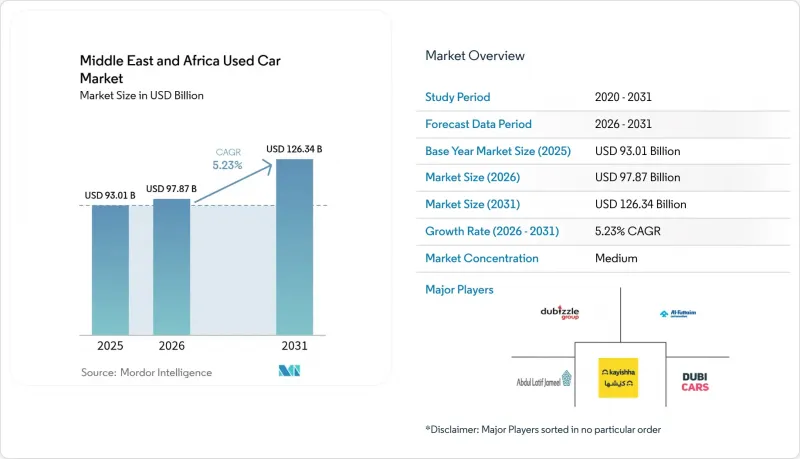
본 보고서는 차종별(해치백, 세단 등), 공급업체별(조직화, 비조직화), 연료별(가솔린, 디젤 등), 차량 연식(0-2년, 3-5년 등), 판매 채널(온라인 광고·전자상거래, 오프라인/실제 매장),및 국가(아랍에미리트, 사우디아라비아 등)별로 분류되어 있습니다. 시장 예측은 금액(달러)으로 표시되어 있습니다.
중동 및 아프리카 중고차 시장 동향 및 인사이트
신차 가격 급등과 공급망 지연
홍해의 해운 병목 현상으로 인해 차량 인도까지의 리드타임이 최대 6주 연장되었습니다. 이로 인해 2024년 중 지역 유통업체들이 신차 가격을 인상함에 따라, 가격에 민감한 구매자들이 중동 및 아프리카 중고차 시장으로 몰리고 있습니다. 구매 부담이 커지는 가운데, 차령 2-3년 된 중고차에 대한 수요가 높아지고 있는 반면, 기업용 차량(플릿) 부문에서는 추가적인 가격 급등을 앞두고 잔존 가치를 확보하기 위해 교체 주기를 단축하고 있습니다. 인기 모델의 딜러 재고는 4-6개월 분량에 그치고 있어, 소비자들은 그동안 고려 대상에서 제외되었던 중고차 구매를 어쩔 수 없이 선택하고 있습니다. 리스 회사는 주행 거리가 짧은 반납 차량을 재판매하여 이익을 창출하고, 거의 신차와 다름없는 재고를 안정적으로 공급하고 있습니다. 이러한 요인들이 맞물려 거래량이 증가하고 있으며, 수요가 높은 주요 브랜드 차종에서는 높은 재판매 가치가 유지되고 있습니다.
합리적인 가격의 중국 브랜드 진입이 판매 회전율을 끌어올리고 있다.
BYD, 지리(Geely), 체리(Chery)의 적극적인 사업 확대로 인해 기존 경쟁사보다 저렴한 가격의 매력적인 대체 차량이 제공되며, 신차 구매 수요를 자극하고 있습니다. 이러한 수요는 곧바로 중고차 시장으로 파급되고 있습니다. 현지 조립 합작 사업을 통해 공급 주기가 단축되고 정비 공장에서 각 모델에 대한 이해도도 깊어짐에 따라, 소유에 따른 위험에 대한 인식이 낮아지고 있습니다. 차량 대여 사업자들은 자본 지출을 억제하기 위해 중국산 세단 및 SUV를 도입하고 있으며, 그 결과 2-4년 된 중고차가 시장에 지속적으로 공급되고 있습니다. 파노라마 카메라나 첨단 인포테인먼트 시스템과 같은 경쟁력 있는 기능 세트는 기술에 정통한 구매자들에게 매력을 더하고 있습니다. 그 결과, 재고 회전율이 가속화되어 중동 및 아프리카의 중고차 시장에서 각 가격대의 재고가 더욱 풍부해지고 있습니다.
아프리카에서 비조직적 판매업자의 지배
아프리카의 주요 경제권에서는 비공식적인 노상 판매업자들이 거래의 대부분을 장악하고 있으며, 현금 거래만 허용하는 관행과 불투명한 가격 책정이 고착화되어 있어, 이는 신용 거래의 확산을 저해하고 있습니다. 표준화된 검사 체계가 부재하여 품질에 편차가 발생하고, 이는 소비자의 신뢰를 훼손하며 해당 지역의 수출 전망을 제한하고 있습니다. 규제 당국은 제한된 자원과 뿌리 깊은 가족 경영 거래 네트워크로 인해 법 집행에 어려움을 겪고 있습니다. 디지털 광고는 성장세를 보이고 있지만, 등록 및 과세에 대한 저항감으로 인해 정식 시장화가 지연되고 있습니다. 해외 투자자들은 중동 및 아프리카 중고차 시장의 수익 예측 가능성을 저하시키는 법적 불확실성을 이유로 여전히 신중한 태도를 유지하고 있습니다.
부문 분석
2025년, SUV는 중동 및 아프리카 중고차 시장에서 42.72%의 점유율을 차지하며 세단 및 해치백을 앞질렀고, 2031년까지 연평균 성장률(CAGR) 5.55%로 성장했습니다. 2025년 중동 및 아프리카 중고차 시장에서 SUV의 규모는 사막 지형을 견딜 수 있는 높은 최저 지상고를 갖춘 디자인에 대한 꾸준한 수요를 반영한 것입니다. 내구성의 우위는 감가상각 지연을 초래하여, 인증 중고 SUV는 동등한 주행 거리를 가진 세단보다 더 높은 가격을 책정할 수 있게 되었습니다. 중국산 신형 SUV 모델이 등장하여 경쟁력 있는 가격대를 제공함에 따라, 차량 관리 담당자들은 기존의 일본 자동차 브랜드 외에도 조달 범위를 넓히고 있습니다.
세라믹 보호 코팅부터 어댑티브 서스펜션 키트에 이르기까지, 지속적으로 성장하는 애프터마켓 분야는 차량의 인지 가치를 더욱 높이고 판매 회전율 향상에 기여하고 있습니다. 세단은 연비와 좁은 주차 공간을 우선시하는 도시 통근자들의 지지를 받아 안정적인 시장 점유율을 유지하고 있습니다. 한편, 해치백은 예산이 제한된 첫 차 구매자들에게 여전히 입문 모델로서의 위상을 지키고 있습니다. MPV는 대가족이나 틈새 상용 부문 수요를 충족시키고 있습니다. 그러나 건설, 석유, 관광 각 부문의 인프라 확장에 따라 중동 및 아프리카 중고차 시장 전반에서 오프로드 주행이 가능한 차량에 대한 수요가 지속될 것으로 보임에 따라, SUV의 우위는 앞으로도 이어질 것으로 예측됩니다.
2025년에는 비조직화된 딜러가 거래의 61.70%를 차지했으나, 조직화된 판매업체는 2031년까지 연평균 성장률(CAGR) 6.55%라는 가장 높은 성장률을 기록하며, 체계적인 보증과 투명한 가격 책정을 원하는 소비자의 선호도 변화를 여실히 보여주고 있습니다. 중동 및 아프리카의 중고차 시장 규모는 2025년에 공식 딜러의 매출이 크게 증가했으며, 이는 인증 중고차 프로그램의 도입이 확대되고 있음을 반영합니다. GCC 국가들의 규제 개혁에 따라 딜러들은 재고 디지털화 및 검사 서류 제공이 의무화되었으며, 이를 통해 정보의 비대칭성이 완화되고 금융 기관의 신뢰도가 높아지고 있습니다.
디지털 플랫폼을 통해 정식 판매업체는 국경을 넘어 매물 정보를 공유할 수 있게 되었으며, 그동안 지역적 제약으로 인해 제한되었던 재고 풀을 활용할 수 있게 되었습니다. 한편, 비공식 거래업자에게는 규제 위반 시 엄격한 처벌이 부과되기 때문에 공식 채널의 상대적 매력이 높아지고 있습니다. 이러한 추세는 사우디아라비아에서 가장 두드러지는데, 통관 대리인 요건이 철폐됨에 따라 수입 절차 시간이 단축되어 공식 판매업체는 재고 회전 속도를 높일 수 있게 되었습니다. 은행들이 자동차 금융의 보급을 확대하고, 신용 승인을 검증 가능한 차량 데이터와 연계함에 따라 시장 점유율의 변화는 더욱 가속화될 것으로 예측됩니다.
기타 혜택:
- 엑셀 형식 시장 예측(ME) 시트
- 3개월간의 애널리스트 지원
자주 묻는 질문
목차
제1장 서론
제2장 조사 방법
제3장 주요 요약
제4장 시장 구도
제5장 시장 규모와 성장 예측
제6장 경쟁 구도
제7장 시장 기회와 향후 전망
JHS 26.08.28According to Mordor Intelligence, the Middle East and Africa used car market size was valued at USD 93.01 billion in 2025 and estimated to grow from USD 97.87 billion in 2026 to reach USD 126.34 billion by 2031, at a CAGR of 5.23% during the forecast period (2026-2031).
This report is Segmented by Vehicle Type (Hatchbacks, Sedans, and More), Vendor Type (Organized, Unorganized), Fuel Type (Petrol, Diesel, and More), Vehicle Age (0-2 Years, 3-5 Years, and More), Distribution Channel (Online Classified and E-Commerce, Offline/Brick-and-Mortar), and Country (United Arab Emirates, Saudi Arabia, and More). The Market Forecasts are Provided in Terms of Value (USD).
Middle East And Africa Used Car Market Trends and Insights
High New-Vehicle Prices and Supply-Chain Delays
Red Sea shipping bottlenecks have extended delivery lead times by up to six weeks, prompting regional distributors to raise new-car prices during 2024 and pushing budget-sensitive buyers into the Middle East and Africa used car market. Affordability gaps intensify demand for 2-3-year-old vehicles, while corporate fleets shorten replacement cycles to lock in residual values ahead of further price inflation. Dealer inventories of popular models remain tight for four to six months, compelling consumers to consider used options previously out of scope. Leasing companies capitalize by remarketing low-mileage returns, creating a steady pipeline of nearly-new stock. Collectively, these factors elevate transaction volumes and sustain premium resale values across high-demand nameplates.
Influx of Affordable Chinese Brands Boosts Turnover
Aggressive expansion by BYD, Geely, and Chery delivers attractively priced alternatives often below legacy competitors, stoking new-vehicle uptake that swiftly filters into secondary channels. Local assembly joint ventures shorten supply cycles and raise model familiarity among service workshops, lowering perceived ownership risk. Fleet operators embrace Chinese sedans and SUVs to contain capital outlays, thereby feeding a pipeline of 2-4-year returns. Competitive feature sets-such as panoramic cameras and advanced infotainment-heighten appeal to tech-savvy buyers. Consequently, turnover accelerates, deepening inventory across price tiers within the Middle East and Africa used car market.
Dominance of Unorganized Vendors in Africa
Informal street-level traders retain control over a majority of transactions across key African economies, perpetuating cash-only dealings and opaque pricing that hinder credit penetration. Absence of standardized inspections allows quality variance that suppresses consumer confidence and limits regional export prospects. Regulatory agencies struggle with enforcement owing to limited resources and entrenched familial trading networks. Although digital classifieds gain traction, resistance to registration and taxation slows formalization. Foreign investors remain cautious, citing legal uncertainties that dilute return predictability in the Middle East and Africa used car market.
Other drivers and restraints analyzed in the detailed report include:
- Digital Classifieds and O2O Platforms Proliferation
- SUV and Pickup Preference for Harsh Terrain
- Restrictive Cross-Border Import Regulations
For complete list of drivers and restraints, kindly check the Table Of Contents.
Segment Analysis
SUVs posted 42.72% share of the Middle East and Africa used car market in 2025, outpacing sedans and hatchbacks and expanding at a 5.55% CAGR to 2031. The Middle East and Africa used car market size for SUVs in 2025, reflected entrenched demand for high-ground-clearance designs that withstand desert terrains. Durability advantages translate into slower depreciation, enabling certified pre-owned SUVs to command premiums over equivalent mileage sedans. Emerging Chinese SUV models introduce competitive price tiers, enticing fleet managers to broaden procurement beyond traditional Japanese nameplates.
Growing aftermarket sectors-from ceramic protective coatings to adaptive suspension kits-further elevate perceived value, contributing to higher turnover velocity. Sedans hold a stable share, driven by urban commuters prioritizing fuel economy and compact parking footprints, while hatchbacks remain the entry point for budget-constrained first-time buyers. MPVs cater to large families and niche commercial segments. Nevertheless, SUV dominance is expected to persist as infrastructure expansions in construction, oil, and tourism sectors sustain off-road-capable vehicle requirements across the Middle East and Africa used car market.
Unorganized dealers accounted for 61.70% of transactions in 2025, but organized vendors are growing with fastest 6.55% CAGR by 2031, underscoring shifting consumer preferences toward structured warranties and transparent pricing. The Middle East and Africa used car market size recorded significant organized sales during 2025, reflecting rising adoption of certified pre-owned programs. Regulatory reforms in GCC states compel dealers to digitize inventories and provide inspection documentation, reducing asymmetry and increasing lender confidence.
Digital platforms empower organized vendors to syndicate listings across borders, tapping inventory pools previously constrained by geography. Conversely, informal traders face punitive penalties for non-compliance, enhancing the relative attractiveness of formal channels. Momentum is most evident in Saudi Arabia, where removal of the customs-broker requirement trims import processing times, enabling organized players to rotate stock faster. The share shift is expected to accelerate as banks deepen auto-finance penetration, tethering credit approvals to verifiable vehicle data.
Complete Report Scope:
- By Vehicle Type
- Hatchbacks
- Sedans
- SUVs and Crossovers
- MPVs
- By Vendor Type
- Organized (Dealerships and CPO)
- Unorganized (Independents and P2P)
- By Fuel Type
- Petrol
- Diesel
- Hybrid
- Battery-Electric
- By Vehicle Age
- 0-2 Years
- 3-5 Years
- 6-8 Years
- Above 8 Years
- By Distribution Channel
- Online Classified and E-commerce
- Offline / Brick-and-Mortar
- By Country
- United Arab Emirates
- Saudi Arabia
- Egypt
- Kenya
- South Africa
- Morocco
- Nigeria
- Kuwait
- Oman
- Rest of Middle East and Africa
List of Companies Covered in this Report:
- Al-Futtaim Automotive
- Dubizzle Motors (OLX UAE)
- Kayishha (SellAnyCar KSA)
- Abdul Latif Jameel Motors
- YallaMotor
- DubiCars
- Cars24 Middle East
- CarSwitch
- OpenSooq Motors
- Motory Saudi Arabia
- CarMax East Africa Limited
- Alba Cars
- CFAO Mobility South Africa
- Expat Motors
Additional Benefits:
- The market estimate (ME) sheet in Excel format
- 3 months of analyst support
TABLE OF CONTENTS
1 Introduction
- 1.1 Study Assumptions & Market Definition
- 1.2 Scope of the Study
2 Research Methodology
3 Executive Summary
4 Market Landscape
- 4.1 Market Overview
- 4.2 Market Drivers
- 4.2.1 High New-Vehicle Prices and Supply-Chain Delays
- 4.2.2 Influx of Affordable Chinese Brands Boosts Turnover
- 4.2.3 Digital Classifieds and O2O Platforms Proliferation
- 4.2.4 SUV and Pickup Preference for Harsh Terrain
- 4.2.5 Expansion of Inspection/History-Verification Services
- 4.2.6 Early Secondary-Market Supply of Electrified Fleets
- 4.3 Market Restraints
- 4.3.1 Dominance of Unorganized Vendors in Africa
- 4.3.2 Restrictive Cross-Border Import Regulations
- 4.3.3 Odometer Fraud and Limited History Transparency
- 4.3.4 Heat-Induced Battery Degradation Limits Used-EV Uptake
- 4.4 Value / Supply-Chain Analysis
- 4.5 Regulatory Landscape
- 4.6 Technological Outlook
- 4.7 Porter's Five Forces
- 4.7.1 Threat of New Entrants
- 4.7.2 Bargaining Power of Buyers
- 4.7.3 Bargaining Power of Suppliers
- 4.7.4 Threat of Substitute Products
- 4.7.5 Intensity of Competitive Rivalry
5 Market Size & Growth Forecasts (Value, USD)
- 5.1 By Vehicle Type
- 5.1.1 Hatchbacks
- 5.1.2 Sedans
- 5.1.3 SUVs and Crossovers
- 5.1.4 MPVs
- 5.2 By Vendor Type
- 5.2.1 Organized (Dealerships and CPO)
- 5.2.2 Unorganized (Independents and P2P)
- 5.3 By Fuel Type
- 5.3.1 Petrol
- 5.3.2 Diesel
- 5.3.3 Hybrid
- 5.3.4 Battery-Electric
- 5.4 By Vehicle Age
- 5.4.1 0-2 Years
- 5.4.2 3-5 Years
- 5.4.3 6-8 Years
- 5.4.4 Above 8 Years
- 5.5 By Distribution Channel
- 5.5.1 Online Classified and E-commerce
- 5.5.2 Offline / Brick-and-Mortar
- 5.6 By Country
- 5.6.1 United Arab Emirates
- 5.6.2 Saudi Arabia
- 5.6.3 Egypt
- 5.6.4 Kenya
- 5.6.5 South Africa
- 5.6.6 Morocco
- 5.6.7 Nigeria
- 5.6.8 Kuwait
- 5.6.9 Oman
- 5.6.10 Rest of Middle East and Africa
6 Competitive Landscape
- 6.1 Market Concentration
- 6.2 Strategic Moves
- 6.3 Market Share Analysis
- 6.4 Company Profiles (includes Global Level Overview, Market Level Overview, Core Segments, Financials as Available, Strategic Information, Market Rank/Share for Key Companies, Products and Services, SWOT Analysis, and Recent Developments)
- 6.4.1 Al-Futtaim Automotive
- 6.4.2 Dubizzle Motors (OLX UAE)
- 6.4.3 Kayishha (SellAnyCar KSA)
- 6.4.4 Abdul Latif Jameel Motors
- 6.4.5 YallaMotor
- 6.4.6 DubiCars
- 6.4.7 Cars24 Middle East
- 6.4.8 CarSwitch
- 6.4.9 OpenSooq Motors
- 6.4.10 Motory Saudi Arabia
- 6.4.11 CarMax East Africa Limited
- 6.4.12 Alba Cars
- 6.4.13 CFAO Mobility South Africa
- 6.4.14 Expat Motors
7 Market Opportunities & Future Outlook
- 7.1 White-space & Unmet-Need Assessment


