

|
시장보고서
상품코드
2116607
방적 기계 시장 : 점유율 분석, 업계 동향과 통계, 성장 예측(2026-2031년)Spinning Machinery - Market Share Analysis, Industry Trends & Statistics, Growth Forecasts (2026 - 2031) |
||||||
 Mordor Intelligence
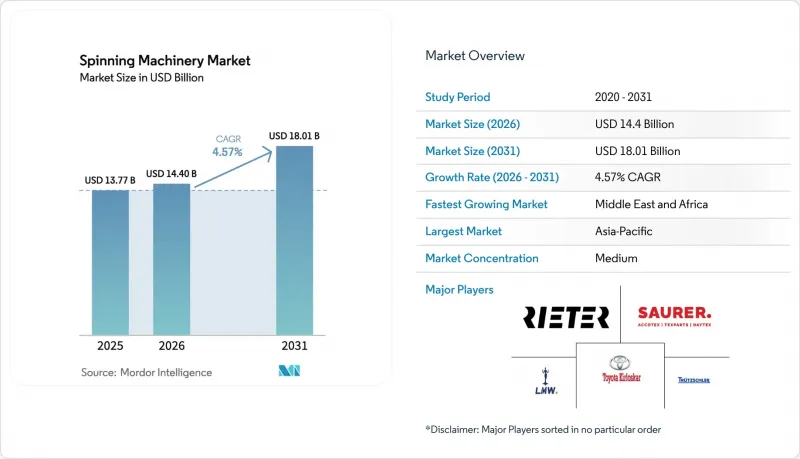
Mordor Intelligence에 의하면, 2026년 방적 기계 시장 규모는 144억 달러로 추정되고 있어 2025년 137억 7,000만 달러에서 확대해, 2031년에는 180억 1,000만 달러에 이를 것으로 예측됩니다.
2026년부터 2031년까지 연평균 성장률(CAGR) 4.57%로 성장할 것으로 전망됩니다.
본 보고서는 기계 유형(링식, 로터/오픈엔드식 등), 소재(천연섬유, 합성섬유, 재생섬유),용도(의류 및 패션, 홈·가정용 섬유 등), 자동화 수준(기존 등), 지역(북미, 남미, 유럽, 아시아태평양, 중동 및 아프리카)별로 분류되어 있습니다. 시장 전망은 금액(달러) 기준으로 제시되어 있습니다.
세계 방적 기계 시장 동향 및 인사이트
인더스트리 4.0 대응 방적 라인 도입 급증
현재 방적 공장에서는 IoT 센서와 클라우드 분석을 도입하여 가동 중단 시간을 줄이고 품질을 안정화하고 있습니다. 리터(Leeter)사의 ‘ESSENTIAL’ 제품군은 스핀들 데이터를 실시간으로 전송하여, 이를 통해 작업 인력을 30% 감축하는 동시에 원자재 수율을 1-2% 향상시키고 있습니다. 지멘스와 스피노바의 협력을 통해 소개된 ‘디지털 트윈’ 기술로 가상 시운전이 가능해져, 생산 가동 시작을 가속화하고 비용이 많이 드는 수정 작업을 피할 수 있게 되었습니다. 아시아태평양의 많은 방적 공장에서는 10만 개 이상의 스핀들을 가동하고 있기 때문에 약간의 효율 향상만으로도 연간 7자리 수의 비용 절감으로 이어집니다. 소프트웨어 구독 수익도 증가하고 있어, 하드웨어 판매가 성숙기에 접어든 후에도 기계 제조업체에 지속적인 수익을 가져다주고 있습니다. 도입 비용은 여전히 높은 편이지만, 금융 기관은 비용 절감 효과를 추적할 수 있는 프로젝트를 선호하기 때문에 비즈니스 사례의 매력이 높아지고 있습니다.
기능성·기술형 섬유 수요 급증
자동차, 의료, 지오텍스타일 분야에서는 가혹한 조건을 견딜 수 있는 원사가 요구되고 있으며, 이에 따라 방적 제조업체들은 뛰어난 균일성을 실현하는 콤팩트 방적기나 에어젯 방적기 도입을 추진하고 있습니다. 인도는 ‘국가 테크니컬 텍스타일 미션(National Technical Textiles Mission)’의 일환으로 총액 509카롤 루피(6,130만 달러)에 해당하는 168건의 테크니컬 텍스타일 프로젝트를 승인했으며, 이는 특수 섬유에 대한 강력한 정부 지원을 보여줍니다. 유럽의 1차 공급업체들도 에어백용 원단을 직물에서 니트 소재로 전환하고 있어, 고강도 폴리아미드 방적 라인에 대한 새로운 수요를 창출하고 있습니다. 테크니컬 텍스타일는 범용 원사에 비해 20-30%의 높은 이익률을 보이기 때문에 방적 제조업체들은 안정적인 품질을 보장하는 자동화에 더욱 적극적으로 투자하고 있습니다.
높은 자본 집약도와 불확실한 투자 회수율
10만 스핀들을 갖춘 완전 자동화 라인의 비용은 4,000만 달러를 초과하기도 하여 중소기업의 재무 상황을 압박하고 있습니다. 폴리에스터와 면의 가격 변동으로 인해 매출 총이익률이 압박받고, 투자 회수 기간이 장기화되면서 설비 현대화가 저해되고 있습니다. 또한, 금융 기관은 현재 자금 지원에 앞서 ESG 정보 공개와 디지털화 로드맵 제시를 요구하고 있어, 이로 인해 관리상의 부담이 증가하고 있습니다. 과잉 생산 능력을 겪고 있는 지역의 방적 공장은 설비 갱신을 미루고, 대신 단계적인 수리를 선택하는 경우가 많습니다. 이러한 상황으로 인해 전 세계 링 프레임의 평균 사용 연수는 12년을 계속 초과하고 있으며, 이는 최적의 효율 수준을 훨씬 밑돌고 있습니다.
부문별 분석
링 프레임은 2025년 매출의 49.20%를 차지했습니다. 다양한 섬유에 대응할 수 있는 능력 덕분에 공장은 설비를 변경하지 않고도 면, 폴리에스터 및 혼방사 사이에서 생산을 전환할 수 있어 가동률을 유지하고 있습니다. 리터(Leeter)사의 콤팩트 라인은 원사의 균일성을 향상시키고 폐기물을 줄여, 스핀들 수 10만 개 규모의 방적 공장에서 연간 730만 위안(103만 달러)의 추가 현금 흐름을 창출합니다. 이러한 구체적인 비용 절감 효과는 방적 기계 시장에서 이 회사의 입지를 강화하고 있습니다. 볼텍스/콤팩트 분야는 규모는 작지만, 테크니컬 텍스타일 소비 확대에 따라 연평균 성장률(CAGR) 5.78%로 성장할 전망입니다. 자우어(Sauer)사의 로터식 방적기 ‘Autocoro 11’은 이전 세대 기종에 비해 에너지 소비량을 10% 절감하는 것으로 알려져 있어, 스코프 3 배출량 감축을 목표로 하는 방적 공장에 매력적인 제품입니다. 에어젯 시스템은 특수 폴리프로필렌 및 비스코스에 대응하며, 밸류체인의 업스트림로 재편을 목표로 하는 방적 공장의 선택지를 확대되고 있습니다.
2차 공급업체들은 핵심 방적 장비에 더해 블로우실, 카딩, 드로우 프레임 유닛을 묶어 원스톱 조달을 추진하고 있습니다. 대규모 계약에서는 개별 기계의 사양보다 라인 전체의 효율 보장이 점점 더 중요시되고 있습니다. 많은 구매자가 엔드투엔드 업그레이드를 검토하고 있는 가운데, 시뮬레이션 도구와 가상 시운전을 제공하는 공급업체는 경쟁 우위를 확보하고 있습니다. 이러한 환경 하에서는 원사 가격이 변동하더라도 방적 기계 시장은 꾸준한 현대화의 길을 계속 걸어갈 것으로 전망됩니다.
2025년에는 합성섬유가 총 처리량의 61.90%를 차지하며, 이는 폴리에스터의 비용 측면에서의 우위와 내구성의 특징을 반영한 것입니다. 스테이플 길이와 섬도(細度)의 균일성 덕분에 스핀들 회전수를 높일 수 있게 되어, 방적 기계 시장의 단위 비용 절감으로 이어집니다. 재활용 및 재생 원료는 시장 점유율이 미미하지만, 각 브랜드가 2030년까지 재활용 소재 함유율을 25-50%로 높이겠다고 공약하고 있어 연평균 성장률(CAGR)은 6.14%를 기록할 전망입니다. ANDRITZ사의 슈레더 라인은 소비 후 폐기물을 시간당 최대 3,000kg 처리하여 오픈 엔드 원사에 적합한 플레이크를 공급합니다. 재활용 섬유 블렌드를 정제하는 방적 공장은 15-20%의 가격 프리미엄을 책정할 수 있어, 소폭의 수율 저하를 상쇄할 수 있습니다.
재생 섬유의 가공은 스테이플 길이가 짧아 기존의 카딩 설정에 부담을 주지만, 적응형 자동 레벨러를 갖춘 설비가 보급되고 있습니다. 리터(Leeter)사의 재활용 분류 도구는 입력 지표를 바탕으로 원사의 품질을 예측하여, 구매자가 투자 위험을 줄이는 데 도움을 줍니다. 천연섬유는 고급 셔츠 원단 및 침구 시장 내에서 틈새 시장 지위를 유지할 전망이지만, 기후 위험과 물 부족으로 인해 적극적인 생산 능력 확대는 제한될 것입니다. EU 전역의 EPR(확대 생산자 책임) 제도 등 지속적인 정책 인센티브로 인해, 예측 기간 동안 재활용 섬유의 성장세는 지속될 것입니다.
지역별 분석
2025년, 아시아태평양은 방적 기계 시장의 54.10%를 차지했습니다. 중국은 약 9,400만 스핀들 상당, 인도는 6,300만 스핀들 상당을 가동하고 있으며, 양국이 전 세계 공급을 뒷받침하고 있습니다. 중국은 현재 인건비 급등을 상쇄하기 위해 콤팩트 프레임으로의 개조에 설비 투자를 집중하고 있는 반면, 인도는 셔틀리스 직기의 수입 관세를 면제하는 주 정부의 우대 조치에 의존하고 있습니다. 6억 3,520만 달러에 달하는 연방 정부 지출과 타밀나두 주가 지원한 6,020만 달러의 보조금은 세계적으로 경쟁력 있는 산업 클러스터를 구축하겠다는 정치적 의지를 여실히 보여주고 있습니다. 주요 부품의 현지화가 가능한 공급업체는 관세 우대 조치를 받아 구자라트주, 산둥성, 절강성의 통합형 방적 공장에서 대규모 수주를 확보하고 있습니다.
중동 및 아프리카는 이집트, 에티오피아, 걸프 국가들에 새로운 자본이 유입되고 있어 2031년까지 연평균 성장률(CAGR) 5.83%로 가장 높은 성장률을 기록할 전망입니다. 에로그루(Eroglu)사가 이집트에 건설한 1억 2,000만 달러 규모의 공장은 방적부터 봉제까지 일괄적으로 수행하여 물류 비용을 절감하고, 생산에서 매장 진열까지의 주기를 단축하고 있습니다. 튀르키예는 폴리에스터 칩 생산 라인과 재활용 방적 설비 건설을 위해 IFC로부터 5,000만 달러를 조달하여, 순환형 생산 능력에 대한 다자간 지원을 상징하고 있습니다. 이 지역의 바이어들은 첫 출하까지 원금 상환을 유예할 수 있는 벤더 파이낸싱이 포함된 턴키 패키지를 원하고 있으며, 이는 포화 상태에 이른 국내 시장 밖에서 판매량 확대를 목표로 하는 유럽의 OEM에 적합한 모델입니다. 북미와 유럽은 그린필드 시장이라기보다는 여전히 기술 업그레이드 단계에 머물러 있습니다. EU의 방적 공장은 탄소 국경 조정 메커니즘(CBAM)에 대비하고 있으며, 이로 인해 재생에너지로 구동되는 스핀들 모터와 화학 약품 사용량이 적은 염색 공정으로의 전환이 촉진되고 있습니다. 미국의 면 방적 활동은 틈새 시장이며, 고급 스포츠웨어의 니어쇼어링을 목표로 하고 있습니다. 두 지역 모두 추적성을 중시하고 있어, 각 OEM 업체에 블록체인 기반 인증 취득을 요구하고 있습니다. 남미 수요는 소폭이지만 안정적이며, 브라질 생산자들은 방적기를 전액 구매하는 대신 리스함으로써 환율 변동 위험을 헤지하고 있습니다. 이러한 다양한 상황으로 인해 방적 기계 시장은 확장 수요와 갱신 수요 사이에서 지리적 균형을 유지하고 있습니다.
기타 혜택:
- 엑셀 형식 시장 예측(ME) 시트
- 3개월간 애널리스트 지원
자주 묻는 질문
목차
제1장 서론
제2장 조사 방법
제3장 개요
제4장 시장 구도
제5장 시장 규모와 성장 예측
제6장 경쟁 구도
제7장 시장 기회와 향후 전망
JHS 26.09.01According to Mordor Intelligence, the spinning machinery market size in 2026 is estimated at USD 14.4 billion, growing from 2025 value of USD 13.77 billion with 2031 projections showing USD 18.01 billion, growing at 4.57% CAGR over 2026-2031.
This report is Segmented by Machine Type (Ring, Rotor/Open-End, and More), by Material (Natural Fibers, Synthetic Fibers, Regenerated Fibers), by Application (Apparel & Fashion, Home & Household Textiles, and More), by Automation Level (Conventional, and More), and by Geography (North America, South America, Europe, Asia-Pacific, Middle East and Africa). The Market Forecasts are Provided in Terms of Value (USD).
Global Spinning Machinery Market Trends and Insights
Surging Adoption of Industry 4.0 Enabled Spinning Lines
Mills now deploys IoT sensors and cloud analytics to cut idle time and stabilize quality. Rieter's ESSENTIAL suite streams real-time spindle data that trims operator headcount by 30% and lifts raw-material yield by 1-2%. Digital twins, showcased through a Siemens-Spinnova collaboration, allow virtual commissioning that accelerates ramp-up and avoids costly rework. Because many APAC mills run 100,000+ spindles, even fractional efficiency gains translate into seven-figure annual savings. Software subscription revenues are also rising, giving machinery OEMs recurring income once hardware sales mature. Implementation costs remain high, but lenders favor projects with traceable resource savings, making the business case more attractive.
Technical/Functional Textile Demand Boom
Automotive, medical, and geotextile segments require yarns that can endure extreme conditions, pushing mills toward compact and air-jet equipment that delivers superior evenness. India approved 168 technical-textile projects worth INR 509 crore (USD 61.3 million) under its National Technical Textiles Mission, underscoring public support for specialty fibers. European Tier-1 suppliers are also shifting from woven to knit airbag fabrics, adding new demand for high-tenacity polyamide spinning lines. Because technical textiles fetch margin premiums of 20-30% over commodity yarns, mills are more willing to invest in automation that assures repeatable quality.
High Capital Intensity & Uncertain ROI
Fully automated lines with 100,000 spindles can cost over USD 40 million, stretching SME balance sheets. Fluctuating polyester and cotton prices compress gross margins and extend payback, deterring modernization. Lenders now request ESG disclosures and digital roadmaps before releasing capital, adding administrative burden. Mills in over-capacity regions often defer upgrades, choosing incremental repairs instead. This dynamic keeps the average global ring frame age above 12 years, well beyond optimal efficiency levels.
Other drivers and restraints analyzed in the detailed report include:
- Capacity Shift to Cost-Competitive Asian Hubs
- Government Modernization Incentives
- Shortage of Digital-Skill Operators
For complete list of drivers and restraints, kindly check the Table Of Contents.
Segment Analysis
Ring frames generated 49.20% of 2025 revenue. Their broad fiber compatibility allows mills to toggle between cotton, polyester, and blends without retooling, safeguarding utilization rates. Rieter's compact line improves yarn evenness and cuts waste, generating an incremental cash flow of CNY 7.3 million (USD 1.03 million) annually at a 100,000-spindle mill. This tangible saving reinforces their position in the spinning machinery market. The vortex/compact niche, although smaller, will outpace at a 5.78% CAGR as technical textile consumption grows. Saurer's Autocoro 11 rotor machine claims 10% lower energy use than its predecessor, appealing to mills chasing Scope-3 emission cuts. Air-jet systems serve specialty polypropylene and viscose, expanding option sets for mills repositioning up the value chain.
Second-tier vendors bundle blow-room, carding, and draw-frame units with the core spinning element, promoting one-stop procurement. Larger contracts increasingly hinge on total-line efficiency guarantees rather than individual machine specs. With many buyers contemplating end-to-end upgrades, vendors that offer simulation tools and virtual commissioning secure competitive leverage. This environment should keep the spinning machinery market on a steady modernization course, even if yarn prices fluctuate.
Synthetic fibers represented 61.90% of total throughput in 2025, mirroring polyester's cost advantage and durability attributes. Consistency in staple length and fineness allows higher spindle speeds, lowering unit costs in the spinning machinery market. Recycled and regenerated inputs, while only a minor share, will clock a 6.14% CAGR because brands pledge to hit 25-50% recycled content by 2030. ANDRITZ's shredding line processes up to 3,000 kg per hour of post-consumer waste, supplying flake suitable for open-end yarns. Mills that refine recycled fiber blends can command 15-20% price premiums, offsetting modest yield losses.
Processing reclaimed fibers strains traditional carding settings due to short staple lengths, so equipment with adaptive auto-levellers is gaining traction. Rieter's recycling classification tool forecasts yarn quality based on input metrics, helping buyers de-risk investments. Natural fibers will hold niche positions in luxury shirting and bed linen, yet climatic risks and water scarcity limit aggressive capacity additions. Persistent policy incentives, such as EU-wide EPR schemes, should perpetuate recycled fiber momentum through the forecast horizon.
Complete Report Scope:
- By Machine Type
- Ring
- Rotor / Open-End
- Air-Jet
- Vortex / Compact
- Others (Blow-room, Carding, Draw-frame, Comber, Winder)
- By Material
- Natural Fibers (Cotton, Jute, Flax/Linen, Hemp, Coir, Wool, Silk, Alpaca, Cashmere, Mohair, etc.)
- Synthetic Fibers (Polyester, Nylon, Acrylic, Olefin/Polypropylene, Elastane/Spandex, Aramid, etc.)
- Recycled / Regenerated Fibers (Viscose Rayon, Modal, Lyocell/Tencel, Cupro, Acetate, Recycled Polyester (rPET), Recycled Nylon, PLA Fiber, etc.)
- By Application
- Apparel & Fashion
- Home & Household Textiles
- Technical & Industrial Textiles
- By Automation Level
- Conventional
- Semi-Automated
- Fully Digital / Smart Factory
- By Geography
- North America
- United States
- Canada
- Mexico
- South America
- Brazil
- Argentina
- Rest of South America
- Europe
- United Kingdom
- Germany
- France
- Italy
- Spain
- BENELUX (Belgium, Netherlands, and Luxembourg)
- NORDICS (Denmark, Finland, Iceland, Norway, and Sweden)
- Rest of Europe
- Asia-Pacific
- China
- India
- Japan
- Australia
- South Korea
- ASEAN (Indonesia, Thailand, Philippines, Malaysia, Vietnam)
- Rest of Asia-Pacific
- Middle East and Africa
- Saudi Arabia
- United Arab Emirates
- Qatar
- Kuwait
- Turkey
- Egypt
- South Africa
- Nigeria
- Rest of Middle East and Africa
- North America
Geography Analysis
Asia-Pacific commanded 54.10% of the spinning machinery market in 2025. China operated roughly 94 million spindle equivalents and India 63 million, together anchoring global supply. China now channels capex into compact-frame retrofits to offset higher wages, whereas India leans on state incentives that waive import duties on shuttle-less looms. The USD 635.2 million federal outlay and USD 60.2 million Tamil Nadu subsidy underline the political will to create globally competitive clusters. Suppliers able to localize key components enjoy tariff relief, winning big orders from integrated mills in Gujarat, Shandong, and Zhejiang.
The Middle East and Africa will post the fastest 5.83% CAGR through 2031 because fresh capital pours into Egypt, Ethiopia, and the Gulf. Eroglu's USD 120 million Egyptian plant links spinning to garmenting, which cuts logistics cost and speeds trend-to-shelf cycles. Turkey tapped USD 50 million from IFC for a polyester chip line and recycling spin unit, illustrating multilateral backing for circular capacity. Buyers here seek turnkey packages with vendor-financed options that defer principal until first shipment, a model suiting European OEMs chasing volume growth outside saturated home markets. North America and Europe remain technology upgrade zones rather than greenfield arenas. EU mills brace for the Carbon Border Adjustment Mechanism, incentivizing the shift to renewable-powered spindle motors and low-chem dye routes. U.S. cotton-spinning activity is niche, aimed at near-shoring premium athletic wear. Both regions value traceability, pushing OEMs to certify blockchain readiness. South America's demand is modest but stable; Brazilian producers hedge currency swings by leasing rather than buying frames outright. These varied profiles ensure the spinning machinery market retains geographic balance between expansion and replacement revenues.
- Rieter
- Saurer Intelligent Technology AG
- Toyota Industries (Kirloskar Toyota)
- Lakshmi Machine Works
- Trutzschler Group SE
- Murata Machinery
- Savio Macchine Tessili
- Marzoli Spinning Solutions
- Itema S.p.A.
- A.T.E. Pvt Ltd
- Crosrol
- Jingwei Textile Machinery
- RIFA
- Tsudakoma
- Haijia Machinery
- Qingdao Dongjia
- Premier Mills
- Vardhman Textiles (Machinery division)
- Nahar Spinning
- Bajaj Steel Industries (Ginning)
Additional Benefits:
- The market estimate (ME) sheet in Excel format
- 3 months of analyst support
TABLE OF CONTENTS
1 Introduction
- 1.1 Study Assumptions & Market Definition
- 1.2 Scope of the Study
2 Research Methodology
3 Executive Summary
4 Market Landscape
- 4.1 Market Overview
- 4.2 Market Drivers
- 4.2.1 Surging adoption of Industry 4.0 enabled spinning lines
- 4.2.2 Capacity shift to cost-competitive Asian hubs
- 4.2.3 Technical/functional textile demand boom
- 4.2.4 Government modernization incentives
- 4.2.5 ESG-linked financing for low-energy machines
- 4.2.6 Circular-fiber recycling compatible retrofits
- 4.3 Market Restraints
- 4.3.1 High capital intensity & uncertain ROI
- 4.3.2 Shortage of digital-skill operators
- 4.3.3 Climate-driven cotton supply volatility
- 4.3.4 Carbon-border taxation risk
- 4.4 Value / Supply-Chain Analysis
- 4.5 Regulatory Landscape
- 4.6 Technological Outlook
- 4.7 Industry Attractiveness - Porter's Five Forces Analysis
- 4.7.1 Bargaining Power of Suppliers
- 4.7.2 Bargaining Power of Buyers
- 4.7.3 Threat of New Entrants
- 4.7.4 Threat of Substitutes
- 4.7.5 Competitive Rivalry
5 Market Size & Growth Forecasts (Value, In USD Billion)
- 5.1 By Machine Type
- 5.1.1 Ring
- 5.1.2 Rotor / Open-End
- 5.1.3 Air-Jet
- 5.1.4 Vortex / Compact
- 5.1.5 Others (Blow-room, Carding, Draw-frame, Comber, Winder)
- 5.2 By Material
- 5.2.1 Natural Fibers (Cotton, Jute, Flax/Linen, Hemp, Coir, Wool, Silk, Alpaca, Cashmere, Mohair, etc.)
- 5.2.2 Synthetic Fibers (Polyester, Nylon, Acrylic, Olefin/Polypropylene, Elastane/Spandex, Aramid, etc.)
- 5.2.3 Recycled / Regenerated Fibers (Viscose Rayon, Modal, Lyocell/Tencel, Cupro, Acetate, Recycled Polyester (rPET), Recycled Nylon, PLA Fiber, etc.)
- 5.3 By Application
- 5.3.1 Apparel & Fashion
- 5.3.2 Home & Household Textiles
- 5.3.3 Technical & Industrial Textiles
- 5.4 By Automation Level
- 5.4.1 Conventional
- 5.4.2 Semi-Automated
- 5.4.3 Fully Digital / Smart Factory
- 5.5 By Geography
- 5.5.1 North America
- 5.5.1.1 United States
- 5.5.1.2 Canada
- 5.5.1.3 Mexico
- 5.5.2 South America
- 5.5.2.1 Brazil
- 5.5.2.2 Argentina
- 5.5.2.3 Rest of South America
- 5.5.3 Europe
- 5.5.3.1 United Kingdom
- 5.5.3.2 Germany
- 5.5.3.3 France
- 5.5.3.4 Italy
- 5.5.3.5 Spain
- 5.5.3.6 BENELUX (Belgium, Netherlands, and Luxembourg)
- 5.5.3.7 NORDICS (Denmark, Finland, Iceland, Norway, and Sweden)
- 5.5.3.8 Rest of Europe
- 5.5.4 Asia-Pacific
- 5.5.4.1 China
- 5.5.4.2 India
- 5.5.4.3 Japan
- 5.5.4.4 Australia
- 5.5.4.5 South Korea
- 5.5.4.6 ASEAN (Indonesia, Thailand, Philippines, Malaysia, Vietnam)
- 5.5.4.7 Rest of Asia-Pacific
- 5.5.5 Middle East and Africa
- 5.5.5.1 Saudi Arabia
- 5.5.5.2 United Arab Emirates
- 5.5.5.3 Qatar
- 5.5.5.4 Kuwait
- 5.5.5.5 Turkey
- 5.5.5.6 Egypt
- 5.5.5.7 South Africa
- 5.5.5.8 Nigeria
- 5.5.5.9 Rest of Middle East and Africa
- 5.5.1 North America
6 Competitive Landscape
- 6.1 Market Concentration Analysis
- 6.2 Strategic Moves
- 6.3 Market Share Analysis
- 6.4 Company Profiles (includes Global level Overview, Market level overview, Core Segments, Financials as available, Strategic Information, Products & Services, Recent Developments)
- 6.4.1 Rieter
- 6.4.2 Saurer Intelligent Technology AG
- 6.4.3 Toyota Industries (Kirloskar Toyota)
- 6.4.4 Lakshmi Machine Works
- 6.4.5 Trutzschler Group SE
- 6.4.6 Murata Machinery
- 6.4.7 Savio Macchine Tessili
- 6.4.8 Marzoli Spinning Solutions
- 6.4.9 Itema S.p.A.
- 6.4.10 A.T.E. Pvt Ltd
- 6.4.11 Crosrol
- 6.4.12 Jingwei Textile Machinery
- 6.4.13 RIFA
- 6.4.14 Tsudakoma
- 6.4.15 Haijia Machinery
- 6.4.16 Qingdao Dongjia
- 6.4.17 Premier Mills
- 6.4.18 Vardhman Textiles (Machinery division)
- 6.4.19 Nahar Spinning
- 6.4.20 Bajaj Steel Industries (Ginning)
7 Market Opportunities & Future Outlook
- 7.1 White-space & Unmet-Need Assessment


