

|
시장보고서
상품코드
2116632
북미의 무인 시스템 시장 : 점유율 분석, 업계 동향과 통계, 성장 예측(2026-2031년)North America Unmanned Systems - Market Share Analysis, Industry Trends & Statistics, Growth Forecasts (2026 - 2031) |
||||||
 Mordor Intelligence
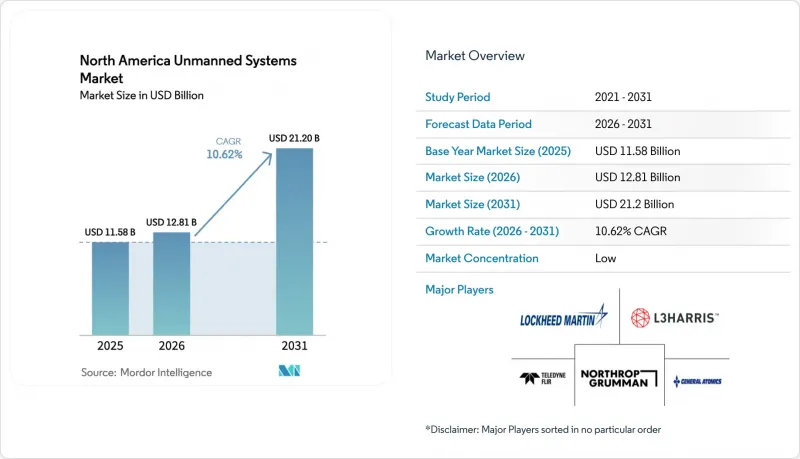
Mordor Intelligence에 의하면, 북미 무인 시스템 시장 규모는 2025년에 115억 8,000만 달러로 평가되었고 2026년 128억 1,000만 달러에서 2031년까지 212억 달러에 이를 것으로 추정되고 있어 예측 기간(2026-2031년) CAGR은 10.62%를 나타낼 전망입니다.
본 보고서는 유형별(무인 항공기, 무인 지상 차량, 무인 수중정), 용도별(군사 ISR, 민간 및 법 집행 기관, 기타), 최종 사용자별(국방·국토 안보, 공공 안전 기관, 기타), 지역별(미국, 캐나다, 멕시코)로 분류되어 있습니다. 시장 예측은 금액(달러) 기준으로 제시되어 있습니다.
북미 무인 시스템 시장 동향 및 인사이트
다중 영역 방위의 현대화가 무인 시스템 조달을 가속화하고 있습니다.
다중 도메인에 대한 요구 사항이 높아짐에 따라 미국의 견조한 군사 지출이 뒷받침되고 있습니다. 그 예로, 2025 회계연도의 무인 차량 예산 요청액이 101억 달러로 전년도보다 10억 달러 증가한 점을 들 수 있습니다. ‘Future Tactical UAS’나 ‘Launched Effects’와 같은 육군의 통합 프로그램은 도메인 간 상호 운용성 향상을 목표로 하고 있는 반면, 해군의 무인수상정 49척 추가 구매는 해상 분야 수요 증가를 뒷받침하고 있습니다. 드론 대응 시스템에 대한 5억 달러 이상의 투자는 위협 환경의 변화를 반영하는 동시에, 함대의 현대화를 최우선 과제로 삼는 태도를 강화하고 있습니다. 수천 대의 소모 가능한 자율 비행체의 실전 배치를 임무로 하는 국방부의 ‘Replicator’ 프로그램은 대량 생산형이자 저비용 시스템으로의 전환이 가속화되고 있음을 보여줍니다. 이러한 노력들이 어우러져 방위 지출은 북미 무인 시스템 시장을 지탱하는 주요 기둥으로서의 입지를 확고히 하고 있습니다.
농업 및 물류 분야에서의 상용 드론 도입 확대
미국 내 등록된 상용 드론의 수는 2019년부터 2024년 사이에 2배 이상 증가하여 84만 2,000대에 달했습니다. 또한 2028년까지 110만 대 규모에 이를 것으로 예측됩니다. 연방항공청(FAA)의 멀티 드론 스웜 운용 승인으로 인해, 한 명의 조종사가 더 무거운 탑재물을 실은 플랫폼을 지휘할 수 있게 되었으며, 정밀 살포 및 작물 분석과 같은 농업 분야의 활용 사례가 확대되고 있습니다. 물류 분야에서의 도입도 이에 뒤이어 진행되고 있습니다. 월마트의 댈러스-포트워스 사업에서는 이미 180만 명의 주민을 대상으로 서비스가 전개되고 있으며, 업계 예측에 따르면 2034년까지 연간 8억 800만 건의 상업용 드론 배송이 이루어질 것으로 전망됩니다. 농업과 물류의 시너지 효과로 인해 MightyFly와 같은 제조업체들은 100파운드의 적재 능력을 갖추고 600마일을 비행할 수 있는 화물용 드론 개발을 추진하고 있습니다. 이러한 성과는 북미 무인 시스템 시장에서 민간 수요가 확대되고 있음을 뒷받침합니다.
일관성 없는 개인정보 보호 및 데이터 거버넌스 규제가 확장성을 저해
미국 내 주별 개인정보 보호법의 파편화와 캐나다의 연방 및 주 규정의 차이는 규정 준수 비용을 증가시키고, 여러 관할 구역에 걸친 사업 확장을 제약하고 있습니다. 센서를 활용한 감시에 대한 지역 사회의 우려는 긴급 대응에서의 효과가 입증되었음에도 불구하고, 공공 안전을 위한 도입을 복잡하게 만들고 있습니다. 데이터 보존에 관한 의무가 통일되지 않은 점은 국경을 넘는 물류 비행을 더욱 제한하고, 전국적인 ‘드론을 1차 대응자로 활용하는’ 프로그램의 시행을 지연시키고 있습니다. 통일된 기준이 확립될 때까지 거버넌스의 불확실성은 북미 무인 시스템 시장 전체의 확장 계획에 걸림돌이 될 것입니다.
부문 분석
무인 항공기(UAV)는 2025년 매출의 59.62%를 차지하며, 2031년까지 연평균 성장률(CAGR) 11.42%로 확대될 것으로 예측됩니다. 그 우위는 정찰용 나노급 쿼드콥터부터 600마일 거리에서 100파운드를 운반하는 MightyFly사의 ‘Cento’와 같은 대형 고정익 화물 드론에 이르기까지 다양합니다. 북미 무인 시스템 시장에서 UAV의 응용 분야는 시장 규모의 전반적인 성장에 주된 기여를 하고 있습니다. 무인 지상 차량(UGV)은 전장의 병참 지원 및 불발탄 처리를 보완하고 있는 반면, 자율적인 병참 수송을 위해 블랙호크 헬리콥터를 개조하는 프로그램은 항공기의 자율화가 회전익기 부대에 얼마나 깊이 침투하고 있는지를 보여줍니다.
무인 수중 정찰기(UUV)는 생산 대수가 가장 적은 분야이지만, 석유 및 가스전 점검 수요와 해군의 해저 상황 파악에 대한 관심 덕분에 혜택을 보고 있습니다. Freedom사의 AUV를 이용한 최근 미 해군 시험과 Anduril사가 로드아일랜드주에 건설 중인 연간 200대 규모의 AUV 생산 시설은 해저 분야에 대한 투자가 증가하고 있음을 뒷받침하고 있습니다. 분야 간 기술 이전도 진행되고 있으며, UUV에서 소나를 활용한 딥러닝이나 UAV에서 GPS 미사용 환경에서의 항법은 AI 알고리즘을 공유함으로써 플랫폼의 융합을 가능하게 하고, 북미 무인 시스템 시장의 확장을 뒷받침하고 있습니다.
기타 혜택:
- 엑셀 형식 시장 예측(ME) 시트
- 3개월간의 애널리스트 지원
자주 묻는 질문
목차
제1장 서론
제2장 조사 방법
제3장 주요 요약
제4장 시장 구도
제5장 시장 규모와 성장 예측
제6장 경쟁 구도
제7장 시장 기회와 향후 전망
JHS 26.08.28According to Mordor Intelligence, the north american unmanned systems market size was valued at USD 11.58 billion in 2025 and estimated to grow from USD 12.81 billion in 2026 to reach USD 21.20 billion by 2031, at a CAGR of 10.62% during the forecast period (2026-2031).
This report is Segmented by Type (Unmanned Aerial Vehicles, Unmanned Ground Vehicles, and Unmanned Underwater Vehicles), Application (Military ISR, Civil and Law-Enforcement, and More), End User (Defense and Homeland Security, Public-Safety Agencies, and More), and Geography (United States, Canada, and Mexico). The Market Forecasts are Provided in Terms of Value (USD).
North America Unmanned Systems Market Trends and Insights
Multi-domain defense modernization accelerating unmanned systems procurement
Rising multi-domain requirements underpin robust US military spending, as illustrated by the USD 10.1 billion FY 2025 uncrewed-vehicle budget request, which is USD 1 billion higher than the prior year. Consolidated Army programs such as Future Tactical UAS and Launched Effects aim to boost cross-domain interoperability, while the Navy's purchase of 49 additional unmanned surface vehicles underscores maritime demand growth. Investments exceeding USD 500 million in counter-drone systems reflect an evolving threat environment and reinforce fleet modernization priorities. The DoD's Replicator program-tasked with fielding thousands of attritable autonomous aircraft-signals an accelerated shift toward large-volume, low-cost systems. These combined initiatives cement defense spending as the chief pillar supporting the North American unmanned systems market.
Commercial drone integration expanding across agriculture and logistics sectors
Registered commercial drones in the United States more than doubled between 2019 and 2024, reaching 842,000 units, and projections indicate a fleet of 1.1 million by 2028. FAA approvals for multi-drone swarm operations enable a single pilot to command heavier payload platforms, widening agricultural use cases such as precision spraying and crop analytics. Logistics adoption follows suit-Walmart's Dallas-Fort Worth operation already covers 1.8 million residents, and industry forecasts anticipate 808 million commercial drone deliveries annually by 2034. The synergy between agriculture and logistics drives producers like MightyFly to develop 100-pound-payload cargo drones capable of 600-mile missions. Together, these milestones validate expanding civilian demand in the North American unmanned systems market.
Inconsistent privacy and data-governance regulations hindering scalability
Fragmented state-level privacy laws in the United States and differing federal-provincial rules in Canada increase compliance costs and constrain multi-jurisdictional operations. Community concerns about sensor-enabled surveillance complicate public safety deployments despite proven emergency-response gains. Unaligned data-retention mandates further restrict cross-border logistics flights and delay nationwide drone-as-first-responder programs. Until uniform standards emerge, governance uncertainty will weigh on expansion plans across the North American unmanned systems market.
Other drivers and restraints analyzed in the detailed report include:
- Regulatory progress enabling large-scale BVLOS operations
- Cost reductions in AI autonomy and edge processing driving broader adoption
- Sensor and chip supply-chain vulnerabilities impacting production timelines
For complete list of drivers and restraints, kindly check the Table Of Contents.
Segment Analysis
Unmanned aerial vehicles (UAVs) held 59.62% of 2025 revenue and are forecast to expand at an 11.42% CAGR through 2031. Their dominance spans nano-class quadcopters for reconnaissance to large fixed-wing cargo drones such as MightyFly's Cento, which carries 100 lbs across 600 miles. The North American unmanned systems market size for UAV applications primarily contributes to overall growth. Unmanned ground vehicles supplement battlefield logistics and explosive-ordnance disposal, while programs retrofitting Black Hawk helicopters for autonomous logistics illustrate how aerial autonomy permeates rotorcraft fleets.
Unmanned underwater vehicles (UUVs) record the smallest unit volumes but benefit from oil-and-gas inspection demand and naval interest in seabed domain awareness. Freedom AUV's recent US Navy trials and Anduril's Rhode Island production facility targeting 200 AUVs per year confirm rising subsea investment. Cross-domain technology transfer is increasing; sonar-enabled deep learning in UUVs and GPS-denied navigation in UAVs share AI algorithms, enabling platform convergence and reinforcing the North American unmanned systems market expansion.
Complete Report Scope:
- By Type
- Unmanned Aerial Vehicles (UAVs)
- Unmanned Ground Vehicles (UGVs)
- Unmanned Underwater Vehicles (UUVs)
- By Application
- Military ISR
- Civil and Law-Enforcement
- Commercial Logistics and Delivery
- Agriculture and Natural-Resources
- Industrial Inspection and Maintenance
- By End User
- Defense and Homeland Security
- Public Safety Agencies
- Enterprise and Industrial Operators
- Service Providers (Drone-as-a-Service)
- By Geography
- United States
- Canada
- Mexico
List of Companies Covered in this Report:
- The Boeing Company
- Lockheed Martin Corporation
- Northrop Grumman Corporation
- General Atomics
- L3Harris Technologies, Inc.
- General Dynamics Corporation
- Elbit Systems Ltd.
- Teledyne FLIR LLC (Teledyne Technologies Incorporated)
- AeroVironment, Inc.
- SZ DJI Technology Co. Ltd.
- Anduril Industries, Inc.
- Kratos Defense & Security Solutions, Inc.
- Skydio, Inc.
- Shield AI, Inc.
- Textron Systems Corporation (Textron Inc.)
- Oceaneering International, Inc.
- Kongsberg Gruppen ASA
- Saab AB
- QinetiQ Group
Additional Benefits:
- The market estimate (ME) sheet in Excel format
- 3 months of analyst support
TABLE OF CONTENTS
1 INTRODUCTION
- 1.1 Study Assumptions and Market Definition
- 1.2 Scope of the Study
2 RESEARCH METHODOLOGY
3 EXECUTIVE SUMMARY
4 MARKET LANDSCAPE
- 4.1 Market Overview
- 4.2 Market Drivers
- 4.2.1 Multi-domain defense modernization accelerating unmanned systems procurement
- 4.2.2 Commercial drone integration expanding across agriculture and logistics sectors
- 4.2.3 Regulatory progress enabling large-scale beyond-visual-line-of-sight operations
- 4.2.4 Cost reductions in AI autonomy and edge processing driving broader adoption
- 4.2.5 Rising demand for AUVs in offshore energy and subsea inspection missions
- 4.2.6 Public safety and emergency response agencies scaling drone-based operations
- 4.3 Market Restraints
- 4.3.1 Inconsistent privacy and data governance regulations hindering scalability
- 4.3.2 Sensor and chip supply-chain vulnerabilities impacting production timelines
- 4.3.3 Delayed counter-UAS acquisitions slowing unmanned system fielding
- 4.3.4 Acoustic emission restrictions limiting underwater vehicle deployment
- 4.4 Value Chain Analysis
- 4.5 Regulatory Landscape
- 4.6 Technological Outlook
- 4.7 Porter's Five Forces Analysis
- 4.7.1 Bargaining Power of Suppliers
- 4.7.2 Bargaining Power of Buyers/Consumers
- 4.7.3 Threat of New Entrants
- 4.7.4 Threat of Substitute Products
- 4.7.5 Intensity of Competitive Rivalry
5 MARKET SIZE AND GROWTH FORECASTS
- 5.1 By Type
- 5.1.1 Unmanned Aerial Vehicles (UAVs)
- 5.1.2 Unmanned Ground Vehicles (UGVs)
- 5.1.3 Unmanned Underwater Vehicles (UUVs)
- 5.2 By Application
- 5.2.1 Military ISR
- 5.2.2 Civil and Law-Enforcement
- 5.2.3 Commercial Logistics and Delivery
- 5.2.4 Agriculture and Natural-Resources
- 5.2.5 Industrial Inspection and Maintenance
- 5.3 By End User
- 5.3.1 Defense and Homeland Security
- 5.3.2 Public Safety Agencies
- 5.3.3 Enterprise and Industrial Operators
- 5.3.4 Service Providers (Drone-as-a-Service)
- 5.4 By Geography
- 5.4.1 United States
- 5.4.2 Canada
- 5.4.3 Mexico
6 COMPETITIVE LANDSCAPE
- 6.1 Market Concentration
- 6.2 Strategic Moves
- 6.3 Market Share Analysis
- 6.4 Company Profiles (includes Global level Overview, Market level overview, Core Segments, Financials as available, Strategic Information, Market Rank/Share for key companies, Products and Services, and Recent Developments)
- 6.4.1 The Boeing Company
- 6.4.2 Lockheed Martin Corporation
- 6.4.3 Northrop Grumman Corporation
- 6.4.4 General Atomics
- 6.4.5 L3Harris Technologies, Inc.
- 6.4.6 General Dynamics Corporation
- 6.4.7 Elbit Systems Ltd.
- 6.4.8 Teledyne FLIR LLC (Teledyne Technologies Incorporated)
- 6.4.9 AeroVironment, Inc.
- 6.4.10 SZ DJI Technology Co. Ltd.
- 6.4.11 Anduril Industries, Inc.
- 6.4.12 Kratos Defense & Security Solutions, Inc.
- 6.4.13 Skydio, Inc.
- 6.4.14 Shield AI, Inc.
- 6.4.15 Textron Systems Corporation (Textron Inc.)
- 6.4.16 Oceaneering International, Inc.
- 6.4.17 Kongsberg Gruppen ASA
- 6.4.18 Saab AB
- 6.4.19 QinetiQ Group
7 MARKET OPPORTUNITIES AND FUTURE OUTLOOK
- 7.1 White-space and Unmet-Need Assessment


