|
시장보고서
상품코드
2116633
스판덱스 시장 : 점유율 분석, 업계 동향과 통계, 성장 예측(2026-2031년)Spandex - Market Share Analysis, Industry Trends & Statistics, Growth Forecasts (2026 - 2031) |
||||||
 Mordor Intelligence
Mordor Intelligence에 의하면, 스판덱스 시장 규모는 2025년에 141만 톤으로 평가되어 2026년 149만 톤에서 2031년까지 196만 톤에 이를 것으로 예측되며, 예측 기간(2026-2031년) CAGR은 5.63%를 나타낼 전망입니다.
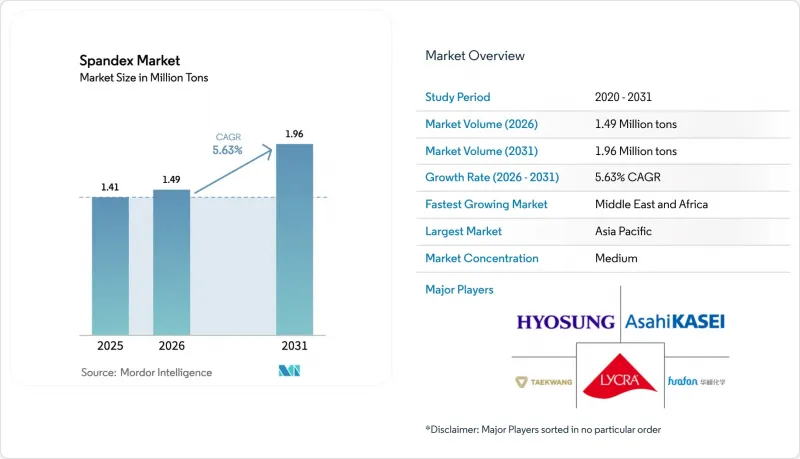
본 보고서는 제조 방법(용액 건식 방적, 용액 습식 방적, 기타), 용도(의류, 의료, 기타 용도) 및 지역(아시아태평양, 북미, 유럽, 남미, 중동 및 아프리카)별로 분류되어 있습니다. 시장 예측은 수량(톤) 기준으로 제시되어 있습니다.
세계 스판덱스 시장 동향 및 인사이트
애슬레저 및 퍼포먼스웨어의 보급 확대
애슬레저가 틈새 시장에서 주류로 부상함에 따라 스판덱스 수요는 기존의 스포츠웨어 범위를 훨씬 뛰어넘게 되었습니다. 퍼포먼스 의류의 성장은 사무실에서 헬스장까지 폭넓게 착용할 수 있는 다용도성을 추구하는 소비자에 의해 주도되고 있습니다. 재택근무 문화로 인해 캐주얼한 복장 규정이 정착되는 한편, D2C(소비자 직접 판매) 브랜드는 일관된 신축성, 복원력 및 흡습발산 성능을 제공할 수 있는 섬유 공급업체를 높이 평가하는 혁신의 주기를 가속화했습니다. 룰루레몬(Lululemon)과 같은 프리미엄 브랜드는 기능성 소재 신제품 출시 수가 전년 대비 25% 증가했으며, 이는 프리미엄 시장에서도 더 이상 고기능성 원단이 배제되지 않음을 여실히 보여주고 있습니다.
섬유 클러스터에 대한 정부 주도 투자
이집트, 베트남, 방글라데시의 국가 산업 정책에서는 저비용 자금 조달, 세제 혜택, 인력 양성이 통합형 섬유 산업 단지로 이어지고 있습니다. 이러한 클러스터에서는 방적, 직조, 후가공 각 공정을 동일한 부지 내에 집약함으로써 리드 타임을 단축하고 품질 관리를 향상시키고 있습니다. 이를 통해 현지 원료 및 섬유 시설을 구축한 스판덱스 공급업체에 대한 장기적인 수요가 확고해지고 있습니다. 튀르키예와 인도에서 시행되는 유사한 우대 조치는 고용 창출에 있어 섬유 산업의 구조적 역할을 강화하고, 경제 사이클 전반에 걸쳐 스판덱스 시장 수요가 견조하게 유지되도록 보장하고 있습니다.
미세 플라스틱 오염을 둘러싼 NGO의 압력 고조
환경 보호 단체들은 세탁 1회당 최대 70만 개에 달하는 마이크로파이버 탈락 문제에 주목하고 있으며, 이는 유럽연합(EU)의 여과 및 표시 관련 규정 제정을 촉진하고 있습니다. 소비자의 선호도는 천연 소재와 재활용 소재로 이동하고 있으며, 각 브랜드는 탈락이 적거나 생분해성 스판덱스 제품의 채택을 요구받고 있습니다. 생산자가 코팅 공정을 추가하거나 생분해 기술에 투자함으로써 규정 준수 비용이 증가하고, 대체 섬유와의 가격 경쟁력이 저하될 가능성이 있습니다.
부문 분석
2025년, 용액 건식 방적은 스판덱스 시장 점유율의 91.78%를 차지했습니다. 이는 뛰어난 섬유 균일성, 인장 강도 및 염색성 덕분입니다. 이 부문은 고성능 웨어러블 제품에 있어 중요한 매개변수인 데니어 편차를 최소화하는 공정 제어 시스템의 이점을 누리고 있습니다. 지속가능성 목표에 부합하여 차세대 건식 방적 라인은 에너지 소비를 최대 20% 절감하고, 단위당 탄소 배출량을 줄이고 있습니다. ‘기타’로 분류되는 대체 기술은 용매를 사용하지 않는 용융 일렉트로스피닝 및 원심 분리 기술이 성숙해짐에 따라 2031년까지 연평균 성장률(CAGR) 6.08%로 확대될 것으로 예상되지만, 그 성장세는 낮은 기저에서 출발한 것입니다.
신흥 공정에서는 폐쇄형 용매 회수 및 바이오 폴리머의 통합이 우선시되고 있지만, 확장성에 대한 과제는 여전히 남아 있습니다. 멜트 일렉트로스피닝은 용제를 배제할 수 있다는 점에서 VOC 배출에 대한 규제 압력에 대응할 가능성을 지니고 있지만, 산업 규모에서는 섬유의 균일성 확보가 과제로 남아 있습니다. 원심 방적은 높은 처리량을 실현하지만, 고급 속옷이나 의료기기에 요구되는 미세 데니어 제어에는 불충분합니다. 따라서 기존 건식 방적 제조업체들은 하이브리드형 파일럿 라인에 투자하는 동시에, 특정 탄성 유지 특성을 반영한 독자적인 폴리우레탄 배합을 통해 시장에서의 우위를 유지하고 있습니다.
지역별 분석
아시아태평양은 2025년 스판덱스 시장 규모에서 63.88%의 점유율을 유지했습니다. 이는 중국의 원료부터 원단까지의 통합 공급망, 한국의 선진적인 고분자 연구 개발, 그리고 인도의 확대되는 방적 능력에 힘입은 결과입니다. 이 지역의 생산자들은 석유화학 클러스터와의 근접성 및 밀집된 수출 물류 네트워크의 혜택을 누리고 있습니다. 그러나 중국의 과잉 생산 능력으로 인해 평균 판매 가격이 정기적으로 하락하고 있어, 방적 제조업체들은 운영 효율성 향상과 제품 다각화를 추진해야 하는 상황에 놓여 있습니다. 배출 기준 개정에 따른 환경 대책 강화에는 설비 투자가 필요하며, 이는 지역 내 업계 재편을 가속화할 가능성이 있습니다.
중동 및 아프리카은 2026년부터 2031년까지 6.11%라는 가장 높은 연평균 성장률(CAGR)을 나타낼 전망입니다. 이집트의 통합형 텍스타일 파크 프로젝트와 사우디아라비아의 ‘비전 2030’에 따른 우대 조치는 유럽 및 미국 시장에 관세 면제 혜택을 통해 진출하고자 하는 해외 투자자들을 끌어들이고 있습니다. 경쟁력 있는 전기 요금과 현대적인 항만 인프라 덕분에 이 지역은 신흥 스판덱스 시장의 생산 거점으로서의 위상을 더욱 높이고 있습니다.
유럽연합(EU)의 ‘디지털 제품 여권’ 및 확장된 생산자 책임(EPR) 프레임워크는 환경 부하가 낮은 엘라스토머와 지역 밀착형 재활용 루프에 대한 수요를 자극하고 있습니다. 멕시코와 중부 유럽의 니어쇼어링 동향은 아시아 중심의 대량 공급망을 대체하기보다는 이를 보완하는 형태로, 신속한 재고 보충이라는 이점을 제공합니다. 브라질을 중심으로 한 남미에서는 국내 스포츠웨어 브랜드의 확대와 공적 의료 제도 내 압박 요법의 보급에 따라 완만한 성장이 예상됩니다.
기타 혜택:
- 엑셀 형식 시장 예측(ME) 시트
- 3개월간 애널리스트 지원
자주 묻는 질문
목차
제1장 서론
제2장 조사 방법
제3장 개요
제4장 시장 구도
제5장 시장 규모와 성장 예측
제6장 경쟁 구도
제7장 시장 기회와 향후 전망
JHS 26.09.01According to Mordor Intelligence, the spandex market size was valued at 1.41 million tons in 2025 and estimated to grow from 1.49 million tons in 2026 to reach 1.96 million tons by 2031, at a CAGR of 5.63% during the forecast period (2026-2031).
This report is Segmented by Production Method (Solution Dry Spinning, Solution Wet Spinning, and Others), Application (Apparels, Medical, and Other Applications), and Geography (Asia-Pacific, North America, Europe, South America, and Middle-East and Africa). The Market Forecasts are Provided in Terms of Volume (Tons).
Global Spandex Market Trends and Insights
Rising Penetration of Athleisure and Performance Wear
Athleisure's rise from niche to mainstream has pushed spandex demand far beyond traditional sportswear. Performance apparel growth is driven by consumers who expect office-to-gym versatility. Remote-work culture reinforced casual dress codes, while direct-to-consumer brands accelerated innovation loops that reward fiber suppliers able to deliver consistent stretch, recovery, and moisture-management performance. Luxury labels such as Lululemon logged 25% year-over-year increases in technical fabric launches, underscoring how premium positioning no longer excludes high-function textiles.
Government-Backed Investments in Textile Clusters
National industrial policies in Egypt, Vietnam, and Bangladesh channel low-cost financing, tax holidays, and workforce training into integrated textile parks. These clusters shorten lead times and improve quality control by co-locating spinning, weaving, and finishing operations, thereby anchoring long-term demand for spandex suppliers that establish local feedstock and fiber facilities. Similar incentives in Turkey and India reinforce the structural role of textiles in employment generation, ensuring that spandex market demand remains resilient across economic cycles.
Intensifying NGO Pressure Over Micro-Plastic Pollution
Environmental groups spotlight microfiber shedding-up to 700,000 particles per wash-driving European Union rules on filtration and labeling. Consumer sentiment shifts toward natural or recycled options, compelling brands to specify low-shedding or biodegradable spandex variants. Compliance costs rise as producers add coating steps or invest in intrinsic biodegradation technologies, potentially narrowing price competitiveness versus alternative fibers.
Other drivers and restraints analyzed in the detailed report include:
- Medical Compression Garments Demand Surge Post-COVID
- Rapid Uptake of Seamless Knitting Technology
- Petrochemical Feedstock Price Volatility
For complete list of drivers and restraints, kindly check the Table Of Contents.
Segment Analysis
Solution dry spinning commanded 91.78% spandex market share in 2025, reflecting its superior fiber uniformity, tensile strength, and dye uptake. The segment benefits from process control systems that minimize denier variability, a critical parameter for high-performance wearables. Aligning with sustainability targets, next-generation dry spinning lines reduce energy consumption by up to 20%, lowering specific carbon emissions. Alternative methods grouped under "Others" are projected to expand at a 6.08% CAGR through 2031 as solvent-free melt electrospinning and centrifugal techniques mature, albeit from a low base.
Emerging processes prioritize closed-loop solvent recovery and bio-based polymer integration, but scalability hurdles persist. Melt electrospinning's promise of solvent elimination suits regulatory pressure on VOC emissions, yet faces fiber-uniformity challenges at industrial speeds. Centrifugal spinning delivers high throughput but falls short on fine-denier control required for premium intimates and medical devices. Accordingly, established dry-spinning producers invest in hybrid pilot lines while safeguarding their dominant positions through proprietary polyurethane formulations that embed specific elasticity-retention profiles.
Complete Report Scope:
- By Production Method
- Solution Dry Spinning
- Solution Wet Spinning
- Others
- By Application
- Apparels
- Medical
- Other Applications
- By Geography
- Asia-Pacific
- China
- India
- Japan
- South Korea
- Rest of Asia-Pacific
- North America
- United States
- Canada
- Mexico
- Europe
- Germany
- United Kingdom
- France
- Italy
- Russia
- Rest of Europe
- South America
- Brazil
- Argentina
- Rest of South America
- Middle-East and Africa
- Saudi Arabia
- South Africa
- Rest of Middle-East and Africa
- Asia-Pacific
Geography Analysis
Asia-Pacific retained a 63.88% share of the spandex market size in 2025, underpinned by China's integrated feedstock-to-fabric chain, South Korea's advanced polymer research and development, and India's expanding spinning capacity. Regional producers benefit from proximity to petrochemical clusters and dense export logistics networks. Yet Chinese overcapacity periodically depresses average selling prices, pushing mills to chase operational efficiency and product diversification. Environmental upgrades mandated by updated emission norms require capital expenditure that may accelerate regional consolidation.
The Middle-East and Africa are forecast to deliver the highest CAGR at 6.11% during 2026-2031. Egypt's integrated textile park projects and Saudi Arabia's Vision 2030 incentives attract overseas investors keen on duty-free access to European and U.S. markets. Competitive electricity tariffs and modern port infrastructure further elevate the region as an emerging spandex market production hub.
The European Union's Digital Product Passport and extended producer responsibility frameworks stimulate demand for low-impact elastomers and localized recycling loops. Nearshoring trends in Mexico and Central Europe offer quick-turn replenishment advantages that complement, rather than replace, Asia-centric bulk supply chains. South America, anchored by Brazil, shows moderate growth as domestic sportswear brands scale and public healthcare systems embrace compression therapies.
- Asahi Kasei Corporation
- Huafon Chemical Co., Ltd.
- HYOSUNG
- Indorama Corporation
- Jining Ruyi High-tech Fibre Co.,Ltd.
- Mitsui Chemicals, Inc.
- TAEKWANG INDUSTRIAL CO., LTD
- The LYCRA Company
- TK CHEMICAL CORPORATION
- TORAY INDUSTRIES, INC.
- Xiamen Lilong Spandex Co., Ltd.
- Yantai Tayho Advanced Materials Co., Ltd.
Additional Benefits:
- The market estimate (ME) sheet in Excel format
- 3 months of analyst support
TABLE OF CONTENTS
1 Introduction
- 1.1 Study Assumptions and Market Definition
- 1.2 Scope of the Study
2 Research Methodology
3 Executive Summary
4 Market Landscape
- 4.1 Market Overview
- 4.2 Market Drivers
- 4.2.1 Rising penetration of athleisure and performance wear
- 4.2.2 Government-backed investments in textile clusters
- 4.2.3 Medical compression garments demand surge post-COVID
- 4.2.4 Rapid uptake of seamless knitting technology in apparel
- 4.2.5 Bio-based diisocyanate breakthroughs lowering carbon footprint
- 4.3 Market Restraints
- 4.3.1 Intensifying NGO pressure over micro-plastic pollution
- 4.3.2 Petrochemical feedstock price volatility
- 4.3.3 Supply-demand imbalance due to China capacity additions
- 4.4 Value Chain Analysis
- 4.5 Porter's Five Forces Analysis
- 4.5.1 Bargaining Power of Suppliers
- 4.5.2 Bargaining Power of Buyers
- 4.5.3 Threat of New Entrants
- 4.5.4 Threat of Substitutes
- 4.5.5 Degree of Competition
5 Market Size and Growth Forecasts (Volume)
- 5.1 By Production Method
- 5.1.1 Solution Dry Spinning
- 5.1.2 Solution Wet Spinning
- 5.1.3 Others
- 5.2 By Application
- 5.2.1 Apparels
- 5.2.2 Medical
- 5.2.3 Other Applications
- 5.3 By Geography
- 5.3.1 Asia-Pacific
- 5.3.1.1 China
- 5.3.1.2 India
- 5.3.1.3 Japan
- 5.3.1.4 South Korea
- 5.3.1.5 Rest of Asia-Pacific
- 5.3.2 North America
- 5.3.2.1 United States
- 5.3.2.2 Canada
- 5.3.2.3 Mexico
- 5.3.3 Europe
- 5.3.3.1 Germany
- 5.3.3.2 United Kingdom
- 5.3.3.3 France
- 5.3.3.4 Italy
- 5.3.3.5 Russia
- 5.3.3.6 Rest of Europe
- 5.3.4 South America
- 5.3.4.1 Brazil
- 5.3.4.2 Argentina
- 5.3.4.3 Rest of South America
- 5.3.5 Middle-East and Africa
- 5.3.5.1 Saudi Arabia
- 5.3.5.2 South Africa
- 5.3.5.3 Rest of Middle-East and Africa
- 5.3.1 Asia-Pacific
6 Competitive Landscape
- 6.1 Market Concentration
- 6.2 Strategic Moves
- 6.3 Market Share (%)/Ranking Analysis
- 6.4 Company Profiles (includes Global level Overview, Market level overview, Core Segments, Financials as available, Strategic Information, Market Rank/Share for key companies, Products and Services, and Recent Developments)
- 6.4.1 Asahi Kasei Corporation
- 6.4.2 Huafon Chemical Co., Ltd.
- 6.4.3 HYOSUNG
- 6.4.4 Indorama Corporation
- 6.4.5 Jining Ruyi High-tech Fibre Co.,Ltd.
- 6.4.6 Mitsui Chemicals, Inc.
- 6.4.7 TAEKWANG INDUSTRIAL CO., LTD
- 6.4.8 The LYCRA Company
- 6.4.9 TK CHEMICAL CORPORATION
- 6.4.10 TORAY INDUSTRIES, INC.
- 6.4.11 Xiamen Lilong Spandex Co., Ltd.
- 6.4.12 Yantai Tayho Advanced Materials Co., Ltd.
7 Market Opportunities and Future Outlook
- 7.1 White-space and unmet-need assessment