

|
시장보고서
상품코드
2116636
폴리스티렌 폼 시장 : 점유율 분석, 업계 동향과 통계, 성장 예측(2026-2031년)Polystyrene Foam - Market Share Analysis, Industry Trends & Statistics, Growth Forecasts (2026 - 2031) |
||||||
 Mordor Intelligence
Mordor Intelligence에 의하면, 폴리스티렌 폼 시장 규모는 2025년에 428억 7,000만 달러로 평가되었고 2026년 449억 8,000만 달러에서 2031년까지 572억 2,000만 달러에 이를 것으로 추정되고 있어 예측 기간(2026-2031년) CAGR은 4.92%를 나타낼 전망입니다.
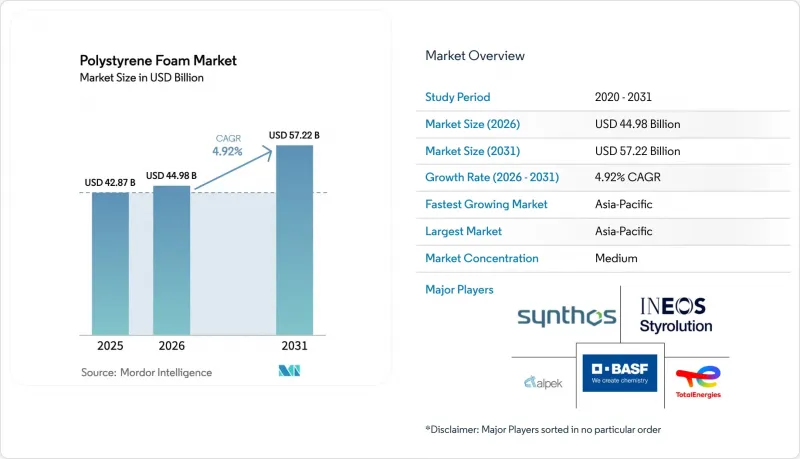
본 보고서에서는 산업을 ‘유형’(발포 폴리스티렌(EPS) 및 압출 성형 폴리스티렌(XPS)), ‘최종 사용자 산업’(건축 및 건설, 포장, 기타), ‘지역’(아시아태평양, 북미, 유럽, 기타)별로 분류하고 있습니다. 시장 예측은 금액(달러) 기준으로 제시되어 있습니다.
세계 폴리스티렌 폼 시장 동향 및 인사이트
친환경 건축물에서의 단열재 의무화
현재 건축 에너지 기준에서는 연속 단열이 의무화되어 있어, 신축 및 개보수 공사 모두에서 폴리스티렌 폼의 채택이 증가하고 있습니다. 국제 건축 기준(IBC)에서는 방화층이 포함된 경우 발포 플라스틱 단열재가 허용되며, 이를 통해 LEED 인증을 취득할 수 있고, HVAC(냉난방·환기) 에너지의 최대 30%를 절약할 수 있습니다. 듀폰(DuPont)사의 저 GWP(지구 온난화 지수) XPS 배합 변경을 통해 매립 탄소가 94% 감축된 사실은 규제가 혁신을 촉진하면서도 대상 수요를 확실하게 보호하고 있음을 보여줍니다. 무할로겐 난연제에 관한 북유럽 국가들의 정책 성공은 전 세계적으로 EPS를 보다 안전하게 도입하기 위한 지침이 됩니다. 이러한 규제의 명확화를 통해 폴리스티렌 폼 시장은 성장 궤도를 유지하면서 환경 목표 달성도 지원받고 있습니다.
전자상거래 분야의 보호 포장 붐
소포 처리량은 계속 증가하는 추세를 보이며, 충격 흡수성이 뛰어난 저밀도 보호용 성형품에 대한 수요를 견인하고 있습니다. 아마존의 가이드라인은 적절한 크기 선정을 권장하고 있어, 파손되기 쉬운 품목을 위한 EPS 성형 부품에 대한 수요를 높이고 있습니다. 동시에, 에코베티브(EcoBative)사의 균사체 포장재와 같은 바이오 경쟁 제품들이 지속가능성을 중시하는 계약을 수주하고 있는데, 이는 급격한 변화라기보다는 오히려 전환 과정임을 여실히 보여주고 있습니다. 그 결과, 전자상거래 사업자들이 비용, 성능, 환경 목표 간의 균형을 맞추는 가운데, 폴리스티렌 폼 시장은 점진적인 성장을 이루고 있습니다.
스티렌 단량체 가격 변동
벤젠 가격의 상승은 스티렌을 거쳐 폴리스티렌에 직접적인 영향을 미치고 있으며, 이로 인해 각 생산 업체들은 2024년 초 여러 지역에서 톤당 110달러의 추가 요금을 발표했습니다. 유럽이 순수출국에서 순수입국으로 전환되어 2023년 수입량이 400킬로톤에 육박한 것도 공급망의 위험을 높였습니다. 이러한 변동은 가공업체의 이익률을 압박하여 폴리스티렌 폼 시장의 단기적인 확장을 억제하고 있습니다.
부문 분석
EPS는 건축 외피 및 성형 포장재에 폭넓게 활용되는 것을 배경으로, 2025년에는 폴리스티렌 폼 시장 점유율의 61.43%를 차지했습니다. 2025년 EPS(발포 폴리스티렌) 시장 규모는 263억 4,000만 달러에 달할 것으로 예상되며, 재활용 촉진 프로그램의 확대에 따라 해당 부문은 한 자릿수 중반대의 성장률을 기록할 전망입니다. 규제가 난연제 미사용 배합을 권장하는 상황에서도, EPS의 저비용과 범용성 덕분에 지속적인 우위가 뒷받침되고 있습니다.
XPS는 더 높은 단위 이익률을 창출하며, 2031년까지 연평균 성장률(CAGR) 6.22%로 확대되고 있습니다. 그 열전도율은 0.032-0.037W/(m·K)로, 0.035-0.040W/(m·K) 범위에 있는 EPS를 상회합니다. 따라서 단열재의 연속 시공에 관한 건축 기준, 공간 제약, 고급스러운 외관 디자인과 같은 요인으로 인해 XPS가 선택되는 경향이 있으며, 이로 인해 에너지 절약 개보수 부문에서 폴리스티렌 폼 시장의 성장 궤도가 상승하고 있습니다. 듀폰(DuPont)의 AIM-Act 준수 보드와 BASF의 Styrodur 제품 라인을 칼 바할(Karl Bachar)사에 매각한 것은 제품의 초점을 명확히 하는 동시에, 치열한 경쟁을 유지하기 위한 생산 능력 확충을 촉진하고 있습니다.
지역별 분석
아시아태평양의 폴리스티렌 폼 시장 규모는 2025년에 184억 9,000만 달러에 달하고, 세계 시장 규모의 43.12%를 차지하며, 2031년까지 연평균 성장률(CAGR) 6.55%를 나타낼 것으로 전망됩니다. 중국이 전 세계 스티렌 수입량의 35%를 차지하고 있어 수지 공급을 뒷받침하고 있는 한편, 가전제품 교체 보조금으로 인해 추가적인 EPS가 포장 및 단열재 생산 라인으로 유입되고 있습니다. 인도에서는 Styrenix Performance Materials와 Supreme Petrochem이 견조한 가전제품 및 자동차용 플라스틱 수요를 배경으로 2028년까지 명목 생산 능력을 2배 이상 확대될 전망입니다.
북미는 2025년 102억 1,000만 달러에 가까운 견실한 매출 기준을 유지했습니다. 2024년에 잇달아 이루어진 생산자 가격 인상은 건설 수요의 회복을 시사하는 것이었습니다. 한편, AIM-Act 규제로 인해 초저 GWP 발포제 시스템으로의 신속한 배합 변경이 촉진되었습니다. 정부의 인프라 지출 및 에너지 개보수 인센티브 덕분에 이 지역은 폴리스티렌 폼 시장의 중요한 축으로 계속 자리 잡고 있습니다.
유럽의 매출액은 약 76억 3,000만 달러를 차지했으며, 구형 스티렌 생산 설비가 폐쇄됨에 따라 2023년 수입량은 400킬로톤에 달했습니다. EU의 ‘포장 및 포장 폐기물 규정’은 2030년까지 완전한 재활용 가능성을 의무화하고 있으며, 이에 따라 현재 검토 중인 탈중합 및 기계적 재활용을 통한 식품 접촉용 EPS 등급에 대한 투자가 촉진되고 있습니다. 이러한 전환은 국내 가공업체를 지원하고 있지만, 경제적 마진을 압박하고 있습니다.
남미와 중동 및 아프리카를 합친 시장 규모는 65억 4,000만 달러에 약간 미치지 못했습니다. 수요는 도로 건설, 콜드체인 관련 스타트업, 가처분 소득 증가에 힘입고 있습니다. 비교적 완화된 규제와 식료품 전자상거래의 확대가 EPS 보급의 첫 물결을 뒷받침하고 있으며, 규제 집행이 강화됨에 따라 향후 XPS로의 전환을 위한 토대가 마련되고 있습니다.
기타 혜택
- 엑셀 형식 시장 예측(ME) 시트
- 3개월간의 애널리스트 지원
자주 묻는 질문
목차
제1장 서론
제2장 조사 방법
제3장 개요
제4장 시장 구도
제5장 시장 규모와 성장 예측
제6장 경쟁 구도
제7장 시장 기회와 향후 전망
JHS 26.09.01According to Mordor Intelligence, the polystyrene foam market size was valued at USD 42.87 billion in 2025 and estimated to grow from USD 44.98 billion in 2026 to reach USD 57.22 billion by 2031, at a CAGR of 4.92% during the forecast period (2026-2031).
This report Segments the Industry by Type (Expandable Polystyrene (EPS) and Extruded Polystyrene (XPS)), End-User Industry (Building and Construction, Packaging, and More), and Geography (Asia-Pacific, North America, Europe, and More). The Market Forecasts are Provided in Terms of Value (USD).
Global Polystyrene Foam Market Trends and Insights
Green-building Insulation Mandates
Building-energy codes now require continuous insulation, increasing polystyrene-foam uptake in both new construction and retrofits. The International Building Code recognises foam-plastic insulation when fire-safety layers are integrated, enabling LEED credits and up to 30% HVAC-energy savings. DuPont's low-GWP XPS reformulation cut embodied carbon 94%, illustrating how regulation spurs innovation while safeguarding addressable demand. Nordic policy success with halogen-free flame retardants offers a blueprint for safer EPS adoption worldwide. Such regulatory clarity keeps the polystyrene foam market on a growth path while supporting environmental goals.
E-commerce Protective-Packaging Boom
Parcel volumes continue to climb, driving demand for shock-absorbing, low-density protective shapes. Amazon's guidelines encourage right-sizing, making EPS moulded parts attractive for fragile items. At the same time, bio-based contenders such as Ecovative's mycelium packaging are winning sustainability-minded contracts, highlighting a transition rather than a sudden shift. The net effect is incremental growth for the polystyrene foam market as e-tailers balance cost, performance, and environmental targets.
Styrene-monomer Price Volatility
Rising benzene costs transmit directly to styrene and then to polystyrene, pushing producers to announce USD 110 per-ton surcharges in multiple regions in early 2024. Europe's shift from net exporter to net importer, with 2023 inflows near 400 kilotons, added supply-chain risk. These swings squeeze converter margins and temper near-term expansion in the polystyrene foam market.
Other drivers and restraints analyzed in the detailed report include:
- Cold-chain & Pharma-logistics Expansion
- Geofoam Adoption for Seismic/Lightweight Embankments
- Single-use-Plastic Bans on EPS Food-service
For complete list of drivers and restraints, kindly check the Table Of Contents.
Segment Analysis
EPS captured 61.43% of polystyrene foam market share in 2025 on the strength of broad use in building envelopes and molded packaging. The polystyrene foam market size for EPS amounted to USD 26.34 billion in 2025, and the segment is slated to post mid-single-digit gains as recyclability programmes expand. EPS's low cost and versatility underpin a lasting edge even as regulations favour flame-retardant-free formulations.
XPS generates higher unit margins and is advancing at 6.22% CAGR to 2031. It features thermal conductivity between 0.032-0.037 W/(m*K), outperforming EPS, which ranges 0.035-0.040 W/(m*K). Continuous-insulation codes, space constraints and premium facade designs therefore tilt toward XPS, lifting the polystyrene foam market trajectory in energy-efficient retrofits. DuPont's AIM-Act-compliant boards and BASF's sale of its Styrodur line to Karl Bachl sharpen product focus while facilitating capacity adds that sustain competitive intensity.
Complete Report Scope:
- By Type
- Expandable Polystyrene (EPS)
- Extruded Polystyrene (XPS)
- By End-User Industry
- Building and Construction
- Packaging
- Other End-User Industries (Consumer and Home Appliances, etc.)
- By Geography
- Asia-Pacific
- China
- Japan
- India
- South Korea
- Rest of Asia-Pacific
- North America
- United States
- Canada
- Mexico
- Europe
- Germany
- United Kingdom
- France
- Italy
- Rest of Europe
- South America
- Brazil
- Argentina
- Rest of South America
- Middle East and Africa
- Saudi Arabia
- South Africa
- Middle East and Africa
- Asia-Pacific
Geography Analysis
Asia-Pacific's polystyrene foam market size topped USD 18.49 billion in 2025, equal to 43.12% of global value, and is predicted to post a 6.55% CAGR to 2031. China's 35% slice of worldwide styrene imports drives resin availability, while appliance-replacement subsidies funnel additional EPS into packaging and insulation lines. India is on track to more than double nameplate capacity by 2028, with Styrenix Performance Materials and Supreme Petrochem riding robust consumer-electronics and automotive plastics demand.
North America retained a solid revenue base close to USD 10.21 billion in 2025. A string of producer price increases in 2024 signalled recovering construction demand, even as AIM-Act rules prompted fast reformulation to ultra-low-GWP blowing-agent systems. Government infrastructure spending and energy-retrofit incentives keep the region an important pillar of the polystyrene foam market.
Europe accounted for roughly USD 7.63 billion and saw imports hit 400 kilotons in 2023 after older styrene units shut. The EU Packaging and Packaging Waste Regulation mandates full recyclability by 2030, spurring investments in depolymerisation and mechanically recycled EPS food-contact grades now under review. These transitions sustain domestic converters but tighten economic margins.
South America and the Middle East & Africa combined delivered slightly under USD 6.54 billion, with demand tied to road building, cold-chain start-ups and disposable-income growth. Lower regulation and expanding grocery e-commerce underpin first-wave EPS penetration, setting the stage for future XPS upgrades as code enforcement strengthens.
- Alpek S.A.B. de C.V.
- Atlas Molded Products
- BASF
- Epsilyte LLC
- INEOS Styrolution Group GmbH
- JSP
- KANEKA CORPORATION
- Kumho Petrochemical
- Owens Corning
- Styropek
- SUNPOR
- Synthos
- TotalEnergies
- Trinseo
- Versalis S.p.A.
- Wuxi Xingda foam plastic new material Limited
Additional Benefits:
- The market estimate (ME) sheet in Excel format
- 3 months of analyst support
TABLE OF CONTENTS
1 Introduction
- 1.1 Study Assumptions & Market Definition
- 1.2 Scope of the Study
2 Research Methodology
3 Executive Summary
4 Market Landscape
- 4.1 Market Overview
- 4.2 Market Drivers
- 4.2.1 Green-building insulation mandates
- 4.2.2 E-commerce protective-packaging boom
- 4.2.3 Cold-chain & pharma-logistics expansion
- 4.2.4 Geofoam adoption for seismic/lightweight embankments
- 4.2.5 Graphite-infused EPS for thin-retrofit insulation
- 4.3 Market Restraints
- 4.3.1 Styrene-monomer price volatility
- 4.3.2 Single-use-plastic bans on EPS food-service
- 4.3.3 Mushroom/mycelium packaging substitution threat
- 4.4 Value Chain Analysis
- 4.5 Porter's Five Forces
- 4.5.1 Bargaining Power of Suppliers
- 4.5.2 Bargaining Power of Buyers
- 4.5.3 Threat of New Entrants
- 4.5.4 Threat of Substitutes
- 4.5.5 Degree of Competition
5 Market Size & Growth Forecasts (Value)
- 5.1 By Type
- 5.1.1 Expandable Polystyrene (EPS)
- 5.1.2 Extruded Polystyrene (XPS)
- 5.2 By End-User Industry
- 5.2.1 Building and Construction
- 5.2.2 Packaging
- 5.2.3 Other End-User Industries (Consumer and Home Appliances, etc.)
- 5.3 By Geography
- 5.3.1 Asia-Pacific
- 5.3.1.1 China
- 5.3.1.2 Japan
- 5.3.1.3 India
- 5.3.1.4 South Korea
- 5.3.1.5 Rest of Asia-Pacific
- 5.3.2 North America
- 5.3.2.1 United States
- 5.3.2.2 Canada
- 5.3.2.3 Mexico
- 5.3.3 Europe
- 5.3.3.1 Germany
- 5.3.3.2 United Kingdom
- 5.3.3.3 France
- 5.3.3.4 Italy
- 5.3.3.5 Rest of Europe
- 5.3.4 South America
- 5.3.4.1 Brazil
- 5.3.4.2 Argentina
- 5.3.4.3 Rest of South America
- 5.3.5 Middle East and Africa
- 5.3.5.1 Saudi Arabia
- 5.3.5.2 South Africa
- 5.3.5.3 Middle East and Africa
- 5.3.1 Asia-Pacific
6 Competitive Landscape
- 6.1 Market Concentration
- 6.2 Strategic Moves
- 6.3 Market Share(%)/Ranking Analysis
- 6.4 Company Profiles (includes Global level Overview, Market level overview, Core Segments, Financials as available, Strategic Information, Market Rank/Share, Products & Services, Recent Developments)
- 6.4.1 Alpek S.A.B. de C.V.
- 6.4.2 Atlas Molded Products
- 6.4.3 BASF
- 6.4.4 Epsilyte LLC
- 6.4.5 INEOS Styrolution Group GmbH
- 6.4.6 JSP
- 6.4.7 KANEKA CORPORATION
- 6.4.8 Kumho Petrochemical
- 6.4.9 Owens Corning
- 6.4.10 Styropek
- 6.4.11 SUNPOR
- 6.4.12 Synthos
- 6.4.13 TotalEnergies
- 6.4.14 Trinseo
- 6.4.15 Versalis S.p.A.
- 6.4.16 Wuxi Xingda foam plastic new material Limited
7 Market Opportunities & Future Outlook
- 7.1 White-space & Unmet-need Assessment


