

|
시장보고서
상품코드
2116671
독일의 컴퓨터 단층촬영 시장 : 점유율 분석, 업계 동향과 통계, 성장 예측(2026-2031년)Germany Computed Tomography - Market Share Analysis, Industry Trends & Statistics, Growth Forecasts (2026 - 2031) |
||||||
 Mordor Intelligence
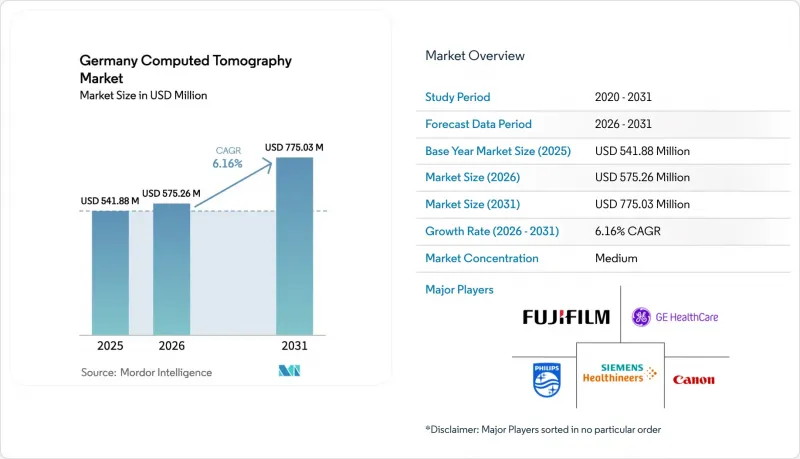
Mordor Intelligence에 의하면, 독일 컴퓨터 단층촬영(CT) 시장 규모는 2025년 5억 4,188만 달러에서 2026년에는 5억 7,526만 달러로 확대되어 2026년부터 2031년까지 CAGR 6.16%로 성장을 지속하여, 2031년에는 7억 7,503만 달러에 이를 것으로 예측됩니다.
본 보고서는 제품 유형(저슬라이스, 중슬라이스, 고슬라이스), 용도(종양학, 신경학 등), 설치 형태(고정식 시스템, 이동식 시스템) 및 최종 사용자(병원, 영상진단센터 등)별로 세분화되어 있습니다. 시장 규모 및 전망은 금액(달러) 기준으로 제시되어 있습니다.
독일 컴퓨터 단층촬영(CT) 시장 동향 및 인사이트
만성 질환의 부담과 고령화
독일의 컴퓨터 단층촬영(CT) 시장 규모는 꾸준히 확대되고 있습니다. 이는 1,530만 명의 주민이 심혈관 질환을 앓고 있으며, 연간암 발병 건수가 50만 건에 달하기 때문입니다. 암 환자 1인당 치료 기간 동안 평균 4-6회의 스캔을 받기 때문에 이는 영상 진단 사업자에게 예측 가능한 수익원이 되고 있습니다. 인구 밀도가 낮은 동부 주에서는 인구 동향의 변화가 더욱 두드러지며, 병원 통합이 진행됨에 따라 의료 접근성에 대한 우려가 커지고 있습니다. 인력 부족 속에서도 검사 처리 능력을 유지하기 위해 의료 기관들은 검사 시간을 단축하고 영상 품질을 표준화하는 자동화 도구에 투자하고 있습니다. 병원들은 이러한 효율화 성과를 활용하여 대기 목록을 늘리지 않으면서도 증가하는 만성 질환의 경과 관찰 비율에 대응하고 있습니다.
연속 검출기, AI 및 광자 계수 기술 분야의 획기적인 발전
광자 계수 CT는 0.2mm 미만의 공간 분해능을 실현하며, 기존 검출기에 비해 피폭 선량을 45% 감소시킵니다. 아우크스부르크 대학병원에서는 이미 8,000건 이상의 임상 사례를 완료했으며, 복잡한 심혈관 및 정형외과 평가에서 스펙트럼 이미징의 이점이 입증되었습니다. AI 기반 재구성을 통해 피폭 선량을 50-80% 더 낮추는 동시에, 일일 스캔 처리 능력을 3배로 높여 방사선과 인력 부족을 완화하는 데 기여하고 있습니다. 독일의 컴퓨터 단층촬영(CT) 시장에서 시장 진출기업들이 검출기, AI, 워크플로우 소프트웨어를 통합함에 따라 경쟁의 초점은 하드웨어 자체에서 검사실의 활용 효율을 최적화하는 통합 플랫폼으로 이동하고 있습니다.
스캐너의 높은 자본 지출(CAPEX) 및 운영 비용(OPEX)
최첨단 128슬라이스 CT의 가격은 최대 300만 달러에 달하며, 연간 유지보수 계약 비용으로 구매 가격의 8-12%가 추가로 소요됩니다. 독일의 진단 관련 그룹(DRG)에 기반한 자금 조달 제도 하에서 병원은 고정된 상환액에 직면하고 있으며, 이는 하이엔드 장비의 수명 주기 비용을 충당하기에는 턱없이 부족합니다. 의료 기관은 전용 방사선과 부서의 손익분기점에 도달하기 위해 연간 최소 1,065건의 스캔이 필요하며, 이로 인해 소규모 시설은 원격 방사선 진단(텔레라디올로지) 제휴를 맺을 수밖에 없는 상황에 몰리고 있습니다. 자금 면의 제약으로 인해 임상적 이점이 있음에도 불구하고 광자 계수 시스템의 도입은 지연되고 있으며, 기능과 비용의 균형이 잡힌 중급 플랫폼이 선호되는 경향이 강해지고 있습니다.
부문 분석
중간 슬라이스 수 플랫폼은 지속 가능한 가격에 고급 기능을 원하는 구매자를 확보하고 있으며, 이 부문은 연평균 성장률(CAGR) 6.71%를 나타낼 것으로 예측되어 독일 CT 시장 전체를 상회하는 성장을 보일 것으로 전망됩니다. 고슬라이스 수 장치는 심장 및 종양학 분야의 프리미엄 용도 강점을 바탕으로 2025년 기준 독일 CT 시장 점유율 35.88%를 유지했습니다. 대학 병원에서는 초고해상도 사례에 대해 256슬라이스 이상 또는 광자 계수 방식의 스캐너가 선호되는 반면, 지방 진료소에서는 예산 한도를 초과하지 않으면서 대부분의 진단 경로를 커버할 수 있는 64슬라이스 시스템으로의 전환이 진행되고 있습니다.
검출기의 급속한 기술 발전으로 인해 중슬라이스 장치에서도 과거에는 플래그십 모델에만 국한되었던 거의 등방성 영상화 및 스펙트럼 후처리가 가능해졌습니다. 이러한 보급은 가치 기반 의료를 중시하는 조달 방침과 부합합니다. 독일 CT 시장에서 중슬라이스 시스템 시장 규모는 심장 CT에 대한 보험 환급 수요에 부응하기 위해 외래 영상 진단 체인이 노후화된 장비를 교체해 나감에 따라 꾸준히 확대될 것으로 예측됩니다. 한편, 저슬라이스 스캐너는 구매 비용이 고급 기능보다 우선시되는 응급용 백업이나 소규모 외상 센터에 제공되는 틈새 시장으로 남아 있습니다.
신경학 분야는 전국적인 뇌졸중 치료 프로토콜과 혈관 내 치료 역량의 확대에 힘입어 독일 CT 시장 내에서 가장 높은 연평균 성장률(CAGR) 6.62%를 나타낼 것으로 예측됩니다. 베를린의 STEMO 구급차는 차량용 CT를 통해 혈전 용해 요법 시행률이 30% 이상으로 상승한다는 사실을 입증하여, 병원 전 영상 진단의 임상적 및 경제적 이점을 부각시키고 있습니다. 2025년에도 종합 암 센터가 병기 분류, 치료 계획, 경과 관찰을 위해 연속 CT 검사에 의존하고 있기 때문에 종양학 분야는 독일 CT 시장 규모의 31.78%라는 최대 점유율을 유지했습니다.
심혈관 영상은 2025년 보험 환급 제도 변경으로 인해 가장 직접적인 혜택을 받을 것으로 보입니다. 보험사가 비침습적 관상동맥 치료 경로를 권장하는 가운데, 중형 병원들은 1회 심장 박동으로 심장 검사가 가능한 듀얼 소스 시스템에 대한 투자를 확대되고 있습니다. 근골격계 및 외상 적응증 분야는 교통사고와 산업재해 발생 건수가 많아 안정적인 추세를 유지하고 있습니다. AI 기반 의사결정 지원 도구는 신경계 스캔의 판독 시간을 단축하여, 방사선과 전문의가 진단 정확도를 저하시키지 않으면서 급증하는 수요에 대응할 수 있도록 지원합니다.
기타 혜택:
- 엑셀 형식 시장 예측(ME) 시트
- 3개월간의 애널리스트 지원
자주 묻는 질문
목차
제1장 서론
제2장 조사 방법
제3장 주요 요약
제4장 시장 구도
제5장 시장 규모와 성장 예측
제6장 경쟁 구도
제7장 시장 기회와 향후 전망
JHS 26.08.28According to Mordor Intelligence, the Germany computed tomography market size is expected to grow from USD 541.88 million in 2025 to USD 575.26 million in 2026 and is forecast to reach USD 775.03 million by 2031 at 6.16% CAGR over 2026-2031.
This report is Segmented by Product Type (Low Slice, Medium Slice, and High Slice), Application (Oncology, Neurology, and More), Mobility (Fixed Systems and Mobile Systems), and End User (Hospitals, Diagnostic Imaging Centers, and Others). The Market and Forecasts are Provided in Terms of Value (USD).
Germany Computed Tomography Market Trends and Insights
Chronic-Disease Burden & Ageing Population
Germany computed tomography market volumes climb steadily as 15.3 million residents live with cardiovascular disease and annual cancer incidence reaches 500,000 cases . Each oncology patient undergoes an average of 4-6 scans during therapy, forming a predictable revenue stream for imaging providers. The demographic shift is more pronounced in sparsely populated eastern states where hospital consolidation raises concern over access. To maintain throughput amid staffing gaps, providers invest in automation tools that shorten exam times and standardize image quality. Hospitals use these efficiency gains to accommodate a growing share of chronic-care follow-ups without lengthening wait lists.
Continuous Detector, AI & Photon-Counting Breakthroughs
Photon-counting CT delivers sub-0.2 mm spatial resolution and 45% lower dose relative to conventional detectors . University Hospital Augsburg has already completed more than 8,000 clinical cases, validating spectral imaging benefits in complex cardiovascular and orthopedic evaluations. AI-based reconstruction drives a further 50-80% dose reduction while tripling daily scan capacity, helping radiology departments mitigate workforce shortages. As Germany computed tomography market participants bundle detectors, AI and workflow software, competitive focus shifts from hardware alone to integrated platforms that optimize room utilization.
High Scanner CAPEX & OPEX
A state-of-the-art 128-slice CT costs up to USD 3 million, and annual service contracts add 8-12% of purchase value. Under Germany's diagnosis related group (DRG) financing, hospitals face fixed reimbursements that rarely cover high-end equipment lifecycle costs. Providers need a minimum of 1,065 scans per year to reach breakeven for a dedicated radiology unit, pushing smaller facilities toward teleradiology partnerships. Capital constraints slow uptake of photon-counting systems despite their clinical upside, reinforcing the preference for mid-range platforms that balance capability and cost.
Other drivers and restraints analyzed in the detailed report include:
- Reimbursement of Cardiac CT Angiography from 2025
- Growth of Low-Dose Lung-Cancer Screening Programs
- Stringent BfArM / CE-MDR Approval Timelines
For complete list of drivers and restraints, kindly check the Table Of Contents.
Segment Analysis
Medium Slice platforms capture buyers seeking advanced functionality at sustainable prices, and this category is forecast to grow at a 6.71% CAGR, outpacing the overall Germany computed tomography market. High Slice units retained a 35.88% Germany computed tomography market share in 2025 on the strength of premium cardiac and oncology applications. University hospitals prefer >=256-slice or photon-counting scanners for ultra-high-resolution cases, whereas regional clinics migrate to 64-slice systems that cover most diagnostic pathways without exceeding budget ceilings.
Rapid detector improvements enable Medium Slice devices to deliver near-isotropic imaging and spectral post-processing once reserved for flagship models. This democratization aligns with procurement policies emphasizing value-based care. The Germany computed tomography market size for Medium Slice systems is projected to advanced steadily as outpatient imaging chains refurbish ageing fleets to meet cardiac CT reimbursement demand. Conversely, Low Slice scanners remain niche, serving emergency backups and small trauma centers where acquisition cost trumps advanced features.
Neurology is projected to register a 6.62% CAGR, the fastest within the Germany computed tomography market, driven by nationwide stroke pathways and expanding endovascular therapy capacity. Berlin's STEMO ambulances demonstrate how on-board CT raises thrombolysis rates above 30%, underscoring clinical and economic payoffs of pre-hospital imaging. Oncology preserved the largest 31.78% slice of Germany computed tomography market size in 2025 as comprehensive cancer centers rely on serial CT for staging, treatment planning and surveillance.
Cardiovascular imaging will benefit most directly from the 2025 reimbursement change. As payers encourage non-invasive coronary pathways, mid-tier hospitals invest in dual-source systems that deliver one-beat cardiac studies. Musculoskeletal and trauma indications remain steady, sustained by high road-traffic and workplace injury volumes. AI decision-support tools shorten neurological scan interpretation times, freeing radiologists to handle surging demand without sacrificing diagnostic accuracy.
Complete Report Scope:
- By Product Type
- Low Slice
- Medium Slice
- High Slice
- By Application
- Oncology
- Neurology
- Cardiovascular
- Musculoskeletal
- Other Applications
- By Mobility
- Fixed Systems
- Mobile Systems
- By End User
- Hospitals
- Diagnostic Imaging Centers
- Others
List of Companies Covered in this Report:
- Siemens Healthineers
- GE Healthcare
- Koninklijke Philips
- Canon
- Fujifilm Holdings Corp.
- Samsung Group
- Neusoft
- United Imaging Healthcare
- Shimadzu
- Carestream Health
- Planmeca Group (Planmed Oy)
- Ziehm Imaging
- Brain Lab
- Stryker
- Koning Corp.
- Xoran Technologies LLC
- SternMed
- Imalogix Inc.
Additional Benefits:
- The market estimate (ME) sheet in Excel format
- 3 months of analyst support
TABLE OF CONTENTS
1 Introduction
- 1.1 Study Assumptions & Market Definition
- 1.2 Scope of the Study
2 Research Methodology
3 Executive Summary
4 Market Landscape
- 4.1 Market Overview
- 4.2 Market Drivers
- 4.2.1 Chronic-disease burden & ageing population
- 4.2.2 Continuous detector, AI & photon-counting breakthroughs
- 4.2.3 Reimbursement of cardiac CT angiography from 2025
- 4.2.4 Growth of low-dose lung-cancer screening programs
- 4.2.5 Outpatient imaging platform roll-ups
- 4.2.6 Rural teleradiology demand closing service gaps
- 4.3 Market Restraints
- 4.3.1 High scanner CAPEX & OPEX
- 4.3.2 Stringent BfArM / CE-MDR approval timelines
- 4.3.3 Radiographer & radiologist workforce shortages
- 4.3.4 Oversupply in metro areas compressing scan prices
- 4.4 Regulatory Landscape
- 4.5 Technological Outlook
- 4.6 Porters Five Forces Analysis
- 4.6.1 Threat of New Entrants
- 4.6.2 Bargaining Power of Buyers
- 4.6.3 Bargaining Power of Suppliers
- 4.6.4 Threat of Substitutes
- 4.6.5 Intensity of Competitive Rivalry
5 Market Size & Growth Forecasts (Value, USD)
- 5.1 By Product Type
- 5.1.1 Low Slice
- 5.1.2 Medium Slice
- 5.1.3 High Slice
- 5.2 By Application
- 5.2.1 Oncology
- 5.2.2 Neurology
- 5.2.3 Cardiovascular
- 5.2.4 Musculoskeletal
- 5.2.5 Other Applications
- 5.3 By Mobility
- 5.3.1 Fixed Systems
- 5.3.2 Mobile Systems
- 5.4 By End User
- 5.4.1 Hospitals
- 5.4.2 Diagnostic Imaging Centers
- 5.4.3 Others
6 Competitive Landscape
- 6.1 Market Concentration
- 6.2 Market Share Analysis
- 6.3 Company Profiles (includes Global level Overview, Market level overview, Core Segments, Financials as available, Strategic Information, Market Rank/Share for key companies, Products & Services, and Recent Developments)
- 6.3.1 Siemens Healthineers AG
- 6.3.2 GE Healthcare
- 6.3.3 Koninklijke Philips N.V.
- 6.3.4 Canon Medical Systems Corp.
- 6.3.5 Fujifilm Holdings Corp.
- 6.3.6 Samsung Electronics Co. Ltd (Samsung Medison)
- 6.3.7 Neusoft Medical Systems Co. Ltd
- 6.3.8 United Imaging Healthcare Co. Ltd
- 6.3.9 Shimadzu Corp.
- 6.3.10 Carestream Health
- 6.3.11 Planmeca Group (Planmed Oy)
- 6.3.12 Ziehm Imaging GmbH
- 6.3.13 Brainlab AG
- 6.3.14 Stryker Corp.
- 6.3.15 Koning Corp.
- 6.3.16 Xoran Technologies LLC
- 6.3.17 SternMed GmbH
- 6.3.18 Imalogix Inc.
7 Market Opportunities & Future Outlook
- 7.1 White-space & Unmet-Need Assessment


