

|
시장보고서
상품코드
2116689
영국의 자기공명영상 시장 : 점유율 분석, 업계 동향과 통계, 성장 예측(2026-2031년)United Kingdom Magnetic Resonance Imaging - Market Share Analysis, Industry Trends & Statistics, Growth Forecasts (2026 - 2031) |
||||||
 Mordor Intelligence
Mordor Intelligence에 의하면, 영국의 자기공명영상(MRI) 시장 규모는 2025년에 25억 3,000만 달러로 평가되었고 2026년 26억 6,000만 달러에서 2031년까지 34억 3,000만 달러에 이를 것으로 예측되며, 예측 기간(2026-2031년) CAGR은 5.23%를 나타낼 전망입니다.
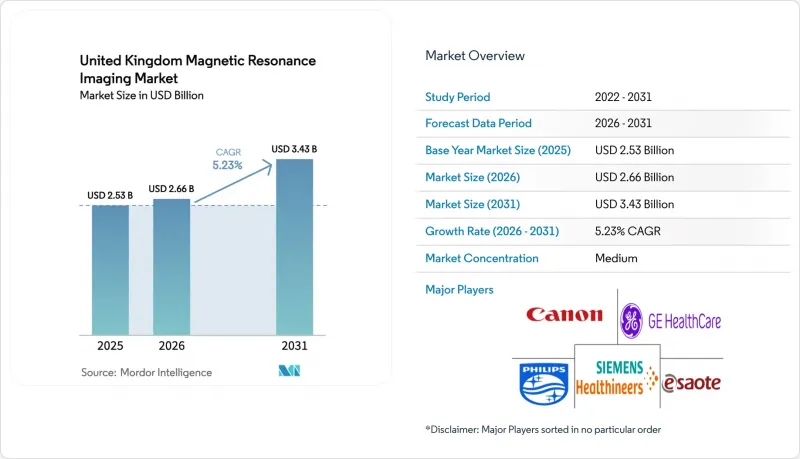
본 보고서는 아키텍처(밀폐형 MRI 시스템 및 개방형 MRI 시스템), 자기장 강도(저자기장 0.55T 이하, 중·고자기장 1.5T, 초고자기장 3T, 초초고자기장 7T 이상),용도(신경학, 종양학, 근골격계, 순환기내과, 소화기내과, 기타 용도)별로 분류되어 있습니다. 시장 예측은 금액(미 달러) 기준으로 제시되어 있습니다.
영국 자기공명영상 시장 동향 및 인사이트
만성 질환 및 노화 관련 질환 유병률 증가
영국 65세 이상 주민의 비율은 2024년에 19%를 나타낼 것으로 예측되며, 2030년까지 22%로 상승할 것으로 전망되고 있어, 고해상도 MRI 진단이 필요한 신경퇴행성 질환 및 근골격계 질환의 발생률이 급격히 증가하고 있습니다. MRI 검사 건수는 이미 연간 430만 건을 넘어섰으며, NHS의 종단적 데이터에 따르면 잉글랜드 북부와 스코틀랜드 전역에서 치매 관련 검사 건수가 두 자릿수 증가세를 보이고 있습니다. 고해상도 3T 시스템은 알츠하이머병 및 파킨슨병의 조기 발견에 필요한 뛰어난 콘트라스트를 제공하여, 진단까지 걸리는 긴 과정을 단축하고 그에 따른 의료비를 절감합니다. 케임브리지 대학의 초고자기장 연구에서는 병변 수준에서의 감도 향상이 입증되었으며, 이는 예측 기간 내에 일상적인 임상 프로토콜에 반영될 가능성이 있습니다. 따라서 인구 통계학적 변화와 신경 질환 유병률 증가 간의 연관성으로 인해, MRI는 고령자 친화적인 의료 시스템 계획의 중심에 자리 잡고 있습니다. 정부가 정한 대기 시간 목표 달성을 위해 각 트러스트가 경쟁하는 가운데, 고령자용 영상 프로토콜과 AI를 활용한 후처리를 결합한 공급업체의 전략은 조달 과정에서 우선적인 선택을 받을 가능성이 높다고 여겨집니다.
NHS 시설 전반에 걸친 3T 스캐너의 급속한 도입
중앙 집중형 조달 컨소시엄은 현재 3T 플랫폼에 대해 다년 계약을 체결하고 있으며, 그 예로 임페리얼 칼리지 헬스케어와 사우샘프턴 대학 병원의 최근 도입을 들 수 있습니다. 두 시설 모두 더 높은 자기장 강도를 도입한 결과, 재검사가 20% 감소했다고 보고하고 있습니다. 이러한 성과는 우수한 신호 대 잡음비(SN비) 덕분에, 그렇지 않았다면 경과 관찰 예약이 필요했을 불확실한 소견이 감소한다는 NHS의 가정을 뒷받침합니다. 최대 12년 동안 서비스 가격을 고정하는 프레임워크 계약을 통해 자본 위험이 경감되어, 트러스트는 예측 가능한 예산 범위 내에서 고성능 스캐너의 감가상각이 가능해집니다. 지멘스의 ‘Deep Resolve’와 같은 AI 지원 프로토콜을 도입함으로써 병원의 처리 능력이 최대 50% 향상되었으며, NHS.UK에 따르면 전국 평균 23일에 달하는 MRI 검사 대기 시간을 직접적으로 해소하고 있습니다. 1.5T에서 3T로 자기장을 업그레이드할 수 있는 경로를 제공하는 공급업체는 기존 인프라 투자를 유지하면서 진단 범위를 확대할 수 있으므로, 시장 점유율을 더욱 확대할 것으로 예측됩니다.
MRI 장비의 높은 초기 비용과 수명 주기 비용
프레임워크 계약을 통한 할인이 있더라도, 새로운 3T 스캐너와 검사실 건설 비용은 350만 달러를 초과할 가능성이 있어 소규모 지방 병원의 자본 예산을 압박하고 있습니다. 헬륨 가격이 급등하면 수명 주기 전반에 걸친 경제성은 더욱 악화됩니다. 옥스포드 기기가 2024년에 극저온 냉각제 비용이 자사의 MRI 서비스 이익률을 압박했다고 공개한 것이 그 증거입니다. 인프라 개보수(RF 차폐, 냉각기 업그레이드, 케이블 재배선 등)는 총 비용의 35%를 추가하는 경우가 많아, 이로 인해 의료 기관은 제조업체가 권장하는 10년의 교체 주기를 넘어서까지 장비 교체를 미룰 수밖에 없는 실정입니다. 그 결과 중고 시장이 형성되어, 인증된 리퍼브 1.5T 시스템이 신제품 가격의 3분의 1 수준으로 제공되게 되었으나, 가동 시간 보증이나 소프트웨어 업데이트에 대해서는 여전히 논란의 여지가 있습니다.
부문 분석
밀폐형 보어 시스템은 2025년에 13억 9,000만 달러의 매출을 기록하며 영국 자기공명영상 시장의 55.12%를 차지했습니다. 이는 기능적 뇌 매핑, 분광법, 시간 분해형 심장 영상 촬영을 지원하는 뛰어난 자기장 균일성 덕분입니다. 의료 기관 수준의 증거에 따르면, 밀폐형 플랫폼은 소아 진정 사례에서 움직임으로 인한 아티팩트를 줄이는 것으로 나타났으며, 이는 영상 재촬영률을 벤치마크로 삼는 의료 기관에게 중요한 KPI가 되고 있습니다. 초기 구매 가격은 높지만, 리퍼비시 주기를 분석해 보면 밀폐형 시스템은 개방형에 비해 25% 더 높은 잔존 가치를 유지하고 있으며, 이는 리스 전략에 영향을 미치고 있습니다. 이동형 도입의 경우, 무게 및 냉각과 관련된 물류상의 상충 관계가 진단의 범용성 및 환자 처리 능력에 의해 점점 더 상쇄되고 있어, 이동형 장비 운영 사업자들은 더 가벼운 개방형 저자기장 장치보다 밀폐형 1.5T 장치를 선호하는 경향이 있습니다.
일반적으로 0.3-0.5T로 작동하는 개방형 설계는 2025년에 11억 4,000만 달러 시장 규모를 기록하고, 2031년까지 연평균 성장률(CAGR) 6.88%를 나타낼 것으로 예측되며, 이는 모든 아키텍처 카테고리 중 가장 높은 성장률입니다. 이러한 성장률은 밀실공포증 완화나 비만 환자 대응과 같은 환자 중심의 요인에 기인하며, 편안함을 중시하는 지역 병원 및 영상 센터에서 지지를 얻고 있습니다. AI를 활용한 노이즈 제거 기술로 인해 밀폐형 시스템과의 화질 격차가 줄어들고 있으며, 개방형 자석에 적합한 임상 적응증이 단순한 정형외과 스캔을 넘어 확대되고 있습니다. 영국의 의료 서비스 전략이 지역 밀착형 진단 허브로 전환됨에 따라 개방형 플랫폼에 대한 시범 사업 자금이 지원될 전망이지만, 고차 신경계 및 심장 프로토콜의 제한으로 인해 절대적인 시장 점유율 확대에는 여전히 한계가 있습니다.
기타 혜택
- 엑셀 형식 시장 예측(ME) 시트
- 3개월간의 애널리스트 지원
자주 묻는 질문
목차
제1장 서론
제2장 조사 방법
제3장 개요
제4장 시장 구도
제5장 시장 규모와 성장 예측
제6장 경쟁 구도
제7장 시장 기회와 향후 전망
JHS 26.09.01According to Mordor Intelligence, the United Kingdom magnetic resonance imaging market size was valued at USD 2.53 billion in 2025 and estimated to grow from USD 2.66 billion in 2026 to reach USD 3.43 billion by 2031, at a CAGR of 5.23% during the forecast period (2026-2031).
This report is Segmented by Architecture (Closed MRI Systems and Open MRI Systems), Field Strength (Low-Field <=0. 55T, Mid/High-Field 1. 5T, Very-High-Field 3T, and Ultra-High-Field 7T+), Application (Neurology, Oncology, Musculoskeletal, Cardiology, Gastroenterology, and Other Applications). The Market Forecasts are Provided in Terms of Value (USD).
United Kingdom Magnetic Resonance Imaging Market Trends and Insights
Rising Prevalence of Chronic and Age-Related Diseases
The proportion of U.K. residents aged 65 years and older reached 19% in 2024 and is projected to climb to 22% by 2030, sharply increasing the incidence of neurodegenerative and musculoskeletal disorders that require advanced MRI diagnostics. MRI procedure volumes already exceed 4.3 million annually, and longitudinal NHS data show double-digit growth in dementia-related scans across northern England and Scotland. High-resolution 3 T systems provide the superior contrast needed for early Alzheimer's and Parkinson's detection, which shortens diagnostic odysseys and reduces downstream healthcare costs. Ultra-high-field research at the University of Cambridge demonstrates lesion-level sensitivity improvements that could translate into routine clinical protocols over the forecast period. The linkage between demographic change and escalating neurological morbidity therefore places MRI at the center of age-friendly health-system planning. Vendor strategies that bundle geriatric-focused imaging protocols with AI-enriched post-processing are likely to secure procurement preference as trusts compete to meet government wait-time targets.
Rapid Adoption of 3 T Scanners Across NHS Estates
Centralized buying consortia now award multi-year lots for 3 T platforms, evidenced by recent installations at Imperial College Healthcare and University Hospital Southampton, both of which reported 20% reductions in repeat scans after commissioning higher field strengths. These outcomes validate the NHS assumption that superior signal-to-noise ratios reduce indeterminate findings that would otherwise trigger follow-up appointments. Capital risk is mitigated by framework contracts that lock in service pricing for up to 12 years, enabling trusts to amortize premium scanners over predictable budgets. By embedding AI-assisted protocols such as Siemens Deep Resolve, hospitals have shown throughput gains of up to 50%, directly addressing an average national MRI wait of 23 days NHS.UK. Vendors offering field-upgrade paths-for example, from 1.5 T to 3 T-are expected to capture incremental share because the strategy preserves legacy infrastructure investments while boosting diagnostic breadth.
High Upfront and Lifecycle Costs of MRI Equipment
Even with framework discounts, a new 3 T scanner and room build-out can exceed USD 3.5 million, stretching the capital envelopes of smaller district hospitals. Lifecycle economics further deteriorate when helium prices spike, as evidenced by Oxford Instruments' disclosure that cryogen costs eroded its MRI service margins in 2024. Infrastructure retrofits-RF shielding, chiller upgrades, and cable rerouting-often add 35% to total spend, forcing trusts to defer replacements beyond the manufacturer's recommended 10-year timeline. A secondary-market ecosystem has therefore emerged, offering certified refurbished 1.5 T systems at one-third the new-build price, although guarantees of uptime and software updates remain contentious.
Other drivers and restraints analyzed in the detailed report include:
- AI-Driven Image Reconstruction and Workflow Optimization
- Growth of Point-of-Care Low-Field MRI Pilots in Community Settings
- Stringent UKCA/CE Regulatory and HTA Approval Processes
For complete list of drivers and restraints, kindly check the Table Of Contents.
Segment Analysis
Closed-bore systems generated USD 1.39 billion in 2025, equal to 55.12% of the United Kingdom magnetic resonance imaging market, owing to their superior magnetic homogeneity that supports functional brain mapping, spectroscopy, and time-resolved cardiac imaging. Institution-level evidence shows that closed platforms reduce motion artifacts in pediatric sedation cases, a critical KPI for trusts that benchmark image-repeat rates. Though the initial purchase price is higher, refurbishment cycles reveal that closed systems retain residual value 25% above open counterparts, which influences leasing strategies. In mobile deployments, logistical trade-offs around weight and cooling are increasingly offset by diagnostic versatility and patient throughput, leading mobile fleet operators to favor closed 1.5 T units over lighter, open low-field alternatives.
Open designs, typically operating at 0.3-0.5 T, captured USD 1.14 billion in 2025 and are projected to grow at a 6.88% CAGR until 2031, the fastest of any architecture category. The growth rate stems from patient-centric factors such as claustrophobia mitigation and bariatric accommodation, which win favor in community hospitals and imaging centers that compete on comfort scores. AI-based denoising is narrowing the image-quality gap with closed systems, expanding the clinical indications suitable for open magnets beyond simple orthopedic scans. As the U.K. health-service strategy pivots toward community-based diagnostics hubs, open platforms will likely see pilot funding, yet their absolute market share gain remains capped by limitations in advanced neuro and cardiac protocols.
Complete Report Scope:
- By Architecture
- Closed MRI Systems
- Open MRI Systems
- By Field Strength
- Low-Field (<=0.55 T)
- Mid/High-Field (1.5 T)
- Very-High-Field (3 T)
- Ultra-High-Field (7 T +)
- By Application
- Neurology
- Oncology
- Musculoskeletal
- Cardiology
- Gastroenterology
- Other Applications
List of Companies Covered in this Report:
- Aspect Imaging
- Aurora Imaging Technology
- Canon
- Esaote
- FUJIFILM
- GE Healthcare
- Hitachi Healthcare
- Hyperfine
- Koninklijke Philips
- MR Solutions Group
- Neusoft Medical Systems
- Oxford Instruments
- Paramed Medical Systems
- Mindray
- Siemens Healthineers
- Tesla Engineering Ltd.
- Time Medical Systems
- United Imaging Healthcare
Additional Benefits:
- The market estimate (ME) sheet in Excel format
- 3 months of analyst support
TABLE OF CONTENTS
1 Introduction
- 1.1 Study Assumptions & Market Definition
- 1.2 Scope of the Study
2 Research Methodology
3 Executive Summary
4 Market Landscape
- 4.1 Market Overview
- 4.2 Market Drivers
- 4.2.1 Rising Prevalence of Chronic and Age-Related Diseases
- 4.2.2 Rapid Adoption of 3 T Scanners Across NHS Estates
- 4.2.3 AI-Driven Image-Reconstruction & Workflow Optimisation
- 4.2.4 Growth of Point-of-Care Low-Field MRI Pilots in Community Settings
- 4.2.5 Expansion of Intra-Operative MRI Suites for Neuro-Oncology Surgery
- 4.2.6 NHS Imaging Networks' Centralised Procurement Driving Fleet Standardisation
- 4.3 Market Restraints
- 4.3.1 High Upfront and Lifecycle Costs of MRI Equipment
- 4.3.2 Stringent UKCA/CE Regulatory and HTA Approval Processes
- 4.3.3 Shortage of Radiographers & MR-Qualified Physicists
- 4.3.4 Volatile Global Helium Supply Affecting Uptime
- 4.4 Value / Supply-Chain Analysis
- 4.5 Regulatory Landscape
- 4.6 Technological Outlook
- 4.7 Porter's Five Forces Analysis
- 4.7.1 Bargaining Power of Buyers
- 4.7.2 Bargaining Power of Suppliers
- 4.7.3 Threat of New Entrants
- 4.7.4 Threat of Substitute Products
- 4.7.5 Intensity of Competitive Rivalry
5 Market Size & Growth Forecasts (Value, USD)
- 5.1 By Architecture
- 5.1.1 Closed MRI Systems
- 5.1.2 Open MRI Systems
- 5.2 By Field Strength
- 5.2.1 Low-Field (<=0.55 T)
- 5.2.2 Mid/High-Field (1.5 T)
- 5.2.3 Very-High-Field (3 T)
- 5.2.4 Ultra-High-Field (7 T +)
- 5.3 By Application
- 5.3.1 Neurology
- 5.3.2 Oncology
- 5.3.3 Musculoskeletal
- 5.3.4 Cardiology
- 5.3.5 Gastroenterology
- 5.3.6 Other Applications
6 Competitive Landscape
- 6.1 Market Concentration
- 6.2 Market Share Analysis
- 6.3 Company Profiles (includes Global level Overview, Market level overview, Core Segments, Financials as available, Strategic Information, Market Rank/Share for key companies, Products & Services, Recent Developments)
- 6.3.1 Aspect Imaging
- 6.3.2 Aurora Imaging Technology
- 6.3.3 Canon Medical Systems
- 6.3.4 Esaote SpA
- 6.3.5 Fujifilm Healthcare
- 6.3.6 GE Healthcare
- 6.3.7 Hitachi Healthcare
- 6.3.8 Hyperfine Inc.
- 6.3.9 Koninklijke Philips N.V.
- 6.3.10 MR Solutions Group
- 6.3.11 Neusoft Medical Systems
- 6.3.12 Oxford Instruments plc
- 6.3.13 Paramed Medical Systems
- 6.3.14 Shenzhen Mindray Bio-Medical Electronics
- 6.3.15 Siemens Healthineers
- 6.3.16 Tesla Engineering Ltd.
- 6.3.17 Time Medical Systems
- 6.3.18 United Imaging Healthcare
7 Market Opportunities & Future Outlook
- 7.1 White-space & Unmet-Need Assessment


