|
시장보고서
상품코드
2116725
말레이시아의 석유 및 가스 파이프라인 시장 : 점유율 분석, 업계 동향과 통계, 성장 예측(2026-2031년)Malaysia Oil And Gas Pipeline - Market Share Analysis, Industry Trends & Statistics, Growth Forecasts (2026 - 2031) |
||||||
 Mordor Intelligence
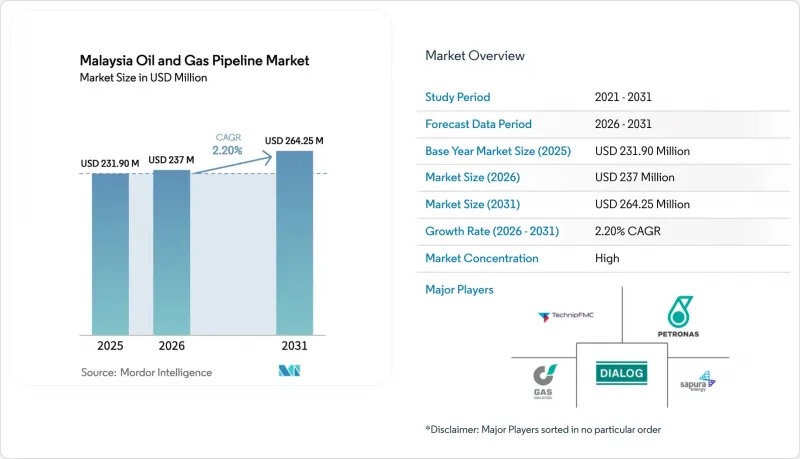
Mordor Intelligence에 의하면, 말레이시아의 석유 및 가스 파이프라인 시장 규모는 2025년에 2억 3,190만 달러로 평가되었고 2026년 2억 3,700만 달러에서 2031년까지 2억 6,425만 달러에 이를 것으로 예측되며, 예측 기간(2026-2031년) CAGR은 2.2%를 나타낼 전망입니다.
본 보고서는 활동별(CAPEX, OPEX), 기능별(집적 라인, 수송 라인, 배급 라인), 구축 위치별(온쇼어, 오프쇼어), 최종 사용자 부문별(업스트림 부문(EnP), 중류 사업자, 하류 산업·석유화학)로 분류되어 있습니다. 시장 규모와 전망은 금액(달러)으로 표시되어 있습니다.
말레이시아 석유 및 가스 파이프라인 시장 동향 및 인사이트
발전 및 석유화학 산업의 확장에 따른 가스 수요 증가
2027년 하반기까지 시피탕(Sipitang)에 위치한 PETRONAS의 제3호 부유식 LNG 시설이 연간 200만 톤공급 능력을 추가함에 따라 가스 소비량이 가속화되고, 새로운 공급 가스 파이프라인의 육상 연장이 촉진될 것입니다. 조호르 주의 53억 달러 규모의 펭겔란 에너지 단지에서는 하루 15만 배럴의 콘덴세이트를 처리할 예정이며, 2028년까지 전용 제품 및 콘덴세이트 파이프라인을 구축해야 합니다. PETRONAS와 사바 전력 간에 체결된 16MMscfd 공급 계약, 반도 지역의 여러 전력 구매 계약(PPA), 80km 파이프라인을 통해 제룸 플랫폼에서 공급되는 첫 가스 덕분에 반도 지역 네트워크로의 가스 유량은 종합적으로 증가할 것입니다. 엔퀘스트(Enquest)의 세리기(Seligi) 업그레이드 프로젝트는 기존 경로를 통해 70MMscfd를 추가함으로써 브라운필드 타이백(brownfield tie-back)의 경제적 이점을 부각시키고 있습니다. 이러한 각 프로젝트는 수송 시스템과 배급 시스템 모두의 처리 능력을 향상시켜 말레이시아의 석유 및 가스 파이프라인 시장에 대한 지속적인 투자를 뒷받침하고 있습니다.
PETRONAS RAPID의 하류 통합이 인프라 시너지를 창출하고 있습니다.
RAPID 복합 단지의 일일 30만 배럴 규모의 정유시설와 통합 석유화학 플랜트는 펭게란과 국내 수요 거점, 그리고 싱가포르의 정제 허브를 연결하는 다중 제품 파이프라인 회랑에 의존하고 있습니다. RAPID를 통해 연료, 원료, 제품에 따른 파이프라인 공유가 가능해져, 단위 운송 비용이 절감되고 파이프라인 자산의 이용률이 향상됩니다. 단계적인 생산 능력 확충을 통해 네트워크 확장과 제품 생산 확대 일정을 조율함으로써 설비 투자(CAPEX) 지출을 평준화하고 있습니다. 또한, 이 복합 시설은 조호르주 내 제3자 터미널 건설을 촉진하고 있으며, 이에 필요한 연결 지선이 요구됨에 따라 파이프 제조 및 설치에 대한 2차 수요를 창출하고 있습니다. 장기적으로는 RAPID의 간선 수송량이 지역의 현물 수송량을 유치하여, 동남아시아의 수송 거점으로서 말레이시아의 역할을 강화하는 동시에 말레이시아의 석유 및 가스 파이프라인 시장을 확대되고 있습니다.
장기화되는 재정 승인 주기가 프로젝트 일정을 제약
여러 기관에 의한 심사로 인해 환경 조사가 24개월에 달할 수 있으며, 주와 연방 정부의 요건이 다른 경우, 간선 파이프라인 승인까지 추가로 18-30개월이 소요될 가능성이 있습니다. 인구 밀집 지역에서의 토지 임베디드 장벽은 보상 비용을 증가시키고, 공사를 무기한 중단시킬 가능성이 있는 법적 분쟁을 야기합니다. 2025년 4월 푸트라 하이츠에서 발생한 폭발 사고를 계기로 안전 프로토콜이 강화되었으며, 기술적 심사 및 서류 작성 절차가 새롭게 추가되었습니다. 이러한 지연이 누적되면 자금 조달 유지 비용이 상승하고 프로젝트의 순현재가치가 하락하기 때문에 말레이시아 석유 및 가스 파이프라인 산업에서 개발업자들의 의욕이 꺾이고 있습니다.
부문별 분석
2025년, 말레이시아의 석유 및 가스 파이프라인 시장에서 설비 투자(CAPEX)는 시장 점유율의 63.55%를 차지하며 연평균 성장률(CAGR) 4.07%를 나타낼 것으로 예측되는데, 이는 전체 시장 성장률의 거의 2배에 해당합니다. 10억 링깃 규모의 랑카위 해저 파이프라인 교체 및 2026년까지 1,130km에 달하는 신규 건설 프로그램과 같은 고액 프로젝트가 수주 잔고의 대부분을 차지하고 있습니다. PETRONAS가 비용 급등을 헤지하기 위해 자재 조달을 앞당기고 있어, 고강도 라인 파이프, 자동 용접 시스템, 부식 방지제 공급업체들은 지속적인 계약을 확보하고 있습니다. 현지 조달 규정에 따라 제조는 말레이시아 국내 조선소에서 이루어지도록 되어 있어, 고용 및 부대 서비스에 파급 효과를 가져오고 있습니다.
OPEX(운영비)는 총 길이 2,551km에 달하는 반도 가스 이용(PGU) 네트워크의 건전성 관리에 힘입어 안정적인 수익 흐름을 형성하고 있습니다. 지출의 대부분은 파이프라인 내부 검사, 음극 방식 시스템 업그레이드, 누출 감지 센서 설치에 사용되고 있습니다. 해체 작업은 아직 시작 단계이지만, 사업자가 퇴역한 파이프라인의 재사용을 계획함에 따라 탄력을 받고 있으며, 이는 장기적인 OPEX의 중요성을 보장하고 있습니다. 디지털 트윈 및 머신러닝을 통한 분석이 유지보수 일정 수립에 점점 더 큰 역할을 수행하고 있어, 예기치 않은 가동 중단을 줄이고 자산의 수명을 연장하고 있습니다. 이러한 추세는 말레이시아 석유 및 가스 파이프라인 시장의 변동성을 완화하는 요인이 되고 있습니다.
2025년 말레이시아 석유 및 가스 파이프라인 시장 규모 중 수송 네트워크가 52.20%를 차지하며, PGU의 3,000 MMscfd 수송 능력이 이를 뒷받침하고 있습니다. 사바·사라왁 가스 파이프라인은 동말레이시아에 여전히 매우 중요하지만, 일부 구간에서는 재가동이나 수소 대응을 위한 개보수에 대한 검토가 필요합니다. 제랑 등의 신규 유전과의 연결을 통해 추가 공급량이 확보되어 처리 능력을 유지하는 동시에 루프 확장의 타당성을 뒷받침하고 있습니다.
연평균 성장률(CAGR) 4.85%로 성장하고 있는 배급 파이프라인은 조호르주와 셀랑고르주에서 확대되는 산업용 수요에 대응하고 있습니다. 가스 말레이시아의 12억-14억 링깃 규모의 5개년 예산은 800km에 달하는 배급 파이프라인 건설에 투입되어, 중소기업 및 대규모 석유화학제품 구매자에 대한 라스트 마일 연결을 실현할 것입니다. 가스 수집 시스템은 업스트림 부문의 시추 속도를 따라가고 있으며, 특히 여러 유정으로 구성된 위성 시스템이 공유 처리 허브에 가스를 공급하는 마진 클러스터에서 말레이시아의 석유 및 가스 파이프라인 시장 전체에 걸쳐 균형 잡힌 성장을 보장하고 있습니다.
기타 혜택
- 엑셀 형식 시장 예측(ME) 시트
- 3개월간의 애널리스트 지원
자주 묻는 질문
목차
제1장 서론
제2장 조사 방법
제3장 개요
제4장 시장 구도
제5장 시장 규모와 성장 예측
제6장 경쟁 구도
제7장 시장 기회와 향후 전망
JHS 26.09.01According to Mordor Intelligence, the Malaysia oil and gas pipeline market size was valued at USD 231.90 million in 2025 and estimated to grow from USD 237 million in 2026 to reach USD 264.25 million by 2031, at a CAGR of 2.2% during the forecast period (2026-2031).
This report is Segmented by Activity (CAPEX and OPEX), Function (Gathering Lines, Transmission Lines, and Distribution Lines), Location of Deployment (Onshore and Offshore), and End-User Sector (Upstream, Midstream Operators, and Downstream and Petrochemicals). The Market Sizes and Forecasts are Provided in Terms of Value (USD).
Malaysia Oil And Gas Pipeline Market Trends and Insights
Rising Gas Demand from Power Generation and Petrochemical Expansion
Gas consumption accelerates as PETRONAS's third floating LNG unit at Sipitang adds 2 mtpa by H2 2027, driving new feed-gas lines to shore. The USD 5.3 billion Pengerang Energy Complex in Johor will process 150,000 barrels per day of condensate, necessitating dedicated product and condensate pipelines by 2028. PETRONAS's 16 MMscfd supply contract with Sabah Electricity, multiple Peninsular power PPAs, and first gas from the Jerun platform via an 80 km line collectively lift gas flows to Peninsula networks. EnQuest's Seligi upgrade adds 70 MMscfd through existing corridors, underscoring the economic benefits of brownfield tie-backs. Each of these projects heightens throughput on both transmission and distribution systems, reinforcing sustained investment in the Malaysia oil and gas pipeline market.
PETRONAS RAPID Downstream Integration Creating Infrastructure Synergies
The RAPID complex's 300,000 b/d refinery and integrated petrochemical trains rely on multi-product pipeline corridors that connect Pengerang with national demand centers and Singapore's refining hub. RAPID enables shared line usage for fuels, feedstocks, and byproducts, thereby lowering unit transport costs and increasing pipeline asset utilization. Phased capacity additions align network expansions with product ramp-up schedules, smoothing CAPEX outflows. The complex also stimulates third-party terminal builds in Johor that require link-in spurs, creating secondary demand for pipe fabrication and installation. Over the long term, RAPID's anchor volumes attract regional spot volumes, reinforcing Malaysia's role as Southeast Asia's transit interface and expanding the Malaysia oil and gas pipeline market.
Prolonged Fiscal Approval Cycles Constraining Project Timelines
Multiple agency reviews can extend environmental studies to 24 months and increase trunkline approvals by an additional 18-30 months when state and federal requirements diverge. Land acquisition hurdles in populated corridors increase compensation costs and lead to legal disputes that can halt work indefinitely. The April 2025 Putra Heights explosion triggered stricter safety protocols, adding fresh layers of technical vetting and documentation. These cumulative delays elevate financing carry costs and erode the net present value of projects, dampening developer appetite in the Malaysia oil and gas pipeline industry.
Other drivers and restraints analyzed in the detailed report include:
- Offshore Marginal Field Development Driving Subsea Pipeline Expansion
- National Hydrogen Roadmap Enabling Pipeline Repurposing Opportunities
- Low Regulated Gas Transmission Tariffs Pressuring Operator Margins
For complete list of drivers and restraints, kindly check the Table Of Contents.
Segment Analysis
CAPEX spending accounted for 63.55% of the Malaysian oil and gas pipeline market share in 2025 and is projected to grow at a 4.07% CAGR, nearly twice the overall rate. Large-ticket items, such as the RM1 billion Langkawi submarine replacement and the 1,130 km newbuild program through 2026, dominate order books. Suppliers of high-strength line pipe, automated welding systems, and corrosion inhibitors secure recurring contracts as PETRONAS front-loads material procurement to hedge cost escalation. Local content rules direct fabrication to Malaysian yards, creating multiplier effects on jobs and ancillary services.
OPEX forms a stable annuity stream anchored to the integrity management of the 2,551 km Peninsula Gas Utilisation (PGU) grid. Inline inspection runs, cathodic-protection upgrades, and leak-detection sensor installs account for the bulk of the spend. Decommissioning, although nascent, is gaining traction as operators plan for the reuse of retired lines, ensuring long-term OPEX relevance. Digital twins and machine-learning analytics are increasingly shaping maintenance schedules, reducing unplanned outages and extending asset life -a trend that mitigates volatility in the Malaysian oil and gas pipeline market.
Transmission networks accounted for 52.20% of the Malaysia oil and gas pipeline market size in 2025, anchored by the PGU's 3,000 MMscfd capacity. The Sabah-Sarawak Gas Pipeline remains pivotal for East Malaysia, although select segments require reactivation or hydrogen retrofit studies. New field tie-backs, such as Jerun, inject incremental volumes that sustain throughput and justify loop expansions.
Distribution pipelines, growing at a 4.85% CAGR, respond to expanding industrial loads in Johor and Selangor. Gas Malaysia's RM 1.2-1.4 billion five-year budget funds 800 km of distribution lines, unlocking last-mile connectivity to SMEs and large petrochemical off-takers. Gathering systems follow the upstream drilling pace, especially across marginal clusters where multi-well satellite systems feed shared processing hubs, ensuring balanced growth across the Malaysian oil and gas pipeline market.
Complete Report Scope:
- By Activity
- CAPEX
- Pipeline Materials and Equipment
- Pipeline Fabrication and Construction
- OPEX
- Inspection
- MRO
- Decommissioning
- CAPEX
- By Function
- Gathering Lines
- Transmission Lines
- Distribution Lines
- By Location of Deployment
- Onshore
- Offshore
- By End-user Sector
- Upstream (EnP)
- Midstream Operators
- Downstream and Petrochemicals
List of Companies Covered in this Report:
- Petroliam Nasional Berhad (PETRONAS)
- PETRONAS Gas Berhad
- Sapura Energy Berhad
- Dialog Group Berhad
- Gas Malaysia Berhad
- JFE Engineering Corporation
- Stats Group
- Cortez Subsea Limited
- PBJV Group Sdn Bhd
- Yokogawa Kontrol (Malaysia) Sdn Bhd
- EcoPrasinos Engineering Sdn Bhd
- Punj Lloyd Limited
- Saipem S.p.A.
- TechnipFMC plc
- McDermott International
- Worley Ltd.
- Malaysia Marine & Heavy Engineering
- Muhibbah Engineering (M) Bhd
- Asiaflex Products Sdn Bhd
- MMC Oil & Gas Engineering
Additional Benefits:
- The market estimate (ME) sheet in Excel format
- 3 months of analyst support
TABLE OF CONTENTS
1 Introduction
- 1.1 Study Assumptions & Market Definition
- 1.2 Scope of the Study
2 Research Methodology
3 Executive Summary
4 Market Landscape
- 4.1 Market Overview
- 4.2 Market Drivers
- 4.2.1 Rising gas demand from power & petrochemical projects
- 4.2.2 PETRONAS RAPID downstream integration synergies
- 4.2.3 Offshore marginal-field tie-backs boosting subsea lines
- 4.2.4 National hydrogen roadmap repurposing existing pipes
- 4.2.5 Aging on-shore pipe replacement programs (2025-30)
- 4.2.6 Decommissioning-to-CCS re-use opportunities
- 4.3 Market Restraints
- 4.3.1 Prolonged fiscal approval cycles for new trunklines
- 4.3.2 Low regulated gas-transmission tariffs
- 4.3.3 Heightened ESG scrutiny on new oil pipelines
- 4.3.4 Skilled-labour shortages for deep-water welding
- 4.4 Supply-Chain Analysis
- 4.5 Regulatory Landscape
- 4.6 Technological Outlook
- 4.7 Installed Pipeline Capacity Analysis
- 4.8 Key Upcoming Projects
- 4.9 Porter's Five Forces
- 4.9.1 Bargaining Power of Suppliers
- 4.9.2 Bargaining Power of Buyers
- 4.9.3 Threat of New Entrants
- 4.9.4 Threat of Substitutes
- 4.9.5 Competitive Rivalry
- 4.10 PESTLE Analysis
5 Market Size & Growth Forecasts
- 5.1 By Activity
- 5.1.1 CAPEX
- 5.1.1.1 Pipeline Materials and Equipment
- 5.1.1.2 Pipeline Fabrication and Construction
- 5.1.2 OPEX
- 5.1.2.1 Inspection
- 5.1.2.2 MRO
- 5.1.2.3 Decommissioning
- 5.1.1 CAPEX
- 5.2 By Function
- 5.2.1 Gathering Lines
- 5.2.2 Transmission Lines
- 5.2.3 Distribution Lines
- 5.3 By Location of Deployment
- 5.3.1 Onshore
- 5.3.2 Offshore
- 5.4 By End-user Sector
- 5.4.1 Upstream (EnP)
- 5.4.2 Midstream Operators
- 5.4.3 Downstream and Petrochemicals
6 Competitive Landscape
- 6.1 Market Concentration
- 6.2 Strategic Moves (M&A, Partnerships, PPAs)
- 6.3 Market Share Analysis (Market Rank/Share for key companies)
- 6.4 Company Profiles (includes Global level Overview, Market level overview, Core Segments, Financials as available, Strategic Information, Products & Services, and Recent Developments)
- 6.4.1 Petroliam Nasional Berhad (PETRONAS)
- 6.4.2 PETRONAS Gas Berhad
- 6.4.3 Sapura Energy Berhad
- 6.4.4 Dialog Group Berhad
- 6.4.5 Gas Malaysia Berhad
- 6.4.6 JFE Engineering Corporation
- 6.4.7 Stats Group
- 6.4.8 Cortez Subsea Limited
- 6.4.9 PBJV Group Sdn Bhd
- 6.4.10 Yokogawa Kontrol (Malaysia) Sdn Bhd
- 6.4.11 EcoPrasinos Engineering Sdn Bhd
- 6.4.12 Punj Lloyd Limited
- 6.4.13 Saipem S.p.A.
- 6.4.14 TechnipFMC plc
- 6.4.15 McDermott International
- 6.4.16 Worley Ltd.
- 6.4.17 Malaysia Marine & Heavy Engineering
- 6.4.18 Muhibbah Engineering (M) Bhd
- 6.4.19 Asiaflex Products Sdn Bhd
- 6.4.20 MMC Oil & Gas Engineering
7 Market Opportunities & Future Outlook
- 7.1 White-space & Unmet-Need Assessment