

|
시장보고서
상품코드
2116770
인지질 시장 : 점유율 분석, 업계 동향과 통계, 성장 예측(2026-2031년)Phospholipids - Market Share Analysis, Industry Trends & Statistics, Growth Forecasts (2026 - 2031) |
||||||
 Mordor Intelligence
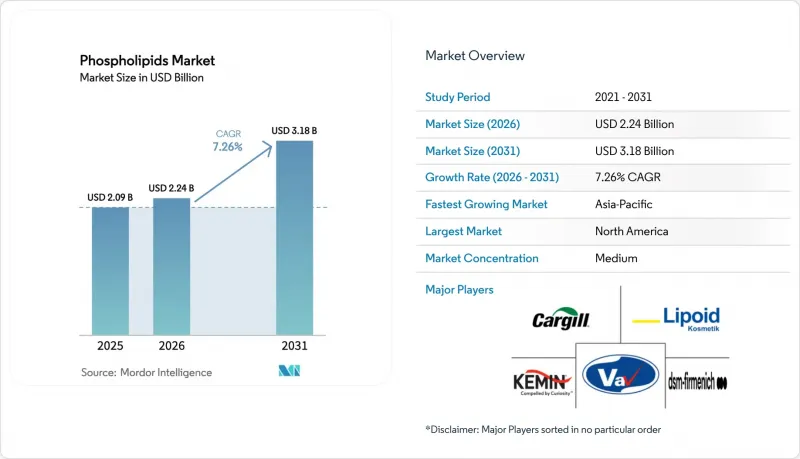
Mordor Intelligence에 의하면, 인지질 시장 규모는 2025년에 20억 9,000만 달러로 평가되었고 2026년 22억 4,000만 달러에서 2031년까지 31억 8,000만 달러에 이를 것으로 예측되며, 예측 기간(2026-2031년) CAGR은 7.26%를 나타낼 전망입니다.
본 보고서는 유형(포스파티딜세린, 포스파티딜콜린, 기타), 원료(대두, 해바라기, 계란, 기타), 용도(식음료, 영양보조식품, 의약품, 기타),지역(북미, 유럽, 아시아태평양, 남미, 중동 및 아프리카)별로 분류되어 있습니다. 본 보고서에서는 시장 규모와 예측치를 금액 기준(100만 미달러)으로 제시하고 있습니다.
세계 인지질 시장 동향 및 인사이트
인지 기능의 건강 유지 및 향상을 목적으로 한 영양 보조제에 대한 수요 증가
인지 기능의 중요성이 점점 더 인식되면서 소비자의 라이프스타일이 변화하고 있는 것이, 뇌 건강을 지원하는 뉴트라슈티컬 제품 수요를 견인하고 있습니다. 인지질은 신경 기능 및 구조에서 수행하는 역할로 인해 필수적인 성분이 되었습니다. 유럽식품안전청(EFSA)은 1일 콜린 섭취량을 400mg으로 권장하고 있는데, 이는 일반적인 식사를 통한 섭취량보다 많은 양이므로 인지질 보충제 시장에 큰 기회가 있음을 시사합니다. 각 기업은 다양한 인지 기능 건강 요구에 대응하기 위해 전문적인 제형을 개발하고 있습니다. 2024년, 인데나(Indena)사는 은행잎 추출물과 포스파티딜세린을 결합한 ‘Virtiva Plus’를 출시하며, 시장이 프리미엄급의 전문성이 높은 제품으로 이동하고 있음을 보여주었습니다. 젊은 소비자들이 포스파티딜세린 보충제를 통해 인지 기능 향상을 추구함에 따라, 포스파티딜세린 시장은 스트레스 관리 및 스포츠 영양 부문으로 확대되고 있습니다. 이러한 추세는 전 세계 뉴트라슈티컬 시장에서 포스파티딜세린이 고부가가치 다기능 성분으로서의 입지를 공고히 하고 있습니다.
급증하는 비건 및 식물성 인지질 공급원
식물성 인지질 공급원에 대한 선호도 증가는 지속가능성에 대한 우려와 알레르기 유발 물질 회피 요구에 의해 주도되고 있으며, 이러한 요인들이 공급망의 양상을 변화시키고 있습니다. 비유전자변형(Non-GMO) 식품 시장은 2020년대 말까지의 예측 기간 동안 상당한 성장이 예상되며, 이는 해바라기 유래 인지질에 대한 수요를 뒷받침하고 있습니다. 헥산 추출을 대체하는 에탄올 기반 추출법의 도입은 식품 가공용 용매에 관한 현행 EU 규정을 준수하고 있습니다. 이러한 추출 방식의 전환은 생산 효율과 제품 품질을 유지하면서 산업이 규제 요건에 적응하고 있음을 보여줍니다. 각 제조업체가 소비자 수요와 규제 기준을 충족하기 위해 지속 가능한 이니셔티브와 대체 가공 방법에 투자함에 따라 시장은 계속 진화하고 있습니다.
의약품 등급 인지질의 높은 비용
의약품 등급 인지질의 높은 가격은 시장 성장을 현저히 제약하고 있습니다. 특히 신흥 경제국에서는 비용에 대한 우려로 인해 다양한 치료 용도로의 광범위한 채택이 제한되고 있습니다. 쿠로다의 생명과학 부문은 2024년에 5억 430만 유로의 매출을 기록했으나, 이는 전년 대비 16% 감소한 수치이며, 인지질이 총 매출의 불과 1%만을 차지하고 있습니다. 이는 고사양 제품의 수익성을 유지하는 데 큰 어려움이 있음을 보여줍니다. 의약품용 지질 제제에 대한 엄격한 ‘품질 설계(QbD)’ 요건은 막대한 규제 준수 비용을 부과하며, 중소 제조업체에게는 그 관리가 점점 더 어려워지고 있어, 결국 시장 내 공급업체 간의 통합 추세를 가속화하고 있습니다.
부문 분석
포스파티딜콜린은 2025년 42.98%의 시장 점유율을 차지하며, 이는 주로 인지 기능 지원 보충제 및 의약품 제제에 사용되기 때문입니다. 기억과 학습을 지원하는 아세틸콜린 합성을 위한 콜린 공급원으로서의 그 기능은 광범위한 조사를 통해 입증되었습니다. 이 부문 시장 지위는 여러 지역의 규제 당국 승인을 통해 강화되고 있으며, 다른 유형의 인지질이 큰 시장 점유율을 확보하기는 어려워지고 있습니다.
포스포티딜세린은 스포츠 영양 제품에서의 채택 확대와 스트레스 관리 효과를 입증하는 새로운 연구에 힘입어, 2031년까지 연평균 성장률(CAGR) 7.78%를 나타낼 것으로 예측됩니다. 운동 성능 향상 보충제 및 정신 건강 제품에서 이 화합물의 인기가 높아짐에 따라, 인지질 시장의 제조업체와 공급업체에게 새로운 기회가 열리고 있습니다.
지역별 분석
북미는 첨단 의약품 연구개발 인프라, 지원적인 규제 체계, 확립된 영양 보충제 시장의 뒷받침을 받아 2025년에 32.10%라는 압도적인 시장 점유율을 차지하고 있습니다. 이 지역의 우위는 mRNA 백신 기술 및 약물 전달 시스템에 대한 투자로 인해 더욱 강화되고 있습니다. 그 예로, 2024년 모더나(Moderna)가 31억 달러의 순매출을 기록한 것을 들 수 있으며, 이는 인지질 기반 치료의 상업적 성공을 뒷받침합니다. 또한, 견고한 공급망 인프라, 확립된 연구 기관, 혁신적인 인지질 응용 기술 개발에 있어 산학 간의 강력한 협력 덕분에 이 지역의 선도적 지위는 더욱 공고해지고 있습니다.
아시아태평양은 2031년까지 연평균 성장률(CAGR)이 7.66%로 가장 높은 성장률을 보이고 있습니다. 이러한 성장은 중산층의 확대, 건강에 대한 인식 제고, 새로운 인지질 공급원 시장 진입을 지원하는 규제 체계 개선에 기인합니다. 중국 국가위생건강위원회가 2024년에 L-α-글리세릴포스포릴콜린을 식품 원료로 승인한 것은 시장 기회를 확대하는 규제적 지원을 보여줍니다. 심사 기간 단축 및 승인률 향상과 같은 중국의 승인 절차 효율화는 해외 인지질 공급업체에게 큰 성장 기회를 제공합니다. 이 지역의 급속한 산업화, 의료비 증가, 예방 의료에 대한 관심 증대가 시장 성장을 더욱 가속화하고 있습니다.
유럽에서는 복잡한 규제에도 불구하고 꾸준한 성장이 이어지고 있습니다. 유럽연합 집행위원회의 유아용 조제분유 규제 개정이 인지질의 용도에 영향을 미치는 한편, 지역 내 지속가능성 노력에 힘입어 환경 기준을 충족하는 식물성 인지질 공급원에 대한 수요가 증가하고 있습니다. 이 지역의 성숙한 시장 특성에 더해, 엄격한 품질 기준과 지속 가능한 생산 방식에 대한 중시가 맞물리면서, 인지질 제조업체 및 공급업체에게는 안정적이면서도 경쟁적인 환경이 조성되고 있습니다.
기타 혜택
- 엑셀 형식 시장 예측(ME) 시트
- 3개월간의 애널리스트 지원
자주 묻는 질문
목차
제1장 서론
제2장 조사 방법
제3장 개요
제4장 시장 구도
제5장 시장 규모와 성장 예측
제6장 경쟁 구도
제7장 시장 기회와 향후 전망
JHS 26.09.01According to Mordor Intelligence, the phospholipids market size was valued at USD 2.09 billion in 2025 and estimated to grow from USD 2.24 billion in 2026 to reach USD 3.18 billion by 2031, at a CAGR of 7.26% during the forecast period (2026-2031).
This report is Segmented by Type (Phosphatidylserine, Phosphatidylcholine, and Others), Source (Soy, Sunflower, Egg, and Others); Application (Food and Beverages, Dietary Supplements, Pharmaceutical, and Others); and Geography (North America, Europe, Asia-Pacific, South America, and the Middle East and Africa). The Report Offers Market Size and Forecasts in Value (USD Million).
Global Phospholipids Market Trends and Insights
Growing Demand in Nutraceuticals for Cognitive Health Support
The growing recognition of cognitive health importance and changing consumer lifestyles are driving demand for brain health nutraceuticals. Phospholipids have become essential ingredients due to their role in neural function and structure. The European Food Safety Authority recommends a daily choline intake of 400 mg, which is higher than typical dietary consumption, indicating a significant market opportunity for phospholipid supplements. Companies are developing specialized formulations to address various cognitive health requirements. In 2024, Indena introduced Virtiva Plus, which combines Ginkgo biloba extract with phosphatidylserine, illustrating the market's shift toward premium, specialized products. The phospholipids market is expanding into stress management and sports nutrition segments, as younger consumers seek cognitive performance enhancement through phospholipid supplements. This trend strengthens phospholipids' position as high-value, multifunctional ingredients in the global nutraceutical market.
Surging Vegan and Plant-Based Phospholipid Sources
The increasing preference for plant-based phospholipid sources is driven by sustainability concerns and allergen avoidance requirements, which are changing supply chain patterns. The non-GMO foods market is projected to experience significant growth in the forecast period through the end of this decade, supporting the demand for sunflower-derived phospholipids. The adoption of ethanol-based extraction methods instead of hexane extraction aligns with current EU regulations on food processing solvents. This transition in extraction methodology demonstrates the industry's adaptation to regulatory requirements while maintaining production efficiency and product quality. The market continues to evolve as manufacturers invest in sustainable practices and alternative processing methods to meet consumer demands and regulatory standards.
High Cost of Pharmaceutical Grade Phospholipids
High prices of pharmaceutical-grade phospholipids significantly constrain market growth, particularly in emerging economies where cost concerns restrict their widespread adoption across various therapeutic applications. Croda's Life Sciences segment reported sales of EUR 504.3 million in 2024, representing a 16% decline, with phospholipids contributing only 1% of total sales, demonstrating the substantial challenges in maintaining profitability for high-specification products. The stringent quality-by-design requirements for pharmaceutical lipid formulations impose substantial regulatory compliance costs, which smaller manufacturers find increasingly difficult to manage, ultimately driving consolidation trends among suppliers in the market.
Other drivers and restraints analyzed in the detailed report include:
- High Demand in Infant Nutrition Products
- Rising Demand of Phospholipids in Drug Delivery Systems
- Complex Extraction and Refining Process
For complete list of drivers and restraints, kindly check the Table Of Contents.
Segment Analysis
Phosphotidylcholine holds 42.98% of the market share in 2025, primarily due to its use in cognitive health supplements and pharmaceutical formulations. Its function as a choline source for acetylcholine synthesis, which supports memory and learning, has been validated through extensive research. The segment's market position is strengthened by regulatory approvals across multiple regions, making it difficult for alternative phospholipid types to gain significant market share.
Phosphotidylserine is projected to grow at 7.78% CAGR through 2031, driven by increased adoption in sports nutrition products and new research demonstrating its stress management benefits. The compound's growing popularity in athletic performance supplements and mental wellness products has created new opportunities for manufacturers and suppliers in the phospholipid market .
Complete Report Scope:
- By Type
- Phosphotidylserine
- Phosphotidylcholine
- Others
- By Source
- Soy
- Sunflower
- Egg
- Others
- By Application
- Food and Beverage
- Dietary Supplements
- Pharmaceutical
- Others
- By Geography
- North America
- United States
- Canada
- Mexico
- Rest of North America
- Europe
- Germany
- France
- United Kingdom
- Spain
- Netherlands
- Italy
- Sweden
- Poland
- Belgium
- Rest of Europe
- Asia-Pacific
- China
- India
- Japan
- Australia
- South Korea
- Indonesia
- Thailand
- Singapore
- Rest of Asia-Pacific
- South America
- Brazil
- Argentina
- Chile
- Colombia
- Peru
- Rest of South America
- Middle East and Africa
- United Arab Emirates
- South Africa
- Nigeria
- Saudi Arabia
- Egypt
- Morocco
- Turkey
- Rest of Middle East and Africa
- North America
Geography Analysis
North America holds a dominant 32.10% market share in 2025, driven by advanced pharmaceutical research and development infrastructure, supportive regulatory frameworks, and established nutraceutical markets. The region's prominence is reinforced by investments in mRNA vaccine technologies and drug delivery systems, as evidenced by Moderna's USD 3.1 billion net product sales in 2024, validating the commercial success of phospholipid-based therapeutics. The region's leadership position is further strengthened by its robust supply chain infrastructure, established research institutions, and strong collaboration between industry and academia in developing innovative phospholipid applications.
Asia-Pacific exhibits the highest growth rate at 7.66% CAGR through 2031. This growth stems from expanding middle-class populations, rising health awareness, and improved regulatory frameworks that support market entry for new phospholipid ingredients. China's National Health Commission's 2024 approval of L-alpha-Glycerylphosphorylcholine as a food raw material demonstrates regulatory support that enhances market opportunities. The streamlined approval process in China, featuring reduced review periods and higher acceptance rates, presents significant expansion opportunities for international phospholipid suppliers. The region's rapid industrialization, increasing healthcare expenditure, and growing focus on preventive healthcare further accelerate market growth.
Europe maintains consistent growth despite complex regulations. The European Commission's revised infant formula regulations influence phospholipid applications, while regional sustainability initiatives increase demand for plant-based phospholipid sources that meet environmental standards. The region's mature market characteristics, combined with stringent quality standards and emphasis on sustainable production methods, create a stable but competitive environment for phospholipid manufacturers and suppliers.
- Cargill, Incorporated
- VAV Life Sciences
- Lipoid GmbH
- DSM-Firmenich
- Kemin Industries
- Matlani Group (Sonic Biochem)
- BOC Sciences
- Matrix Life Science
- Botanic Healthcare Pvt. Ltd. (LipsoBio)
- ChemFaces
- Amitex Agro Product Pvt. Ltd.
- Croda International Plc (Croda Pharma)
- Creative Biolabs
- Agro Solvent Products Pvt Ltd (Sun Nutrafoods)
- Fengchen Group Co.,Ltd
- Biosynth
- Merck KGaA
- Chemi S.p.A.
- FUJIFILM Corporation (FUJIFILM Wako Pure Chemical Corporation)
- Nippon Fine Chemical
Additional Benefits:
- The market estimate (ME) sheet in Excel format
- 3 months of analyst support
TABLE OF CONTENTS
1 INTRODUCTION
- 1.1 Study Assumptions and Market Definition
- 1.2 Scope of the Study
2 RESEARCH METHODOLOGY
3 EXECUTIVE SUMMARY
4 MARKET LANDSCAPE
- 4.1 Market Overview
- 4.2 Market Drivers
- 4.2.1 Growing Demand in Nutraceuticals for Cognitive Health Support
- 4.2.2 Surging Vegan and Plant-Based Phospholipid Sources
- 4.2.3 High Demand in Infant Nutrition Products
- 4.2.4 Rising Demand of Phospholipids in Drug Delivery Systems
- 4.2.5 Technological Advancements in Extraction and Purification
- 4.2.6 Emerging Application in Tissue Engineering and Cell Culture
- 4.3 Market Restraints
- 4.3.1 High Cost of Pharmaceutical Grade Phospholipids
- 4.3.2 Complex Extraction and Refining Process
- 4.3.3 Regulatory Variability Across Geography
- 4.3.4 Low Stability in High-Temperature Food Processing
- 4.4 Supply Chain Analysis
- 4.5 Regulatory Outlook
- 4.6 Porter's Five Forces
- 4.6.1 Threat of New Entrants
- 4.6.2 Bargaining Power of Buyers/Consumers
- 4.6.3 Bargaining Power of Suppliers
- 4.6.4 Threat of Substitute Products
- 4.6.5 Intensity of Competitive Rivalry
5 MARKET SIZE AND GROWTH FORECASTS (VALUE)
- 5.1 By Type
- 5.1.1 Phosphotidylserine
- 5.1.2 Phosphotidylcholine
- 5.1.3 Others
- 5.2 By Source
- 5.2.1 Soy
- 5.2.2 Sunflower
- 5.2.3 Egg
- 5.2.4 Others
- 5.3 By Application
- 5.3.1 Food and Beverage
- 5.3.2 Dietary Supplements
- 5.3.3 Pharmaceutical
- 5.3.4 Others
- 5.4 By Geography
- 5.4.1 North America
- 5.4.1.1 United States
- 5.4.1.2 Canada
- 5.4.1.3 Mexico
- 5.4.1.4 Rest of North America
- 5.4.2 Europe
- 5.4.2.1 Germany
- 5.4.2.2 France
- 5.4.2.3 United Kingdom
- 5.4.2.4 Spain
- 5.4.2.5 Netherlands
- 5.4.2.6 Italy
- 5.4.2.7 Sweden
- 5.4.2.8 Poland
- 5.4.2.9 Belgium
- 5.4.2.10 Rest of Europe
- 5.4.3 Asia-Pacific
- 5.4.3.1 China
- 5.4.3.2 India
- 5.4.3.3 Japan
- 5.4.3.4 Australia
- 5.4.3.5 South Korea
- 5.4.3.6 Indonesia
- 5.4.3.7 Thailand
- 5.4.3.8 Singapore
- 5.4.3.9 Rest of Asia-Pacific
- 5.4.4 South America
- 5.4.4.1 Brazil
- 5.4.4.2 Argentina
- 5.4.4.3 Chile
- 5.4.4.4 Colombia
- 5.4.4.5 Peru
- 5.4.4.6 Rest of South America
- 5.4.5 Middle East and Africa
- 5.4.5.1 United Arab Emirates
- 5.4.5.2 South Africa
- 5.4.5.3 Nigeria
- 5.4.5.4 Saudi Arabia
- 5.4.5.5 Egypt
- 5.4.5.6 Morocco
- 5.4.5.7 Turkey
- 5.4.5.8 Rest of Middle East and Africa
- 5.4.1 North America
6 COMPETITIVE LANDSCAPE
- 6.1 Market Concentration
- 6.2 Strategic Moves
- 6.3 Market Ranking Analysis
- 6.4 Company Profiles (includes Global-level Overview, Market-level Overview, Core Segments, Financials (if available), Strategic Information, Market Rank/Share, Products and Services, Recent Developments)
- 6.4.1 Cargill, Incorporated
- 6.4.2 VAV Life Sciences
- 6.4.3 Lipoid GmbH
- 6.4.4 DSM-Firmenich
- 6.4.5 Kemin Industries
- 6.4.6 Matlani Group (Sonic Biochem)
- 6.4.7 BOC Sciences
- 6.4.8 Matrix Life Science
- 6.4.9 Botanic Healthcare Pvt. Ltd. (LipsoBio)
- 6.4.10 ChemFaces
- 6.4.11 Amitex Agro Product Pvt. Ltd.
- 6.4.12 Croda International Plc (Croda Pharma)
- 6.4.13 Creative Biolabs
- 6.4.14 Agro Solvent Products Pvt Ltd (Sun Nutrafoods)
- 6.4.15 Fengchen Group Co.,Ltd
- 6.4.16 Biosynth
- 6.4.17 Merck KGaA
- 6.4.18 Chemi S.p.A.
- 6.4.19 FUJIFILM Corporation (FUJIFILM Wako Pure Chemical Corporation)
- 6.4.20 Nippon Fine Chemical


