

|
시장보고서
상품코드
2116826
유럽의 안전화 : 시장 점유율 분석, 업계 동향과 통계, 성장 예측(2026-2031년)Europe Protective Footwear - Market Share Analysis, Industry Trends & Statistics, Growth Forecasts (2026 - 2031) |
||||||
 Mordor Intelligence
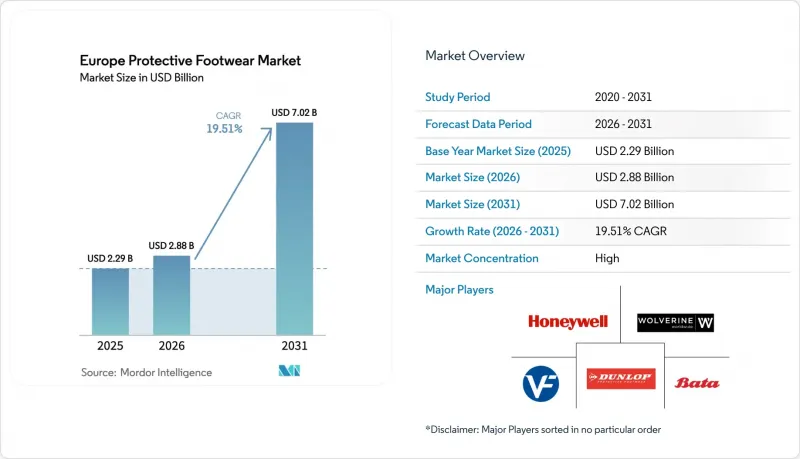
Mordor Intelligence에 따르면 유럽의 안전화 시장 규모는 2025년 22억 9,000만 달러, 2026년 28억 8,000만 달러에서 2031년까지 70억 2,000만 달러로 확대할 것으로 예측되고 있으며, 2026-2031년에 CAGR 19.51%를 기록할 전망입니다.
이 보고서는 소재(가죽, 고무 등), 최종사용자 산업(건설, 제조, 광업 등), 발가락 보호 유형(스틸 토, 복합재 토, 합금 토, 중족골 보호대), 유통 채널(직판/산업용 도매업체, 소매점, E-Commerce,대여·리스 서비스), 그리고 지역별로 분류되어 있습니다. 시장 전망은 금액(달러) 기준으로 제시되어 있습니다.
유럽 안전화 시장의 동향 및 인사이트
노동 보호에 관한 정부 규제
2024-2025년에 각국의 노동 감독 당국은 현장 감사를 강화하고, 특히 건설 및 물류 부문에서 부적절한 발 보호에 대한 시정 권고를 늘렸습니다. 2027년 1월부터 적용되는 ‘기계 규정(EU) 2023/1230’은 개인 보호 장비(PPE) 요건을 협동 로봇 구역으로도 확대하고 있으며, 고용주에게 미끄럼 방지 기능과 중족골 보호대가 장착된 안전화 구매를 권장하고 있습니다. 전자기기 및 제약 업계의 클린룸에서 강철 발가락 보호대 모델이 전자기 간섭의 원인으로 검사관에게 지적되는 사례가 증가함에 따라 복합 소재 발가락 보호대 모델의 판매가 가속화되고 있습니다. 감독이 엄격해짐에 따라 신발의 표준 교체 주기가 연장되면서, 기존에는 저사양 신발에 의존하던 하청업체들의 주문도 확대되고 있습니다.
증가하는 산업재해 건수
2023년, EU-OSHA는 282만 건의 비치명적 산업재해를 기록했으며, 그중 30%가 하지 부상이었습니다. 건설업만으로도 치사 사고의 22.9%를 차지하고 있으며, 금속 가공 현장에서는 1,100 N의 내관통 성능을 갖춘 미드솔이나 300°C의 접촉을 견딜 수 있는 내열성 아웃솔에 대한 고용주의 수요가 높아지고 있습니다. 또한 이러한 사고 추세를 반영하여, 오일으로 미끄러운 바닥에서도 미끄럼 방지 성능을 유지하는 이중 밀도 니트릴 고무 설계와, 장시간 근무시 피로를 줄여주는 경량 복합 플레이트 부츠의 개발도 진행되고 있습니다.
일반 신발에 비해 고가
EN ISO 20345:2011 S3 규격을 준수하는 인증 안전화의 소매 가격은 1켤레당 80유로에서 150유로(90달러에서 170달러)로, 일반적인 운동화에 비해 3배에서 5배 정도 비쌉니다. 동유럽의 중소기업에서는 건설업이나 제조업의 월급이 800유로에서 1,200유로 범위에 머물러 있으므로 많은 기업이 권장되는 12-18개월의 교체 주기를 초과하여 사용을 연장할 수밖에 없는 상황에 처해 있습니다. 구매를 미루게 되면, 특히 단기 프로젝트 간을 빈번하게 이동하는 하청 작업자들 사이에서 밑창 박리, 내천자성 저하, 미끄럼 방지 성능 저하와 같은 위험이 높아집니다. 폴란드, 루마니아, 불가리아에서는 개인 보호 장비에 대한 국가 보조금이 없기 때문에 구매자들은 수명 주기 비용보다 초기 가격을 우선시하고 있으며, 이는 경량 복합 소재로 제작된 발가락 보호 부츠나 재활용 가능한 열가소성 수지 소재 디자인의 보급을 저해하고 있습니다. 유통업체에 따르면 천연 고무나 가죽 가격이 급등할 때마다 보급형 강철 발가락 보호 부츠의 주문이 급증하고 있으며, 이는 상품 가격 변동과 가격에 민감한 조달 행동 사이에 밀접한 관련이 있음을 보여줍니다. 이러한 가격 격차는 해당 지역의 수백만 명에 달하는 기술직 근로자층에 대한 시장 침투를 여전히 제약하고 있으며, 그 결과 EU 안전 기준 준수 목표를 향한 전반적인 진전을 지연시키고 있습니다.
부문 분석
2025년에는 높은 내마모성과 통기성을 강점으로 하는 가죽이 매출의 48.24%를 차지했습니다. 그러나 BASF사의 ‘Elastollan 1400’ 시리즈가 주도적인 역할을 하여, 폴리우레탄 및 열가소성 폴리우레탄(TPU) 혼합 소재는 연평균 성장률(CAGR) 20.33%로 확대될 것으로 예측됩니다. 이 시리즈는 탄소발자국을 30% 줄이고, 무게를 늘리지 않으면서도 SRC 미끄럼 저항 기준을 충족합니다. EU의 산림 파괴 규제에 따른 추적성 요건의 부담에 직면한 가죽에서 브랜드들이 점차 벗어나면서, 유럽의 안전화 시장에서 폴리우레탄 및 열가소성 폴리우레탄 시장 규모는 2031년까지 약 25억 달러에 달할 것으로 예측됩니다. 내화학성 때문에 석유 및 가스 산업의 밑창에는 여전히 고무가 필수적이지만, 탈락이 없는 표면이 요구되는 클린룸에서는 플라스틱으로 만든 갑피가 주류를 이루고 있습니다.
ISO 20345:2021에서는 세라믹 타일 및 스틸 데크를 이용한 새로운 미끄럼 시험이 도입되었습니다. 이에 따라 고무 소재에 비해 1켤레당 150-200g 가벼워진 폴리우레탄 아웃솔이 재설계되어, 10시간 근무시 작업자의 피로 감소로 이어지고 있습니다. BASF의 Elastopan 시스템은 유연성을 저해하지 않으면서 정전기 방전(ESD) 안전성을 확보할 수 있게 되어, 제조업체들은 제약 및 전자기기 조립 시장에 진출할 수 있게 되었습니다. 유럽의 안전화 시장은 이러한 경량 및 재활용 가능한 컴파운드의 혜택을 받고 있으며, 특히 확대 생산자 책임(EPR)이 의무화된 국가에서 그 효과가 두드러집니다.
2025년 수요 중 건설 부문이 28.67%를 차지했으나, 풍력 및 태양광발전 설비 설치가 사상 최고치를 기록하고 있는 것을 배경으로, 공공사업·에너지 부문은 2031년까지 연평균 성장률(CAGR) 21.13%로 확대될 것으로 예측됩니다. 유럽의 안전화 시장에서 공공사업 분야만 시장 규모는 2026-2031년 사이에 2배로 증가할 것으로 추정됩니다. 이는 기술자들이 고소 터빈 작업시 아크 내성 부츠가 필요하기 때문입니다. 제조, 광업, 석유 및 가스 기업은 중족골 보호화의 꾸준한 구매자로 남아 있지만, 화학·제약 공장에서는 ATEX 구역에 부합하는 정전기 방전 방지 부츠가 지정되어 있습니다.
스페인은 2025년에 8.2GW의 재생 가능 에너지 설비 용량이 추가되고, 안전 장비에 대한 보조금이 지원되면서 설치 작업자들 사이에서 복합 소재 발가락 보호 신발의 채택이 확대되어 성장을 주도하고 있습니다. 독일의 에너지 전환(Energiewende)은 해상 플랫폼을 위해 -17°C까지의 내한 성능을 갖춘 신발에 대한 수요를 촉진하고 있습니다. 폴란드와 네덜란드의 물류 사업자들은 업무 중단을 초래하는 사고를 줄이기 위해 스마트 깔창 솔루션을 도입하고 있으며, 이로 인해 유럽 보호화 시장의 최종사용자 요구는 더욱 다양해지고 있습니다.
기타 혜택:
- 엑셀 형식의 시장 예측(ME) 시트
- 3개월간의 애널리스트 지원
자주 묻는 질문
목차
제1장 서론
제2장 조사 방법
제3장 개요
제4장 시장 구도
제5장 시장 규모와 성장 예측
제6장 경쟁 구도
제7장 시장 기회와 향후 전망
KSA 26.08.26According to Mordor Intelligence, the Europe protective footwear market size is projected to expand from USD 2.29 billion in 2025 and USD 2.88 billion in 2026 to USD 7.02 billion by 2031, registering a CAGR of 19.51% between 2026 to 2031.
This report is Segmented by Material (Leather, Rubber, and More), End-User Industry (Construction, Manufacturing, Mining, and More), Protection Toe Type (Steel Toe, Composite Toe, Alloy Toe, Metatarsal Guard), Distribution Channel (Direct/Industrial Distributors, Retail Stores, E-Commerce, Rental and Leasing Services), and Geography. The Market Forecasts are Provided in Terms of Value (USD).
Europe Protective Footwear Market Trends and Insights
Government Regulations for Labour Protection
National labor inspectorates intensified onsite audits during 2024-2025, issuing more citations for inadequate foot protection, particularly in the construction and logistics sectors. The Machinery Regulation (EU) 2023/1230, applicable from January 2027, extends PPE requirements to collaborative-robot zones, encouraging employers to buy slip-resistant, metatarsal-guard footwear. As inspectors increasingly flag steel-toe models for electromagnetic interference in electronics and pharmaceutical cleanrooms, sales of composite-toe models accelerate. Stricter oversight increases the baseline replacement cycle and expands orders from subcontractors that formerly relied on low-spec footwear.
Increasing Number of Industrial Accidents
In 2023, EU-OSHA recorded 2.82 million non-fatal workplace accidents, with 30% involving the lower limbs. Construction alone contributed 22.9% of fatal cases, reinforcing employer demand for puncture-resistant midsoles rated to 1,100 N and heat-resistant outsoles capable of withstanding 300 °C contact for metal fabrication. The incident profile is also driving the development of dual-density nitrile-rubber designs that maintain slip resistance on oily floors, as well as lightweight composite-plate boots that reduce fatigue during extended shifts.
High Prices Compared to Normal Footwear
Certified safety boots that meet EN ISO 20345:2011 S3 specifications retail for EUR 80 to EUR 150 (USD 90 to USD 170) per pair, representing a three-to-five times premium over mainstream athletic shoes. Small and medium-sized enterprises in Eastern Europe operate on monthly construction and manufacturing wages ranging from EUR 800 to EUR 1,200, forcing many to stretch replacement cycles beyond the recommended 12- to 18-month window. Deferred purchases increase exposure to sole delamination, compromised puncture resistance, and reduced slip-grip performance, particularly among subcontractor crews that frequently shift between short-term projects. Because national subsidies for personal protective equipment are absent in Poland, Romania, and Bulgaria, buyers prioritize the initial price over the lifecycle cost, hampering the uptake of lighter composite-toe or recyclable thermoplastic designs. Distributors report that orders for entry-level steel-toe boots spike whenever natural-rubber or leather prices jump, demonstrating the tight link between commodity volatility and price-sensitive procurement behavior. This affordability gap continues to constrain market penetration among the region's millions of tradespeople, thereby slowing overall progress toward EU safety compliance targets.
Other drivers and restraints analyzed in the detailed report include:
- Stricter EU PPE Regulation (EU) 2016/425 Updates
- Expansion of E-Commerce Channels for B2B PPE Procurement
- Volatility in Raw Material Costs
For complete list of drivers and restraints, kindly check the Table Of Contents.
Segment Analysis
Leather captured 48.24% of the revenue in 2025, driven by its high abrasion resistance and breathability. Yet polyurethane and thermoplastic polyurethane blends are forecast to expand at a 20.33% CAGR, propelled by BASF's Elastollan 1400 series that cuts carbon footprint by 30% and meets SRC slip-resistance without added weight. The European protective footwear market size for polyurethane and thermoplastic polyurethane is projected to reach approximately USD 2.5 billion by 2031, as brands transition away from leather, which is burdened by traceability requirements under the EU Deforestation Regulation. Rubber remains essential for oil-and-gas outsoles due to its chemical resistance, while plastic uppers dominate in cleanrooms, where non-shedding surfaces are required.
ISO 20345:2021 introduced new ceramic-tile and steel-deck slip tests, prompting the reformulation of polyurethane outsoles that shed 150-200 g per pair relative to rubber, thereby reducing worker fatigue over 10-hour shifts. BASF's Elastopan systems now deliver electrostatic-discharge safety without compromising flexibility, allowing manufacturers to penetrate the pharmaceutical and electronics assembly markets. The Europe protective footwear market benefits from these lighter, recyclable compounds, especially in countries with extended producer responsibility mandates.
Construction generated 28.67% of 2025 demand; however, utilities and energy are forecast to rise at a 21.13% CAGR through 2031, driven by record wind and solar installations. The Europe protective footwear market size for utilities alone is estimated to double between 2026 and 2031 as technicians require arc-rated boots for turbine work at heights. Manufacturing, mining, and oil and gas companies remain stable buyers of metatarsal-guard footwear, while chemical and pharmaceutical plants specify electrostatic-discharge boots that comply with ATEX zones.
Spain leads growth, fueled by 8.2 GW of renewable capacity additions in 2025 and supportive safety equipment grants, raising composite toe adoption among installation crews. Germany's Energiewende stimulates demand for cold-insulated footwear rated to -17 °C for offshore platforms. Logistics operators in Poland and the Netherlands deploy smart-insole solutions to cut lost-time incidents, further diversifying end-user needs across the Europe protective footwear market.
Complete Report Scope:
- By Material
- Leather
- Rubber
- Plastic
- PU and TPU Blends
- By End-User Industry
- Construction
- Manufacturing
- Mining
- Oil and Gas
- Chemical
- Pharmaceutical
- Transportation and Logistics
- Utilities and Energy
- By Protection Toe Type
- Steel Toe
- Composite Toe
- Alloy Toe
- Metatarsal Guard
- By Distribution Channel
- Direct/Industrial Distributors
- Retail Stores
- E-Commerce
- Rental and Leasing Services
- By Country
- Germany
- United Kingdom
- France
- Italy
- Spain
- Russia
- Rest of Europe
List of Companies Covered in this Report:
- Honeywell International Inc.
- Bata Corporation
- Wolverine World Wide Inc.
- VF Corporation
- Dunlop Protective Footwear
- Rock Fall (UK) Ltd
- Uvex Group
- COFRA Holding AG
- JAL Group
- Dr. Martens plc
- Emma Safety Footwear B.V.
- Elten GmbH
- Atlas Schuhfabrik GmbH
- Lemaitre Securite
- Hultafors Group AB
Additional Benefits:
- The market estimate (ME) sheet in Excel format
- 3 months of analyst support
TABLE OF CONTENTS
1 INTRODUCTION
- 1.1 Study Assumptions and Market Definition
- 1.2 Scope of the Study
2 RESEARCH METHODOLOGY
3 EXECUTIVE SUMMARY
4 MARKET LANDSCAPE
- 4.1 Market Overview
- 4.2 Market Drivers
- 4.2.1 Government Regulations for Labour Protection
- 4.2.2 Increasing Number of Industrial Accidents
- 4.2.3 Stricter EU PPE Regulation (EU) 2016/425 Updates
- 4.2.4 Expansion of E-Commerce Channels for B2B PPE Procurement
- 4.2.5 Adoption of Smart Boots with Embedded IoT Sensors
- 4.2.6 Circular-Economy Demand for Recyclable Safety Footwear
- 4.3 Market Restraints
- 4.3.1 High Prices Compared to Normal Footwear
- 4.3.2 Volatility in Raw Material (Leather and Rubber) Costs
- 4.3.3 Low Compliance Levels among SMEs in Eastern Europe
- 4.3.4 Complex Recycling of Multi-Material Safety Boots
- 4.4 Industry Value Chain Analysis
- 4.5 Regulatory Landscape
- 4.6 Technological Outlook
- 4.7 Impact of Macroeconomic Factors on the Market
- 4.8 Porter's Five Forces Analysis
- 4.8.1 Bargaining Power of Suppliers
- 4.8.2 Bargaining Power of Buyers
- 4.8.3 Threat of New Entrants
- 4.8.4 Threat of Substitutes
- 4.8.5 Intensity of Competitive Rivalry
- 4.9 Assessment of Impact of COVID-19 on the Market
5 MARKET SIZE AND GROWTH FORECASTS (VALUE)
- 5.1 By Material
- 5.1.1 Leather
- 5.1.2 Rubber
- 5.1.3 Plastic
- 5.1.4 PU and TPU Blends
- 5.2 By End-User Industry
- 5.2.1 Construction
- 5.2.2 Manufacturing
- 5.2.3 Mining
- 5.2.4 Oil and Gas
- 5.2.5 Chemical
- 5.2.6 Pharmaceutical
- 5.2.7 Transportation and Logistics
- 5.2.8 Utilities and Energy
- 5.3 By Protection Toe Type
- 5.3.1 Steel Toe
- 5.3.2 Composite Toe
- 5.3.3 Alloy Toe
- 5.3.4 Metatarsal Guard
- 5.4 By Distribution Channel
- 5.4.1 Direct/Industrial Distributors
- 5.4.2 Retail Stores
- 5.4.3 E-Commerce
- 5.4.4 Rental and Leasing Services
- 5.5 By Country
- 5.5.1 Germany
- 5.5.2 United Kingdom
- 5.5.3 France
- 5.5.4 Italy
- 5.5.5 Spain
- 5.5.6 Russia
- 5.5.7 Rest of Europe
6 COMPETITIVE LANDSCAPE
- 6.1 Market Concentration
- 6.2 Strategic Moves
- 6.3 Market Share Analysis
- 6.4 Company Profiles (includes Global Level Overview, Market Level Overview, Core Segments, Financials as Available, Strategic Information, Market Rank/Share for Key Companies, Products and Services, and Recent Developments)
- 6.4.1 Honeywell International Inc.
- 6.4.2 Bata Corporation
- 6.4.3 Wolverine World Wide Inc.
- 6.4.4 VF Corporation
- 6.4.5 Dunlop Protective Footwear
- 6.4.6 Rock Fall (UK) Ltd
- 6.4.7 Uvex Group
- 6.4.8 COFRA Holding AG
- 6.4.9 JAL Group
- 6.4.10 Dr. Martens plc
- 6.4.11 Emma Safety Footwear B.V.
- 6.4.12 Elten GmbH
- 6.4.13 Atlas Schuhfabrik GmbH
- 6.4.14 Lemaitre Securite
- 6.4.15 Hultafors Group AB
7 MARKET OPPORTUNITIES AND FUTURE OUTLOOK
- 7.1 White-Space and Unmet-Need Assessment


