

|
시장보고서
상품코드
2116867
항공기용 마이크로터빈 : 시장 점유율 분석, 업계 동향과 통계, 성장 예측(2026-2031년)Aircraft Micro Turbine - Market Share Analysis, Industry Trends & Statistics, Growth Forecasts (2026 - 2031) |
||||||
 Mordor Intelligence
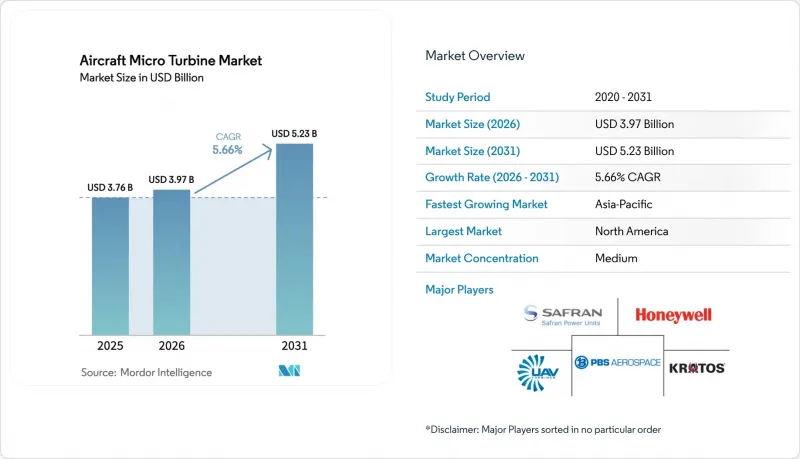
Mordor Intelligence에 따르면 항공기용 마이크로터빈 시장 규모는 2025년에 37억 6,000만 달러로 평가되며, 2026년 39억 7,000만 달러에서 2031년까지 52억 3,000만 달러에 달할 것으로 예측되고 있으며, 예측 기간(2026-2031년)에 CAGR은 5.66%에 달할 전망입니다.
이 보고서는 엔진 유형(터보샤프트, 터보프롭 등), 정격 출력(30kW 미만, 30-60kW, 60-90kW 및 기타),용도(유인 경량 고정익기, EVTOL/도시 항공 모빌리티 및 기타), 최종사용자(군사·방위, 민간 항공 및 기타), 지역(북미, 유럽 및 기타)별로 분류되어 있습니다. 시장 예측은 금액(달러) 기준으로 제시되어 있습니다.
전 세계 항공기용 마이크로터빈 시장의 동향 및 인사이트
비행 지속 시간을 중시하는 무인항공기(UAV) 도입 확대
운영자가 8시간 이상의 비행 시간을 필요로 하므로 장시간 비행이 가능한 드론이 새로운 조달 주기를 주도하고 있습니다. 미국 공군(USAF)의 ATTAM 프로그램은 2024년에 크라토스(Cratos)사에 소모성 엔진 개발을 위해 1,270만 달러를 지원함으로써, 장시간 체공 플랫폼에 대한 연방 정부의 노력을 지원했습니다. 파이프라인 검사 및 정밀농업 분야의 민간 사업자들도 마찬가지로 비행 시간 확보가 필수적이며, 마이크로터빈은 외딴 지역에서 구할 수 있는 중유를 연소시켜 이러한 수요를 충족시키고 있습니다. 진동 수준이 낮아지면 센서의 수명이 연장되고, 유지보수 일정이 간소화되어 가동률이 높은 기체군 전체의 가동 중단 시간이 줄어듭니다.
eVTOL/UAM용 하이브리드 전기식 항속 거리 연장 장치의 부상
혼다가 2024년에 eVTOL 기체를 대상으로 실시한 가스 터빈 하이브리드 시험을 통해 마이크로터빈이 실용적인 항속 거리 연장 장치로서 유효하다는 것이 입증되었습니다. 도시 항공 모빌리티 개발 기업은 이러한 장치를 활용하여 중량 제한을 초과하지 않으면서 실용 항속 거리를 3배로 늘리고 있습니다. 2025년에는 FAA가 동력 상승기를 국가 공역 시스템(NAS)에 통합하고 인증 절차를 간소화함으로써 규제 측면의 명확성이 확보되었습니다. 또한 하이브리드 아키텍처는 배터리 고장시 예비 전원을 제공함으로써 신뢰성에 대한 대중의 우려를 완화하는 역할도 하고 있습니다.
높은 도입 및 유지 비용
Turbotech사의 R90이 보여주듯이, 소매 가격이 10만 달러에 달하는 터빈 엔진은 동급 피스톤 엔진에 비해 3-5배 더 비쌉니다. 엔진 가격의 40%에 달할 수도 있는 전용 공구 및 고온 부위의 정밀 점검 비용이 총 소유 비용을 더욱 끌어올리고 있습니다. 전 세계 정비 능력 부족은 2026년에 정점에 달할 것으로 예측되며, 이로 인해 시간당 정비 요금이 상승하여 비행 훈련이나 레크리에이션 항공 등 비용에 민감한 분야의 도입이 제한될 것입니다.
부문 분석
터보프롭기는 2025년 매출의 37.42%를 차지하며, 훈련기, 경량 통근기 및 장거리 비행이 가능한 무인 항공기(UAV) 분야에서 확고한 입지를 입증하고 있습니다. 이러한 점유율로 인해 터보프롭 항공기는 항공기용 마이크로터빈 시장에서 가장 큰 점유율을 차지하는 분야가 되었으며, 확립된 인증 절차와 범용 프로펠러 기술의 혜택을 받고 있습니다. 한편, 터보샤프트 항공기는 민간 및 준공공 회전익기의 수주가 회복되고, 하이브리드 전기식 분배기가 샤프트 출력을 선호함에 따라 2031년까지 연평균 성장률(CAGR) 7.36%로 성장할 것으로 예상됩니다. 터보제트 설계는 고속 정찰 드론에 널리 채택되고 있지만, 연료 소비량이 많기 때문에 더 광범위한 보급에는 과제가 남아 있습니다.
터보팬 및 열회수형은 기술적인 틈새 시장에 머물러 있지만, 열회수 시스템으로 인해 열효율이 향상되고 있으며, 향후 성장이 예상됩니다. 중국의 AES100 터보샤프트는 2025년에 생산을 시작할 예정이며, 이는 아시아태평양이 유럽과 미국의 리드 타임을 단축할 수 있는 능력을 갖추고 있음을 보여줍니다. 샤프트 결합형 추진 시스템 및 회생 사이클로의 장기적인 전환은 eVTOL, 틸트로터 및 지역 하이브리드 프로젝트가 엄격한 배출량 상한선 하에서 더 높은 효율을 요구함에 따라 항공기용 마이크로터빈 시장을 재편할 것입니다.
정격 출력 60-90kW의 엔진은 2025년 매출의 45.12%를 차지하며, 중량 여유가 제한된 주류 UAV 및 경량 항공기용 항공기용 마이크로터빈 시장 규모의 기반을 형성하고 있습니다. 시스템의 성숙도가 높아짐에 따라 통합 위험이 감소하여, OEM 각사는 열 관리 시스템을 재설계하지 않고도 엄격한 취항 예정일을 맞출 수 있게 되었습니다. 90kW를 초과하는 수요는 대형 수송용 UAV, 단거리 화물기, 그리고 분산형 하이브리드 전기식 실증기가 시제품 단계에서 소량 생산 단계로 전환됨에 따라 연평균 성장률(CAGR) 6.47%로 확대되고 있습니다.
30kW 미만의 유닛은 특수한 ISR 드론에 대응하며, 30-60kW 플랫폼은 훈련기 개조 및 저출력 틸트로터기를 대상으로 합니다. 출력 확대에 따른 과제는 열적 한계와 기어박스의 질량에 집중되어 있으며, 이는 세라믹 매트릭스 복합재료 및 적층 제조를 통한 디퓨저의 채택을 촉진하고 있습니다. FAA가 자금을 지원하는 CLEEN III 프로젝트에서는 90kW 터보 발전기를 통해 지역 노선의 연료 소비를 최대 30%까지 줄일 수 있을 것으로 예측되며, 프로그램의 위험 요소가 해소된다면 급격한 성장이 예상됩니다.
지역별 분석
북미는 2025년 매출의 39.05%를 차지하고 있으며, 이는 미 공군(USAF)의 풍부한 소모형 드론 개발 파이프라인, GE 및 허니웰의 광범위한 공급업체 기반, 그리고 멕시코의 저비용 항공기 구조 클러스터에 의해 지원되고 있습니다. 인증 기관, 정부의 연구개발(R&D) 자금, 그리고 애프터마켓의 MRO(정비·수리·오버홀) 밀도는 해외 진입 기업에게 매우 높은 진입 장벽이 되고 있습니다.
아시아태평양은 가장 역동적인 지역으로, 2031년까지 연평균 성장률(CAGR)이 7.32%에 달할 것으로 예측됩니다. 중국의 AES100 터보샤프트 라이선스 획득은 1,000kW급 엔진에 대한 국산화 능력 확립을 알리는 것이며, 한편 인도는 ‘메이크 인 인디아(Make in India)’ 정책 하에 무인항공기(UAV) 및 경수송기용 추진 시스템의 공백을 메우기 위한 노력을 가속화하고 있습니다. 일본은 미쓰비시 중공업과 롤스로이스의 제휴를 활용하여 첨단 터보 발전기를 공동 개발하고 있으며, 호주는 공급망을 확보하기 위해 방위 조달을 국산 드론 프로그램으로 전환하고 있습니다.
유럽은 사프란, 롤스로이스, 터보텍을 보유한 강호로서의 지위를 유지하고 있습니다. 청정 항공 분야에 대한 자금 지원으로 하이브리드 전기식 및 수소 대응 마이크로터빈에 대한 투자가 촉진되고 있으며, ICAO의 CO₂ 기준을 상회하는 초저배출 설계가 장려되고 있습니다. 동유럽의 MRO(정비·수리·오버홀) 거점 확대와 중동의 공항 확장은 수출에 적합한 엔진 및 애프터마켓 서비스에 대한 상호 수요를 창출하고 있지만, 지정학적 리스크로 인해 단기적인 규모 확대는 제한되고 있습니다.
기타 혜택:
- 엑셀 형식의 시장 예측(ME) 시트
- 3개월간의 애널리스트 지원
자주 묻는 질문
목차
제1장 서론
제2장 조사 방법
제3장 개요
제4장 시장 구도
제5장 시장 규모와 성장 예측
제6장 경쟁 구도
제7장 시장 기회와 향후 전망
KSA 26.08.26According to Mordor Intelligence, the aircraft micro turbine market size was valued at USD 3.76 billion in 2025 and estimated to grow from USD 3.97 billion in 2026 to reach USD 5.23 billion by 2031, at a CAGR of 5.66% during the forecast period (2026-2031).
This report is Segmented by Engine Type (Turboshaft, Turboprop, and More), Power Output Rating (Less Than 30 KW, 30 To 60 KW, 60 To 90 KW, and More), Application (Manned Light Fixed-Wing Aircraft, EVTOL/Urban Air Mobility, and More), End User (Military and Defense, Commercial Aviation, and More), and Geography (North America, Europe, and More). The Market Forecasts are Provided in Terms of Value (USD).
Global Aircraft Micro Turbine Market Trends and Insights
Growing Deployment of Endurance-Focused UAVs
Extended-mission drones dominate new procurement cycles as operators require flight times beyond eight hours. The USAF's ATTAM program awarded USD 12.7 million to Kratos in 2024 to develop attritable engines, confirming federal commitment to long-loiter platforms. Commercial operators in pipeline inspection and precision agriculture share the same endurance imperative, and micro turbines satisfy this demand by burning heavy fuels available at remote sites. Lower vibration levels lengthen sensor life, while simplified maintenance schedules reduce downtime across high-utilization fleets.
Rise of Hybrid-Electric Range Extenders for eVTOL/UAM
Honda's 2024 test of a gas-turbine hybrid for eVTOL aircraft validated micro turbines as viable range extenders. Urban air mobility developers use these units to triple practical range without breaching weight budgets. Regulatory clarity arrived in 2025 when the FAA integrated powered-lift aircraft into the National Airspace System, streamlining certification. Hybrid architectures also allay public reliability concerns by providing redundant power in case of battery faults.
High Acquisition and Maintenance Cost
Retail prices near USD 100,000 place turbines at a 3-5X premium to equivalent piston engines, as highlighted by Turbotech's R90 offering. Specialized tooling and hot-section overhauls that can cost 40% of engine value exacerbate total ownership expenses. Global maintenance-capacity shortages are projected to peak in 2026, elevating hourly service rates and limiting adoption in cost-sensitive sectors like flight training and recreational aviation.
Other drivers and restraints analyzed in the detailed report include:
- Superior Power-to-Weight and Multi-Fuel Capability versus Piston Engines
- Fleet Renewal of Trainer and Light Aircraft
- Certification Pathway Uncertainty
For complete list of drivers and restraints, kindly check the Table Of Contents.
Segment Analysis
Turboprops accounted for 37.42% of 2025 revenue, underscoring their entrenched role in trainers, light commuters, and endurance UAVs. This share positions turboprops as the single largest slice of the aircraft micro turbine market, benefiting from ready certification pathways and commodity propeller technology. Turboshaft units, however, advance at a 7.36% CAGR through 2031 as civil and parapublic rotorcraft orders rebound and hybrid-electric distributors favor shaft power. Turbojet designs populate high-speed reconnaissance drones but remain fuel-hungry for broader uptake.
Turbofan and recuperated variants occupy smaller technical niches but offer upside as heat-recovery systems elevate thermal efficiency. China's AES100 turboshaft entered production in 2025, signaling Asia-Pacific's capacity to erode Western lead times. The long-term shift toward shaft-coupled propulsion and regenerative cycles will reshape the aircraft micro turbine market as eVTOL, tiltrotor, and regional hybrid projects demand higher efficiency under strict emission ceilings.
Engines rated 60 to 90 kW delivered 45.12% of 2025 sales, anchoring the aircraft micro turbine market size for mainstream UAVs and light aircraft, where weight margins are narrow. System maturity reduces integration risk, letting OEMs meet aggressive entry-into-service dates without redesigning thermal management. Demand above 90 kW is scaling at 6.47% CAGR as heavy-lift UAVs, short-haul cargo planes, and distributed hybrid-electric demonstrators progress from prototype to low-rate production.
Sub-30 kW units cater to specialized ISR drones, while 30 to 60 kW platforms target trainer retrofits and lower-power tiltrotors. Power-scaling challenges center on thermal limits and gearbox mass, encouraging the adoption of ceramic matrix composites and additive-manufactured diffusers. FAA-funded CLEEN III projects that a 90 kW turbogenerator can cut block fuel up to 30% on regional flights, hinting at steep growth potential once program risk retires.
Complete Report Scope:
- By Engine Type
- Turbojet
- Turboshaft
- Turboprop
- Turbofan
- Recuperated/Regenerative
- By Power Output Rating
- Less than 30 kW
- 30 to 60 kW
- 60 to 90 kW
- Greater than 90 kW
- By Application
- Unmanned Aerial Vehicles (UAVs)
- Manned Light Fixed-Wing Aircraft
- Rotary-Wing/Light Helicopters
- eVTOL/Urban Air Mobility (UAM)
- Aircraft Auxiliary Power Units (APUs)
- By End User
- Military and Defense
- Commercial Aviation
- General Aviation
- UAV OEMs/Drone Operators
- Research and Experimental
- By Geography
- North America
- United States
- Canada
- Mexico
- Europe
- Germany
- United Kingdom
- France
- Russia
- Rest of Europe
- Asia-Pacific
- China
- Japan
- India
- South Korea
- Australia
- Rest of Asia-Pacific
- South America
- Brazil
- Rest of South America
- Middle East and Africa
- Middle East
- United Arab Emirates
- Saudi Arabia
- Israel
- Rest of Middle East
- Africa
- South Africa
- Rest of Africa
- Middle East
- North America
Geography Analysis
North America held 39.05% of 2025 revenue, supported by the USAF's deep attritable drone pipeline, GE and Honeywell's extensive supplier bases, and Mexico's low-cost aerostructure clusters. Certification bodies, government R&D funding, and aftermarket MRO density create formidable entry barriers for foreign challengers.
Asia-Pacific is the most dynamic region, projected at 7.32% CAGR to 2031. China's AES100 turboshaft license heralds indigenous capability in 1,000 kW class engines, while India accelerates under "Make in India" to close propulsion gaps for UAVs and light transport aircraft. Japan leverages Mitsubishi Heavy Industries' partnership with Rolls-Royce to co-develop advanced turbogenerators, and Australia channels defense procurement into sovereign drone programs to secure supply chains.
Europe remains a powerhouse, home to Safran, Rolls-Royce, and Turbotech. Clean-Aviation funding steers investment toward hybrid-electric and hydrogen-ready micro turbines, incentivizing ultra-low-emission designs that exceed ICAO CO2 standards. Eastern Europe's growing MRO footprint and the Middle East's airport expansion create reciprocal demand for export-friendly engines and aftermarket services, though geopolitical risks temper near-term scale-up.
- Safran Power Units (Safran SA)
- Honeywell International Inc.
- RTX Corporation
- GE Aerospace
- Kratos Defense & Security Solutions, Inc.
- UAV Turbines, Inc.
- Turbotech SAS
- AeroDesignWorks GmbH
- Capstone Green Energy
- Rolls-Royce plc
- TurbAero
- CAT, M. Zipperer GmbH
- AMT Netherlands B.V.
- PBS AEROSPACE Inc.
Additional Benefits:
- The market estimate (ME) sheet in Excel format
- 3 months of analyst support
TABLE OF CONTENTS
1 INTRODUCTION
- 1.1 Study Assumptions and Market Definition
- 1.2 Scope of the Study
2 RESEARCH METHODOLOGY
3 EXECUTIVE SUMMARY
4 MARKET LANDSCAPE
- 4.1 Market Overview
- 4.2 Market Drivers
- 4.2.1 Growing deployment of endurance-focused UAVs
- 4.2.2 Rise of hybrid-electric range extenders for eVTOL/UAM
- 4.2.3 Superior power-to-weight and multi-fuel capability vs piston engines
- 4.2.4 Fleet renewal of trainer and light aircraft
- 4.2.5 Defense demand for attritable drones
- 4.2.6 Adoption of micro-turbine APUs in more-electric regional aircraft
- 4.3 Market Restraints
- 4.3.1 High acquisition and maintenance cost
- 4.3.2 Certification pathway uncertainty
- 4.3.3 Additive-manufacturing capacity bottlenecks for hot-section parts
- 4.3.4 Competition from lightweight hydrogen fuel cells
- 4.4 Value Chain Analysis
- 4.5 Regulatory Landscape
- 4.6 Technological Outlook
- 4.7 Porter's Five Forces Analysis
- 4.7.1 Threat of New Entrants
- 4.7.2 Bargaining Power of Buyers
- 4.7.3 Bargaining Power of Suppliers
- 4.7.4 Threat of Substitutes
- 4.7.5 Intensity of Competitive Rivalry
5 MARKET SIZE AND GROWTH FORECASTS (VALUE)
- 5.1 By Engine Type
- 5.1.1 Turbojet
- 5.1.2 Turboshaft
- 5.1.3 Turboprop
- 5.1.4 Turbofan
- 5.1.5 Recuperated/Regenerative
- 5.2 By Power Output Rating
- 5.2.1 Less than 30 kW
- 5.2.2 30 to 60 kW
- 5.2.3 60 to 90 kW
- 5.2.4 Greater than 90 kW
- 5.3 By Application
- 5.3.1 Unmanned Aerial Vehicles (UAVs)
- 5.3.2 Manned Light Fixed-Wing Aircraft
- 5.3.3 Rotary-Wing/Light Helicopters
- 5.3.4 eVTOL/Urban Air Mobility (UAM)
- 5.3.5 Aircraft Auxiliary Power Units (APUs)
- 5.4 By End User
- 5.4.1 Military and Defense
- 5.4.2 Commercial Aviation
- 5.4.3 General Aviation
- 5.4.4 UAV OEMs/Drone Operators
- 5.4.5 Research and Experimental
- 5.5 By Geography
- 5.5.1 North America
- 5.5.1.1 United States
- 5.5.1.2 Canada
- 5.5.1.3 Mexico
- 5.5.2 Europe
- 5.5.2.1 Germany
- 5.5.2.2 United Kingdom
- 5.5.2.3 France
- 5.5.2.4 Russia
- 5.5.2.5 Rest of Europe
- 5.5.3 Asia-Pacific
- 5.5.3.1 China
- 5.5.3.2 Japan
- 5.5.3.3 India
- 5.5.3.4 South Korea
- 5.5.3.5 Australia
- 5.5.3.6 Rest of Asia-Pacific
- 5.5.4 South America
- 5.5.4.1 Brazil
- 5.5.4.2 Rest of South America
- 5.5.5 Middle East and Africa
- 5.5.5.1 Middle East
- 5.5.5.1.1 United Arab Emirates
- 5.5.5.1.2 Saudi Arabia
- 5.5.5.1.3 Israel
- 5.5.5.1.4 Rest of Middle East
- 5.5.5.2 Africa
- 5.5.5.2.1 South Africa
- 5.5.5.2.2 Rest of Africa
- 5.5.5.1 Middle East
- 5.5.1 North America
6 COMPETITIVE LANDSCAPE
- 6.1 Market Concentration
- 6.2 Strategic Moves
- 6.3 Market Share Analysis
- 6.4 Company Profiles (includes Global level Overview, Market level overview, Core Segments, Financials as available, Strategic Information, Market Rank/Share for key companies, Products and Services, and Recent Developments)
- 6.4.1 Safran Power Units (Safran SA)
- 6.4.2 Honeywell International Inc.
- 6.4.3 RTX Corporation
- 6.4.4 GE Aerospace
- 6.4.5 Kratos Defense & Security Solutions, Inc.
- 6.4.6 UAV Turbines, Inc.
- 6.4.7 Turbotech SAS
- 6.4.8 AeroDesignWorks GmbH
- 6.4.9 Capstone Green Energy
- 6.4.10 Rolls-Royce plc
- 6.4.11 TurbAero
- 6.4.12 CAT, M. Zipperer GmbH
- 6.4.13 AMT Netherlands B.V.
- 6.4.14 PBS AEROSPACE Inc.
7 MARKET OPPORTUNITIES AND FUTURE OUTLOOK
- 7.1 White-space and Unmet-Need Assessment


