
|
시장보고서
상품코드
2116887
전기자동차 센서 시장 : 점유율 분석, 업계 동향과 통계, 성장 예측(2026-2031년)Electric Vehicle Sensor - Market Share Analysis, Industry Trends & Statistics, Growth Forecasts (2026 - 2031) |
||||||
 Mordor Intelligence
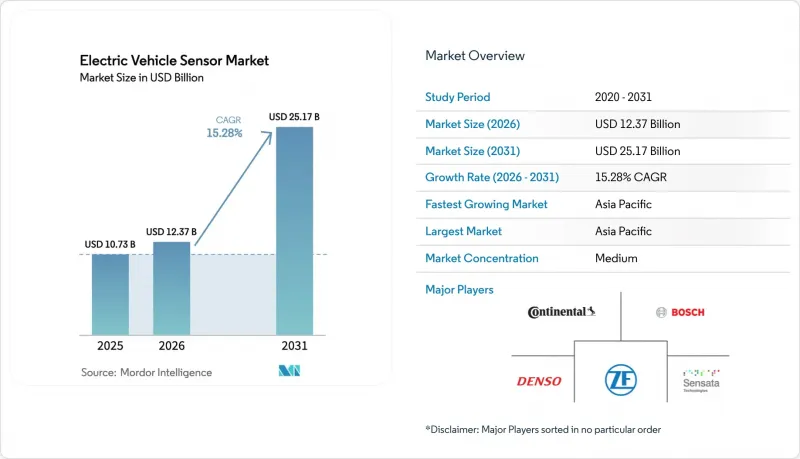
Mordor Intelligence에 의하면, 전기자동차 센서 시장 규모는 2025년에 107억 3,000만 달러로 평가되었고 2026년 123억 7,000만 달러에서 2031년까지 251억 7,000만 달러에 이를 것으로 예측되며, 예측 기간(2026-2031년) CAGR은 15.28%를 나타낼 전망입니다.
본 보고서는 센서 유형(전류, 온도, 위치, 압력 등), 차량 유형(승용차, 상용차), 구동 방식(배터리식 전기자동차 등), 용도(배터리 관리, 열 관리 등), 센서 기술(홀 효과, MEMS 등) 및 지역별로 분류되어 있습니다. 시장 전망은 금액(달러) 기준으로 제시되어 있습니다.
전 세계 전기자동차 센서 시장 동향 및 인사이트
800V 플랫폼의 진화가 전류·전압 센서 수요를 확대
각 OEM 업체들이 400V에서 800V 전기 아키텍처로 전환함에 따라, 연속 전류 요구 사항은 1,000A로 높아지고 있으며, 스위칭 주파수는 100kHz를 초과하고 있습니다. 이에 따라 더 넓은 대역폭과 강화된 절연성을 갖춘 XMR 및 첨단 홀 센서의 채택이 요구되고 있습니다. 포르쉐는 Taycan을 통해 800V를 상용화하여 22.5분 만에 5-80%의 급속 충전이 가능하게 했습니다. 현대자동차의 E-GMP는 이 토폴로지를 양산 부문으로 확대하고, 공급망 전반에 걸쳐 새로운 센서 사양을 표준화하고 있습니다. 실리콘 카바이드(SiC) 인버터는 응답 지연에 대한 민감도가 높기 때문에 마이크로초 단위의 정밀도와 기능 안전 진단 기능을 겸비한 센서가 선호됩니다. 공급업체들은 이러한 전환을 활용하여 다기능 센싱 모듈의 평균 판매 가격(ASP)을 인상하는 동시에, 차세대 플랫폼을 위한 장기적인 설계 채택을 확보하고 있습니다.
홀 효과 센서의 평균 판매 가격(ASP) 하락이 BEV 보급 확대에 기여
12인치 팹에서의 생산 규모 확대와 테스트 처리량 향상으로 인해 홀 효과 센서의 평균 판매 가격은 매년 대폭 하락하고 있으며, 비용에 민감한 BEV 제조업체들은 차량의 가격 경쟁력을 유지하면서도 차량당 120개 이상의 센서를 탑재할 수 있게 되었습니다. TDK-Micronas 및 Allegro MicroSystems는 감지, 컨디셔닝, 디지털 인터페이스를 통합한 단일 패키지 홀 효과 센서를 제공하여 BOM(부품표)과 기판 면적을 줄이고 있습니다. 중국의 BEV 제조업체들은 기본적인 기능 안전 요건을 충족하기 위해 이러한 장치를 채택하고 있으며, 이로 인해 전기자동차 센서 시장이 엔트리 레벨로 확대되고 있습니다. 가격 탄력성의 효과로 인해 매출 감소 속도를 상회하는 속도로 단위 수요가 확대되고 있어 시장 전체의 가치가 유지되고 있습니다.
XMR 웨이퍼 가격 급등이 이익률을 압박
자동차 등급 XMR 웨이퍼의 세계 파운드리 생산 능력이 제한적이어서 2024년 수준에 비해 조달 비용이 크게 상승했으며, 매출이 견조하게 증가하고 있음에도 불구하고 매출 총이익률이 압박받고 있습니다. 희토류 상품의 가격 변동이, 특히 헤지 계약을 체결하지 않은 중소 벤더들에게 이 압박을 더욱 가중시키고 있습니다. TDK-Micronas는 프라이베르크의 생산 능력을 확대했으나, 자본 집약도가 높아 급속한 증산에는 한계가 있습니다. 이익 측면의 역풍을 맞아, 공급망 내 제휴 및 수직 통합 전략이 촉진되고 있습니다.
부문별 분석
전류 센서는 BMS, 인버터, 충전 장치 및 차량용 DC-DC 컨버터에 널리 채택된 것을 배경으로, 2025년 전기자동차 센서 시장에서 26.74%의 점유율을 유지했습니다. 모터 출력 수준의 지속적인 확대와 병렬 트랙션 아키텍처의 보급이 판매량 증가를 뒷받침하고 있습니다. 자기 저항식 센서는 서브 마이크로초의 응답 속도와 3ppm의 오프셋 드리프트를 활용하여 2031년까지 연평균 성장률(CAGR) 15.44%를 기록하며 홀 소자를 능가하는 성장세를 보이고 있습니다. 배터리 팩 내부의 온도 센서 보급은 계속되고 있으며, 위치 및 속도 센서는 모터 제어와 회생 제동의 정밀도를 뒷받침하고 있습니다.
전기자동차 센서 시장은 설계 주기를 단축하기 위해 전류, 온도, 절연 기능을 통합한 단일 패키지 조합을 요구하는 OEM의 요구에 부응하고 있습니다. 1차 공급업체들은 PCB 실적를 중복하지 않으면서 ASIL-D 수준의 이중화를 충족하기 위해 XMR 모듈 내에 션트 기반의 백업 기능을 통합하고 있습니다. 압력 센서는 콜드 플레이트 냉각 회로 및 연료전지 스택 모니터링 용도로 수요가 확대되고 있지만, 수소 보급 속도가 더딘 탓에 출하량은 정체되어 있습니다. 새롭게 등장한 가스 감지 및 진동 감지 기술은 기업 소유의 밴과 버스에서 예측 유지보수로의 전환을 예고하고 있습니다.
2025년에는 인센티브와 배터리 비용의 하락으로 전 세계적으로 전기자동차 보급이 촉진된 결과, 승용차가 전기자동차 센서 시장 점유율의 73.52%를 차지했습니다. 그럼에도 불구하고, 상용차는 캘리포니아주의 ‘첨단 청정 트럭 규정’ 등의 규제에 힘입어 2031년까지 연평균 성장률(CAGR) 15.46%라는 가장 높은 성장률을 기록하고 있습니다. 일일 주행 거리가 늘어날수록 TCO(총 소유 비용)의 이점이 커지고, 열, 하중 및 예측 유지보수를 위한 대규모 센서 어레이의 도입이 촉진되고 있습니다. 도시 버스나 라스트 마일용 밴에는 차량당 190개 이상의 센서가 탑재되어 있어, 일반 승용차의 130-150개와 비교할 때 서브시스템의 비즈니스 기회가 확대되고 있습니다.
차량 운영 사업자는 가동 중지 시간을 줄이기 위해 실시간 진단 기능을 요구합니다. 이에 따라 CAN-FD 및 자동차 이더넷을 탑재한 스마트 센서는 데이터를 사전 처리하기 위해 엣지 측으로 이동하고 있습니다. 승용차 모델은 햅틱 공조 제어 및 생체 인증 모니터링과 같은 체험형 차별화 요소로 초점을 옮기고 있으며, 이는 센서의 평균 판매 가격(ASP)에 완만하지만 지속적인 성장을 가져오고 있습니다. 부문 간 기술 공유를 통해 부품의 편차가 줄어들면서, 전기자동차 센서 시장의 Tier 1 공급업체들에게 플랫폼 기반의 규모의 경제 효과가 실현되고 있습니다.
지역별 분석
아시아태평양은 2025년에 전기자동차 센서 시장 점유율의 36.12%를 차지하며, 2031년까지 연평균 성장률(CAGR) 15.36%로 확대될 것으로 전망됩니다. 중국은 2024년에 1,149만 대의 전기자동차를 생산할 예정이며, 반도체 부품의 현지 조달을 추진하고 있어 2028년까지 수입 의존도를 70% 미만으로 낮추겠다는 방침입니다. 현재 중국의 보조금 제도는 현지 센서 조달과 연계되어 있어, 외국 공급업체들은 합작 투자 참여나 기술 라이선싱을 할 수밖에 없는 상황입니다. 한국과 일본은 첨단 XMR 및 MEMS 지적재산권(IP)을 제공하고 있는 반면, 동남아시아 국가들은 유럽 및 북미로의 무관세 수출을 목적으로 생산 능력 확대를 유치하고 있습니다.
유럽은 ISO 26262 및 Euro 7 규정에 따라 모든 신형 전기자동차에 최소한의 센서 탑재가 의무화되어 있어, 계속해서 최첨단 센서 기술의 거점으로 자리 잡고 있습니다. 독일은 전문 반도체 제조 공장을 보유하여 밸류체인의 핵심을 담당하고 있는 반면, 북유럽 국가들은 적극적인 세제 혜택 조치를 통해 1인당 전기자동차 보급률을 높이고 있습니다. 유럽의 전기자동차 센서 시장은 EU 칩법에 따른 국내 반도체 생산 인센티브를 통해 공급망의 회복탄력성을 최우선 과제로 삼고 있습니다. 2027년에 시행될 배터리 상태 모니터링(OBD) 의무화로 인해 센서 탑재율은 더욱 높아질 전망입니다.
북미에서는 인플레이션 억제법에 따른 국내 반도체 생산 라인에 대한 제조 세액 공제 및 캘리포니아주의 ZEV 규제에 힘입어 꾸준한 성장이 예상됩니다. 미국의 상용 차량 플릿에서는 택배용 밴,스쿨버스, 쓰레기 수거차 등이 전기화되고 있으며, 이들 모두 고주기 내구성을 갖춘 견고한 센서 네트워크가 요구되고 있습니다. 캐나다는 홀 자석 및 XMR 자석용 중요 광물을 공급하고 있는 반면, 멕시코는 미국 OEM 공장을 위한 Tier-1 센서 모듈의 비용 최적화된 조립 거점으로서의 입지를 확립하고 있습니다. USMCA 가입국 간 안전 기준 및 사이버 보안 규정이 통일됨에 따라, 형식 인증 절차가 간소화되어 전기자동차 센서 시장에서 국경을 초월한 생산 규모 확대가 촉진되고 있습니다.
기타 혜택:
- 엑셀 형식 시장 예측(ME) 시트
- 3개월간의 애널리스트 지원
목차
제1장 서론
제2장 조사 방법
제3장 주요 요약
제4장 시장 구도
제5장 시장 규모와 성장 예측
제6장 경쟁 구도
제7장 시장 기회와 향후 전망
JHSAccording to Mordor Intelligence, the electric vehicle sensor market size was valued at USD 10.73 billion in 2025 and estimated to grow from USD 12.37 billion in 2026 to reach USD 25.17 billion by 2031, at a CAGR of 15.28% during the forecast period (2026-2031).
This report is Segmented by Sensor Type (Current, Temperature, Position, Pressure, and More), Vehicle Type (Passenger Cars and Commercial Vehicles), Propulsion Type (Battery Electric and More), Application (Battery Management, Thermal Management, and More), Sensor Technology (Hall-Effect, MEMS, and More), and Geography. The Market Forecasts are Provided in Terms of Value (USD).
Global Electric Vehicle Sensor Market Trends and Insights
Evolution of 800 V Platforms Expanding Current/Voltage Sensor Demand
OEM migration from 400 V to 800 V electrical architectures raises continuous current requirements toward 1,000 A and pushes switching frequencies beyond 100 kHz, compelling the adoption of XMR and advanced Hall sensors with wider bandwidths and reinforced isolation. Porsche commercialized 800V with Taycan, enabling 22.5-minute 5-80% fast charges. Hyundai's E-GMP expands the topology to higher-volume segments, normalizing new sensor specifications across supply chains. Silicon-carbide inverters heighten sensitivity to response latency, favoring sensors that combine microsecond accuracy with functional-safety diagnostics. Suppliers leverage the transition to lift ASPs on feature-rich sensing modules and secure long-term design wins for next-generation platforms.
Declining Hall-Effect ASPs Broadening BEV Adoption
Manufacturing scale at 12-inch fabs and higher test-throughput flows cut Hall-effect ASPs by a considerable margin yearly, letting cost-sensitive BEV nameplates integrate 120-plus sensors per unit while preserving vehicle affordability. TDK-Micronas and Allegro MicroSystems offer single-package Hall sensors that merge sensing, conditioning, and digital interfaces, trimming BOM and board area. Chinese BEVs use these devices to meet base functional-safety needs, expanding the electric vehicle sensor market into entry strata. Price elasticity effects enlarge unit demand faster than revenue erosion, sustaining overall market value.
XMR Wafer Inflation Squeezing Margins
Limited global foundry capacity for automotive-grade XMR wafers raises procurement costs substantially compared with 2024 levels, compressing gross margins despite strong top-line growth. Rare-earth commodity price volatility magnifies the pressure, especially for smaller vendors without hedged contracts. TDK-Micronas expanded Freiberg capacity, yet capital intensity restricts rapid incremental additions. Profit headwinds incentivize supply-chain partnerships and vertical integration strategies.
Other drivers and restraints analyzed in the detailed report include:
- Mandatory ISO 26262 Functional-Safety Levels for Traction Inverters
- Stricter Battery-Health OBD Requirements (EU 2027, China 2026)
- Persistent Tier-2 Chipset Shortages
For complete list of drivers and restraints, kindly check the Table Of Contents.
Segment Analysis
Current sensors retained a 26.74% electric vehicle sensor market share in 2025 on the back of universal deployment in BMS, inverters, charging, and on-board DC-DC converters. Continuous scaling of motor power levels and parallel traction architectures sustains volume momentum. Magneto-resistive sensors record a 15.44% CAGR to 2031, outspeeding Hall devices by capitalizing on sub-μs response and 3-ppm offset drift. Temperature sensors continue proliferating inside battery packs, while position and speed sensors underpin motor control and regenerative braking accuracy.
The electric vehicle sensor market responds to OEM calls for single-package combinations that unite current, temperature, and isolation functions to shorten design cycles. Tier-1s embed shunt-based back-ups within XMR modules to satisfy ASIL-D redundancy without duplicating PCB footprint. Pressure sensors grow inside cold-plate cooling circuits and fuel-cell stack monitoring, although their volume lags due to slower hydrogen rollout. Emerging gas detection and vibration sensing herald a shift toward predictive maintenance across fleet-owned vans and buses.
Passenger cars held 73.52% of the electric vehicle sensor market share in 2025 as incentives and falling battery costs stimulated mainstream adoption worldwide. Nonetheless, commercial vehicles log the strongest 15.46% CAGR through 2031, leveraging regulatory pushes like California's Advanced Clean Trucks Rule. Daily mileage intensifies TCO benefits, motivating large sensor arrays for thermal, load, and predictive safety monitoring. City buses and last-mile vans embed more than 190 sensors per vehicle, against 130-150 in typical passenger cars, magnifying subsystem opportunities.
Fleet operators demand real-time diagnostics to cut downtime; thus, smart sensors featuring CAN-FD and automotive Ethernet move toward the edge to pre-process data. Passenger car models pivot to experiential differentiators such as haptic climate controls and biometric monitoring, feeding moderate but sustained sensor ASP growth. Cross-segment technology sharing narrows component variance, enabling platform economies for Tier-1 suppliers inside the electric vehicle sensor market.
Complete Report Scope:
- By Sensor Type
- Current
- Temperature
- Position
- Pressure
- Magnetic
- Speed/Rotation
- Others
- By Vehicle Type
- Passenger Cars
- Commercial Vehicles
- By Propulsion Type
- Battery-Electric
- Plug-in Hybrid
- Fuel-Cell Electric
- By Application
- Battery Management
- Powertrain and Inverter
- ADAS and Safety
- Thermal Management
- Chassis/Braking
- Cabin Comfort
- By Sensor Technology
- Hall-effect
- MEMS
- Magneto-resistive
- Optical
- Capacitive
- Ultrasonic
- Others
- By Geography
- North America
- United States
- Canada
- Rest of North America
- South America
- Brazil
- Argentina
- Rest of South America
- Europe
- Germany
- United Kingdom
- France
- Italy
- Spain
- Russia
- Rest of Europe
- Asia-Pacific
- China
- Japan
- India
- South Korea
- Australia and New Zealand
- Rest of Asia-Pacific
- Middle East and Africa
- Saudi Arabia
- United Arab Emirates
- South Africa
- Rest of Middle East and Africa
- North America
Geography Analysis
Asia-Pacific held 36.12% of the electric vehicle sensor market share 2025 and is expected to rise at a 15.36% CAGR through 2031. China manufactured 11.49 million electric vehicles in 2024 and pursues the localization of semiconductor inputs, decreasing import reliance below 70% by 2028. Beijing's subsidies now link to local sensor sourcing, forcing foreign suppliers to join ventures or technology licensing. South Korea and Japan contribute advanced XMR and MEMS IP, while Southeast Asian nations attract capacity expansions targeting tariff-free exports to Europe and North America.
Europe remains a premium sensor technology hub as ISO 26262 and Euro 7 rules embed minimum sensor content in every new EV. Germany anchors the value chain with specialist fabs, whereas Northern Europe stimulates per-capita EV uptake through aggressive tax exemptions. The European electric vehicle sensor market prioritizes supply-chain resilience with EU Chips Act incentives for domestic silicon. Battery-health OBD mandates taking effect in 2027 further enlarge sensor attachment rates.
North America exhibits steady growth, aided by the Inflation Reduction Act's manufacturing credits for domestic semiconductor lines and California's ZEV regulations. US commercial fleets electrify parcel vans, school buses, and refuse trucks, each requiring rugged sensor networks for high-cycle durability. Canada supplies critical minerals for Hall and XMR magnets, while Mexico positions as a cost-optimized assembly hub for Tier-1 sensor modules serving US OEM plants. Harmonized safety and cyber-security rules across USMCA nations simplify homologation efforts and support cross-border volume scaling inside the electric vehicle sensor market.
- Continental AG
- Robert Bosch GmbH
- ZF Friedrichshafen AG
- Denso Corporation
- Sensata Technologies Inc.
- Valeo Group
- Amphenol Corp.
- Renesas Electronics Corp.
- NXP Semiconductors N.V.
- Allegro MicroSystems Inc.
- Infineon Technologies AG
- Melexis NV
- Analog Devices Inc.
- TE Connectivity Ltd.
- Texas Instruments Inc.
- ON Semiconductor Corp.
Additional Benefits:
- The market estimate (ME) sheet in Excel format
- 3 months of analyst support
TABLE OF CONTENTS
1 Introduction
- 1.1 Study Assumptions & Market Definition
- 1.2 Scope of the Study
2 Research Methodology
3 Executive Summary
4 Market Landscape
- 4.1 Market Overview
- 4.2 Market Drivers
- 4.2.1 Evolution of 800 V platforms expanding current-/voltage-sensor demand
- 4.2.2 Declining Hall-effect ASPs broadening BEV adoption
- 4.2.3 Mandatory ISO 26262 functional-safety levels for traction inverters
- 4.2.4 Stricter battery-health OBD (EU 2027, China 2026)
- 4.2.5 AI-enhanced BMS needing multi-axis sensing (under-the-radar)
- 4.2.6 GaN/SiC shift opening new current-sensing sockets (under-the-radar)
- 4.3 Market Restraints
- 4.3.1 XMR wafer inflation squeezing margins
- 4.3.2 Persistent Tier-2 chipset shortages
- 4.3.3 China / RoW IP split fragmenting supply chains (under-the-radar)
- 4.3.4 Cyber-security mandates raising sensor BOM (under-the-radar)
- 4.4 Value / Supply-Chain Analysis
- 4.5 Regulatory Landscape
- 4.6 Technological Outlook
- 4.7 Porter's Five Forces
- 4.7.1 Threat of New Entrants
- 4.7.2 Bargaining Power of Buyers
- 4.7.3 Bargaining Power of Suppliers
- 4.7.4 Threat of Substitute Products
- 4.7.5 Intensity of Competitive Rivalry
5 Market Size & Growth Forecasts (Value (USD))
- 5.1 By Sensor Type
- 5.1.1 Current
- 5.1.2 Temperature
- 5.1.3 Position
- 5.1.4 Pressure
- 5.1.5 Magnetic
- 5.1.6 Speed/Rotation
- 5.1.7 Others
- 5.2 By Vehicle Type
- 5.2.1 Passenger Cars
- 5.2.2 Commercial Vehicles
- 5.3 By Propulsion Type
- 5.3.1 Battery-Electric
- 5.3.2 Plug-in Hybrid
- 5.3.3 Fuel-Cell Electric
- 5.4 By Application
- 5.4.1 Battery Management
- 5.4.2 Powertrain and Inverter
- 5.4.3 ADAS and Safety
- 5.4.4 Thermal Management
- 5.4.5 Chassis/Braking
- 5.4.6 Cabin Comfort
- 5.5 By Sensor Technology
- 5.5.1 Hall-effect
- 5.5.2 MEMS
- 5.5.3 Magneto-resistive
- 5.5.4 Optical
- 5.5.5 Capacitive
- 5.5.6 Ultrasonic
- 5.5.7 Others
- 5.6 By Geography
- 5.6.1 North America
- 5.6.1.1 United States
- 5.6.1.2 Canada
- 5.6.1.3 Rest of North America
- 5.6.2 South America
- 5.6.2.1 Brazil
- 5.6.2.2 Argentina
- 5.6.2.3 Rest of South America
- 5.6.3 Europe
- 5.6.3.1 Germany
- 5.6.3.2 United Kingdom
- 5.6.3.3 France
- 5.6.3.4 Italy
- 5.6.3.5 Spain
- 5.6.3.6 Russia
- 5.6.3.7 Rest of Europe
- 5.6.4 Asia-Pacific
- 5.6.4.1 China
- 5.6.4.2 Japan
- 5.6.4.3 India
- 5.6.4.4 South Korea
- 5.6.4.5 Australia and New Zealand
- 5.6.4.6 Rest of Asia-Pacific
- 5.6.5 Middle East and Africa
- 5.6.5.1 Saudi Arabia
- 5.6.5.2 United Arab Emirates
- 5.6.5.3 South Africa
- 5.6.5.4 Rest of Middle East and Africa
- 5.6.1 North America
6 Competitive Landscape
- 6.1 Market Concentration
- 6.2 Strategic Moves
- 6.3 Market Share Analysis
- 6.4 Company Profiles (includes Global Level Overview, Market Level Overview, Core Segments, Financials as Available, Strategic Information, Market Rank/Share for Key Companies, Products and Services, SWOT Analysis, and Recent Developments)
- 6.4.1 Continental AG
- 6.4.2 Robert Bosch GmbH
- 6.4.3 ZF Friedrichshafen AG
- 6.4.4 Denso Corporation
- 6.4.5 Sensata Technologies Inc.
- 6.4.6 Valeo Group
- 6.4.7 Amphenol Corp.
- 6.4.8 Renesas Electronics Corp.
- 6.4.9 NXP Semiconductors N.V.
- 6.4.10 Allegro MicroSystems Inc.
- 6.4.11 Infineon Technologies AG
- 6.4.12 Melexis NV
- 6.4.13 Analog Devices Inc.
- 6.4.14 TE Connectivity Ltd.
- 6.4.15 Texas Instruments Inc.
- 6.4.16 ON Semiconductor Corp.
7 Market Opportunities & Future Outlook
- 7.1 White-space & Unmet-Need Assessment