

|
시장보고서
상품코드
2116896
PTT(Push To Talk) : 시장 점유율 분석, 업계 동향과 통계, 성장 예측(2026-2031년)Push To Talk - Market Share Analysis, Industry Trends & Statistics, Growth Forecasts (2026 - 2031) |
||||||
 Mordor Intelligence
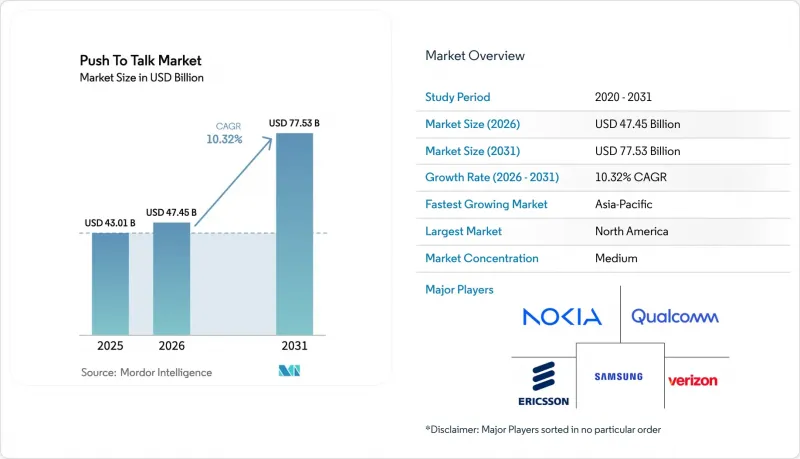
Mordor Intelligence에 따르면 PTT(Push To Talk)(PTT) 시장 규모는 2025년에 430억 1,000만 달러로 평가되며, 2026년 474억 5,000만 달러에서 2031년까지 775억 3,000만 달러에 달할 것으로 예측되고 있으며, 예측 기간(2026-2031년)에 CAGR은 10.32%에 달할 전망입니다.
이 보고서는 구성 요소(하드웨어, 소프트웨어, 서비스), 네트워크 유형(지상 이동 무선 및 셀룰러), 산업 분야(공공안전, 정부·국방, 상업) 및 지역별로 분류되어 있습니다.
글로벌 푸시-투-토크(PTT) 시장 동향 및 인사이트
기존 지상 이동 무선(LMR)에서 LTE/5G PoC 솔루션으로의 전환
아날로그 및 초기 디지털 LMR 시스템은 수명이 다해가고 있으며, 각 기관은 음성, 영상, 데이터를 단일 서비스로 처리하기 위해 광대역 ‘Push to Talk over Cellular(PoC)’로 전환하고 있습니다. 영국의 ‘Emergency Services Network’는 공공안전 기관이 임무에 필수적인 가용성 기준을 유지하면서 광대역 기능을 우선시하고 있음을 여실히 보여줍니다. 북미에서는 FirstNet을 통해 각 기관이 통신 범위를 저해하지 않으면서 P25 장비를 단계적으로 폐지할 수 있게 되었습니다. 공장이나 해상 플랫폼 내의 프라이빗 5G 네트워크는 기존에 LMR 도입을 어렵게 만들었던 가시거리 제약을 해소하고 있습니다. 이러한 사용 사례가 결합되어 푸시-투-토크 시장의 셀룰러 아키텍처로의 전환을 지속적으로 가속화하고 있습니다.
공공안전 분야의 미션 크리티컬 통신 수요 증가
경찰, 소방, 응급의료팀은 이미 음성 전용 통신 단계를 넘어섰습니다. 오늘날 현장 요원들은 바디캠 영상, 드론 영상, 센서 데이터를 지휘 센터로 원활하게 스트리밍할 수 있는 광대역 PTT 서비스를 기대하고 있습니다. 2025년에 실시된 NATO 야외 훈련에서는 여러 기관이 공동으로 활동하는 가운데 5G가 어떻게 안전한 통신을 유지할 수 있는지 입증되었으며, 상호 운용성이 높고 지연 시간이 짧은 서비스의 필요성이 부각되었습니다. 지자체 예산은 빠듯하지만, 연방 정부의 보조금을 통해 예측 분석 및 위치 정보 인식을 일상 업무에 도입하는 시스템 업그레이드가 촉진되고 있습니다. 이러한 요건으로 인해 공공안전은 앞으로도 푸시-투-토크(PTT) 시장에서 핵심적인 수직 시장으로 남을 것이 확실합니다.
분산된 주파수 대역 할당 및 규제상의 지연
각국의 우선순위가 상충하고 있으며, 미션 크리티컬 주파수의 조화로운 확보가 어려워지고 있습니다. 미국에서는 4.9 GHz 대역의 사이드링크 이용을 둘러싼 장기화된 논의로 인해 주 전체적인 도입이 지연되고 있습니다. 유럽에서는 380-470MHz TETRA 채널에 대한 의존이 700MHz 대역의 광대역 할당과의 통합에 있으며, 과제가 되고 있습니다. 인증 주기가 2년 이상 소요되는 경우도 있으며, 이로 인해 소규모 벤더들이 신규 시장 진입을 주저하게 되고, 푸시-투-토크(PTT) 시장의 수익화가 지연되고 있습니다.
부문 분석
2025년에도 하드웨어는 여전히 245억 달러의 매출을 창출하며, 푸시-투-토크 시장에서 가장 큰 단일 부문를 차지하고 있습니다. 석유화학 플랜트의 본질 안전형 무전기 및 건설 현장을 위한 견고한 스마트폰에 대한 꾸준한 수요로 인해 기기 매출은 안정적입니다. 그럼에도 불구하고 기기 관리, 사이버 보안, 연중무휴 네트워크 모니터링을 포괄하는 관리형 서비스 계약의 성장률은 판매 대수 증가율을 상회하고 있습니다. 서비스 제공업체들은 현재 예측 유지보수 및 분석 대시보드를 번들로 제공하고 있으며, 이로 인해 전환 비용이 증가하고 고객 수명 주기가 장기화되고 있습니다. 이러한 변화는 일회성 자본 구매보다 운영비를 선호하는 기업의 조달 팀 정책과 부합합니다.
연평균 12.18%의 성장률을 기록하고 있는 서비스 부문에는 규제 관련 자문, 보조금 신청 지원, 사용자 교육 구독 서비스 등이 점점 더 많이 포함되고 있습니다. 소프트웨어 벤더들은 AI 모듈을 사용자 수 기준으로 과금하며, 새로운 하드웨어 구매 없이도 맞춤 설정 가능한 사고 대응 기능을 제공하고 있습니다. 그 결과, PTT(Push to Talk) 서비스 시장 규모는 2031년까지 357억 달러를 넘어설 것으로 예상되며, 이는 수익 구성에서 물리적 장비에 대한 의존도가 크게 감소하고 있음을 나타냅니다. 특히 하이브리드 LMR·셀룰러 환경에서의 도입 복잡성은 전문 서비스 매출에 있으며, 향후 수년간 안정적인 성장의 기반을 보장하고 있습니다.
지역별 분석
2024년에는 FirstNet의 서비스 지역 확대, 연방 정부의 보조금 인센티브, 그리고 업그레이드가 필요한 P25 네트워크의 방대한 도입 기반에 힘입어 북미가 지역별 최대 매출을 기록했습니다. 캐나다의 공공안전 기관은 광대한 영토에 걸친 상호 운용성을 우선시하는 반면, 멕시코의 마키라도라 공장에서는 효율적인 업무 흐름을 지원하기 위한 통합된 통신 채널이 요구되고 있습니다.
유럽의 현대화 프로그램은 국경을 초월한 원활한 로밍에 중점을 두고 있습니다. 스칸디나비아의 시범 프로젝트에서는 고속철도 이동 중에도 푸시-투-토크(PTT) 세션을 유지하는 통신 사업자 간 MCPTT 핸드오버가 입증되었습니다. 700MHz 대역의 협대역 주파수에 대한 규제가 명확해짐에 따라 입찰 활동이 가속화되고 있지만, 공급망 제약으로 인해 장비 납품에 차질이 발생할 수도 있습니다.
11.12%라는 가장 높은 성장률을 자랑하는 아시아태평양은 중국, 일본, 인도에서의 대규모 5G 구축과 산업 자동화 추진의 혜택을 받고 있습니다. 현지 벤더들이 저가형 전용 단말기를 공급하고 있으며, 중소기업의 광대역 PTT 도입이 촉진되고 있습니다. 호주와 뉴질랜드는 광업 안전 애플리케이션에 중점을 둔 틈새 시장으로 남아 있지만, 엄격한 장비 기준 덕분에 고급 단말기 제조사들에게는 매력적인 수익률을 창출하고 있습니다.
중동 및 아프리카는 매출 절대치 면에서는 다른 지역에 뒤처지고 있지만, 에너지 및 스마트 시티의 공공안전과 같은 수직 시장에서 성장세를 보이고 있습니다. 걸프협력회의(GCC) 회원국들은 메가 프로젝트의 보안을 지원하기 위해 네트워크 슬라이싱에 투자하고 있는 반면, 남아프리카공화국에서는 심층 광산 운영을 모니터링하기 위해 광대역 PTT를 활용하고 있습니다. 통신 사각지대가 해소됨에 따라 ‘셀룰러 퍼스트(Cellular First)’ 도입을 통해 신규 진입 기업이 기존의 지상 이동 무선(LMR)을 완전히 우회할 수 있게 되어, 푸시-투-토크(PTT) 시장의 잠재 고객 기반이 확대될 가능성이 있습니다.
기타 혜택:
- 엑셀 형식의 시장 예측(ME) 시트
- 3개월간 애널리스트 지원
자주 묻는 질문
목차
제1장 서론
제2장 조사 방법
제3장 개요
제4장 시장 구도
제5장 시장 규모와 성장 예측
제6장 경쟁 구도
제7장 시장 기회와 향후 전망
KSA 26.08.26According to Mordor Intelligence, the push to talk market size was valued at USD 43.01 billion in 2025 and estimated to grow from USD 47.45 billion in 2026 to reach USD 77.53 billion by 2031, at a CAGR of 10.32% during the forecast period (2026-2031).
This report is Segmented by Component (Hardware, Software, and Services), Network Type (Land Mobile Radio and Cellular), Vertical (Public Safety, Government and Defense, and Commercial), and Geography.
Global Push To Talk Market Trends and Insights
Migration from Legacy LMR to LTE/5G PoC Solutions
Analog and early digital LMR systems are approaching end-of-life, and agencies are turning to broadband Push to Talk over Cellular (PoC) to address voice, video, and data in one service. The United Kingdom's Emergency Services Network provides a prominent illustration of how public safety organizations are prioritizing broadband capability while preserving mission-critical availability standards. In North America, FirstNet allows agencies to phase out P25 equipment gradually without jeopardizing coverage. Private 5G networks inside factories and offshore platforms remove the line-of-sight constraints that previously complicated LMR roll-outs. Together, these use cases continue to accelerate the Push to Talk market shift toward cellular architectures.
Growing Mission-Critical Communications Demand in Public Safety
Police, fire, and emergency medical teams have moved beyond voice-only communication. Today's frontline personnel expect broadband Push to Talk services that seamlessly stream body-worn camera feeds, drone footage, and sensor data back to command centers. NATO field exercises in 2025 validated how 5G can maintain secure communications across multiple agencies operating jointly, highlighting the need for interoperable, low-latency services. Despite tight municipal budgets, federal grants motivate system upgrades that bring predictive analytics and location awareness into routine operations. These requirements ensure that public safety will remain the anchor vertical within the Push to Talk market.
Fragmented Spectrum Allocation and Regulatory Delays
Conflicting national priorities complicate the hunt for harmonized mission-critical spectrum. In the United States, protracted debates around 4.9 GHz sidelink usage have slowed statewide deployments. Europe's reliance on 380-470 MHz TETRA channels poses integration challenges with 700 MHz broadband allocations. Certification cycles can stretch past two years, deterring smaller vendors from entering new territories and delaying revenue realization for the Push to Talk market.
Other drivers and restraints analyzed in the detailed report include:
- Proliferation of Rugged Smart Devices with Integrated PTT
- AI-Driven Dispatch Analytics and Situational Awareness
- Security Vulnerabilities in PoC over Public Networks
For complete list of drivers and restraints, kindly check the Table Of Contents.
Segment Analysis
Hardware still generated USD 24.5 billion in 2025, representing the largest single slice of the Push to Talk market. Strong demand for intrinsically safe radios in petrochemical sites and for rugged smartphones in construction has kept device revenues steady. Nevertheless, managed service contracts that wrap device management, cybersecurity, and 24/7 network monitoring are outpacing unit sales growth. Service providers now bundle predictive maintenance and analytics dashboards, which elevate switching costs and lengthen customer lifecycles. The evolution aligns with enterprise procurement teams that favor operational expenditure over lump-sum capital purchases.
The services category, growing at 12.18% annually, increasingly includes regulatory advisory, grant-writing assistance, and user-training subscriptions. Software vendors monetize artificial-intelligence modules on a per-seat basis, delivering customizable incident-command features without fresh hardware purchases. As a result, the Push to Talk market size for services is projected to exceed USD 35.7 billion by 2031, indicating a substantial shift in revenue mix away from physical equipment. Deployment complexity, particularly in hybrid LMR-cellular environments, guarantees a multi-year runway for professional services revenue.
Complete Report Scope:
- By Component (Value)
- Hardware
- PTT Radios
- Rugged / Ultra-rugged Smart Devices
- Gateways and Repeaters
- Audio Accessories
- Solutions
- PoC Software (MCPTT, PoC, iPTT)
- Dispatch and Command-Centre Consoles
- Application-Integration Middleware
- Services
- Professional Services
- Managed Services
- Training and Support
- Hardware
- By Network Type (Value)
- Land Mobile Radio (LMR)
- Analog LMR
- Digital LMR (DMR, TETRA, P25, dPMR, NXDN)
- Cellular
- 3G
- 4G / LTE
- 5G
- Land Mobile Radio (LMR)
- By Vertical (Value)
- Public Safety
- Police
- Fire and Rescue
- Emergency Medical Services
- Government and Defense
- Commercial
- Transportation and Logistics
- Manufacturing
- Construction
- Oil and Gas and Utilities
- Hospitality and Retail
- Public Safety
- By Geography (Value)
- North America
- United States
- Canada
- Mexico
- South America
- Brazil
- Argentina
- Rest of South America
- Europe
- Germany
- United Kingdom
- France
- Russia
- Rest of Europe
- Asia Pacific
- China
- Japan
- South Korea
- India
- Australia and New Zealand
- Rest of Asia Pacific
- Middle East and Africa
- Middle East
- Saudi Arabia
- United Arab Emirates
- Turkey
- Rest of Middle East
- Africa
- South Africa
- Nigeria
- Rest of Africa
- Middle East
- North America
Geography Analysis
North America generated the largest regional revenue in 2024, underpinned by extended FirstNet coverage, federal grant incentives, and a sizable installed base of P25 networks needing upgrades. Canada's public safety agencies prioritize interoperability across vast territories, while Mexico's maquiladora factories seek unified communication channels to support lean workflows.
Europe's modernization programs focus on seamless roaming across borders. Pilot projects in Scandinavia demonstrate cross-carrier MCPTT hand-offs that preserve push-to-talk sessions during high-speed rail travel. Regulatory clarity on 700 MHz narrowband spectrum has accelerated tender activity, though supply-chain constraints occasionally disrupt device deliveries.
Asia Pacific, the fastest-growing region at 11.12%, benefits from large-scale 5G roll-outs and industrial automation drives in China, Japan, and India. Local vendors supply purpose-built terminals at lower price points, encouraging small- and mid-size enterprises to adopt broadband Push to Talk. Australia and New Zealand remain niche markets that emphasize mining safety applications, yet their stringent equipment standards create attractive margins for premium device makers.
The Middle East and Africa trail on absolute revenue yet show momentum in verticals such as energy and smart city public safety. Gulf Cooperation Council members invest in network slicing to support megaproject security, while South Africa leans on broadband PTT to monitor deep-level mine operations. As coverage gaps close, cellular-first deployments may let new entrants bypass legacy LMR entirely, broadening the Push to Talk market addressable base.
- Motorola Solutions
- AT&T (FirstNet)
- Verizon Communications
- Hytera Communications
- Tait Communications
- Iridium Communications
- Telstra
- Qualcomm Technologies
- Zebra Technologies
- Samsung Electronics
- Airbus Defence and Space
- Cisco Systems
- Nokia
- Ericsson
- L3Harris Technologies
- Sonim Technologies
- Sepura
- ESChat
- RugGear
- Siyata Mobile
Additional Benefits:
- The market estimate (ME) sheet in Excel format
- 3 months of analyst support
TABLE OF CONTENTS
1 INTRODUCTION
- 1.1 Study Assumptions and Market Definition
- 1.2 Scope of the Study
2 RESEARCH METHODOLOGY
3 EXECUTIVE SUMMARY
4 MARKET LANDSCAPE
- 4.1 Market Overview
- 4.2 Market Drivers
- 4.2.1 Migration from legacy LMR to LTE/5G PoC solutions
- 4.2.2 Growing mission-critical communications demand in public safety
- 4.2.3 Proliferation of rugged smart devices with integrated PTT
- 4.2.4 AI-driven dispatch analytics and situational awareness
- 4.2.5 Carrier-integrated MCPTT standards (3GPP Release 18+)
- 4.2.6 Industrial private-5G campus networks enabling ultra-low-latency PTT
- 4.3 Market Restraints
- 4.3.1 Fragmented spectrum allocation and regulatory delays
- 4.3.2 Security vulnerabilities in PoC over public networks
- 4.3.3 Interoperability gaps between LMR and broadband PTT platforms
- 4.3.4 Budgetary capex constraints in public-sector agencies
- 4.4 Value /Chain Analysis
- 4.5 Regulatory Landscape
- 4.6 Technological Outlook
- 4.7 Porter's Five Forces Analysis
- 4.7.1 Threat of New Entrants
- 4.7.2 Bargaining Power of Buyers
- 4.7.3 Bargaining Power of Suppliers
- 4.7.4 Threat of Substitutes
- 4.7.5 Intensity of Competitive Rivalry
- 4.8 Assessment of Macro-Economic Shocks
5 MARKET SIZE AND GROWTH FORECASTS (VALUE)
- 5.1 By Component (Value)
- 5.1.1 Hardware
- 5.1.1.1 PTT Radios
- 5.1.1.2 Rugged / Ultra-rugged Smart Devices
- 5.1.1.3 Gateways and Repeaters
- 5.1.1.4 Audio Accessories
- 5.1.2 Solutions
- 5.1.2.1 PoC Software (MCPTT, PoC, iPTT)
- 5.1.2.2 Dispatch and Command-Centre Consoles
- 5.1.2.3 Application-Integration Middleware
- 5.1.3 Services
- 5.1.3.1 Professional Services
- 5.1.3.2 Managed Services
- 5.1.3.3 Training and Support
- 5.1.1 Hardware
- 5.2 By Network Type (Value)
- 5.2.1 Land Mobile Radio (LMR)
- 5.2.1.1 Analog LMR
- 5.2.1.2 Digital LMR (DMR, TETRA, P25, dPMR, NXDN)
- 5.2.2 Cellular
- 5.2.2.1 3G
- 5.2.2.2 4G / LTE
- 5.2.2.3 5G
- 5.2.1 Land Mobile Radio (LMR)
- 5.3 By Vertical (Value)
- 5.3.1 Public Safety
- 5.3.1.1 Police
- 5.3.1.2 Fire and Rescue
- 5.3.1.3 Emergency Medical Services
- 5.3.2 Government and Defense
- 5.3.3 Commercial
- 5.3.3.1 Transportation and Logistics
- 5.3.3.2 Manufacturing
- 5.3.3.3 Construction
- 5.3.3.4 Oil and Gas and Utilities
- 5.3.3.5 Hospitality and Retail
- 5.3.1 Public Safety
- 5.4 By Geography (Value)
- 5.4.1 North America
- 5.4.1.1 United States
- 5.4.1.2 Canada
- 5.4.1.3 Mexico
- 5.4.2 South America
- 5.4.2.1 Brazil
- 5.4.2.2 Argentina
- 5.4.2.3 Rest of South America
- 5.4.3 Europe
- 5.4.3.1 Germany
- 5.4.3.2 United Kingdom
- 5.4.3.3 France
- 5.4.3.4 Russia
- 5.4.3.5 Rest of Europe
- 5.4.4 Asia Pacific
- 5.4.4.1 China
- 5.4.4.2 Japan
- 5.4.4.3 South Korea
- 5.4.4.4 India
- 5.4.4.5 Australia and New Zealand
- 5.4.4.6 Rest of Asia Pacific
- 5.4.5 Middle East and Africa
- 5.4.5.1 Middle East
- 5.4.5.1.1 Saudi Arabia
- 5.4.5.1.2 United Arab Emirates
- 5.4.5.1.3 Turkey
- 5.4.5.1.4 Rest of Middle East
- 5.4.5.2 Africa
- 5.4.5.2.1 South Africa
- 5.4.5.2.2 Nigeria
- 5.4.5.2.3 Rest of Africa
- 5.4.5.1 Middle East
- 5.4.1 North America
6 COMPETITIVE LANDSCAPE
- 6.1 Market Concentration
- 6.2 Strategic Moves
- 6.3 Market Share Analysis
- 6.4 Company Profiles (includes Global level Overview, Market level overview, Core Segments, Financials as available, Strategic Information, Market Rank/Share, Products and Services, and Recent Developments)
- 6.4.1 Motorola Solutions
- 6.4.2 AT&T (FirstNet)
- 6.4.3 Verizon Communications
- 6.4.4 Hytera Communications
- 6.4.5 Tait Communications
- 6.4.6 Iridium Communications
- 6.4.7 Telstra
- 6.4.8 Qualcomm Technologies
- 6.4.9 Zebra Technologies
- 6.4.10 Samsung Electronics
- 6.4.11 Airbus Defence and Space
- 6.4.12 Cisco Systems
- 6.4.13 Nokia
- 6.4.14 Ericsson
- 6.4.15 L3Harris Technologies
- 6.4.16 Sonim Technologies
- 6.4.17 Sepura
- 6.4.18 ESChat
- 6.4.19 RugGear
- 6.4.20 Siyata Mobile
7 MARKET OPPORTUNITIES AND FUTURE OUTLOOK
- 7.1 White-space & Unmet-Need Assessment


