

|
시장보고서
상품코드
2116900
전략 컨설팅 서비스 : 시장 점유율 분석, 업계 동향과 통계, 성장 예측(2026-2031년)Strategic Consulting Services - Market Share Analysis, Industry Trends & Statistics, Growth Forecasts (2026 - 2031) |
||||||
 Mordor Intelligence
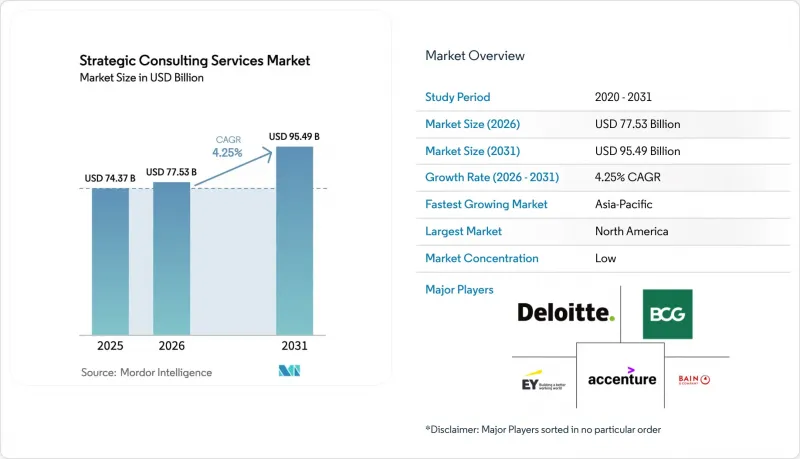
Mordor Intelligence에 따르면 전략 컨설팅 서비스 시장 규모는 2025년 743억 7,000만 달러에서 2026년에는 775억 3,000만 달러로 확대하며, 2026-2031년에 CAGR 4.25%로 추이하며, 2031년까지 954억 9,000만 달러에 달할 것으로 예측됩니다.
이 보고서는 서비스 유형(기업 전략, 비즈니스 모델 혁신 등), 조직 규모(대기업 등), 계약 모델(프로젝트 기반 자문, 리테인형 자문 등), 최종사용자 산업(금융 서비스, 생명과학·헬스케어 등) 및 지역별로 분류되어 있습니다. 시장 예측은 금액(달러) 기준으로 제시됩니다.
글로벌 전략 컨설팅 서비스 시장의 동향 및 인사이트
기업의 디지털 전환 투자
기업이 클라우드 전환, AI 도입 및 광범위한 운영 모델 재설계에 착수함에 따라 디지털 전환에 대한 투자가 자문 프로젝트 파이프라인을 지원하고 있습니다. IT 서비스 지출은 2024년에 1조 5,200억 달러에 달하여 9.7% 증가했습니다. 이에 따라 전략적 로드맵과 실행을 연결할 수 있는 컨설턴트에 대한 수요가 증가하고 있습니다. 컨설팅 기업은 현재 거버넌스 프레임워크와 직원 재교육 프로그램을 결합한 고부가가치 AI 전략 프로젝트를 통해 수익을 창출하고 있습니다. 이미 애널리틱스를 통해 가치를 창출하고 있는 ‘디지털 리더’ 기업은 2025년 변혁 예산을 증액할 가능성이 72% 더 높으며, 이를 통해 컨설팅 분야의 지속적인 수익이 확보될 것입니다. 그러나 생성형 AI 툴의 보급으로 기초 조사가 점점 더 자동화됨에 따라 각 기업은 젊은 인재를 정보 통합, 변경 관리 및 고객 지원 분야로 전환해야 할 필요에 직면해 있습니다. 이러한 상황은 각 기업이 독자적인 AI 플랫폼을 통해 비용 구조를 관리하면서 가치 창출 스토리를 강화하도록 요구하고 있습니다.
전 세계 M&A 거래의 증가와 통합의 복잡화
2024년 전 세계 거래 총액이 3조 5,000억 달러에 육박하며 전년 대비 15% 증가함에 따라 M&A 자문 시장의 기세가 강해지고, 실사 및 통합에 정통한 전략 컨설턴트에 대한 수요가 높아지고 있습니다. 국경 간 거래는 규제 당국의 감시 강화, 데이터 주권 관련 규정, 문화적 통합의 장벽에 직면해 있으며, 기업은 AI를 활용한 실사 툴을 도입해 문서 검토 주기를 30% 단축해야 하는 상황에 놓여 있습니다. 지정학적 불확실성으로 인해 독점금지법 승인 및 이해관계자와의 소통에 관한 전략 시나리오 의뢰가 증가하고 있습니다. 전문적인 규제의 대상이 되는 기술 및 헬스케어 분야의 거래는 해당 부문에 대한 깊은 전문 지식을 갖춘 기업의 자문 업무량을 더욱 끌어올리고 있습니다. 사모펀드의 미투자 자금이 여전히 남아 있는 만큼, 컨설턴트들은 2026년까지 커브아웃 및 플랫폼 롤업 거래가 꾸준히 이어질 것으로 전망하고 있습니다.
사내 전략 팀의 확대
대기업은 사내 전략 부서를 이끌기 위해 전직 컨설턴트를 채용하는 사례가 늘어나면서 외부 자문사에 대한 의존도가 낮아지고 있습니다. AI를 활용한 분석 플랫폼 덕분에 사내 팀에서도 기본적인 시장 조사 업무를 수행할 수 있게 되면서, 컨설팅 회사들은 고액의 보수를 정당화하기가 어려워지고 있습니다. 이에 대해 컨설턴트 측은 도입 프로세스의 엄격성, 변혁 리더십에 대한 전문 지식, 객관적인 관점을 강조하며 대응하고 있습니다. 사내 역량과 외부 전문성을 융합한 하이브리드형 계약 모델이 등장하고 있지만, 클라이언트가 업무 범위에 대해 신속하게 협상하고 지식 이전을 강력히 요구하게 되면서 이익률은 축소되는 추세입니다.
부문 분석
2025년 매출 기준, 기능별 전략 서비스가 전략 컨설팅 서비스 시장 점유율의 38.22%를 차지하며, 인사 재편, 공급망 최적화, 린(Lean) 운영 프로그램 등을 포괄하여 시장을 주도했습니다. 핵심 효율화 과제가 계속해서 이사회 우선순위로 남아 있으며, 수요는 지속되고 있습니다. 한편, 디지털 전략은 AI 통합 로드맵, 데이터 수익화 청사진, 그리고 비즈니스 목표와의 일관성을 도모한 클라우드 전환에 힘입어 연평균 성장률(CAGR) 4.67%로 가장 빠르게 성장하고 있는 틈새 분야입니다. M&A 및 기업 재무 자문 분야도 활발한 거래 주기의 혜택을 받고 있는 한편, 고객들이 지정학적 리스크 헤지를 추구하는 가운데 경제 정책 전략에 대한 수요도 확대되고 있습니다.
디지털 퍼스트 업무에서는 컨설턴트가 기술과 비즈니스에 대한 인사이트를 동시에 제공해야 하므로, 인력 구성은 데이터 과학자 및 제품 관리자로 전환되고 있습니다. 부티크형 전문 컨설팅 회사는 단일 분야의 과제에 집중함으로써 이러한 복잡성을 활용하고, 풀서비스를 제공하는 기존 대기업에 도전하고 있습니다. 시장 점유율을 지키기 위해 글로벌 기업은 다분야에 걸친 ‘원스톱’ 서비스를 패키지화하고, 조사 주기를 단축하며, 분석의 질을 높이는 독자적인 AI 툴에 투자하고 있습니다.
2025년에도 대기업은 매출에서 차지하는 비중이 62.32%로 압도적인 존재감을 유지하고 있으며, 글로벌 변혁, 규제 대응 프로그램, 포트폴리오 다각화를 위한 노력에 컨설턴트를 활용하고 있습니다. 한편, 클라우드 기반 자문 플랫폼에 대한 접근이 대중화되고 기존의 비용 장벽이 낮아짐에 따라 중소기업은 5.28%라는 가장 높은 연평균 성장률(CAGR)을 기록하고 있습니다. 중소기업 대상 전략 컨설팅 서비스 시장 규모는 디지털 문해력 향상에 따라 고객 기반이 확대되고 있음을 반영하여, 2031년까지 200억 달러를 넘어설 것으로 예측됩니다.
서비스 제공업체들은 현재 서비스 범위를 간소화하고 가격 책정을 투명하게 하기 위해 모듈식 플레이북과 템플릿화된 프로젝트 산출물을 중시하고 있습니다. 독립 컨설턴트들은 이 분야에서 활발히 활동하고 있으며, SaaS 벤더와 제휴하여 기술 및 자문 서비스를 구독형 패키지로 통합하는 경우가 많습니다. 이러한 변화로 인해 대기업은 향후 성장을 유지하기 위해 적절한 규모의 제공 모델을 갖춘 중견 기업 시장 전문 부서를 설립할 수밖에 없게 되었습니다.
지역별 분석
북미는 고객의 풍부한 자금력, 복잡한 규제 구조, 그리고 사상 최고 수준의 M&A 활동으로 인해 자문 프로젝트 파이프라인이 유지되고 있으며, 계속해서 주도적인 위치를 지키고 있습니다. 금융 서비스 기업은 DORA 지침에 기반한 사업 연속성 프로그램을 추진하는 한편, 대형 기술 기업은 AI 윤리에 관한 가이드라인을 요구하고 있습니다. 방위 분야의 계약 심사 강화는 부정적 요인으로 작용하고 있으며, 연방 정부의 심사로 인해 컨설팅 지출이 억제될 가능성이 있습니다.
아시아태평양은 정부 주도의 디지털화 계획, 중견 기업의 사업 확장, 그리고 인프라 메가 프로젝트에 힘입어 가장 빠르게 성장하는 시장입니다. 중국은 기술 주권 구상과 다각화 전략을 통해 수요를 견인하고 있는 반면, 인도에서는 디지털 결제 및 공공 부문의 현대화가 안정적인 자문 프로젝트 흐름을 창출하고 있습니다. 일본과 호주는 운영 우수성(Operational Excellence)과 첨단 제조업으로의 전환을 중시하는 성숙한 지출 패턴을 유지하고 있습니다.
유럽에서는 규제 준수에 관한 자문, 지속가능성 로드맵 수립, 국경을 초월한 통합 지원을 기반으로 견실한 비즈니스 기회가 예상됩니다. 독일의 산업 기반은 ‘인더스트리 4.0’ 관련 컨설팅을 지원하고 있으며, 영국은 금융 서비스의 깊이를 활용하고 있습니다. 또한 프랑스, 네덜란드, 북유럽 국가들에서는 디지털 운영의 현대화를 위한 안정적인 수요가 발생하고 있습니다. BCG가 2024년에 ‘지정학 센터’를 설립한 것은 거시적 리스크에 대한 자문을 계속해서 중시하고 있음을 보여줍니다.
기타 혜택:
- 엑셀 형식의 시장 예측(ME) 시트
- 3개월간의 애널리스트 지원
자주 묻는 질문
목차
제1장 서론
제2장 조사 방법
제3장 개요
제4장 시장 구도
제5장 시장 규모와 성장 예측
제6장 경쟁 구도
제7장 시장 기회와 향후 전망
KSA 26.08.26According to Mordor Intelligence, the strategic consulting services market size is expected to grow from USD 74.37 billion in 2025 to USD 77.53 billion in 2026 and is forecast to reach USD 95.49 billion by 2031 at 4.25% CAGR over 2026-2031.
This report is Segmented by Service Type (Corporate Strategy, Business-Model Transformation, and More), Organization Size (Large Enterprises, and More), Engagement Model (Project-Based Advisory, Retained Advisory, and More), End-User Industry (Financial Services, Life Sciences and Healthcare, and More), and Geography. The Market Forecasts are Provided in Terms of Value (USD).
Global Strategic Consulting Services Market Trends and Insights
Digital-Transformation Spend by Enterprises
Enterprise investment in digital overhauls sustains advisory pipelines as organizations grapple with cloud migration, AI adoption, and broad operating-model redesign. IT services outlays climbed to USD 1.52 trillion in 2024, a 9.7% rise that translated into higher demand for consultants capable of bridging strategic road-mapping with implementation. Consulting firms are now monetizing premium AI-strategy engagements, coupling governance frameworks with workforce-reskilling programs. Digital leaders, those already capturing value from analytics, are 72% likelier to lift 2025 transformation budgets, ensuring recurring advisory revenue. Yet generative-AI tooling increasingly automates baseline research, compelling firms to shift junior talent toward synthesis, change-management, and client enablement. The dynamic pressures firms to elevate value-creation narratives while controlling cost structures through proprietary AI platforms.
Rising Global M&A Pipeline and Integration Complexity
Deal advisory momentum strengthened as worldwide transaction value neared USD 3.5 trillion in 2024, expanding 15% year over year and intensifying demand for strategy consultants skilled in diligence and integration. Cross-border deals face heightening regulatory scrutiny, data-sovereignty rules, and cultural integration hurdles, pushing firms to deploy AI-enabled diligence tools that compress document-review cycles by 30%. Geopolitical uncertainty adds strategic-scenario requests on antitrust clearances and stakeholder communications. Technology and healthcare deals, governed by specialized regulations, further boost advisory workloads among firms holding deep sector expertise. As private-equity dry powder persists, consultants expect a steady pipeline of carve-out and platform-roll-up assignments through 2026.
Expansion of In-House Strategy Teams
Large corporations increasingly recruit ex-consultants to head internal strategy units, reducing reliance on external advisors. AI-augmented analytics platforms now equip internal teams to replicate baseline market-research tasks, challenging firms to justify premium fees. Consultants respond by emphasizing implementation rigor, change-leadership expertise, and objective viewpoint. Hybrid engagement models that blend in-house capabilities with external specialization are emerging, though margins tighten as clients negotiate scope faster and insist on knowledge transfer.
Other drivers and restraints analyzed in the detailed report include:
- Regulatory and Compliance Proliferation Across Regions
- SME Demand for External Strategic Expertise
- Talent Drain to the Independent Consultant Economy
For complete list of drivers and restraints, kindly check the Table Of Contents.
Segment Analysis
Functional strategy services dominated 2025 revenue with 38.22% strategic consulting services market share, encompassing HR restructuring, supply-chain optimization, and lean-operations programs. Demand persists as core efficiency agendas remain board priorities. Digital strategy, however, is the fastest-expanding niche at a 4.67% CAGR, fueled by AI-integration roadmaps, data-monetization blueprints, and cloud-migration synchronization with business objectives. M&A and corporate-finance advisory also ride the elevated deal cycle, while economic-policy strategy grows as clients seek geopolitical risk hedging.
Digital-first work requires consultants to deliver technology and business acumen concurrently, changing talent mixes toward data scientists and product managers. Boutique specialists exploit the complexity by targeting single-domain pain points, challenging full-service incumbents. To protect share, global firms package multi-disciplinary "one-stop" offerings and invest in proprietary AI tools that compress research cycles and elevate synthesis quality.
Large enterprises retained a commanding 62.32% revenue contribution in 2025, leveraging consultants for global transformation, regulatory programs, and portfolio-diversification moves. Yet small enterprises are generating the strongest 5.28% CAGR as democratized access to cloud-based advisory platforms compresses traditional cost barriers. The strategic consulting services market size for SME engagements is projected to eclipse USD 20 billion by 2031, reflecting a broadening client base as digital literacy improves.
Providers now emphasize modular playbooks and templated project artifacts to keep scope lean and pricing transparent. Independent consultants thrive in this space, often partnering with SaaS vendors to blend technology and advisory into subscription bundles. The shift forces large firms to establish dedicated mid-market units with right-sized delivery models to preserve future growth.
Complete Report Scope:
- By Service Type
- Corporate Strategy
- Business-Model Transformation
- MandA and Corporate Finance Strategy
- Digital Strategy and Innovation
- Functional Strategy (HR, SCM, etc.)
- Economic and Policy Advisory
- By Organization Size
- Large Enterprises
- Medium Enterprises
- Small Enterprises
- By Engagement Model
- Project-based Advisory
- Retained Advisory
- Managed / Implementation Services
- Outcome-based / Success-fee Consulting
- Digital / Platform-enabled Consulting
- By End-user Industry
- Financial Services
- Life Sciences and Healthcare
- Technology, Media and Telecom
- Energy and Resources
- Government and Public Sector
- Consumer and Retail
- Industrial and Manufacturing
- Other End-user Industries
- By Geography
- North America
- United States
- Canada
- South America
- Brazil
- Argentina
- Europe
- United Kingdom
- France
- Germany
- Netherlands
- Italy
- Rest of Europe
- Asia Pacific
- China
- India
- Japan
- Australia
- Rest of Asia Pacific
- Middle East and Africa
- Middle East
- Saudi Arabia
- United Arab Emirates
- Rest of Middle East and Africa
- Africa
- South Africa
- Nigeria
- Rest of Africa
- Middle East
- North America
Geography Analysis
North America retains leadership owing to deep client pockets, complex regulatory architectures, and record M&A activity that collectively sustain advisory pipelines. Financial-services firms pursue operational-resilience programs under DORA guidelines, while technology giants demand AI-ethics playbooks. Defense-sector contract scrutiny poses a downside threat, with federal reviews potentially curbing consulting spend.
Asia Pacific is the fastest-growing market, buoyed by government digitalization schemes, mid-market enterprise expansion, and infrastructure megaprojects. China drives demand through tech-sovereignty initiatives and diversification strategies, whereas India's digital-payments and public-sector modernization create steady advisory flows. Japan and Australia sustain mature spend profiles emphasizing operational excellence and advanced-manufacturing transformation.
Europe offers resilient opportunity anchored in regulatory-compliance advisory, sustainability road-mapping, and cross-border integration support. Germany's industrial base underpins Industry 4.0 consulting, the U.K. leverages financial-services depth, and France, Netherlands, and the Nordics add steady demand for digital-operations modernization. BCG's 2024 launch of a dedicated Center for Geopolitics signals continued emphasis on macro-risk counsel
- McKinsey and Company, Inc.
- Boston Consulting Group, Inc.
- Bain & Company, Inc.
- Deloitte Consulting LLP
- Accenture plc
- Kearney, Inc.
- Ernst and Young Global Limited (EY-Parthenon)
- PricewaterhouseCoopers Advisory Services LLC (Strategyand)
- KPMG International Limited
- Booz Allen Hamilton Holding Corporation
- IBM Consulting (International Business Machines Corporation)
- Capgemini SE
- Roland Berger Holding GmbH
- Oliver Wyman Inc.
- L.E.K. Consulting LLC
- Arthur D. Little S.A.
- Alvarez and Marsal Holdings, LLC
- Infosys Consulting Ltd.
- Cognizant Technology Solutions Corporation
- CGI Inc.
- Tata Consultancy Services Limited (TCS Consulting)
Additional Benefits:
- The market estimate (ME) sheet in Excel format
- 3 months of analyst support
TABLE OF CONTENTS
1 INTRODUCTION
- 1.1 Study Assumptions and Market Definition
- 1.2 Scope of the Study
2 RESEARCH METHODOLOGY
3 EXECUTIVE SUMMARY
4 MARKET LANDSCAPE
- 4.1 Market Overview
- 4.2 Market Drivers
- 4.2.1 Digital-transformation spend by enterprises
- 4.2.2 Rising global MandA pipeline and integration complexity
- 4.2.3 Regulatory and compliance proliferation across regions
- 4.2.4 SME demand for external strategic expertise
- 4.2.5 Generative-AI governance and strategy mandates
- 4.2.6 Geopolitical fragmentation driving near-shoring strategies
- 4.3 Market Restraints
- 4.3.1 Expansion of in-house strategy teams
- 4.3.2 Talent drain to the independent consultant economy
- 4.3.3 Procurement-led fee pressure and outcome pricing
- 4.3.4 DIY-strategy analytics enabled by Gen-AI tools
- 4.4 Regulatory Landscape
- 4.5 Technological Outlook
- 4.6 Porter's Five Forces Analysis
- 4.6.1 Bargaining Power of Suppliers
- 4.6.2 Bargaining Power of Buyers
- 4.6.3 Threat of New Entrants
- 4.6.4 Threat of Substitutes
- 4.6.5 Intensity of Competitive Rivalry
- 4.7 Impact of Macroeconomic Factors on the Market
- 4.8 Investment Analysis
5 MARKET SIZE AND GROWTH FORECASTS (VALUE)
- 5.1 By Service Type
- 5.1.1 Corporate Strategy
- 5.1.2 Business-Model Transformation
- 5.1.3 MandA and Corporate Finance Strategy
- 5.1.4 Digital Strategy and Innovation
- 5.1.5 Functional Strategy (HR, SCM, etc.)
- 5.1.6 Economic and Policy Advisory
- 5.2 By Organization Size
- 5.2.1 Large Enterprises
- 5.2.2 Medium Enterprises
- 5.2.3 Small Enterprises
- 5.3 By Engagement Model
- 5.3.1 Project-based Advisory
- 5.3.2 Retained Advisory
- 5.3.3 Managed / Implementation Services
- 5.3.4 Outcome-based / Success-fee Consulting
- 5.3.5 Digital / Platform-enabled Consulting
- 5.4 By End-user Industry
- 5.4.1 Financial Services
- 5.4.2 Life Sciences and Healthcare
- 5.4.3 Technology, Media and Telecom
- 5.4.4 Energy and Resources
- 5.4.5 Government and Public Sector
- 5.4.6 Consumer and Retail
- 5.4.7 Industrial and Manufacturing
- 5.4.8 Other End-user Industries
- 5.5 By Geography
- 5.5.1 North America
- 5.5.1.1 United States
- 5.5.1.2 Canada
- 5.5.2 South America
- 5.5.2.1 Brazil
- 5.5.2.2 Argentina
- 5.5.3 Europe
- 5.5.3.1 United Kingdom
- 5.5.3.2 France
- 5.5.3.3 Germany
- 5.5.3.4 Netherlands
- 5.5.3.5 Italy
- 5.5.3.6 Rest of Europe
- 5.5.4 Asia Pacific
- 5.5.4.1 China
- 5.5.4.2 India
- 5.5.4.3 Japan
- 5.5.4.4 Australia
- 5.5.4.5 Rest of Asia Pacific
- 5.5.5 Middle East and Africa
- 5.5.5.1 Middle East
- 5.5.5.1.1 Saudi Arabia
- 5.5.5.1.2 United Arab Emirates
- 5.5.5.1.3 Rest of Middle East and Africa
- 5.5.5.2 Africa
- 5.5.5.2.1 South Africa
- 5.5.5.2.2 Nigeria
- 5.5.5.2.3 Rest of Africa
- 5.5.5.1 Middle East
- 5.5.1 North America
6 COMPETITIVE LANDSCAPE
- 6.1 Market Concentration
- 6.2 Strategic Moves
- 6.3 Market Share Analysis
- 6.4 Company Profiles (includes Global level Overview, Market level overview, Core Segments, Financials as available, Strategic Information, Market Rank/Share for key companies, Products and Services, and Recent Developments)
- 6.4.1 McKinsey and Company, Inc.
- 6.4.2 Boston Consulting Group, Inc.
- 6.4.3 Bain & Company, Inc.
- 6.4.4 Deloitte Consulting LLP
- 6.4.5 Accenture plc
- 6.4.6 Kearney, Inc.
- 6.4.7 Ernst and Young Global Limited (EY-Parthenon)
- 6.4.8 PricewaterhouseCoopers Advisory Services LLC (Strategyand)
- 6.4.9 KPMG International Limited
- 6.4.10 Booz Allen Hamilton Holding Corporation
- 6.4.11 IBM Consulting (International Business Machines Corporation)
- 6.4.12 Capgemini SE
- 6.4.13 Roland Berger Holding GmbH
- 6.4.14 Oliver Wyman Inc.
- 6.4.15 L.E.K. Consulting LLC
- 6.4.16 Arthur D. Little S.A.
- 6.4.17 Alvarez and Marsal Holdings, LLC
- 6.4.18 Infosys Consulting Ltd.
- 6.4.19 Cognizant Technology Solutions Corporation
- 6.4.20 CGI Inc.
- 6.4.21 Tata Consultancy Services Limited (TCS Consulting)
7 MARKET OPPORTUNITIES AND FUTURE OUTLOOK
- 7.1 White-space and Unmet-need Assessment


