

|
시장보고서
상품코드
2116901
후두경 시장 : 점유율 분석, 업계 동향과 통계, 성장 예측(2026-2031년)Laryngoscope - Market Share Analysis, Industry Trends & Statistics, Growth Forecasts (2026 - 2031) |
||||||
 Mordor Intelligence
Mordor Intelligence에 의하면, 2026년 세계의 후두경 시장 규모는 6억 3,966만 달러로 추정되고 있어 2025년 5억 9,552만 달러에서 확대해, 2031년에는 9억 1,448만 달러에 이를 것으로 예측됩니다.
2026년부터 2031년까지 연평균 성장률(CAGR) 7.41%로 성장할 것으로 전망됩니다.
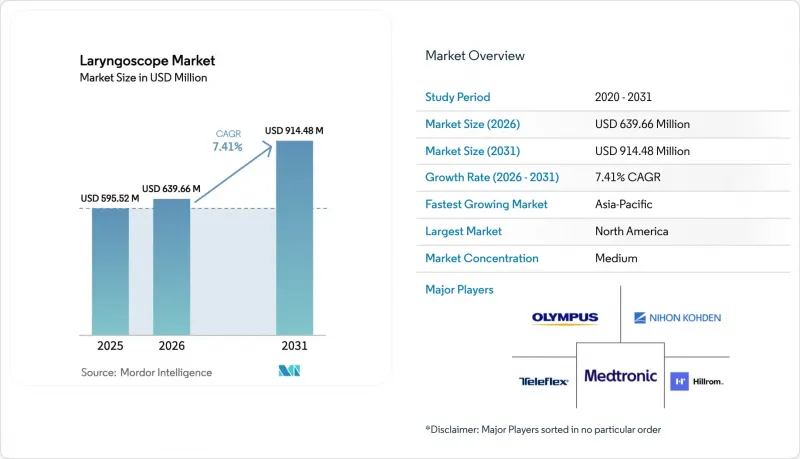
본 보고서는 제품 유형(직접 후두경, 비디오 CMOS 후두경 등), 구성 부품(블레이드, 핸들 등), 사용 방식(일회용, 재사용 가능), 연령대(신생아·소아, 성인, 고령자), 최종 사용자(병원, 진료소 등), 지역(북미, 유럽, 아시아태평양 등)별로 분류되어 있습니다. 시장 예측은 금액(달러) 기준으로 제시되어 있습니다.
전 세계 후두경 시장 동향 및 인사이트력
후두 질환 및 기도 관리 시술의 유병률 증가
2024년 조사 대상인 10만 4,720명의 환자 중 전신 마취 후 쉰 목소리를 호소하는 비율은 11.77%에 달하여, 후두경 검사에 기반한 경과 관찰이 얼마나 보편화되었는지를 여실히 보여주고 있습니다. 진단용 후두경 검사 1건당 직접적인 시술 비용은 평균 842달러이며, 진찰 및 치료에 드는 부수적 비용이 전체 부담을 더욱 가중시키고 있습니다. 고령층은 연하 장애나 악성 종양의 위험이 높기 때문에 임상의들은 조기 영상 진단 전략을 마련해야 하는 압박을 받고 있습니다. AI와 결합된 고속 비디오 내시경 검사는 현재 93%의 정확도로 기질성 병변을 감지할 수 있어 진단 프로토콜을 혁신하고 있습니다. 이러한 임상적 실태로 인해 입원·외래를 불문하고 재사용형 및 일회용 플랫폼에 대한 장기적인 수요가 유지되고 있습니다.
비디오 및 광섬유 시스템의 기술적 진보
비디오 후두경 검사는 신생아 사례에서 첫 시도 성공률이 74%에 달하는 반면, 직접법은 45%에 그쳐 뚜렷한 성능상의 우위를 보이고 있습니다. 개선된 CMOS 센서를 통해 더욱 선명한 영상과 낮은 노이즈를 구현하며, 퀵 커넥트 방식의 배터리 핸들로 설정 시간이 단축됩니다. 슬림한 형태의 유연한 광섬유 내시경은 이비인후과 및 외상 사례에서 불규칙한 해부학적 구조 내부를 원활하게 이동할 수 있습니다. 듀얼 뷰 설계 덕분에 시술자는 기존의 시야를 유지하면서 기록 및 교육용 고해상도 동영상을 촬영할 수 있습니다. 실시간 AI 오버레이 기능을 통해 후두개, 성대, 기관륜에 마킹을 표시할 수 있어 경험이 부족한 의료진을 지원하고 합병증 발생을 줄여줍니다.
의료기기와 관련된 기도 손상 및 수술 후 합병증
치과 외상, 식도 천공, 후두 부종은 여전히 의료 과실 위험의 원인이 되고 있습니다. 배터리 폭발 위험을 이유로 FDA가 McGrath MAC 비디오 후두경에 대해 클래스 I 리콜을 발령한 것은 안전 문제가 조달 패턴에 어떤 혼란을 초래할 수 있는지를 여실히 보여주고 있습니다. 소아 삽관의 경우, 기도가 좁고 사용 가능한 블레이드 크기가 제한적이기 때문에 더 큰 위험이 따르며, 보다 엄격한 자격 인증과 시뮬레이션 훈련이 요구됩니다. 비디오 플랫폼은 성문의 가시성을 높여 많은 위험을 줄여주지만, 장비 고장이나 오용은 여전히 소송이나 보험료 인상의 원인이 되고 있습니다. 따라서 병원의 리스크 관리 부서는 설비 투자 신청을 승인할 때 안전 데이터를 매우 중요하게 여깁니다.
부문 분석
비디오 CMOS 시스템은 타의 추종을 불허하는 시각화 성능과 디지털 통합을 통해 2025년 후두경 시장 점유율의 47.25%를 차지했습니다. 직접법에 비해 첫 삽관 성공률이 30퍼센트 포인트 가까이 향상됨에 따라 외상 치료실 및 신생아 집중 치료실(NICU)에서의 도입이 확대되고 있습니다. 직접법에 따른 맥킨토시법 및 밀러법은 사용에 익숙하고 비용이 저렴하다는 이유로 자원이 제한된 환경에서는 여전히 사용되고 있습니다. 광섬유 내시경은 유연성이 필수적인 이비인후과나 기도 확보가 어려울 것으로 예상되는 증례에 대응하고 있습니다.
의료 기관들이 비디오 삽관을 가이드라인에 명시함에 따라, 비디오 플랫폼 시장은 2031년까지 연평균 8.02%의 성장률을 보일 것으로 예측됩니다. 도입이 확산됨에 따라 실시간 AI 오버레이 및 클라우드 기반 영상 아카이브가 표준화될 전망입니다. 임상의들은 품질 개선 및 의료법적 기록을 위해 시술을 녹화할 수 있는 기능을 중요하게 여기고 있습니다. 한편, 강성 광학 시스템과 내장형 증강현실(AR)의 시각적 힌트를 융합한 연구용 프로토타입은 차기 성능 도약을 예고하고 있습니다.
2025년 시점에서 블레이드는 후두경 시장 규모의 43.85%를 차지하고 있으며, 이는 블레이드의 핵심적인 역할과 빈번한 교체 주기를 반영합니다. 금속 및 폴리머 재질의 블레이드 디자인에는 현재 고휘도 LED 조명과 김서림 방지 코팅이 채택되어 있습니다. 성인 외과 수술에서는 Mac 블레이드가 주류를 이루는 반면, 신생아의 기도 관리에는 미러형이 선호됩니다.
소모품 및 부속품은 일회용 제품의 채택과 모듈식 클립온 센서의 확산에 힘입어 연평균 성장률(CAGR) 8.44%로 성장을 지속하고, 있습니다. 각 제조업체는 독자적인 블레이드 카트리지와 일회용 라이트파이프를 통해 지속적인 수익 확보를 도모하고 있습니다. 수술실 수익에 비해 단가가 낮고, 감염 관리상의 이점을 정량화할 수 있기 때문에 병원 측은 이러한 지출을 쉽게 승인하고 있습니다.
지역별 분석
2025년, 북미는 전 세계 매출의 39.10%를 차지했습니다. 응급의료기관(EMS)은 고급 생명 유지술(ALS) 차량에 비디오 후두경 검사 키트 탑재를 의무화하고 있으며, 병원에서는 해당 영상을 전자 건강 기록에 통합하고 있습니다. 공급망 및 멸균의 회복탄력성에 관한 FDA의 권고가 구매 결정에 영향을 미치고 있습니다. 캐나다도 유사한 추세를 보이고 있으나, 멕시코에서는 공립 병원의 현대화로 인해 중가대 제품의 도입이 진행되고 있습니다.
아시아태평양은 연평균 성장률(CAGR) 9.25%로 가장 높은 성장률을 보이고 있습니다. 중국은 의료기기의 광범위한 교체에 자금을 투입하고 있으며, 2025년까지 중국의 의료기기 시장 규모는 2,100억 달러에 달할 전망입니다. 일본의 초고령화 사회는 1인당 삽관율 상승을 촉진하고 있습니다. 인도 및 동남아시아에서는 2차 의료 네트워크와 의료 관광에 투자가 이루어지고 있으며, 비용 대비 효과가 뛰어나면서도 고도의 기능을 갖춘 비디오 블레이드가 우선적으로 도입되고 있습니다. 이러한 시장에서는 재사용 가능한 핸들과 일회용 블레이드 세트가 호평을 얻고 있습니다.
유럽에서는 엄격한 폐기물 감축 및 감염 예방 지침에 따라 꾸준한 성장이 예상됩니다. 순환 경제 관련 규제로 인해 바이오 제품의 도입이 가속화되고 있습니다. 독일과 프랑스에서는 구급차에 소형 비디오스코프를 장착하고 있는 반면, 영국에서는 국민보건서비스(NHS) 자금을 AI 지원 플랫폼에 투자하고 있습니다. 신흥 중동부 유럽 회원국에서는 EU의 결속 기금을 활용하여 이비인후과용 장비와 마취 카트를 교체하고 있습니다.
기타 혜택:
- 엑셀 형식 시장 예측(ME) 시트
- 3개월간의 애널리스트 지원
자주 묻는 질문
목차
제1장 서론
제2장 조사 방법
제3장 주요 요약
제4장 시장 구도
제5장 시장 규모와 성장 예측
제6장 경쟁 구도
제7장 시장 기회와 향후 전망
JHS 26.09.03According to Mordor Intelligence, global laryngoscope market size in 2026 is estimated at USD 639.66 million, growing from 2025 value of USD 595.52 million with 2031 projections showing USD 914.48 million, growing at 7.41% CAGR over 2026-2031.
This report is Segmented by Product Type (Direct Laryngoscopes, Video-CMOS Laryngoscopes, and More), by Component (Blades, Handles, and More), by Usability (Disposable, Reusable), by Age Group (Neonatal & Pediatric, Adult, Geriatric), by End User (Hospitals, Clinics, and More), and by Geography (North America, Europe, Asia-Pacific, and More). The Market Forecasts are Provided in Terms of Value (USD).
Global Laryngoscope Market Trends and Insights
Rising Prevalence of Laryngeal Disorders & Airway-Management Procedures
Hoarseness after general anesthesia affected 11.77% of 104,720 patients reviewed in 2024, underscoring how common laryngoscopy-based follow-up has become. Direct procedural costs average USD 842 per diagnostic laryngoscopy, and ancillary expenses for consultations and therapy multiply the overall burden. Geriatric populations face higher dysphagia and malignancy risks, pushing clinicians toward early visualization strategies. High-speed videoendoscopy combined with AI now detects organic lesions with 93% accuracy, reshaping diagnostic protocols. These clinical realities sustain long-run demand for both reusable and single-use platforms across inpatient and outpatient settings.
Technological Advances in Video & Fiber-Optic Systems
Video laryngoscopy delivers 74% first-pass success in neonatal cases versus 45% for direct techniques, demonstrating clear performance advantages. Upgraded CMOS sensors bring brighter imaging and lower noise, while quick-connect battery handles cut setup times. Flexible fiber-optic scopes with slim profiles navigate irregular anatomies in ENT and trauma scenarios. Dual-view designs let operators keep traditional sight lines while capturing high-resolution video for documentation and teaching. Real-time AI overlays can mark epiglottis, vocal cords, and tracheal rings, supporting less-experienced practitioners and reducing complications.
Device-Related Airway Injuries & Postoperative Complications
Dental trauma, esophageal perforation, and laryngeal swelling continue to generate malpractice exposure. The FDA's Class I recall of McGrath MAC video laryngoscopes because of battery explosion risk underscores how safety events can disrupt procurement patterns. Pediatric intubations carry additional hazards due to narrow airways and limited blade size availability, prompting stricter credentialing and simulation training. Video platforms do mitigate many risks by enhancing glottic visualization, yet equipment failures or misuse still drive litigation and insurance premiums. Hospital risk-management departments therefore weigh safety data heavily when approving capital requests.
Other drivers and restraints analyzed in the detailed report include:
- Shift Toward Single-Use Devices for Infection Control Post-COVID-19
- AI-Enabled Real-Time Intubation Guidance Systems
- High Capital & Maintenance Cost of Advanced Systems
For complete list of drivers and restraints, kindly check the Table Of Contents.
Segment Analysis
Video-CMOS systems held 47.25% of the laryngoscope market share in 2025 thanks to unparalleled visualization and digital integration. First-pass success gains of nearly 30 percentage points over direct techniques win adoption in trauma bays and neonatal ICUs. Direct Macintosh and Miller designs persist in resource-constrained settings for their familiarity and low cost. Fiber-optic scopes address ENT and anticipated difficult airways where flexibility is indispensable.
Video platforms are forecast to grow 8.02% annually to 2031 as health systems codify video intubation into guidelines. As adoption deepens, real-time AI overlays and cloud-based video archiving become standard. Clinicians value the ability to record procedures for quality improvement and medico-legal documentation. Meanwhile, research prototypes that blend rigid optics with embedded augmented-reality cues hint at the next performance leap.
Blades accounted for 43.85% of the laryngoscope market size in 2025, reflecting their central role and frequent turnover. Metal and polymer edge designs now feature higher-intensity LED lighting and anti-fog coatings. Mac blades dominate adult surgery, while Miller variants are preferred for neonatal airways.
Consumables and accessories show an 8.44% CAGR, propelled by single-use adoption and modular clip-on sensors. Manufacturers pursue recurring revenue through proprietary blade cartridges and disposable light pipes. Hospitals readily approve these expenditures because unit cost is low relative to OR revenue and infection-control benefits are quantifiable.
Complete Report Scope:
- By Product Type
- Direct (Macintosh / Miller) Laryngoscopes
- Fibre-optic Laryngoscopes
- Video-CMOS Laryngoscopes
- Rigid Indirect & Others
- By Component
- Blades
- Mac Blades
- Miller Blades
- Handles
- Consumables & Accessories
- Blades
- By Usability
- Disposable
- Reusable
- By Age Group
- Neonatal & Pediatric
- Adult
- Geriatric
- By End User
- Hospitals
- Clinics
- Ambulatory Surgical Centres (ASCs)
- Others
- By Geography
- North America
- United States
- Canada
- Mexico
- Europe
- Germany
- United Kingdom
- France
- Italy
- Spain
- Rest of Europe
- Asia-Pacific
- China
- Japan
- India
- Australia
- South Korea
- Rest of Asia-Pacific
- Middle East and Africa
- GCC
- South Africa
- Rest of Middle East and Africa
- South America
- Brazil
- Argentina
- Rest of South America
- North America
Geography Analysis
North America held 39.10% of global revenue in 2025. EMS agencies mandate video-laryngoscopy kits on advanced life-support rigs, and hospitals integrate footage into electronic health records. FDA advisories on supply-chain and sterilization resilience shape purchasing decisions.Canada follows similar patterns, while Mexico's public-hospital modernization drives mid-tier adoption.
Asia-Pacific posts the highest growth at 9.25% CAGR. China funds broad device upgrades, pushing its medical-device market toward USD 210 billion by 2025. Japan's super-aging society spurs higher per-capita intubation rates. India and Southeast Asia invest in secondary-care networks and medical tourism, prioritizing cost-efficient yet advanced video blades. Reusable-handle plus disposable-blade bundles resonate in these markets.
Europe grows steadily under stringent waste-reduction and infection-prevention directives. Circular-economy regulations accelerate bio-based product rollouts. Germany and France equip ambulance fleets with compact video scopes, while the United Kingdom channels National Health Service funds toward AI-ready platforms. Emerging Central and Eastern European members tap EU cohesion funds to update ENT suites and anesthesia carts.
- Medtronic
- Ambu
- Karl Storz
- Verathon
- Teleflex
- Olympus
- Baxter (Hill-Rom Co., Inc.)
- Nihon Kohden
- Penlon Ltd (BPL Medical Technologies)
- Flexicare Medical
- Smiths Group
- Venner Medical International
- UE Medical Devices, Inc.
- Timesco Healthcare Ltd.
- Vivid Medical, Inc.
- Intersurgical Ltd.
- Clarus Medical
Additional Benefits:
- The market estimate (ME) sheet in Excel format
- 3 months of analyst support
TABLE OF CONTENTS
1 Introduction
- 1.1 Study Assumptions & Market Definition
- 1.2 Scope of the Study
2 Research Methodology
3 Executive Summary
4 Market Landscape
- 4.1 Market Overview
- 4.2 Market Drivers
- 4.2.1 Rising Prevalence of Laryngeal Disorders & Airway-management Procedures
- 4.2.2 Technological Advances in Video & Fibre-optic Systems
- 4.2.3 Shift Toward Single-use Devices for Infection Control Post-COVID-19
- 4.2.4 AI-enabled Real-time Intubation Guidance Systems\
- 4.2.5 Mandatory Video-laryngoscopy Protocols in Pre-hospital & Military care
- 4.2.6 Expansion of Ambulatory Surgical Centers and Outpatient Procedures
- 4.3 Market Restraints
- 4.3.1 Device-related Airway Injuries & Postoperative Complications
- 4.3.2 High Capital & Maintenance Cost of Advanced Systems
- 4.3.3 Environmental Scrutiny on Disposable Device Waste (ESG Pressure)
- 4.3.4 Supply-chain Disruptions for CMOS Image Sensors
- 4.4 Value / Supply-Chain Analysis
- 4.5 Regulatory Landscape
- 4.6 Technological Outlook
- 4.7 Porter's Five Forces Analysis
- 4.7.1 Threat of New Entrants
- 4.7.2 Bargaining Power of Buyers/Consumers
- 4.7.3 Bargaining Power of Suppliers
- 4.7.4 Threat of Substitute Products
- 4.7.5 Intensity of Competitive Rivalry
5 Market Size & Growth Forecasts (Value)
- 5.1 By Product Type
- 5.1.1 Direct (Macintosh / Miller) Laryngoscopes
- 5.1.2 Fibre-optic Laryngoscopes
- 5.1.3 Video-CMOS Laryngoscopes
- 5.1.4 Rigid Indirect & Others
- 5.2 By Component
- 5.2.1 Blades
- 5.2.1.1 Mac Blades
- 5.2.1.2 Miller Blades
- 5.2.2 Handles
- 5.2.3 Consumables & Accessories
- 5.2.1 Blades
- 5.3 By Usability
- 5.3.1 Disposable
- 5.3.2 Reusable
- 5.4 By Age Group
- 5.4.1 Neonatal & Pediatric
- 5.4.2 Adult
- 5.4.3 Geriatric
- 5.5 By End User
- 5.5.1 Hospitals
- 5.5.2 Clinics
- 5.5.3 Ambulatory Surgical Centres (ASCs)
- 5.5.4 Others
- 5.6 By Geography
- 5.6.1 North America
- 5.6.1.1 United States
- 5.6.1.2 Canada
- 5.6.1.3 Mexico
- 5.6.2 Europe
- 5.6.2.1 Germany
- 5.6.2.2 United Kingdom
- 5.6.2.3 France
- 5.6.2.4 Italy
- 5.6.2.5 Spain
- 5.6.2.6 Rest of Europe
- 5.6.3 Asia-Pacific
- 5.6.3.1 China
- 5.6.3.2 Japan
- 5.6.3.3 India
- 5.6.3.4 Australia
- 5.6.3.5 South Korea
- 5.6.3.6 Rest of Asia-Pacific
- 5.6.4 Middle East and Africa
- 5.6.4.1 GCC
- 5.6.4.2 South Africa
- 5.6.4.3 Rest of Middle East and Africa
- 5.6.5 South America
- 5.6.5.1 Brazil
- 5.6.5.2 Argentina
- 5.6.5.3 Rest of South America
- 5.6.1 North America
6 Competitive Landscape
- 6.1 Market Concentration
- 6.2 Market Share Analysis
- 6.3 Company Profiles (includes Global level Overview, Market level overview, Core Segments, Financials as available, Strategic Information, Market Rank/Share for key companies, Products & Services, and Recent Developments)
- 6.3.1 Medtronic plc
- 6.3.2 Ambu A/S
- 6.3.3 KARL STORZ GmbH & Co. KG
- 6.3.4 Verathon Inc.
- 6.3.5 Teleflex Incorporated
- 6.3.6 Olympus Corporation
- 6.3.7 Baxter (Hill-Rom Co., Inc.)
- 6.3.8 Nihon Kohden Corporation
- 6.3.9 Penlon Ltd (BPL Medical Technologies)
- 6.3.10 Flexicare Medical Limited
- 6.3.11 Smiths Medical
- 6.3.12 Venner Medical International
- 6.3.13 UE Medical Devices, Inc.
- 6.3.14 Timesco Healthcare Ltd.
- 6.3.15 Vivid Medical, Inc.
- 6.3.16 Intersurgical Ltd.
- 6.3.17 Clarus Medical LLC
7 Market Opportunities & Future Outlook
- 7.1 White-space & Unmet-Need Assessment


