

|
시장보고서
상품코드
2116907
플렉서블 종이 포장 시장 : 점유율 분석, 업계 동향과 통계, 성장 예측(2026-2031년)Flexible Paper Packaging - Market Share Analysis, Industry Trends & Statistics, Growth Forecasts (2026 - 2031) |
||||||
 Mordor Intelligence
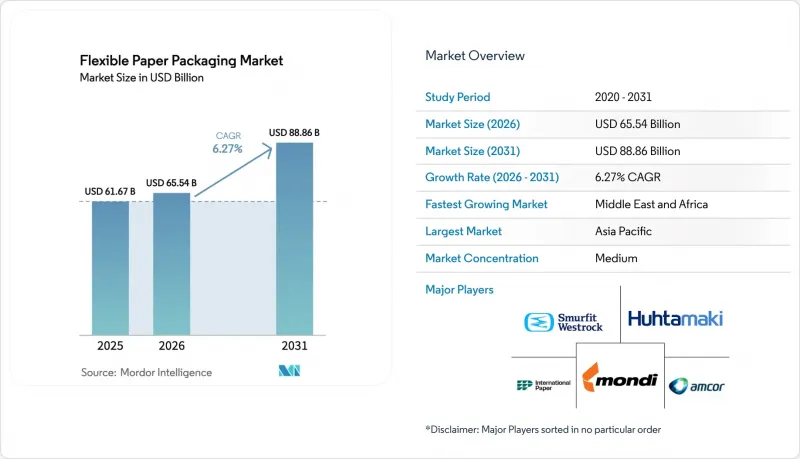
Mordor Intelligence에 의하면, 플렉서블 종이 포장 시장 규모는 2025년 616억 7,000만 달러에서 2026년에는 655억 4,000만 달러로 확대되어 2026년부터 2031년까지 CAGR 6.27%로 성장을 지속하여, 2031년에는 888억 6,000만 달러에 이를 것으로 예측됩니다.
본 보고서는 포장 유형(파우치, 백, 랩, 기타), 용지 등급(코팅지, 라미네이트지, 크라프트지, 기타),최종 이용 산업(식품 및 음료, 헬스케어, 미용·퍼스널케어, 홈케어, 반려동물사료, 기타), 인쇄 기술(플렉소 인쇄, 그라비아 인쇄, 디지털 인쇄, 오프셋 인쇄, 기타), 지역별로 분류되어 있습니다. 시장 예측은 금액(달러) 기준으로 제시되어 있습니다.
세계 플렉서블 종이 포장 시장 동향 및 인사이트
일회용 플라스틱에 대한 규제적 금지 조치
EU의 ‘포장 및 포장 폐기물 규정’에서는 2025년까지 종이 포장재의 재활용률을 65%로 달성해야 할 의무가 규정되어 있으며, 이에 따라 전 세계 FMCG(일용소비재) 공급업체들은 단층 종이 기재를 사용한 다층 라미네이트의 재설계를 강요받고 있습니다. 중국에서 개정된 식품 접촉 재료 규격 GB 4806에는 바이오 유래 코팅이 새롭게 명시되어, 테이크아웃 체인점에 불소 무함유 랩으로의 전환이 권장되고 있습니다. 태국과 일본은 2024년에 유사한 포지티브 리스트 제도를 채택하여, 규정을 준수하는 등급의 지역 간 규모 확대를 가져왔습니다. 브랜드 소유주들은 공급업체 평가 기준에 종이 대체와 관련된 이정표를 포함시키고 있으며, 이를 통해 수년에 걸친 구매 계약이 체결되어 Amcor 및 Mondi의 생산 능력 확대를 뒷받침하고 있습니다.
전자상거래용 밀키트용 고차단성 종이
콜드체인 식사 키트 공급업체들은 48시간의 운송 기간 동안 산소 및 수증기 차단성을 유지할 것을 요구하고 있습니다. 솔레니스(Solenis)는 하이델베르크(Heidelberg)와 제휴하여 폴리머 라미네이션 공정 없이도 결로에 견디는 수성 코팅제를 상용화했습니다. 이를 통해 포장 무게를 18% 줄이면서도 가정용 쓰레기로 재활용이 가능하도록 했습니다. 암콜의 ‘AmFiber’ 플랫폼에서는 현재 -20°C 보관에 견디는 단일 소재 종이 우편 봉투를 출하하고 있으며, FDA의 이행 기준도 충족하고 있습니다. 미국의 밀키트 사업자는 PE 필름에서 ‘광범위하게 재활용 가능’이라고 표시된 How2Recycle 라벨이 부착된 종이 우편 봉투로 전환한 결과, 재구매율이 12% 향상되었다고 보고했습니다.
유제품 및 음료 용도에서의 차단 성능 한계
통제된 보관 시험에 따르면, 종이의 다공성으로 인해 우유나 청량음료의 경우 72시간을 초과하면 풍미와 탄산 유지력이 저하되는 것으로 밝혀졌습니다. 이 시험에서는 냉장 보관 후 무지방 우유 팩에서 미생물 수가 0.2 log CFU 증가한 것으로 기록되었습니다. 나노셀룰로오스나 생분해성 EVOH를 활용한 대체 소재는 상업적으로 아직 초기 단계에 있습니다. Stora Enso사는 2028년까지 파일럿 규모의 생산만을 목표로 하고 있습니다. 그 결과, 액상 유제품 매대에서는 PET나 무균 팩이 여전히 주류를 이루고 있어, 플렉서블 종이 포장 시장 침투를 억제하고 있습니다.
부문 분석
2025년, 파우치는 플렉서블 종이 포장 시장 점유율의 37.83%를 차지하며, 스낵, 영양 보조 식품, 조미료와 같은 다양한 카테고리에서 폭넓게 수용되고 있음을 반영하고 있습니다. 평평한 형태 덕분에 경질 캔에 비해 운송 시 배출량을 최대 30%까지 줄일 수 있어, 소매업체의 Scope 3 탄소 배출 목표에 부합합니다. 브랜드 소유주들은 스토리텔링이나 QR 코드를 통한 추적성을 가능하게 하는 전면 표시 공간을 높이 평가했습니다. 이 봉투는 외관보다 낙하 시험에서의 성능이 중시되는 산업용 종자 및 반려동물사료 분야에서 계속해서 사용되고 있습니다. 랩의 경우 시장 규모는 작지만, 전자상거래 의류 및 과자류 배송 업체들이 PE 재질의 우편 봉투에서 우편함에 들어가기 쉬운 크기로 인열 저항성이 뛰어난 종이 랩으로 전환하고 있어, 2031년까지 연평균 성장률(CAGR) 8.78%를 나타낼 것으로 예측됩니다.
플렉서블 종이 포장 시장 규모는 2031년까지 888억 6,000만 달러에 달할 것으로 예측되며, 전자상거래 사업자가 단일 소재를 활용한 시범 사업을 전국 규모로 확대할 경우 랩 포장의 점유율은 2배에 달할 가능성이 있습니다. 사셰와 스틱팩은 여전히 틈새 시장이지만, 종이 라미네이트와 호환되는 새로운 마이크로 밸브 구조를 활용하는 분말형 전해질 음료나 화장품 샘플의 경우 필수적인 존재입니다. 통합 제지 제조업체들은 스탠드업형과 플랫형 금형을 신속하게 전환할 수 있는 모듈식 파우치 생산 라인을 도입하여 설비 가동률을 높이고 있습니다. 현재 셀룰로오스계 필름으로 제작되는 맞춤형 지퍼 씰은 차단 성능을 저해하지 않으면서 순환 경제 이니셔티브를 추진하고 있습니다.
크래프트지는 높은 인열 저항성과 기존 성형·충진·밀봉(FFS) 라인에서의 뛰어난 가공성 덕분에 2025년에는 매출의 44.68%를 차지했습니다. 각 제지 제조업체들은 소박한 아름다움을 추구하는 프리미엄 반려동물사료 및 유기농 스낵 브랜드를 위해 표백 및 천연 크라프트지의 제품군을 확대되고 있습니다. 연평균 성장률(CAGR) 7.71%로 예측되는 라미네이트 용지는 얇은 배리어 층을 접착하면서도 동일한 스트림에서 재펄프화가 가능한 수성 접착제 시스템을 활용하고 있습니다. 화이트 탑 크라프트 등급은 사진처럼 사실적인 인쇄가 필수적인 분야에서 지지를 얻고 있으며, 비용과 인쇄 적합성 간의 격차를 해소하고 있습니다.
크래프트 등급 전용 플렉서블 종이 포장 시장 규모는 2025년에 275억 5,000만 달러에 달할 것으로 예상되며, 이는 가공업체에게 있어 전략적 중요성을 부각시키고 있습니다. 소비재 기업들이 2028년까지 사용 후 섬유를 30% 사용하겠다고 공약함에 따라, 재생 섬유를 포함한 제품의 인기가 높아지고 있습니다. 특수 내유성 코팅지는 FDA 및 EU의 식품 접촉 관련 프로토콜에서 검증된 불소 무함유 화학 물질을 사용하여 아시아의 냉동 식품 시장에 공급되고 있습니다. 나노클레이 및 키토산 코팅에 대한 연구를 통해 플라스틱을 사용하지 않고도 방습성을 향상시킬 수 있을 것으로 기대되며, 크라프트지의 적용 범위가 베이커리 제품 및 짭짤한 스낵 분야로 확대되고 있습니다.
지역별 분석
아시아태평양은 경쟁력 있는 섬유 조달, 통합된 제지 네트워크, 그리고 중산층 소비 확대에 힘입어 2025년에는 매출 점유율 44.56%로 플렉서블 종이 포장 시장을 주도했습니다. 중국이 식품 접촉용 코팅의 허용 목록을 갱신함에 따라, 바이오 폴리머 배리어 소재의 상업적 전개가 가속화되고 규제 관련 리드 타임이 단축되고 있습니다. 2025년 26억 달러 규모 시장이 예상되는 베트남은 유럽의 재활용 기준을 준수하는 수출용 밀키트 파우치의 모범 사례가 되고 있습니다. 일본의 가공업체들은 고속 디지털 인쇄기 설비 투자 비용을 보전해 주는 정부 보조금의 혜택을 받고 있어 혁신의 확산이 가속화되고 있습니다. 콜드체인 인프라가 3급 도시로 확대됨에 따라 내유성 냉동용 파우치의 용도가 개척되고 있으며, 해당 지역의 플렉서블 종이 포장 시장 규모는 꾸준히 확대될 전망입니다.
중동 및 아프리카는 8.92%라는 가장 높은 연평균 성장률(CAGR)을 기록하고 있으며, 그 배경에는 걸프협력회의(GCC)의 플라스틱 세법 제정과 골판지 및 연포장 가공 분야에 대한 인프라 투자가 있습니다. 사우디아라비아의 ‘비전 2030’에서는 수입 의존도를 낮추기 위해 펄프에서 포장까지 일괄적으로 처리하는 복합 시설 부지가 배정되었습니다. 아프리카에서는 지역 횡단형 슈퍼마켓 체인이 자체 브랜드 제과류에 대해 재활용 가능한 단일 종이 포장재 사용을 의무화하고 있으며, 이는 케냐와 나이지리아의 생산 능력 확대를 촉진하고 있습니다. 국제적인 브랜드 소유주들은 높은 운송 비용을 피하고 환율 리스크를 줄이기 위해 현지 조달 계약을 협상하고 있으며, 계약에 국내 재활용 감사를 의무화하는 순환형 경제 조항을 포함시키고 있습니다.
북미와 유럽은 합쳐서 브랜드 소유자가 높은 차단 성능과 정밀한 인쇄 품질을 요구하는 성숙한 고부가가치 거점이 되고 있습니다. 미국의 온라인 식재료 배송 업체는 상온에서의 온도 변동에도 신선도를 유지할 수 있는 ‘파우치형’ 포장을 채택하고 있으며, 이것이 결로 방지 코팅의 연구 개발을 촉진하고 있습니다. EU에서는 PPWR(종이 포장재)의 재활용 가능성에 관한 목표가 재펄프화가 가능한 라미네이트 소재에 대한 설비 투자를 지속적으로 촉진하고 있습니다. 남미에서는 브라질과 칠레의 풍부한 조림지를 활용하여 비코팅 크라프트지 릴을 수출하고 있습니다. 한편, 아르헨티나의 국내 컨버터 기업들은 편의식품 판매 증가에 따라 스낵 포장재 수요에 주력하고 있습니다. 지역 무역 협정에 따라 점보 릴의 유통이 효율화되어, 제지 제조업체와 인쇄 컨버터 간의 국경을 초월한 협력 관계가 촉진되고 있습니다.
기타 특전:
- 엑셀 형식 시장 예측(ME) 시트
- 3개월간의 애널리스트 지원
자주 묻는 질문
목차
제1장 서론
제2장 조사 방법
제3장 주요 요약
제4장 시장 구도
제5장 시장 규모와 성장 예측
제6장 경쟁 구도
제7장 시장 기회와 향후 전망
JHS 26.09.03According to Mordor Intelligence, the flexible paper packaging market size is expected to grow from USD 61.67 billion in 2025 to USD 65.54 billion in 2026 and is forecast to reach USD 88.86 billion by 2031 at 6.27% CAGR over 2026-2031.
This report is Segmented by Packaging Type (Pouches, Bags, Wraps, Others), Paper Grade (Coated, Laminated, Kraft, Others), End-Use Industry (Food & Beverage, Healthcare, Beauty & Personal Care, Home Care, Pet Food, Others), Printing Technology (Flexography, Rotogravure, Digital, Offset, Others), and Geography. The Market Forecasts are Provided in Terms of Value (USD).
Global Flexible Paper Packaging Market Trends and Insights
Regulatory bans on single-use plastics
The EU's Packaging & Packaging Waste Regulation sets a mandatory 65% recycling rate for paper packs by 2025, forcing global FMCG suppliers to redesign multilayer laminates around mono-paper substrates. China's updated food-contact standard GB 4806 now lists bio-origin coatings, nudging takeaway chains toward fluorine-free wraps. Thailand and Japan adopted similar positive-list schemes in 2024, creating cross-regional scale for compliant grades. Brand owners embed paper-substitution milestones in supplier scorecards, triggering multi-year offtake commitments that underpin capacity expansions by Amcor and Mondi.
High-barrier paper for e-commerce meal-kits
Cold-chain meal-kit vendors require oxygen- and moisture-barrier integrity over 48-hour transit. Solenis teamed with Heidelberg to commercialise aqueous coatings that withstand condensation without polymer lamination, cutting pack weight 18% and maintaining curbside recyclability. Amcor's AmFiber platform now ships mono-paper mailers rated for -20 °C storage while meeting FDA migration limits. US meal-kit operators report 12% repeat-purchase lifts after switching from PE films to paper mailers that carry "widely recyclable" How2Recycle labels.
Barrier limits in dairy & beverage applications
Paper's porosity still compromises flavour and carbonation retention in milk and soft drinks beyond 72 hours, according to controlled storage trials that recorded a 0.2 log CFU microbial uptick in skim-milk cartons after refrigerated hold. Nano-cellulose and biodegradable EVOH replacements remain commercially nascent; Stora Enso targets pilot-scale output only by 2028. As a result, PET and aseptic cartons continue to dominate liquid dairy aisles, capping flexible paper packaging market penetration.
Other drivers and restraints analyzed in the detailed report include:
- High-speed digital printing for DTC brands
- Grease-resistant pouches for refrigerated Asian foods
- Virgin pulp price volatility compressing converter margins
For complete list of drivers and restraints, kindly check the Table Of Contents.
Segment Analysis
Pouches accounted for 37.83% of flexible paper packaging market share in 2025, reflecting cross-category acceptance in snacks, nutraceuticals, and condiments. Their flattened geometry cuts freight emissions by up to 30% versus rigid cans, aligning with retailer scope-3 carbon targets. Brand owners appreciate front-panel real estate that supports storytelling and QR-enabled traceability. Bags persist in industrial seed and pet-food channels where drop-test performance trumps aesthetics. Wraps, although holding a smaller base, post a 8.78% CAGR through 2031 as e-commerce apparel and confectionery shippers pivot from PE mailers to tear-resistant paper wraps that meet mailbox-friendly sizing.
The flexible paper packaging market size is projected to reach USD 88.86 billion by 2031, and wraps could command a doubled share if e-tailers scale mono-material pilots nationwide. Sachets and stick-packs remain niche but vital for powdered electrolytes and cosmetic samplers that exploit new micro-valve fitments compatible with paper laminates. Integrated mills deploy modular pouching lines enabling quick tool changes between stand-up and flat variants, enhancing asset utilisation. Customisable zipper seals, now made from cellulose-based films, advance the circularity narrative without compromising barrier metrics.
Kraft paper delivered 44.68% of revenue in 2025 due to high tear resistance and excellent machinability on existing form-fill-seal lines. Mills expand bleached and natural kraft SKUs tailored for premium pet-food and organic snack brands seeking earthy aesthetics. Laminated paper, forecast at 7.71% CAGR, exploits water-based adhesive systems that bond thin barrier layers yet allow same-stream repulping. White-top kraft grades gain traction where photo-realistic printing is crucial, bridging the gap between cost and printability.
The flexible paper packaging market size for kraft grades alone translates to USD 27.55 billion in 2025, underscoring their strategic importance to converters. Recycled-content options climb in popularity after consumer-goods companies pledged 30% post-consumer fiber by 2028. Specialty grease-resistant coated papers serve Asian frozen meals, using fluorine-free chemistry validated under FDA and EU food-contact protocols. Research into nano-clay and chitosan coatings promises moisture-barrier lifts without plastic, broadening kraft applicability to bakery and salty snack corridors.
Complete Report Scope:
- By Packaging Type
- Pouches
- Bags
- Wraps
- Other Packaging Types
- By Paper Grade
- Coated Papers
- Laminated Pape
- Kraft Paper
- Other Paper Grades
- By End-Use Industry
- Food and Beverage
- Healthcare and Pharmaceutical
- Beauty and Personal Care
- Home Care and Laundry
- Pet Food
- Other End Use Industry
- By Printing Technology
- Flexography
- Rotogravure
- Digital Printing
- Offset
- Other Printing Technology
- By Geography
- North America
- United States
- Canada
- Mexico
- Europe
- Germany
- United Kingdom
- France
- Italy
- Spain
- Russia
- Rest of Europe
- Asia-Pacific
- China
- India
- Japan
- South Korea
- Australia and New Zealand
- Rest of Asia-Pacific
- Middle East and Africa
- Middle East
- United Arab Emirates
- Saudi Arabia
- Turkey
- Rest of Middle East
- Africa
- South Africa
- Nigeria
- Egypt
- Rest of Africa
- Middle East
- South America
- Brazil
- Argentina
- Rest of South America
- North America
Geography Analysis
Asia-Pacific led the flexible paper packaging market with 44.56% revenue share in 2025, supported by competitive fiber sourcing, integrated mill networks, and rising middle-class consumption. China's updated positive list for food-contact coatings expedites commercial rollout of bio-polymer barriers, shortening regulatory lead times. Vietnam, valued at USD 2.60 billion in 2025, represents a template for export-ready meal-kit pouches that align with European recyclability standards. Japanese converters benefit from government subsidies that offset capital costs for high-speed digital presses, accelerating innovation diffusion. The flexible paper packaging market size is set to expand steadily in the region as cold-chain infrastructure spreads into tier-3 cities, unlocking applications for grease-resistant freezer pouches.
The Middle East & Africa region records the fastest 8.92% CAGR, underpinned by plastic-tax legislation in the Gulf Cooperation Council and infrastructure investments in corrugated and flexible converting. Saudi Arabia's Vision 2030 allocates land for integrated pulp-to-packaging complexes that reduce import dependency. In Africa, pan-regional supermarket chains mandate recyclable mono-paper wraps for private-label baked goods, triggering capacity additions in Kenya and Nigeria. International brand owners negotiate local sourcing agreements to bypass high freight costs and mitigate currency risk, embedding circular-economy clauses that require in-country recycling audits.
North America and Europe together represent mature, high-value nodes where brand owners demand advanced barrier performance and precision print quality. US e-commerce meal-kit operators adopt porch-friendly pouch formats that maintain freshness through ambient swings, driving R&D in condensation-resistant coatings. In the EU, PPWR recyclability targets continue to pull forward capital expenditure on repulpable laminates. South America leverages abundant plantation forestry in Brazil and Chile to export uncoated kraft reels, while domestic converters in Argentina focus on snack-wrap demand amid rising convenience-food sales. Regional trade pacts streamline movement of jumbo reels, fostering cross-border cooperation among mill and print converters.
- Amcor Plc
- Mondi Plc
- Smurfit Westrock
- Huhtamaki Oyj
- International Paper Company
- Stora Enso Oyj
- Coveris Holdings SA
- Sonoco Products Company
- Georgia-Pacific LLC
- Sappi Limited
- Graphic Packaging Holding Co.
- Oji Holdings Corporation
- Nippon Paper Industries Co.
- UPM-Kymmene Oyj
- Klabin S/A
- Rengo Co., Ltd.
- Novolex Holdings
- ProAmpac LLC
- Grounded Packaging
- Adeera Packaging Pvt. Ltd.
Additional Benefits:
- The market estimate (ME) sheet in Excel format
- 3 months of analyst support
TABLE OF CONTENTS
1 INTRODUCTION
- 1.1 Study Assumptions and Market Definition
- 1.2 Scope of the Study
2 RESEARCH METHODOLOGY
3 EXECUTIVE SUMMARY
4 MARKET LANDSCAPE
- 4.1 Market Overview
- 4.2 Market Drivers
- 4.2.1 Regulatory Bans on Single-use Plastics Accelerating Paper Substitution (EU and APAC)
- 4.2.2 High-Barrier Paper for E-commerce Meal-Kit Delivery (North America)
- 4.2.3 High-Speed Digital Printing Enabling Custom Runs for DTC Brands (Europe)
- 4.2.4 Surge in Grease-Resistant Pouches for Refrigerated Asian Foods (Asia)
- 4.2.5 Brand-Owner 2025 Recyclability Commitments in Cosmetics Packaging
- 4.2.6 Expansion of Aqueous/Biopolymer Coatings for Snack Wraps (LatAm)
- 4.3 Market Restraints
- 4.3.1 Barrier Limitations in Dairy and Beverage Applications
- 4.3.2 Virgin Pulp Price Volatility Compressing Converter Margins
- 4.3.3 Weak Collection Infrastructure for Paper-Laminates (Emerging Markets)
- 4.3.4 High Capex to Retrofit Plastic Flexible Lines
- 4.4 Supply-Chain Analysis
- 4.5 Regulatory Outlook
- 4.6 Technological Outlook
- 4.7 Porter's Five Forces Analysis
- 4.7.1 Bargaining Power of Suppliers
- 4.7.2 Bargaining Power of Buyers
- 4.7.3 Threat of New Entrants
- 4.7.4 Threat of Substitutes
- 4.7.5 Intensity of Competitive Rivalry
- 4.8 Investment Analysis
5 MARKET SIZE AND GROWTH FORECASTS (VALUE)
- 5.1 By Packaging Type
- 5.1.1 Pouches
- 5.1.2 Bags
- 5.1.3 Wraps
- 5.1.4 Other Packaging Types
- 5.2 By Paper Grade
- 5.2.1 Coated Papers
- 5.2.2 Laminated Pape
- 5.2.3 Kraft Paper
- 5.2.4 Other Paper Grades
- 5.3 By End-Use Industry
- 5.3.1 Food and Beverage
- 5.3.2 Healthcare and Pharmaceutical
- 5.3.3 Beauty and Personal Care
- 5.3.4 Home Care and Laundry
- 5.3.5 Pet Food
- 5.3.6 Other End Use Industry
- 5.4 By Printing Technology
- 5.4.1 Flexography
- 5.4.2 Rotogravure
- 5.4.3 Digital Printing
- 5.4.4 Offset
- 5.4.5 Other Printing Technology
- 5.5 By Geography
- 5.5.1 North America
- 5.5.1.1 United States
- 5.5.1.2 Canada
- 5.5.1.3 Mexico
- 5.5.2 Europe
- 5.5.2.1 Germany
- 5.5.2.2 United Kingdom
- 5.5.2.3 France
- 5.5.2.4 Italy
- 5.5.2.5 Spain
- 5.5.2.6 Russia
- 5.5.2.7 Rest of Europe
- 5.5.3 Asia-Pacific
- 5.5.3.1 China
- 5.5.3.2 India
- 5.5.3.3 Japan
- 5.5.3.4 South Korea
- 5.5.3.5 Australia and New Zealand
- 5.5.3.6 Rest of Asia-Pacific
- 5.5.4 Middle East and Africa
- 5.5.4.1 Middle East
- 5.5.4.1.1 United Arab Emirates
- 5.5.4.1.2 Saudi Arabia
- 5.5.4.1.3 Turkey
- 5.5.4.1.4 Rest of Middle East
- 5.5.4.2 Africa
- 5.5.4.2.1 South Africa
- 5.5.4.2.2 Nigeria
- 5.5.4.2.3 Egypt
- 5.5.4.2.4 Rest of Africa
- 5.5.4.1 Middle East
- 5.5.5 South America
- 5.5.5.1 Brazil
- 5.5.5.2 Argentina
- 5.5.5.3 Rest of South America
- 5.5.1 North America
6 COMPETITIVE LANDSCAPE
- 6.1 Market Concentration
- 6.2 Strategic Moves
- 6.3 Market Share Analysis
- 6.4 Company Profiles (includes Global level Overview, Market level overview, Core Segments, Financials as available, Strategic Information, Market Rank/Share for key companies, Products and Services, and Recent Developments)
- 6.4.1 Amcor Plc
- 6.4.2 Mondi Plc
- 6.4.3 Smurfit Westrock
- 6.4.4 Huhtamaki Oyj
- 6.4.5 International Paper Company
- 6.4.6 Stora Enso Oyj
- 6.4.7 Coveris Holdings SA
- 6.4.8 Sonoco Products Company
- 6.4.9 Georgia-Pacific LLC
- 6.4.10 Sappi Limited
- 6.4.11 Graphic Packaging Holding Co.
- 6.4.12 Oji Holdings Corporation
- 6.4.13 Nippon Paper Industries Co.
- 6.4.14 UPM-Kymmene Oyj
- 6.4.15 Klabin S/A
- 6.4.16 Rengo Co., Ltd.
- 6.4.17 Novolex Holdings
- 6.4.18 ProAmpac LLC
- 6.4.19 Grounded Packaging
- 6.4.20 Adeera Packaging Pvt. Ltd.
7 MARKET OPPORTUNITIES AND FUTURE OUTLOOK
- 7.1 White-Space and Unmet-Need Assessment


