

|
시장보고서
상품코드
2116960
푸드서비스용 일회용 포장 시장 : 시장 점유율 분석, 업계 동향 및 통계, 성장 예측(2026-2031년)Foodservice Disposable Packaging - Market Share Analysis, Industry Trends & Statistics, Growth Forecasts (2026 - 2031) |
||||||
 Mordor Intelligence
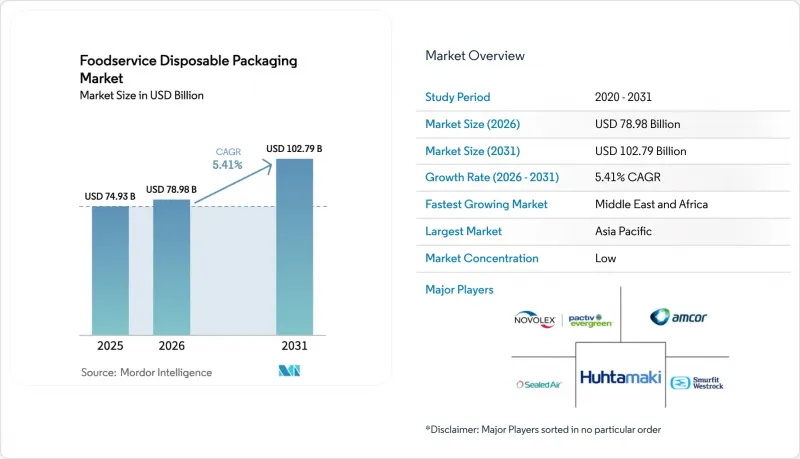
Mordor Intelligence에 의하면, 푸드서비스용 일회용 포장 시장 규모는 2025년에 749억 3,000만 달러로 평가되었고, 2026년 789억 8,000만 달러에서 2031년까지 1,027억 9,000만 달러에 이를 것으로 예측되며, 예측 기간(2026-2031년) CAGR은 5.41%를 나타낼 전망입니다.
본 보고서는 소재별(플라스틱, 종이, 알루미늄, 생분해성), 제품 유형별(컵/뚜껑, 용기, 트레이/접시, 식기, 기타), 최종 사용자별(QSR/카페, 풀서비스, 고스트 키친, 기관용, 기타), 유통 채널별(직접, 간접) 및 지역별(북미, 유럽, 아시아태평양, 중동 및 아프리카, 남미)로 분류되어 있습니다. 시장 예측은 금액(달러) 기준입니다.
세계의 푸드서비스용 일회용 포장 시장 동향 및 인사이트
고스트 키친과 온라인 배달의 급증으로 인해 변조 방지 포장재 수요가 증가
현재 디지털 주문은 미국 레스토랑 총 매출의 40%를 차지했으며, 매장 내 식사 공간을 갖추지 않은 사업자들은 포장을 주요 브랜드 접점으로 삼을 수밖에 없는 상황입니다. DayMark Safety Systems사의 ‘TamperSeal’ 라벨이나 Dart Container사의 ‘ClearPac SafeSeal’ 경첩 기술과 같은 변조 방지 솔루션은 눈에 띄는 개봉 흔적을 보여줌으로써 고객에게 안심감을 줍니다. 제3자 플랫폼에서는 식당 평가의 일부로 보안 점수가 고려되기 때문에 이러한 포장의 도입은 이제 경쟁상 필수 요건이 되었습니다. 또한, 사업자들은 작업 공정과 자재 사용량을 줄이기 위해, 별도로 부착하는 수축 밴드보다 포장에 내장된 변조 방지 기능을 선호하는 경향이 있습니다.
EU 및 아시아의 지속가능성 규제로 인해 수요가 섬유 기반 포장으로 전환
2025년 2월에 시행될 유럽연합(EU)의 ‘포장 및 포장 폐기물 규정’에서는 2030년까지 모든 포장재의 재활용 가능성을 확보해야 할 의무가 부과되며, 식품 접촉 재료에 PFAS 사용이 금지됩니다. 이와 병행하여, 중국의 식품 접촉용 접착제에 관한 GB 4806.15-2024 및 일본의 합성수지에 관한 포지티브 리스트와 같은 정책으로 인해 아시아 전역에서 규정 준수 기준이 강화되고 있습니다. 후타마키(Hutamaki)와 같은 제조업체들은 이러한 규제 동향에 대응하기 위해 북아일랜드에서 섬유제 뚜껑의 생산 능력을 확대되고 있습니다. 이러한 규제들이 맞물리면서, 섬유 소재는 ‘자발적인 지속가능성 선택지’가 아닌 ‘규정 준수를 위한 필수 요건’으로 자리매김하고 있으며, 세계 브랜드들은 기존 SKU의 재설계를 강요받고 있습니다.
높은 생산 비용 : 종이 포장 도입의 큰 장벽
2025년 1월에는 컨테이너 보드 가격이 톤당 70달러로 인상되는 2차 가격 인상이 발효되어, 이미 이전의 인플레이션분을 흡수한 사업자들에게는 추가적인 부담이 되었습니다. 에너지 및 운송비에 대한 추가 요금이 기존 플라스틱에 비해 섬유계 소재의 높은 비용을 더욱 부추겨, 비용에 민감한 신흥 시장에서 대체재의 확산을 둔화시키고 있습니다. 자금 사정이 어려운 중소 외식 기업은 협상력이 부족하여, 규제에 의해 권장되는 경우에도 퇴비화 가능한 종이로의 전환을 미루는 경우가 많습니다.
부문별 분석
2025년 시점에서 푸드서비스용 일회용 포장 시장에서 플라스틱의 점유율은 48.85%를 차지했으나, 생분해성 및 퇴비화 가능한 소재는 연평균 성장률(CAGR) 8.88%로 급속히 확대되고 있습니다. 브라스켐(Bruscem)이 사용 후 식용유를 원료로 한 바이오 순환형 폴리프로필렌 ‘WENEW’를 출시한 것은 성능을 저하시키지 않으면서 주류 수지 등급의 탈탄소화를 실현할 수 있는 드롭인 대체재의 가능성을 보여줍니다. 암콜(Amcor)사는 금속 증착 필름과 직접 경쟁하는 고차단성 재활용 가능 종이 ‘AmFiber Performance Paper’에 대해 유럽 특허를 취득했습니다. 그래픽 패키징(Graphic Packaging)사의 오븐용 제품 ‘PaperSeal Cook Tray’는 섬유 소재의 이용 사례를 고온 환경으로 확대하여 대상 최종 용도의 폭을 넓히고 있습니다.
이 부문의 성장세는 공급 측의 생산 능력에 힘입고 있습니다. 2022년 전 세계 PLA 생산량은 700킬로톤을 넘어섰으며, 아시아태평양이 생산량의 70%, 소비량의 60%를 차지하고 있습니다. BioPak사는 2024년 7월, 식물 섬유 제품 라인에서 PFAS를 제거하고 가정용 퇴비화 기준을 충족하는 PHA 코팅이 적용된 커피 컵을 출시했습니다. Sabert사의 ‘Pulp Ultra’ 용기는 내습성 코팅을 통해 기름기가 많은 고온 식품 분야에서 섬유가 플라스틱을 대체할 수 있음을 보여주고 있습니다. 이러한 발전들은 전반적으로 기술적 장벽이 비용 프리미엄보다 빠른 속도로 해소되고 있는 전환점을 시사합니다.
2025년, 컵과 뚜껑은 음료 분야의 지속적인 혁신에 힘입어 외식 및 푸드서비스용 일회용 포장 시장 규모의 26.21%를 차지했습니다. SIG사의 콜드브루 커피용 ‘백 인 박스(Bag-in-Box)’ 솔루션은 유리 용기에 비해 경량화를 실현하고 유통 기한을 연장하고 있습니다. 한편, 따뜻한 음식 배달이 보급됨에 따라 트레이·접시 시장은 연평균 성장률(CAGR) 6.92%를 나타낼 것으로 예측됩니다. 후타마키사가 북유럽 슈퍼마켓을 대상으로 전개하는 섬유제 레디밀용 트레이는 오븐 사용이 가능한 섬유 소재가 소매 채널뿐만 아니라 외식 산업 채널에서도 수요를 충족시킬 수 있음을 입증하고 있습니다.
트레이 시장의 성장은 위생 측면에서 일회용 솔루션이 여전히 필수적인 업무용 케이터링 시장과도 관련이 있습니다. SEE사의 퇴비화 가능한 육류용 트레이(바이오 54%, 재생 소재 45%)는 사업자의 전환을 원활하게 하는 하이브리드 소재 전략의 한 예입니다. ProAmpac사의 누수 방지 기능이 탑재된 ‘RotiBag’은 보온성, 일체형 손잡이, 포장 중량 감소를 실현하고 있으며, 재료 사용량을 줄이면서도 타겟을 정확히 겨냥한 설계가 배달의 과제를 어떻게 해결하는지 보여주고 있습니다.
지역별 분석
2025년, 아시아태평양은 42.10%의 점유율을 차지했으며, 외식 및 푸드서비스용 일회용 포장 시장을 주도했습니다. 인도, 인도네시아, 베트남의 퀵서비스 업계의 견조한 성장에 더해, 2025년 2월에 시행되는 베이징시의 식품 접촉용 접착제에 관한 개정 규정에 따라, 보다 안전한 소재를 향한 규제 조화가 확실히 진행되고 있습니다. 또한, 이 지역은 전 세계 PLA 생산 능력의 대부분을 차지하고 있어 생분해성 제품에 비용 면에서의 우위를 제공합니다. 2025년 6월 시행될 일본의 포지티브 리스트 제도는 수지 규정을 강화하여 국내 섬유 투자를 촉진하는 한편, 홍콩의 플라스틱 식기 단계적 금지 조치는 호스피탈리티 업계의 구매자들을 퇴비화 가능한 대체품으로 이끌고 있습니다.
유럽은 2030년까지 완전한 재활용 가능성을 의무화하는 ‘포장 및 포장 폐기물 규정’ 덕분에 여전히 정책 주도권을 쥐고 있습니다. 유럽 전역의 생산자들은 섬유 생산 능력 확대를 가속화하고 있으며, 확대 생산자 책임(EPR) 제도에 따라 폐기물의 최종 처분 방법으로 매립 처분이 선택지에서 제외되고 있습니다. 북미에서는 주 차원의 PFAS 금지 조치가 제각각 도입되고 있지만, 2024년 2월 FDA가 PFAS의 단계적 폐지를 완료함에 따라 연방 차원의 통일성이 확보되었습니다. 이러한 중복된 규제는 규정 준수를 복잡하게 만들고 있지만, 동시에 배리어 코팅이 적용된 종이 그릇이나 rPET 뚜껑에 대한 시장 수요를 창출하고 있습니다.
중동 및 아프리카에서는 인프라 확장이 업무용 케이터링용 일회용 제품 수요를 견인하여, 2031년까지 연평균 성장률(CAGR) 6.95%를 나타낼 것으로 예측됩니다. Hotpack과 같은 현지 유력 기업들은 수지 공급과 기술적 노하우를 확보하기 위해 해외에 투자한 뒤, 완제품이나 반제품을 재수입하여 GCC(걸프협력회의) 국가들과의 계약을 이행하고 있습니다. SIG가 이집트에서 진행하는 음료용 카톤 회수 등 시범 재활용 프로젝트는 아직 발전 단계에 있는 폐기물 관리 시스템에서도 순환형 솔루션 구축을 목표로 하고 있습니다.
라틴아메리카에서는 소매용 밀키트와 편의점 식품 프로그램에 일회용 식기가 도입됨에 따라 수요가 꾸준히 증가하고 있습니다. 이 지역의 제조업체들은 유럽의 섬유 제품 디자인을 도입하면서도 비용과 지속가능성을 모두 중시하여, 현지에서 조달한 사탕수수 바가스를 활용하는 경우가 많습니다.
기타 혜택 :
- 엑셀 형식 시장 예측(ME) 시트
- 3개월간의 애널리스트 지원
자주 묻는 질문
목차
제1장 서론
제2장 조사 방법
제3장 개요
제4장 시장 구도
제5장 시장 규모 및 성장 예측
제6장 경쟁 구도
제7장 시장 기회 및 향후 전망
AJY 26.09.01According to Mordor Intelligence, the foodservice disposable packaging market size was valued at USD 74.93 billion in 2025 and estimated to grow from USD 78.98 billion in 2026 to reach USD 102.79 billion by 2031, at a CAGR of 5.41% during the forecast period (2026-2031).
This report is Segmented by Material Type (Plastics, Paper, Aluminum, Biodegradable), Product Type (Cups/Lids, Containers, Trays/Plates, Cutlery, Others), End User (QSR/Cafes, Full-Service, Ghost Kitchens, Institutional, Others), Distribution Channel (Direct, Indirect), and Geography (North America, Europe, Asia-Pacific, MEA, South America). Market Forecasts in Value (USD).
Global Foodservice Disposable Packaging Market Trends and Insights
Surge in Ghost Kitchens and Online Delivery Boosting Tamper-Evident Packaging Demand
Digital ordering now represents 40% of total U.S. restaurant sales, compelling operators without dining rooms to treat packaging as their primary brand touchpoint. Tamper-evident solutions such as DayMark Safety Systems' TamperSeal labels and Dart Container's ClearPac SafeSeal hinge technology reassure customers by showing visible breach indicators. Because third-party platforms rank restaurants partly on security scores, adoption of such packaging is now a competitive necessity. Operators also favour integrated tamper features over add-on shrink bands to reduce labour steps and material usage.
EU and Asian Sustainability Mandates Shifting Demand to Fiber-Based Packaging
The European Union's Packaging and Packaging Waste Regulation, effective February 2025, requires all packaging to achieve recyclability by 2030 and bans PFAS in food contact materials. Parallel policies-China's GB 4806.15-2024 for food-contact adhesives and Japan's Positive List for synthetic resins-tighten compliance thresholds across Asia. Producers such as Huhtamaki have scaled fiber-lid capacity in Northern Ireland to match this regulatory pull. Together, these rules reposition fiber as a compliance imperative rather than a voluntary sustainability choice, pushing global brands to redesign legacy SKUs.
High Production Costs: A Major Barrier to Paper Packaging Adoption
A second wave of containerboard price hikes of USD 70 per metric ton took effect in January 2025, burdening operators who had already absorbed earlier inflation. Energy and freight surcharges compound the premium for fibre formats over conventional plastics, slowing substitution in cost-sensitive emerging markets. Smaller foodservice businesses with tight cash flow have little bargaining power and often postpone switching to compostable paper, even where regulations encourage it.
Other drivers and restraints analyzed in the detailed report include:
- Expansion of QSR Chains in Various Countries
- Post-Hygiene Focus Raising Single-Use Trays in Middle-East Institutions
- Municipal PFAS Bans Reducing Viability of Existing Inventory
For complete list of drivers and restraints, kindly check the Table Of Contents.
Segment Analysis
Plastics held 48.85% of foodservice disposable packaging market share in 2025, yet biodegradable and compostable formats are accelerating at a 8.88% CAGR. Braskem's launch of WENEW bio-circular polypropylene sourced from used cooking oil shows how drop-in replacements can decarbonise mainstream resin grades without performance loss. Amcor has secured European patents for AmFiber Performance Paper, a high-barrier recyclable paper that competes directly with metallised films. Graphic Packaging's oven-ready PaperSeal Cook Tray extends fibre utility to hot applications, broadening addressable end-use cases.
Momentum in this segment also rides on supply-side capacity: global PLA production topped 700 kilotons in 2022, with Asia-Pacific controlling 70% of output and 60% of consumption. BioPak eliminated PFAS from its plant-fibre line in July 2024 and introduced PHA-lined coffee cups that meet home-compost standards. Sabert's Pulp Ultra containers underscore how moisture-resistant coatings can allow fibre to displace plastic in greasy hot-food contexts. Collectively, these developments signal a tipping point where technical hurdles are receding faster than cost premiums.
Cups & lids commanded 26.21% of the foodservice disposable packaging market size in 2025, supported by continued beverage innovation. SIG's bag-in-box solution for cold-brew coffee trims weight versus glass and improves shelf-life. Conversely, trays & plates are projected to grow at a 6.92% CAGR as hot meal delivery proliferates. Huhtamaki's fibre ready-meal trays for Nordic supermarkets prove that ovenable fibre can satisfy retail as well as foodservice channels.
Growth in trays is also linked to institutional catering where single-use solutions remain hygiene-critical. SEE's compostable meat trays-54% bio-based and 45% recycled-illustrate hybrid material strategies that ease operator transition. ProAmpac's leak-resistant RotiBag provides heat retention, integrated handles, and reduced packaging weight, demonstrating how targeted design solves delivery pain points while using fewer materials.
Complete Report Scope:
- By Material Type
- Plastics
- Polypropylene (PP)
- Polyethylene Terephthalate (PET)
- Other Plastic Types
- Paper
- Coated paper
- Kraft paper
- Molded fiber
- Aluminum
- Biodegradable and Compostable
- Plastics
- By Product Type
- Cups and Lids
- Tubs and Containers
- Trays and Plates
- Cutlery, Stirrers and Straw
- Other Product Types (Bags, Wraps, Boxes, Cartons, Clamshell, etc.)
- By End User
- Quick Service Restaurants and Cafes
- Full-service Restaurants
- Cloud / Ghost Kitchens
- Institutional Catering (Hospitals, Schools)
- Other End User
- By Distribution Channel
- Direct Sales
- Indirect Sales
- By Geography
- North America
- United States
- Canada
- Mexico
- Europe
- Germany
- United Kingdom
- France
- Italy
- Spain
- Russia
- Rest of Europe
- Asia-Pacific
- China
- India
- Japan
- South Korea
- Australia and New Zealand
- Rest of Asia-Pacific
- Middle East and Africa
- Middle East
- United Arab Emirates
- Saudi Arabia
- Turkey
- Rest of Middle East
- Africa
- South Africa
- Nigeria
- Egypt
- Rest of Africa
- Middle East
- South America
- Brazil
- Argentina
- Rest of South America
- North America
Geography Analysis
Asia-Pacific dominated the foodservice disposable packaging market with 42.10% share in 2025. Robust quick-service expansion in India, Indonesia, and Vietnam, coupled with Beijing's updated food-contact adhesive rule effective February 2025, ensures strong regulatory alignment toward safer materials. The region also hosts the bulk of global PLA capacity, establishing a cost advantage for biodegradable formats. Japan's Positive List system entering force in June 2025 tightens resin compliance and spurs domestic fibre investment, while Hong Kong's phased plastic tableware ban guides hospitality buyers toward compostable alternatives.
Europe remains an agenda-setter thanks to the Packaging and Packaging Waste Regulation that mandates full recyclability by 2030. Producers across the continent are accelerating fibre capacity, and extended producer responsibility schemes distance landfill from acceptable end-of-life routes. North America faces a patchwork of state-level PFAS bans; federal alignment arrived when the FDA completed the PFAS phase-out in February 2024. These overlapping rules complicate compliance but also create a market pull for barrier-coated paper bowls and rPET lids.
The Middle East & Africa region is expected to post 6.95% CAGR through 2031 as infrastructure growth feeds demand for institutional catering disposables. Local champions like Hotpack are investing abroad to secure resin supply and technical know-how, then re-importing finished or semi-finished goods to service GCC contracts. Pilot recycling projects, such as SIG's beverage-carton retrieval in Egypt, aim to build circular solutions even in nascent waste-management systems.
Latin America shows steady demand growth as disposable tableware accompanies retail meal kits and convenience-store food programs. Regional producers often adapt European fibre designs but utilise locally sourced sugar-cane bagasse, reflecting both cost and sustainability priorities.
- Huhtamaki Oyj
- Amcor plc
- Graphic Packaging International, LLC
- Dart Container Corporation
- Smurfit Westrock
- Sabert Corporation
- Anchor Packaging LLC
- Genpak LLC
- Sealed Air Corporation
- Novolex Holdings, LLC
- Detpak (Eco Products)
- Vegware Ltd
- BioPak
- Hotpack Global
- Falcon Pack
- Pacific National Enterprises Pty Ltd
- Freshpack
Additional Benefits:
- The market estimate (ME) sheet in Excel format
- 3 months of analyst support
TABLE OF CONTENTS
1 INTRODUCTION
- 1.1 Study Assumptions and Market Definition
- 1.2 Scope of the Study
2 RESEARCH METHODOLOGY
3 EXECUTIVE SUMMARY
4 MARKET LANDSCAPE
- 4.1 Market Overview
- 4.2 Market Drivers
- 4.2.1 Surge in ghost kitchens and online delivery boosting tamper-evident packaging demand
- 4.2.2 EU and Asian sustainability mandates shifting demand to fiber-based packaging
- 4.2.3 Expansion of QSR chains in various countries
- 4.2.4 Post-COVID hygiene focus raising single-use trays in Middle-East institutions
- 4.2.5 Adoption of heat-resistant molded-fiber bowls for hot off-premise meals
- 4.2.6 Diversified beverage menus (cold-brew, bubble tea) driving cup-lid innovation
- 4.3 Market Restraints
- 4.3.1 High Production Costs: A Major Barrier to Paper Packaging Adoption in the Foodservice Sector
- 4.3.2 Municipal PFAS bans reducing viability of existing inventory
- 4.3.3 PLA resin supply bottlenecks elevating bioplastic costs
- 4.3.4 Aggregator consolidation squeezing unit pricing for suppliers
- 4.4 Supply-Chain Analysis
- 4.5 Regulatory Outlook
- 4.6 Analysis of the Key Trends Related to Consumer Behavior and Preferences
- 4.7 Porter's Five Forces Analysis
- 4.7.1 Bargaining Power of Suppliers
- 4.7.2 Bargaining Power of Buyers
- 4.7.3 Threat of New Entrants
- 4.7.4 Threat of Substitutes
- 4.7.5 Competitive Rivalry
5 MARKET SIZE AND GROWTH FORECASTS (VALUE)
- 5.1 By Material Type
- 5.1.1 Plastics
- 5.1.1.1 Polypropylene (PP)
- 5.1.1.2 Polyethylene Terephthalate (PET)
- 5.1.1.3 Other Plastic Types
- 5.1.2 Paper
- 5.1.2.1 Coated paper
- 5.1.2.2 Kraft paper
- 5.1.2.3 Molded fiber
- 5.1.3 Aluminum
- 5.1.4 Biodegradable and Compostable
- 5.1.1 Plastics
- 5.2 By Product Type
- 5.2.1 Cups and Lids
- 5.2.2 Tubs and Containers
- 5.2.3 Trays and Plates
- 5.2.4 Cutlery, Stirrers and Straw
- 5.2.5 Other Product Types (Bags, Wraps, Boxes, Cartons, Clamshell, etc.)
- 5.3 By End User
- 5.3.1 Quick Service Restaurants and Cafes
- 5.3.2 Full-service Restaurants
- 5.3.3 Cloud / Ghost Kitchens
- 5.3.4 Institutional Catering (Hospitals, Schools)
- 5.3.5 Other End User
- 5.4 By Distribution Channel
- 5.4.1 Direct Sales
- 5.4.2 Indirect Sales
- 5.5 By Geography
- 5.5.1 North America
- 5.5.1.1 United States
- 5.5.1.2 Canada
- 5.5.1.3 Mexico
- 5.5.2 Europe
- 5.5.2.1 Germany
- 5.5.2.2 United Kingdom
- 5.5.2.3 France
- 5.5.2.4 Italy
- 5.5.2.5 Spain
- 5.5.2.6 Russia
- 5.5.2.7 Rest of Europe
- 5.5.3 Asia-Pacific
- 5.5.3.1 China
- 5.5.3.2 India
- 5.5.3.3 Japan
- 5.5.3.4 South Korea
- 5.5.3.5 Australia and New Zealand
- 5.5.3.6 Rest of Asia-Pacific
- 5.5.4 Middle East and Africa
- 5.5.4.1 Middle East
- 5.5.4.1.1 United Arab Emirates
- 5.5.4.1.2 Saudi Arabia
- 5.5.4.1.3 Turkey
- 5.5.4.1.4 Rest of Middle East
- 5.5.4.2 Africa
- 5.5.4.2.1 South Africa
- 5.5.4.2.2 Nigeria
- 5.5.4.2.3 Egypt
- 5.5.4.2.4 Rest of Africa
- 5.5.4.1 Middle East
- 5.5.5 South America
- 5.5.5.1 Brazil
- 5.5.5.2 Argentina
- 5.5.5.3 Rest of South America
- 5.5.1 North America
6 COMPETITIVE LANDSCAPE
- 6.1 Market Concentration
- 6.2 Strategic Moves
- 6.3 Market Share Analysis
- 6.4 Company Profiles (includes Global level Overview, Market level overview, Core Segments, Financials as available, Strategic Information, Market Rank/Share for key companies, Products and Services, and Recent Developments)
- 6.4.1 Huhtamaki Oyj
- 6.4.2 Amcor plc
- 6.4.3 Graphic Packaging International, LLC
- 6.4.4 Dart Container Corporation
- 6.4.5 Smurfit Westrock
- 6.4.6 Sabert Corporation
- 6.4.7 Anchor Packaging LLC
- 6.4.8 Genpak LLC
- 6.4.9 Sealed Air Corporation
- 6.4.10 Novolex Holdings, LLC
- 6.4.11 Detpak (Eco Products)
- 6.4.12 Vegware Ltd
- 6.4.13 BioPak
- 6.4.14 Hotpack Global
- 6.4.15 Falcon Pack
- 6.4.16 Pacific National Enterprises Pty Ltd
- 6.4.17 Freshpack
7 MARKET OPPORTUNITIES AND FUTURE OUTLOOK
- 7.1 White-space and Unmet-need Assessment


