
|
시장보고서
상품코드
2117198
동의 관리 시장 : 시장 점유율 분석, 업계 동향 및 통계, 성장 예측(2026-2031년)Consent Management - Market Share Analysis, Industry Trends & Statistics, Growth Forecasts (2026 - 2031) |
||||||
 Mordor Intelligence
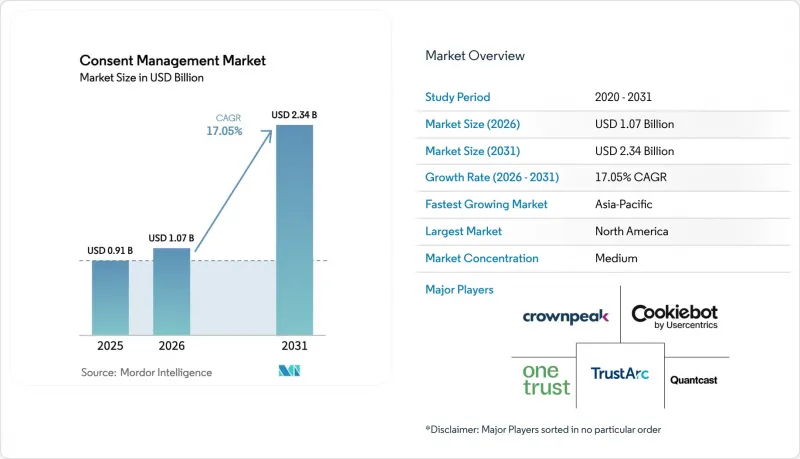
Mordor Intelligence에 의하면, 동의 관리 시장 규모는 2025년에 9억 1,000만 달러로 평가되었고, 2026년 10억 7,000만 달러에서 2031년까지 23억 4,000만 달러에 이를 것으로 예측되며, 예측 기간(2026-2031년) CAGR은 17.05%를 나타낼 전망입니다.
본 보고서는 구성 요소별(소프트웨어 및 서비스), 배포 모델별(클라우드 및 온프레미스), 접점별(웹 앱, 모바일 앱, API/SDK), 조직 규모별(대기업 및 중소기업), 최종 사용자 산업별(IT 및 통신, BFSI 등), 그리고 지역별로 분류되어 있습니다. 시장 예측은 금액(달러) 기준으로 제시되어 있습니다.
세계의 동의 관리 시장 동향 및 인사이트
전 세계적인 엄격한 개인정보 보호 규정 및 산업별 개인정보 보호 규제가 시장 성장을 주도
2025년에는 미국 8개 주에서 새로운 개인정보 보호법이 제정되고, 인도의 ‘디지털 개인 데이터 보호법’ 및 미국 법무부의 새로운 국가안보 규정이 시행됨에 따라 법 집행이 강화되어, 기업들은 동의 관리 도구와 거버넌스 프로세스를 개선할 수밖에 없었습니다. 메릴랜드주의 기밀 데이터 판매 금지나 뉴저지주의 미성년자 보호 강화와 같은 주법에서는 기존의 쿠키 팝업으로는 실현할 수 없는 매우 세밀한 권한 설정이 요구되고 있습니다. 금융 기관은 GDPR(EU 개인정보보호규정)에 따른 벌금 인상, 인도의 생체 인식 관련 보호 조치, 호주의 더욱 엄격해진 오픈 뱅킹 규제 등 유사한 압박에 직면해 있습니다. 2024년에 부과된 벌금은 종종 수백만 달러 규모에 달하며, 이로 인해 동의 플랫폼은 ‘선택적 추가 기능’이 아닌 ‘핵심 인프라’로 재정의되어 예산 재분배와 이사회 차원의 감독이 촉진되고 있습니다.
퍼스트 파티 데이터 전략이 동의 아키텍처를 재구축
구글이 써드파티 쿠키를 유지하는 한편, 2024년 8월에 통합형 CMP(동의 관리 플랫폼) 설정을 출시한 결정은 기업의 초점을 쿠키 규정 준수에에서 종합적인 데이터 거버넌스로 전환시켰으며, 동의 관리 시장의 중요성을 높였습니다. 조사에 따르면, 현재 B2C 브랜드의 78%가 직접적인 데이터 수집을 우선시하고 있으며, 웹, 앱, 서버 환경 전반에 걸쳐 사용자의 선호도를 존중하는 오케스트레이션 엔진에 대한 수요가 발생하고 있습니다. 마이크로소프트가 광고주들에게 2025년 5월 5일까지 동의 신호를 전송할 것을 의무화함에 따라, 동의 모드 및 실시간 선호도 API의 도입이 가속화되었습니다. Didomi 등 기업들이 추진하는 서버사이드 태깅은 규정 준수를 희생하지 않으면서 캠페인 성과를 유지하고, 개인정보를 보호하는 대안으로 주목받고 있습니다.
끊임없이 변화하는 여러 관할권에 걸친 요건들이 도입의 장벽이 되고 있습니다.
미국 19개 주, EU, 중국, 인도에서 사업을 전개하는 조직은 상충되는 옵트인, 옵트아웃, 데이터 현지화 규정을 모두 준수해야 하며, 그 결과 설정에 드는 부담과 법무 컨설팅 비용이 증가하고 있습니다. 인도의 ‘인가된 동의 관리자’라는 개념은 데이터 흐름에 새로운 주체를 추가하는 한편, 중국의 국경 간 보안 평가에서는 국내 사이버 보안 감사관의 데이터 지침을 충족하는 동의 기록이 요구됩니다. 세계 표준이 부재함에 따라 기업의 개인정보 보호 담당 팀은 병행되는 규정 체계를 유지할 수밖에 없으며, 이는 프로그램 총 예산의 최대 40%를 소모하고 도입 주기를 장기화시키고 있습니다.
부문 분석
2025년에는 소프트웨어 플랫폼이 매출의 66.80%를 차지했습니다. 이는 전체 디지털 자산으로 확장 가능한 자동 배너 표시, 기본 설정 볼트, 규정 준수 대시보드에 대한 지속적인 수요를 반영한 것입니다. 구축, 통합 및 규정 준수 관리를 포괄하는 서비스는 조직이 규정 해석 및 지속적인 모니터링을 외부에 위탁함에 따라 연평균 17.1%의 속도로 성장하고 있습니다. 이러한 추세는 정책의 복잡성이 ‘포인트 앤 클릭’ 방식의 설정 대응을 능가하고 있음을 여실히 보여주며, 법무, UX, DevSecOps 기술 세트를 겸비한 다분야 팀에 대한 수요를 높이고 있습니다.
각 서비스 제공업체는 자동 스캔, 스크립트 분류, 에지에서의 동의 현황 모니터링을 패키지화된 서비스에 통합하고 있으며, 이를 통해 프로젝트 기간을 단축하고 총 소유 비용(TCO)을 절감하고 있습니다. 이를 통해 기업은 규칙 세트의 지속적인 업데이트를 위탁할 수 있으며, 입법 기관의 법령 개정에 따라 배너가 적절히 적용되도록 보장할 수 있습니다. 예측 기간 동안, 특히 사내에 개인정보 보호 엔지니어를 보유하지 않은 중견 기업의 구매자층을 중심으로, 라이선스 소프트웨어와 부가가치 서비스를 결합한 하이브리드 모델이 주류를 이룰 것으로 보입니다.
2025년에는 클라우드 제공이 매출의 64.10%를 차지했으며, 예측 기간 동안 연평균 성장률(CAGR) 18.0%를 나타낼 것으로 예측됩니다. 각 브랜드는 지속적으로 업데이트되는 규칙, 지연 없는 배너 호출을 위한 세계 엣지 노드, 그리고 동의 신호 처리를 위한 탄력적인 컴퓨팅을 추구하고 있습니다. 업그레이드 프로젝트가 필요 없는 자동 기능 릴리스의 추진력에 힘입어, 클라우드 솔루션 분야의 동의 관리 시장 규모가 가장 빠르게 확대될 전망입니다. 의료 및 금융 서비스 분야에서는 데이터 상주 요건과 내부 감사 의무로 인해 로컬 스토리지가 요구되므로, 온프레미스 배포가 여전히 지속되고 있습니다. 그러나 이러한 부문에서도 분석 데이터나 개인을 식별할 수 없는 데이터를 안전한 클라우드 환경으로 라우팅하는 하이브리드 아키텍처로 전환하고 있습니다.
엣지 컴퓨팅은 더욱 미묘한 차이를 가져옵니다. 커넥티드카, 스마트 팩토리, 원격 의료기기에서는 중앙 서버에 항상 의존할 수 없는 저지연 동의 확인이 요구됩니다. 클라우드 벤더는 정책 로직을 로컬에 캐시해 두었습니다가 연결이 복구될 때 상태를 동기화하는 경량 에이전트를 제공함으로써 이에 대응하고 있으며, 주권 요건과 세계 오케스트레이션을 양립시키고 있습니다.
지역별 분석
북미는 캘리포니아주 개인정보 보호법, 주 차원의 법규 증가, 그리고 기업의 퍼스트 파티 데이터 거버넌스에 대한 집중에 힘입어 2025년 매출의 36.20%를 차지하며 가장 큰 비중을 차지했습니다. 연방 기관은 2025년 4월 감독을 더욱 강화하여, 미국의 기밀성이 높은 개인 데이터에 대한 외국인의 접근을 제한하는 한편, 의료 서비스 제공업체 및 클라우드 처리 업체에 동의 확인 강화를 의무화했습니다. 캐나다의 PIPEDA 개정과 멕시코에서 마련되고 있는 프레임워크로 인해 지역의 복잡성이 가중되고 있으며, 기업들은 주 및 국가별로 알림을 자동으로 조정할 수 있는 플랫폼으로의 전환을 서두르고 있습니다.
아시아태평양은 가장 빠르게 성장하는 지역으로, 인도의 ‘디지털 개인 데이터 보호법’이 ‘동의 관리자’를 공식적으로 규정하고, 중국이 국경을 넘는 데이터 이전에 관한 보안 평가를 시행하는 가운데, 2031년까지 연평균 성장률(CAGR) 17.4%로 확대될 것으로 전망됩니다. 일본, 한국, 호주는 성숙한 법 제도 하에서 안정적인 도입을 유지하고 있는 반면, 인도네시아, 베트남, 필리핀은 시행 단계에 접어들어 새로운 수요를 창출할 전망입니다. 인구가 많은 시장에서 사용자들의 피로감이 시각적으로 세련된 알림 디자인의 혁신과 대체 법적 근거의 확립을 촉진하고 있습니다.
유럽은 성숙해 가면서도 계속 진화하는 시장입니다. GDPR(EU 개인정보보호규정)은 여전히 규정 준수의 기반이 되고 있지만, 독일의 ‘동의 관리 규정’과 EU의 AI 법에 따라 인터페이스 개선 및 알고리즘 투명성이 요구되는 새로운 요건이 추가되었습니다. ‘동의 또는 결제’ 모델을 둘러싼 EU 전역의 논의가, 공정한 무료 대안을 제공하는 선호도 센터의 개발을 뒷받침하고 있습니다. 영국에서는 브렉시트 이후 규정이 변경되면서 옵트아웃 방식에 차이가 발생하고 있어, 공급업체는 EU 및 영국 방문자 각각에 대응할 수 있는 설정 가능한 템플릿을 유지할 수밖에 없는 상황입니다.
기타 혜택 :
- 엑셀 형식 시장 예측(ME) 시트
- 3개월간의 애널리스트 지원
자주 묻는 질문
목차
제1장 서론
제2장 조사 방법
제3장 개요
제4장 시장 구도
제5장 시장 규모 및 성장 예측
제6장 경쟁 구도
제7장 시장 기회 및 향후 전망
AJY 26.09.01According to Mordor Intelligence, the consent management market size was valued at USD 0.91 billion in 2025 and estimated to grow from USD 1.07 billion in 2026 to reach USD 2.34 billion by 2031, at a CAGR of 17.05% during the forecast period (2026-2031).
This report is Segmented by Component (Software and Services), Deployment Model (Cloud and On-Premises), Touchpoint (Web App, Mobile App, and API/SDK), Organization Size (Large Enterprises and SMEs), End-User Industry (IT and Telecom, BFSI, and More), and by Geography. The Market Forecasts are Provided in Terms of Value (USD).
Global Consent Management Market Trends and Insights
Stringent global and sector-specific privacy rules drive market expansion
Intensified enforcement arrived in 2025 as eight additional US state privacy statutes, India's Digital Personal Data Protection Act, and new Department of Justice national-security rules forced enterprises to refresh consent tooling and governance processes. State laws such as Maryland's ban on sensitive data sales and New Jersey's heightened protections for minors require hyper-granular permissioning that legacy cookie pop-ups cannot deliver. Financial institutions face parallel pressures from rising GDPR penalties, India's biometric safeguards, and Australia's stricter open-banking mandates. Penalties levied in 2024, often reaching multimillion-dollar sums, have reframed consent platforms as core infrastructure rather than discretionary add-ons, triggering budget reallocations and board-level oversight.
First-party data strategies reshape consent architecture
Google's decision to retain third-party cookies, while releasing an integrated CMP setup in August 2024, elevated the consent management market by shifting the enterprise focus from cookie compliance to holistic data governance. Research shows that 78% of B2C brands now prioritize direct data collection, creating demand for orchestration engines that honor user preferences across web, app, and server environments. Microsoft's requirement that advertisers pass consent signals by May 5, 2025, accelerated the adoption of consent mode and real-time preference APIs.Server-side tagging, championed by firms such as Didomi, is gaining traction as a privacy-preserving alternative that maintains campaign performance without sacrificing compliance.
Constantly shifting multi-jurisdictional requirements create implementation barriers
Organizations operating across 19 US states, the EU, China, and India must juggle conflicting opt-in, opt-out, and data-localization rules, inflating configuration overhead and legal consulting spend. India's concept of licensed "consent managers" adds a new actor to data flows, while China's cross-border security assessments require consent records that satisfy domestic cybersecurity auditors' data guidance. Absent global standards, enterprise privacy teams maintain parallel rule sets, consuming as much as 40% of total program budgets and prolonging deployment cycles.
Other drivers and restraints analyzed in the detailed report include:
- Data-trust user experience emerges as a competitive differentiator
- Embedded consent inside IoT-edge devices stimulates technical innovation
- SMB budget constraints limit market penetration
For complete list of drivers and restraints, kindly check the Table Of Contents.
Segment Analysis
Software platforms generated 66.80% revenue in 2025, reflecting enduring demand for automated banner rendering, preference vaults, and compliance dashboards that scale across digital estates. Services, covering implementation, integration, and managed compliance, are expanding at 17.1% annually as organizations outsource regulatory interpretation and ongoing monitoring. This momentum underscores how policy complexity outpaces point-and-click configuration, elevating demand for multidisciplinary teams that combine legal, UX, and DevSecOps skill sets.
Services providers are embedding automated scanning, script categorization, and edge consent monitoring into packaged offerings, shortening project timelines and lowering total cost of ownership. Enterprises can thus delegate continuous rule-set updates, ensuring banners adapt as legislatures revise statutes. Over the forecast window, hybrid models bundling licensed software with value-added services will become prevalent, especially for mid-market buyers lacking in-house privacy engineers.
Cloud delivery captured 64.10% revenue in 2025, expected to register a CAGR of 18.0% over the forecast period. As brands pursued always-on rule updates, global edge nodes for latency-free banner calls, and elastic compute for consent signal processing. The consent management market size for cloud solutions will expand fastest, supported by automatic feature releases that eliminate upgrade projects. On-premises deployments persist in healthcare and financial services, where data residency and internal audit obligations dictate local storage, yet even these sectors gravitate toward hybrid architectures that route analytics and non-identifying data to secure-cloud environments.
Edge computing introduces additional nuance. Connected cars, smart factories, and remote medical devices demand low-latency consent checks that cannot always rely on central servers. Cloud vendors respond with lightweight agents that cache policy logic locally while synchronizing state when connectivity resumes, marrying sovereignty requirements with global orchestration.
Complete Report Scope:
- By Component
- Software
- Services
- By Deployment Model
- Cloud
- On-premises
- By TouchPoint
- Web App
- Mobile App
- API/SDK
- By Organisation Size
- Large Enterprises
- Small and Mid-sized Enterprises
- By End-User Industry
- IT and Telecom
- Government and Public Sector
- Healthcare and Life Sciences
- Retail and E-commerce
- BFSI
- Media and Entertainment
- Others (Travel, Education)
- By Geography
- North America
- United States
- Canada
- Mexico
- South America
- Brazil
- Argentina
- Rest of South America
- Europe
- Germany
- United Kingdom
- France
- Italy
- Spain
- Russia
- Rest of Europe
- Asia Pacific
- China
- Japan
- India
- South Korea
- Australia
- Rest of Asia Pacific
- Middle East and Africa
- Middle East
- Saudi Arabia
- United Arab Emirates
- Turkey
- Rest of Middle East
- Africa
- South Africa
- Nigeria
- Kenya
- Rest of Africa
- Middle East
- North America
Geography Analysis
North America generated the largest portion of 2025 revenue at 36.20%, buoyed by the California Privacy Rights Act, rising state-level statutes, and corporate focus on first-party data governance. Federal agencies further tightened oversight in April 2025, restricting foreign access to sensitive US personal data and compelling health providers and cloud processors to upgrade consent verification. Canada's PIPEDA amendments and Mexico's emerging framework compound regional complexity, driving enterprises to platforms that can auto-calibrate notices by state and country.
Asia-Pacific is the fastest-growing region, rising at 17.4% CAGR through 2031 as India's Digital Personal Data Protection Act formalizes "consent managers" and China enforces cross-border transfer security assessments. Japan, South Korea, and Australia maintain stable adoption under mature regimes, while Indonesia, Vietnam, and the Philippines enter enforcement phases that will unlock fresh demand. User fatigue within populous markets fuels innovation in visually streamlined notice design and alternative lawful bases.
Europe remains a mature yet evolving arena. The GDPR continues to anchor compliance, but Germany's Consent Management Ordinance and the EU AI Act add fresh layers that require interface refinements and algorithmic transparency. Pan-EU debate around "consent or pay" models spurs the development of preference centers that offer equitable free alternatives. The United Kingdom's evolving post-Brexit rules create divergent opt-out mechanics, forcing vendors to maintain configurable templates for EU and UK visitors.
- OneTrust
- TrustArc
- Cookiebot
- Quantcast
- Crownpeak
- Didomi
- BigID
- Osano
- Piwik PRO
- Trunomi
- HIPAA-T
- Ketch
- Usercentrics
- Civic UK
- ConsentManager.net
- Sourcepoint Technologies
- Termly
- Securiti.ai
- MineOS (Mine PrivacyOps)
- Privado.ai
- IBM
- Salesforce
Additional Benefits:
- The market estimate (ME) sheet in Excel format
- 3 months of analyst support
TABLE OF CONTENTS
1 INTRODUCTION
- 1.1 Study Assumptions and Market Definition
- 1.2 Scope of the Study
2 RESEARCH METHODOLOGY
3 EXECUTIVE SUMMARY
4 MARKET LANDSCAPE
- 4.1 Market Overview
- 4.2 Market Drivers
- 4.2.1 Stringent global and sector-specific privacy rules (GDPR, CCPA, HIPAA etc.)
- 4.2.2 Explosion of first-party data strategies post third-party cookie deprecation
- 4.2.3 Rise of data-trust UX as a competitive differentiator
- 4.2.4 Embedded consent inside IoT-edge devices (wearables, vehicles)
- 4.2.5 Automated privacy as code pipelines in DevSecOps stacks
- 4.2.6 Consent tokens as verifiable credentials in Web3 ecosystems
- 4.3 Market Restraints
- 4.3.1 Constantly shifting multi-jurisdictional requirements
- 4.3.2 Low executive budgets in SMBs for privacy tooling
- 4.3.3 Consumer consent fatigue reducing opt-in rates
- 4.3.4 Absence of universal consent interoperability standards
- 4.4 Supply-Chain Analysis
- 4.5 Regulatory Landscape
- 4.6 Technological Outlook
- 4.7 Porters Five Forces Analysis
- 4.7.1 Bargaining Power of Suppliers
- 4.7.2 Bargaining Power of Buyers
- 4.7.3 Threat of New Entrants
- 4.7.4 Threat of Substitute Products
- 4.7.5 Intensity of Competitive Rivalry
- 4.8 Assesment of Macroeconomic Trends on the Market
5 MARKET SIZE AND GROWTH FORECASTS (VALUE)
- 5.1 By Component
- 5.1.1 Software
- 5.1.2 Services
- 5.2 By Deployment Model
- 5.2.1 Cloud
- 5.2.2 On-premises
- 5.3 By TouchPoint
- 5.3.1 Web App
- 5.3.2 Mobile App
- 5.3.3 API/SDK
- 5.4 By Organisation Size
- 5.4.1 Large Enterprises
- 5.4.2 Small and Mid-sized Enterprises
- 5.5 By End-User Industry
- 5.5.1 IT and Telecom
- 5.5.2 Government and Public Sector
- 5.5.3 Healthcare and Life Sciences
- 5.5.4 Retail and E-commerce
- 5.5.5 BFSI
- 5.5.6 Media and Entertainment
- 5.5.7 Others (Travel, Education)
- 5.6 By Geography
- 5.6.1 North America
- 5.6.1.1 United States
- 5.6.1.2 Canada
- 5.6.1.3 Mexico
- 5.6.2 South America
- 5.6.2.1 Brazil
- 5.6.2.2 Argentina
- 5.6.2.3 Rest of South America
- 5.6.3 Europe
- 5.6.3.1 Germany
- 5.6.3.2 United Kingdom
- 5.6.3.3 France
- 5.6.3.4 Italy
- 5.6.3.5 Spain
- 5.6.3.6 Russia
- 5.6.3.7 Rest of Europe
- 5.6.4 Asia Pacific
- 5.6.4.1 China
- 5.6.4.2 Japan
- 5.6.4.3 India
- 5.6.4.4 South Korea
- 5.6.4.5 Australia
- 5.6.4.6 Rest of Asia Pacific
- 5.6.5 Middle East and Africa
- 5.6.5.1 Middle East
- 5.6.5.1.1 Saudi Arabia
- 5.6.5.1.2 United Arab Emirates
- 5.6.5.1.3 Turkey
- 5.6.5.1.4 Rest of Middle East
- 5.6.5.2 Africa
- 5.6.5.2.1 South Africa
- 5.6.5.2.2 Nigeria
- 5.6.5.2.3 Kenya
- 5.6.5.2.4 Rest of Africa
- 5.6.5.1 Middle East
- 5.6.1 North America
6 COMPETITIVE LANDSCAPE
- 6.1 Market Concentration
- 6.2 Strategic Moves
- 6.3 Market Share Analysis
- 6.4 Company Profiles (includes Global level Overview, Market level overview, Core Segments, Financials as available, Strategic Information, Market Rank/Share for key companies, Products and Services, and Recent Developments)
- 6.4.1 OneTrust
- 6.4.2 TrustArc
- 6.4.3 Cookiebot
- 6.4.4 Quantcast
- 6.4.5 Crownpeak
- 6.4.6 Didomi
- 6.4.7 BigID
- 6.4.8 Osano
- 6.4.9 Piwik PRO
- 6.4.10 Trunomi
- 6.4.11 HIPAA-T
- 6.4.12 Ketch
- 6.4.13 Usercentrics
- 6.4.14 Civic UK
- 6.4.15 ConsentManager.net
- 6.4.16 Sourcepoint Technologies
- 6.4.17 Termly
- 6.4.18 Securiti.ai
- 6.4.19 MineOS (Mine PrivacyOps)
- 6.4.20 Privado.ai
- 6.4.21 IBM
- 6.4.22 Salesforce
7 MARKET OPPORTUNITIES AND FUTURE OUTLOOK
- 7.1 White-space and Unmet-need Assessment