

|
시장보고서
상품코드
2117200
에피네프린 자동 주사기 시장 : 시장 점유율 분석, 업계 동향 및 통계, 성장 예측(2026-2031년)Epinephrine Autoinjector - Market Share Analysis, Industry Trends & Statistics, Growth Forecasts (2026 - 2031) |
||||||
 Mordor Intelligence
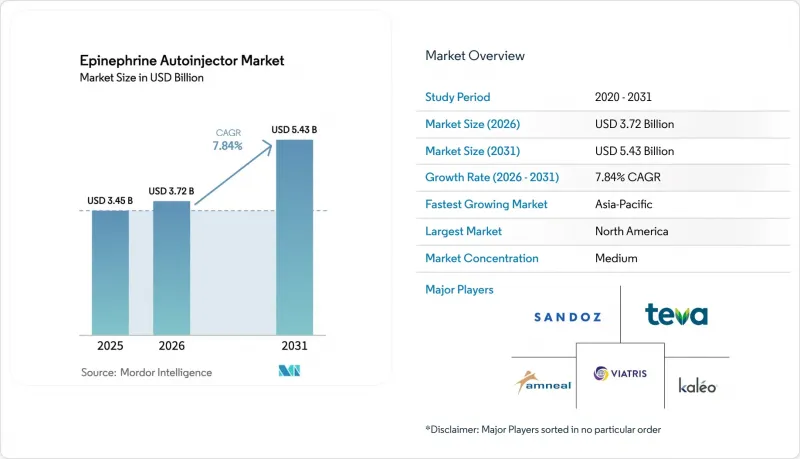
Mordor Intelligence에 의하면, 에피네프린 자동 주사기 시장 규모는 2025년에 34억 5,000만 달러로 평가되었고, 2026년 37억 2,000만 달러에서 2031년까지 54억 3,000만 달러에 이를 것으로 예측되며, 예측 기간(2026-2031년) CAGR은 7.84%를 나타낼 전망입니다.
본 보고서는 투여량별(0.10 mg, 0.15 mg, 0.30 mg 및 0.50 mg), 연령대별(12세), 최종 사용자별(병원, 진료소, 재택 간호 이용자, 학교·대학, 응급 의료 서비스), 지역별(북미, 유럽, 아시아태평양, 중동 및 아프리카, 남미)로 분류되어 있습니다. 시장 예측은 금액(달러) 기준으로 제시되어 있습니다.
세계의 에피네프린 자동 주사기 시장 동향 및 인사이트
심각한 알레르기 질환으로 인한 전 세계적 부담 증가
식품, 의약품, 환경 알레르기가 급속히 증가함에 따라 수요 패턴이 변화하고 있습니다. 매년 약 4,000만 명의 미국인이 제1형 알레르기 반응을 보고하고 있습니다. 소아의 유병률이 가장 빠르게 상승하고 있으며, 현재 13명 중 1명의 어린이가 식품 알레르기를 앓고 있습니다. 임상의들의 조기 선별 검사 도입과 지역사회 건강 인식 제고 캠페인이 신속한 대응을 강조함에 따라, 응급용 기기의 처방량은 수 배로 증가했습니다. 이러한 동향은 자기강화적이며, 진단 범위의 확대가 시장 침투율을 높이고, 유통되는 기기 증가가 치료 성과를 향상시키며, 양호한 치료 성과가 추가적인 선별 검사를 촉진하고 있습니다. 각 제조업체는 연령에 따른 투여량이나 무바늘형 등의 제품을 제공함으로써 이에 대응하고 있으며, 새로운 환자층이 사용하기 쉬운 투여 방법을 찾을 수 있도록 배려하고 있습니다.
유리한 규제 및 보험 급여 환경
유연한 태도를 보이는 규제 당국과 보험 지급 기관이 더 광범위한 접근의 길을 열어주고 있습니다. FDA는 2024년에 네피(neffy) 비강 스프레이를 승인했으며, 2025년 3월에는 신속하게 소아 적응증을 추가했습니다. OptumRx, Cigna Healthcare, Navitus 각사의 전국 처방약 목록에 해당 제품이 등재되었으며, 이 3개사를 합치면 약 2,000만 명의 피보험자를 포괄합니다. 뉴욕주에서는 2026년부터 2개입 제품의 소비자 가격 상한선을 100달러로 설정하여, 가격에 민감한 계층의 주요 장벽을 제거했습니다. 유럽도 이러한 추세를 따르며, EURneffy에 대해 중앙 승인과 8년간의 데이터 독점권을 부여했습니다. 이는 미충족 의료 수요에 대응하는 혁신이 규제 당국의 지원을 받고 있음을 보여주는 명확한 신호입니다. 한편, 메디케어 파트 D에서는 많은 제네릭 의약품이 ‘우선 의약품’으로 분류되어 있어, 이를 통해 고령자의 본인 부담금이 억제되고 처방률이 향상되고 있습니다.
여전히 높은 본인 부담 비용
제네릭 의약품의 보급으로 정가는 점차 하락하고 있지만, 미국의 많은 보험 플랜에서는 고액의 본인 부담금(면책액)이 설정되어 있어, 가구당 평균 처방전 비용은 328.03달러, 평균 본인 부담금은 31.90달러에 달할 전망입니다. 각 가구는 일반적으로 가정, 학교, 여행지에서의 사용을 대비해 여러 팩을 구매하기 때문에 비용 부담은 더욱 커지고 있습니다. 또한, 보험 플랜의 처방약 목록은 매년 변경되므로 환자는 새로운 승인 규정을 파악해야 합니다. 지원 프로그램을 통해 본인부담금 상한선이 설정되는 경우도 있지만, 무보험자는 여전히 위험에 노출되어 있습니다. 경제적 부담으로 인해 유효기간이 지난 후에도 처방전 갱신이 지연될 수 있어, 응급 상황에서 환자가 보호를 받지 못할 뿐만 아니라 시장의 최대 보급에도 차질이 생기고 있습니다.
부문 분석
2025년에는 처방전의 대부분을 차지하는 성인 및 청소년을 대상으로 하기 때문에 0.30 mg 제제가 매출의 47.92%를 차지하며 시장을 독점했습니다. 그러나 0.10 mg 소아용 제제는 2031년까지 연평균 성장률(CAGR) 13.62%로 성장하고 있습니다. 이 용량의 에피네프린 자가 주사기 시장 규모는 2025년에 체중 15-30kg의 소아용 ‘네피 1mg’이 FDA 승인을 받은 데서 직접적인 혜택을 받고 있습니다. 약동학 연구에 따르면, 소아 사용자는 성인보다 비강 투여 시 에피네프린의 혈장 농도가 더 높게 나타나는 것으로 밝혀졌으며, 이는 체중에 따른 투여량 조정의 타당성을 뒷받침합니다. 각 제조업체는 근육량이 적은 소아에 맞추어 플런저의 누르는 힘과 바늘 길이를 재설계하여 내약성을 향상시키고 있습니다. 중증 알레르기가 있는 영아를 치료하는 진료소에서는 현재 3가지 용량을 재고로 보유하고 있으며, 재주문 품목 수가 증가하고 있습니다.
처방 의사가 체중의 정확한 구분에 따라 용량을 조정하는 가운데, 0.15 mg의 ‘브리지 옵션’은 최저 용량 구간에서 넘어가는 소아에게 여전히 중요한 역할을 하고 있습니다. 상한선에서는 0.50 mg이 비만이나 비만 세포 장애가 있는 환자에게 대응하고 있습니다. SKU마다 실린더 직경과 스프링 강도가 다르기 때문에 제조의 복잡성이 증가하고 금형 비용이 상승하고 있습니다. 특히, 투여량이 부족할 경우 위험이 높아지는 소아용 제품의 경우, 품질 관리 프로토콜을 통해 투여량의 편차를 엄격하게 관리해야 합니다. 성공적인 공급업체들은 모듈식 플랫폼 설계와 공통 부품군을 활용함으로써 엔지니어링에 소요되는 간접비를 상쇄하고 있습니다.
지역별 분석
북미는 여전히 가장 큰 기여 지역으로, 2025년 전 세계 매출의 42.25%를 차지하고 있습니다. 미국에서는 종합적인 보험 적용과 ‘Food Allergy Research & Education’ 등의 단체에 의한 적극적인 계몽 활동이 맞물려 1인당 기기 보유 수가 많습니다. 연방 항공 규정과 주 정부의 가격 상한 조치가 수요를 뒷받침하고 있습니다. 캐나다의 국민건강보험 제도에서는 여러 주에서 소아용 에피네프린이 급여 대상에 포함되어 있어, 인구 통계학적 각 계층에 걸쳐 수요가 균등하게 분포되어 있습니다. 멕시코 시장은 규모는 작지만, 민간 보험사가 알레르기 관련 급여를 확대하고 있으며, 도시 지역의 진료소가 병원 내 응급 상황에 대비해 재고를 확보하고 있어 성장을 지속하고 있습니다.
아시아태평양은 2031년까지 연평균 성장률(CAGR)이 11.32%로 가장 빠르게 성장하고 있습니다. 중국, 일본, 한국의 3차 의료기관에서는 진단 능력이 급속히 확대되고 있습니다. ARS 파마슈티컬스는 ALK-Abello를 통해 2024년에 이 3개국 모두에서 네피의 승인 신청을 진행할 예정이며, 규제 당국의 수용성에 대한 자신감을 보이고 있습니다. 일본 후생노동성은 소아 식품 알레르기를 위한 자동 주사기에 대해 이미 보조금을 지급하고 있지만, 이용 실태 조사에 따르면 아이들이 기기를 휴대하는 것을 잊어버려 치료 기회를 놓치고 있는 것으로 드러났습니다. 현재 보호자 및 스포츠 코치를 대상으로 한 인식 제고 캠페인이 진행되어 휴대 습관이 정착되도록 노력하고 있습니다. 의료시설 간 이동 거리가 긴 호주에서는 자가 투여용 기기가 필수적인 것으로 간주되며, 해당 국가의 의약품 급여 제도(Pharmaceutical Benefits Scheme)에서는 여러 용량이 지원 대상에 포함되어 후한 보조금이 지급되고 있습니다.
유럽에서는 시장 점유율이 성숙 단계에 접어들었음에도 꾸준히 유지되고 있습니다. 2024년 유럽의약품청(EMA)이 ‘EURneffy’를 승인한 것은 대체 투여 시스템에 있어 선례가 되었습니다. 지속가능성에 대한 요구도 높아지고 있어, ALK-Abello사는 2030년까지 이산화탄소 배출량을 42% 감축하겠다고 공약했으며, 스칸디나비아 국가들의 조달 컨소시엄에서는 가격 외에도 수명 주기 영향 점수도 평가 대상으로 삼고 있습니다(alk.net). 독일의 공적 의료보험에서는 오토인젝터가 고정 기준가로 환급되므로 제네릭 의약품이 경쟁하고 있습니다. 영국에서는 국민건강서비스(NHS)의 조달과 사립 학교의 구매에 모두 의존하고 있어 이중 유통 경로가 형성되어 있습니다. 이탈리아와 스페인에서는 소아 식품 알레르기에 관한 지침이 강화되어 지역 사회에서의 사용이 증가하고 있습니다.
중동 및 아프리카, 남미의 신흥 시장에서는 여전히 경제적 제약에 직면하고 있지만, 민간 병원에 대한 외국인 직접 투자와 중산층의 보험 가입률 향상이라는 혜택을 받고 있습니다. 걸프협력회의(GCC) 회원국에서는 대규모 공공시설에 자동 주사기 설치를 의무화하고 있으며, 아랍에미리트(UAE)의 의료 관광 거점에서는 방문 환자를 대응하기 위해 여러 용량의 제품을 비축하고 있습니다. 브라질의 안비사(Anvisa)는 2024년에 아나필락시스 관련 지침을 개정할 예정이며, 지역별 표시 및 언어 요건을 충족할 수 있는 공급업체에게는 입찰 기회가 생길 것으로 예측됩니다.
기타 혜택 :
- 엑셀 형식 시장 예측(ME) 시트
- 3개월간의 애널리스트 지원
자주 묻는 질문
목차
제1장 서론
제2장 조사 방법
제3장 개요
제4장 시장 구도
제5장 시장 규모 및 성장 예측
제6장 경쟁 구도
제7장 시장 기회 및 향후 전망
AJY 26.09.01According to Mordor Intelligence, the epinephrine autoinjector market size was valued at USD 3.45 billion in 2025 and estimated to grow from USD 3.72 billion in 2026 to reach USD 5.43 billion by 2031, at a CAGR of 7.84% during the forecast period (2026-2031).
This report is Segmented by Dosage Strength (0. 10 Mg, 0. 15 Mg, 0. 30 Mg, and 0. 50 Mg), Age-Group ( 12 Years), End-User (Hospitals, Clinics, Homecare Individuals, Schools & Universities, and Emergency Medical Services), Geography (North America, Europe, Asia-Pacific, The Middle East and Africa, and South America). The Market Forecasts are Provided in Terms of Value (USD).
Global Epinephrine Autoinjector Market Trends and Insights
Escalating Global Burden of Severe Allergic Disorders
Rapid growth in food, drug and environmental allergies is reshaping demand patterns. Approximately 40 million Americans report Type I allergic reactions each year. Pediatric incidence is climbing fastest, with 1 in 13 children now living with food allergies. As clinicians adopt earlier screening and community health campaigns stress rapid response, prescription volumes for rescue devices have multiplied. The dynamic is self-reinforcing: wider diagnosis raises market penetration, more devices in circulation improve outcomes and positive outcomes encourage additional screening. Manufacturers are responding with age-specific doses and needle-free formats, ensuring that new patient cohorts find a comfortable delivery option.
Favorable Regulatory and Reimbursement Ecosystem
Flexible regulators and payors are clearing a path for broader access. The FDA approved neffy nasal spray in 2024 and quickly added a pediatric indication in March 2025. National formularies at OptumRx, Cigna Healthcare and Navitus now include the product, together reaching about 20 million covered lives. New York State has capped the consumer price of a two-pack at USD 100 starting in 2026, removing a key barrier in a price-sensitive demographic. Europe mirrored the trend by granting central approval plus eight-year data exclusivity for EURneffy, sending a clear signal that innovation addressing unmet need will receive regulatory support. Meanwhile, Medicare Part D classifies many generics as preferred, pushing down patient co-pays and lifting fill rates in senior populations.
Persistently High Out-of-Pocket Costs
Although generic expansion is narrowing list prices, many United States insurance plans carry high deductibles, leaving families with average prescription expenses of USD 328.03 and mean out-of-pocket costs of USD 31.90. Households typically purchase multiple packs to cover home, school and travel, compounding cost burden. Plan formularies also shift annually, forcing patients to navigate new authorisation rules. Assistance programmes cap co-pays for some, yet the uninsured remain exposed. Financial strain can delay refills past expiration, leaving patients unprotected during an emergency and limiting maximum market penetration.
Other drivers and restraints analyzed in the detailed report include:
- Growth in Point-of-Care Self-Administration Culture
- Institutional Stocking Mandates Across Public Spaces
- Vulnerabilities in Manufacturing and Supply Networks
For complete list of drivers and restraints, kindly check the Table Of Contents.
Segment Analysis
The 0.30 mg format dominated revenue with 47.92% share in 2025 because it targets adults and adolescents who account for most prescriptions. Yet the 0.10 mg pediatric dose advances at a 13.62% CAGR through 2031. The epinephrine autoinjector market size for this strength benefits directly from FDA approval of neffy 1 mg for children weighing 15-30 kg, which arrived in 2025. Pharmacokinetic studies show pediatric users achieve higher epinephrine plasma exposure from nasal delivery than adults, supporting weight-based titration. Manufacturers have redesigned plunger force and needle length for smaller musculature, improving tolerability. Clinics that treat severe infant allergies now maintain three strengths in inventory, widening reorder baskets.
As prescribers match dose to precise weight bands, the 0.15 mg bridge option retains relevance for children graduating from the lowest category. At the upper end, 0.50 mg caters to patients with mast-cell disorders or obesity. Production complexity rises as barrel diameter and spring force vary by SKU, raising tooling costs. Quality control protocols must keep dose-delivery variance tight, especially for pediatric units where under-dosing carries heightened risk. Successful vendors amortise engineering overhead by leveraging modular platform designs and common component families.
Complete Report Scope:
- By Dosage Strength
- 0.10 mg
- 0.15 mg
- 0.30 mg
- 0.50 mg
- By Age-Group
- <6 Years
- 6-12 Years
- > 12 Years
- By End-User
- Hospitals
- Clinics
- Homecare Individuals
- Schools & Universities
- Emergency Medical Services (EMS)
- Geography
- North America
- United States
- Canada
- Mexico
- Europe
- Germany
- United Kingdom
- France
- Italy
- Spain
- Rest of Europe
- Asia-Pacific
- China
- Japan
- India
- Australia
- South Korea
- Rest of Asia-Pacific
- Middle East & Africa
- GCC
- South Africa
- Rest of Middle East & Africa
- South America
- Brazil
- Argentina
- Rest of South America
- North America
Geography Analysis
North America remains the largest contributor, delivering 42.25% of 2025 global revenue. The United States blends strong insurance coverage with proactive advocacy by groups such as Food Allergy Research & Education, driving high per-capita device counts. Federal aviation regulations and state price-cap measures add structural floors under demand. Canada's universal pharmacare covers epinephrine for children in multiple provinces, smoothing volume across demographic tiers. Mexico's market is smaller but growing as private insurers extend allergy benefits and urban clinics purchase stock for on-site emergencies.
Asia-Pacific is the fastest growing at an 11.32% CAGR through 2031. Diagnostic capacity is expanding rapidly in tertiary hospitals across China, Japan and South Korea. ARS Pharmaceuticals, through ALK-Abello, filed for neffy approval in all three countries in 2024, signalling confidence in regulatory receptivity. Japan's Ministry of Health already subsidises autoinjectors for paediatric food allergy, although utilisation studies reveal missed opportunities when children forget to carry devices. Awareness campaigns now target parents and sports coaches, reinforcing carriage behaviour. Australia, with long travel distances between medical facilities, regards self-administration devices as critical; its Pharmaceutical Benefits Scheme lists multiple strengths with generous subsidies.
Europe holds a mature but steady share. EMA approval of EURneffy in 2024 set a precedent for alternative delivery systems. Sustainability imperatives resonate: ALK-Abello has pledged a 42% carbon-emission cut by 2030, and procurement consortia in Scandinavia now evaluate life-cycle impact scores alongside price alk.net. Germany's statutory insurance reimburses autoinjectors at fixed reference prices, making generics competitive. The United Kingdom relies on both National Health Service procurement and private-school purchasing, creating dual channels. Italy and Spain have strengthened paediatric-food-allergy guidelines, prompting higher community use.
Emerging territories in the Middle East, Africa and South America still face affordability constraints yet benefit from foreign direct investment in private hospitals and from growing middle-class insurance uptake. Gulf Cooperation Council nations require autoinjectors in large public venues, and medical tourism hubs in the United Arab Emirates stock multiple strengths to cater to visiting patients. Brazil's Anvisa updated anaphylaxis guidelines in 2024, foreshadowing tender opportunities for suppliers who can meet regional labelling and language requirements.
- Adamis Pharmaceuticals
- ALK-Abello
- Amneal Pharmaceuticals
- Antares Pharma
- Bausch Health
- Kalo Inc.
- Viatris
- Pfizer
- Sandoz Group
- Sanofi
- Teva Pharmaceutical Industries
- Emergent Bio Solutions
- Amedra Pharmaceuticals
- Lincoln Medical Ltd.
- SHL Medical
- Owen Mumford
- Ypsomed
- Aptar Pharma
- West Pharmaceutical Services
- Becton Dickinson & Co.
Additional Benefits:
- The market estimate (ME) sheet in Excel format
- 3 months of analyst support
TABLE OF CONTENTS
1 Introduction
- 1.1 Study Assumptions & Market Definition
- 1.2 Scope of the Study
2 Research Methodology
3 Executive Summary
4 Market Landscape
- 4.1 Market Overview
- 4.2 Market Drivers
- 4.2.1 Escalating Global Burden of Severe Allergic Disorders
- 4.2.2 Favorable Regulatory and Reimbursement Ecosystem
- 4.2.3 Expansion of Generic and Authorized Generic Offerings
- 4.2.4 Growth In Point-of-Care Self-Administration Culture
- 4.2.5 Integration of Advanced Digital Health Features
- 4.2.6 Institutional Stocking Mandates Across Public Spaces
- 4.3 Market Restraints
- 4.3.1 Persistently High Out-of-Pocket Costs
- 4.3.2 Vulnerabilities In Manufacturing and Supply Networks
- 4.3.3 Emergence of Non-Injection Epinephrine Delivery Modalities
- 4.3.4 Sustainability Concerns Around Disposable Devices
- 4.4 Regulatory Landscape
- 4.5 Porter's Five Forces Analysis
- 4.5.1 Threat of New Entrants
- 4.5.2 Bargaining Power of Buyers
- 4.5.3 Bargaining Power of Suppliers
- 4.5.4 Threat of Substitute Products
- 4.5.5 Intensity of Competitive Rivalry
5 Market Size & Growth Forecasts (Value, USD)
- 5.1 By Dosage Strength
- 5.1.1 0.10 mg
- 5.1.2 0.15 mg
- 5.1.3 0.30 mg
- 5.1.4 0.50 mg
- 5.2 By Age-Group
- 5.2.1 <6 Years
- 5.2.2 6-12 Years
- 5.2.3 > 12 Years
- 5.3 By End-User
- 5.3.1 Hospitals
- 5.3.2 Clinics
- 5.3.3 Homecare Individuals
- 5.3.4 Schools & Universities
- 5.3.5 Emergency Medical Services (EMS)
- 5.4 Geography
- 5.4.1 North America
- 5.4.1.1 United States
- 5.4.1.2 Canada
- 5.4.1.3 Mexico
- 5.4.2 Europe
- 5.4.2.1 Germany
- 5.4.2.2 United Kingdom
- 5.4.2.3 France
- 5.4.2.4 Italy
- 5.4.2.5 Spain
- 5.4.2.6 Rest of Europe
- 5.4.3 Asia-Pacific
- 5.4.3.1 China
- 5.4.3.2 Japan
- 5.4.3.3 India
- 5.4.3.4 Australia
- 5.4.3.5 South Korea
- 5.4.3.6 Rest of Asia-Pacific
- 5.4.4 Middle East & Africa
- 5.4.4.1 GCC
- 5.4.4.2 South Africa
- 5.4.4.3 Rest of Middle East & Africa
- 5.4.5 South America
- 5.4.5.1 Brazil
- 5.4.5.2 Argentina
- 5.4.5.3 Rest of South America
- 5.4.1 North America
6 Competitive Landscape
- 6.1 Market Concentration
- 6.2 Market Share Analysis
- 6.3 Company Profiles (includes Global level Overview, Market level overview, Core Business Segments, Financials, Headcount, Key Information, Market Rank, Market Share, Products and Services, and analysis of Recent Developments)
- 6.3.1 Adamis Pharmaceuticals Corporation
- 6.3.2 ALK-Abell A/S
- 6.3.3 Amneal Pharmaceuticals LLC
- 6.3.4 Antares Pharma
- 6.3.5 Bausch & Lomb Inc.
- 6.3.6 Kalo Inc.
- 6.3.7 Viatris Inc.
- 6.3.8 Pfizer Inc.
- 6.3.9 Sandoz
- 6.3.10 Sanofi SA
- 6.3.11 Teva Pharmaceutical Industries Ltd.
- 6.3.12 Emergent BioSolutions
- 6.3.13 Amedra Pharmaceuticals
- 6.3.14 Lincoln Medical Ltd.
- 6.3.15 SHL Medical
- 6.3.16 Owen Mumford
- 6.3.17 Ypsomed
- 6.3.18 Aptar Pharma
- 6.3.19 West Pharmaceutical Services
- 6.3.20 Becton Dickinson & Co.
7 Market Opportunities & Future Outlook
- 7.1 White-space & Unmet-Need Assessment


