

|
시장보고서
상품코드
2117201
의료 분야 가상현실(VR) 시장 : 시장 점유율 분석, 업계 동향 및 통계, 성장 예측(2026-2031년)Virtual Reality In Healthcare - Market Share Analysis, Industry Trends & Statistics, Growth Forecasts (2026 - 2031) |
||||||
 Mordor Intelligence
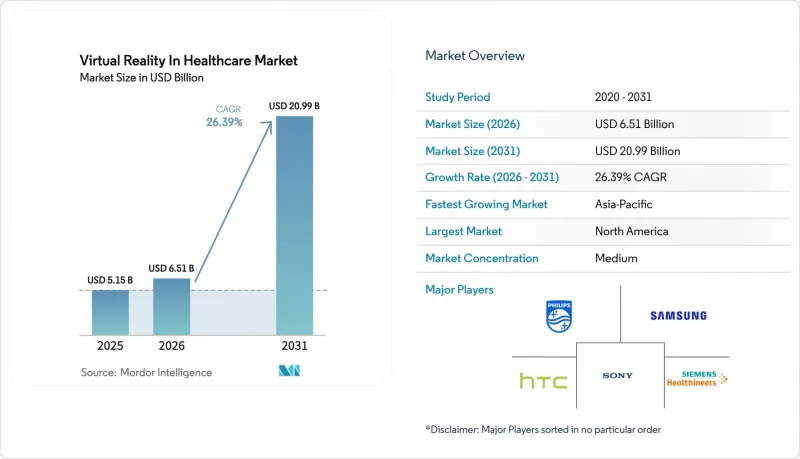
Mordor Intelligence에 의하면, 의료 분야 가상현실(VR) 시장 규모는 2025년 51억 5,000만 달러로 평가되었고, 2026년에는 65억 1,000만 달러로 추정되고, 2026-2031년 CAGR 26.39%로 성장을 지속할 전망이며, 2031년에는 209억 9,000만 달러에 이를 것으로 예측됩니다.
본 보고서에서는 업계를 구성 요소별(하드웨어, 소프트웨어, 서비스), 용도별(통증 관리, 교육·연수, 외과 수술, 환자 관리, 재활 및 치료 시술, 기타 용도), 최종 용도별(병원 및 진료소, 연구기관·제약 기업, 기타 최종 용도), 그리고 지역별(북미, 유럽, 아시아태평양, 기타)로 분류하고 있습니다.
세계의 의료 분야 가상현실(VR) 시장 동향 및 인사이트
외과 훈련 및 시뮬레이션 분야에서의 VR 도입 확대
외과 교육은 단순한 관찰에서 체험형 기술 습득으로 전환되고 있습니다. 2024년에 실시된 무작위 대조 시험을 통해 미국의 주요 교육 병원에서 가상 수술이 정확도를 향상시키고 학습 곡선을 단축시킨다는 사실이 확인되었습니다. 여러 외과 팀이 실제 사례에서 Apple Vision Pro 헤드셋을 성공적으로 도입하여 수술 중 실용성을 입증했을 뿐만 아니라, 기기에 구애받지 않고 무균 구역에서 사용할 수 있는 앱에 대한 수요를 불러일으켰습니다. 각 플랫폼 공급업체들은 현재 햅틱 컨트롤러와, 성과를 평가하여 그 데이터를 자격 인증 시스템에 반영하는 AI 기반 평가 대시보드를 함께 제공합니다. 제약 기업들도 이 생태계에 참여하여, 수술 절차와 함께 약물 투여 프로토콜을 지도하는 맞춤형 증강현실(XR) 모듈 개발을 의뢰하고 있습니다. ‘공간 컴퓨팅 센터 오브 엑설런스’를 형성하는 병원 네트워크에서는 직원 교육 기간이 단축되고 수련의 1인당 교육 비용이 절감되었습니다는 보고가 있어, 이 비즈니스 사례의 유효성이 입증되었습니다. 이에 따라 도입이 지연되고 있는 의료 기관들도 투자 우선순위를 재검토할 수밖에 없게 되었습니다.
통증 관리 및 정신 건강 치료에 대한 수요 증가
오피오이드 위기를 계기로 비약물적 통증 완화 치료로 정책이 급격히 전환됨에 따라, 가상 진통법이 주류 의료로 자리 잡아가고 있습니다. RelieVRx와 같은 FDA 승인 시스템은 치료 18개월 후에도 환자의 약 70%에서 지속적인 통증 완화가 확인되었으며,이에 따라 메디케어·메디케이드 서비스 센터(CMS)는 2025년 1월부터 디지털 정신건강 기기의 비용을 상환하는 3개의 HCPCS 코드를 활성화하기로 했습니다. 현재 대학 부속 병원에서는 VR 마음챙김 모듈과 바이오피드백 센서를 결합하여 사용하고 있으며, 초기 실세계 데이터에 따르면 모바일 앱을 이용한 치료와 비교하여 치료 순응도가 향상된 것으로 나타났습니다. AI가 탑재된 치료 동반자는 시선, 목소리, 생리학적 데이터를 분석하여 장면의 강도를 실시간으로 조정함으로써, 다양한 사회경제적 배경을 가진 사람들의 접근성을 확대하고, 임상의의 업무 부담을 최소화하고 있습니다.
초기 하드웨어 및 통합 비용의 높음
소규모 의료 기관에서는 장비 구입, 직원 교육, 전자 건강 기록(EHR)과의 통합에 동시에 자금을 조달하는 데 어려움을 겪고 있습니다. 헤드셋의 기본 가격은 하락 추세를 보이고 있지만, 멸균 가능한 페이스 쿠션, 3D 추적 카메라, FDA 승인 햅틱 컨트롤러와 같은 의료용 추가 기능으로 인해 비용은 여전히 높은 수준을 유지하고 있습니다. 소프트웨어 라이선스의 경우, 일반적으로 사용자 수에 따른 연간 과금 모델이 채택되고 있으며, 3년 이내에 하드웨어 비용에 필적하는 금액이 될 수도 있습니다. 많은 관리자들은 특히 직원의 웰빙이나 채혈 시 환자의 기분 전환 등 보험 적용 대상이 아닌 이용 사례에 대해 여전히 명확한 투자 수익률(ROI) 산정 기준이 부족합니다. 보조금이나 시범 사업에 대한 지원금은 도움이 되지만, 지속적인 확대는 재입원 및 오피오이드 처방 감소로 인한 비용 절감분을 공유하는 가치 기반 계약에 달려 있는 경우가 많습니다.
부문 분석
2025년 매출액 중 하드웨어가 61.58%를 차지했으며, 의료 분야 가상현실 시장에서 하드웨어가 기반을 이루는 역할을 하고 있음이 부각되고 있습니다. 각 벤더들이 임상 현장에서 장시간 착용할 수 있도록 광학 스택을 최적화하고 플러그 앤 플레이 방식의 멸균 키트를 출시함에 따라, 병원용 헤드셋의 전 세계 출하 대수가 급증했습니다. 제스처 추적 및 포스 피드백을 지원하는 주변 기기는 정형외과를 비롯해 순환기과 및 내시경 검사 연수 프로그램으로 점차 보급되고 있습니다. 의료 분야 가상현실 시장 중 소프트웨어 부문은 현재 규모는 작지만, 병원이 컨텐츠 구독, AI 기반 진행 상황 대시보드, 클라우드 렌더링을 통한 다중 사용자 시나리오로 전환함에 따라 연평균 28.48%의 복합 성장률을 보이고 있습니다. 규제 준수 등급의 소프트웨어 개발 키트에는 FDA 신청을 신속하게 처리할 수 있도록 미리 입력된 문서 템플릿이 포함되게 되어, 독립 개발자의 수익화까지 걸리는 기간이 단축되고 있습니다.
서비스 수익은 이 두 주요 부문에는 미치지 못하지만 여전히 중요한 위치를 차지하고 있습니다. 의료 시스템에서는 VR 스킬 랩 설계, 엔드포인트 프로비저닝 및 크로스 플랫폼 컨텐츠 큐레이션을 외부에 위탁하는 경향이 강해지고 있습니다. 컨설팅 기업들은 임상의가 VR 프로토콜을 기존 치료 경로에 통합하는 방법을 지도하는 변화 관리 워크숍을 패키지로 제공하고 있으며, 이를 통해 장기적인 고객 유지가 강화되고, 소프트웨어 업데이트 주기가 가속화됨에 따라 지속적인 수익이 증가하고 있습니다.
2025년, 외과 수술 시뮬레이션은 32.10%의 점유율을 유지한 것으로 평가되었으며, 정형외과, 신경외과 및 최소 침습 전문 분야에서의 도입이 지속적으로 확대되고 있습니다. 재향군인부는 VR을 통한 리허설이 초보 외과의사의 수술에 대한 자신감을 높인다는 강력한 증거를 강조했습니다. 한편, 몰입형 균형 훈련을 실시한 뇌졸중 생존자의 보행 속도 회복이 20% 빨라졌습니다는 연구 결과에 따라, 재활 및 물리치료 분야가 보험사들의 주목을 받았습니다. 그 결과, 재활과 관련된 의료 분야 가상현실 시장 규모는 기반이 작음에도 불구하고 절대액 기준으로 빠르게 확대되고 있습니다. FDA(미국 식품의약국)가 승인한 통증 치료 모듈은 재활과 만성 통증 치료의 경계를 더욱 모호하게 만들고 있습니다.
의학 교육용 앱은 간호, 약학, 응급 의료 분야로 다각화되고 있으며, 교육 과정에 도입되는 사례가 확산되고 있음을 보여줍니다. 노출 요법 및 수술 전후 불안 완화 모듈을 포함한 환자 관리 도구는 진정제 사용 감소를 목표로 한 보조금을 확보하고 있습니다. 증거 창출과 견고한 분석 대시보드를 결합한 앱 개발자들은 병원이 지속적인 보험 급여를 확보하기 위해 측정 가능한 기능적 개선을 입증해야 하기 때문에 경쟁 우위를 점하고 있습니다.
지역별 분석
북미는 2025년 매출의 42.85%를 차지했으며, 그 배경에는 VR 행동 치료 기기를 위한 전용 21 CFR 코드를 제정하고 메디케어 지급을 가속화하는 ‘신기술에 대한 과도기적 적용(Transitional Coverage for Emerging Technologies)’규정을 마련한 FDA의 적극적인 노력이 있습니다. 대규모 통합 의료 제공 네트워크는 몰입형 기술 연구소에 예산을 배정하고, 지속적으로 결과 데이터를 지급 기관에 제공함으로써 선순환적인 도입 사이클을 강화하고 있습니다. 이 지역의 보험사들은 현재 VR 청구를 내구 의료기기 기준에 따라 심사하고 있으며, 이를 통해 의료 제공업체들에게 더 명확한 비용 회수 경로가 제시되고 있습니다.
유럽에서는 공공 부문의 시범 사업과 국경을 초월한 연구 컨소시엄에 힘입어 꾸준한 보급이 진행되고 있습니다. EU의 일반 데이터 보호 규정(GDPR(EU 개인정보보호규정)) 준수가 시스템 설계에 영향을 미치며 견고한 보안 아키텍처가 구축되고 있어, 이는 전 세계적인 모델로 자리 잡고 있습니다. 2025년에 시행된 독일의 병원 자금 조달 개혁에서는 디지털 치료제에 대한 자금이 확보되었으며, 프랑스 국립 보건 당국은 특정 만성 통증 환자군을 대상으로 VR을 활용한 진통 요법을 권장하는 임상 실무 지침을 발표했습니다.
아시아태평양은 연평균 성장률(CAGR) 30.05%를 기록하며 가장 빠르게 성장하는 지역입니다. 현지 전자기기 공급망을 통해 헤드셋 비용이 절감되는 한편, 정부의 보조금을 통해 지방에서의 원격 재활이 촉진되고 있습니다. 일본의 고령화가 진행됨에 따라 낙상 방지 프로그램에 대한 수요가 증가하고 있으며, 호주의 국민보험 제도에서는 대상 환자를 대상으로 VR을 활용한 만성 통증 치료 모듈에 대한 비용 환급이 시작되었습니다. 따라서 아시아태평양 전체 의료 분야 가상현실 시장 규모는 당초 예상보다 빠르게 유럽 전체 규모를 넘어설 것으로 전망됩니다.
남미 및 중동 및 아프리카는 현재 규모는 작지만 성장세가 가속화되고 있습니다. 브라질의 사립 병원에서는 소아 암 환자의 주의를 분산시키기 위해 VR을 도입하고 있으며, 걸프 국가들에서는 새로운 의료 도시의 마스터플랜에 몰입형 시뮬레이션 센터가 포함되어 있습니다. 전 세계 OEM 및 대학 연구 기관과의 제휴를 통해 기술 이전이 가속화되고 있으며, 과거 디지털 헬스 도입을 지연시켰던 기존의 장벽을 극복해 나가고 있습니다.
기타 혜택 :
- 엑셀 형식 시장 예측(ME) 시트
- 3개월간의 애널리스트 지원
자주 묻는 질문
목차
제1장 서론
제2장 조사 방법
제3장 개요
제4장 시장 구도
제5장 시장 규모 및 성장 예측
제6장 경쟁 구도
제7장 시장 기회 및 향후 전망
AJY 26.09.01According to Mordor Intelligence, the virtual reality in Healthcare market size is expected to grow from USD 5.15 billion in 2025 to USD 6.51 billion in 2026 and is forecast to reach USD 20.99 billion by 2031 at 26.39% CAGR over 2026-2031.
This report Segments the Industry Into Component (Hardware, Software, Services), Application (Pain Management, Education and Training, Surgery, Patient Care Management, Rehabilitation and Therapy Procedures, Other Applications), End Use (Hospitals and Clinics, Research Organizations and Pharma Companies, Other End Uses), and Geography (North America, Europe, Asia-Pacific, and More).
Global Virtual Reality In Healthcare Market Trends and Insights
Rising Adoption of VR for Surgical Training & Simulation
Surgical education is shifting from observation to experiential skill building. Randomized trials in 2024 confirmed that virtual procedures improved accuracy and shortened learning curves at leading U.S. teaching hospitals. Several surgical teams successfully deployed Apple Vision Pro headsets during live cases, proving intraoperative viability and sparking demand for device-agnostic, sterile-field-ready apps. Platform vendors now bundle haptic controllers and AI-guided assessment dashboards that score performance and feed data into credentialing systems. Pharmaceutical firms are joining the ecosystem by commissioning custom extended-reality modules that teach drug administration protocols alongside operative steps. Hospital networks that form "spatial computing centers of excellence" report faster staff onboarding and lower per-resident training costs, underscoring a business case that is forcing laggard institutions to reassess investment priorities.
Growing Demand for Pain Management & Mental-Health Therapies
A sharp policy pivot toward non-pharmacological pain relief, driven by the opioid crisis, has lifted virtual analgesia into mainstream care. FDA-authorized systems such as RelieVRx demonstrated durable pain reduction in almost 70% of patients 18 months after therapy, prompting the Centers for Medicare & Medicaid Services to activate three HCPCS codes that reimburse digital mental-health devices from January 2025. Academic medical centers now pair VR mindfulness modules with biofeedback sensors, and early real-world evidence indicates improved adherence compared with mobile-app counterparts. AI-powered therapy companions analyze gaze, voice, and physiologic data to adjust scene intensity in real time, broadening access for diverse socioeconomic groups and minimizing clinician workload.
High Upfront Hardware & Integration Costs
Smaller providers struggle to fund capital purchases, staff training, and EHR integration simultaneously. Although baseline headset prices are falling, medical-grade add-ons such as sterilizable face cushions, 3D tracking cameras, and FDA-cleared haptic controllers keep bills elevated. Software licensing typically follows annual per-seat models that can rival the hardware cost within three years. Many administrators still lack clear return-on-investment templates, especially for non-reimbursed use cases like staff wellness or patient distraction during phlebotomy. Grants and pilot subsidies help, but sustained scaling often hinges on value-based contracts that share savings from reduced readmissions or opioid prescriptions.
Other drivers and restraints analyzed in the detailed report include:
- Technology Cost Reductions and Improved Hardware
- Expansion of Telemedicine Integrating VR
- Data-Privacy & Cybersecurity Concerns
For complete list of drivers and restraints, kindly check the Table Of Contents.
Segment Analysis
Hardware accounted for 61.58% of 2025 revenue, underscoring its foundational role in the Virtual Reality in Healthcare market. Global headset shipments to hospitals rose sharply after vendors optimized optical stacks for prolonged clinical wear and rolled out plug-and-play sterilization kits. Gesture tracking and force-feedback peripherals are spreading from orthopedics into cardiology and endoscopy training programs. The Virtual Reality in Healthcare market size for software, while smaller today, is compounding at 28.48% annually as hospitals pivot to content subscriptions, AI-driven progress dashboards, and cloud-rendered multi-user scenarios. Regulatory-grade software development kits now ship with pre-filled documentation templates that speed FDA submissions, shortening time-to-revenue for independent developers.
Service revenues lag the two core segments yet remain vital. Health systems increasingly outsource design of VR skills-labs, endpoint provisioning, and cross-platform content curation. Consultants bundle change-management workshops that teach clinicians how to embed VR protocols in existing care pathways, strengthening long-term customer lock-in and boosting recurring revenues as software refresh cycles accelerate.
Surgery simulation retained 32.10% share in 2025, with deployments in orthopedics, neurosurgery, and minimally invasive specialties continuing to expand. The Department of Veterans Affairs highlighted strong evidence for VR rehearsal boosting procedural confidence in novice surgeons. Meanwhile, rehabilitation and physical therapy captured payer attention after studies showed 20% faster gait-speed recovery for stroke survivors who engaged in immersive balance tasks. The Virtual Reality in Healthcare market size tied to rehabilitation is therefore scaling swiftly in absolute dollars despite its smaller base. FDA-authorized pain treatment modules further blur boundaries between rehab and chronic-pain care.
Medical education apps are diversifying into nursing, pharmacy, and emergency medicine, signaling broader curricular adoption. Patient-care-management tools, including exposure therapy and perioperative anxiety reduction modules, are winning grants aimed at lowering sedative use. Application developers who combine evidence generation with robust analytics dashboards gain an edge, because hospitals must demonstrate measurable functional gains to secure ongoing reimbursement.
Complete Report Scope:
- By Component (Value, USD bn)
- Hardware
- Devices
- Head-Mounted Displays
- Gesture-Tracking Devices
- Projectors & Display Walls
- Other Devices
- Accessories
- Devices
- Software
- Services
- Hardware
- By Application (Value, USD bn)
- Surgery Simulation & Training
- Pain Management & PTSD
- Rehabilitation & Physical Therapy
- Medical Education & Training
- Patient Care Management
- Other Applications
- By End-User (Value, USD bn)
- Hospitals & Clinics
- Academic & Research Institutes
- Rehabilitation Centers
- Diagnostic Centers
- Other End-Users
- By Delivery Mode (Value, USD bn)
- Immersive VR
- Semi-Immersive VR
- Non-Immersive VR
- By Geography (Value, USD bn)
- North America
- United States
- Canada
- Mexico
- Europe
- Germany
- United Kingdom
- France
- Italy
- Spain
- Rest of Europe
- Asia-Pacific
- China
- India
- Japan
- South Korea
- Australia
- Rest of Asia-Pacific
- South America
- Brazil
- Argentina
- Rest of South America
- Middle East and Africa
- GCC
- South Africa
- Rest of Middle East and Africa
- North America
Geography Analysis
North America controlled 42.85% of 2025 revenue, supported by a proactive FDA that issued a dedicated 21 CFR code for VR behavioral-therapy devices and a Transitional Coverage for Emerging Technologies rule that accelerates Medicare payments. Large integrated-delivery networks budget for immersive technology labs and continually feed outcome data to payers, reinforcing virtuous adoption cycles. Insurers in the region now review VR claims under durable-medical-equipment criteria, giving providers a clearer cost-recovery path.
Europe follows with steady uptake driven by public-sector pilots and cross-border research consortia. Compliance with the EU's General Data Protection Regulation shapes system design, fostering robust security architectures that are becoming global blueprints. Germany's hospital-funding reforms in 2025 earmarked capital for digital therapeutics, and France's national health authority published clinical-practice guidelines that recommend VR analgesia for certain chronic-pain cohorts.
Asia-Pacific is the fastest-growing region, posting a 30.05% CAGR. Local electronics supply chains trim headset bills, while government grants encourage rural tele-rehabilitation. Japan's aging population fuels demand for fall-prevention programs, and Australia's national insurance scheme has begun reimbursing VR chronic-pain modules for eligible patients. The Virtual Reality in Healthcare market size across APAC is therefore projected to surpass European totals earlier than once anticipated.
South America and the Middle East & Africa are smaller today but gaining momentum. Brazilian private hospitals deploy VR for pediatric oncology distraction, and Gulf states include immersive simulation centers in new medical-city master plans. Partnerships with global OEMs and university research hubs are accelerating technology transfer, bypassing legacy barriers that once slowed digital-health adoption.
- Microsoft
- Meta Platforms, Inc.
- HTC
- Sony Group
- Siemens Healthineers
- GE HealthCare Technologies Inc.
- Osso VR, Inc.
- Surgical Theater, Inc.
- MindMaze SA
- XRHealth USA, Inc.
- AppliedVR, Inc.
- Medical Realities Ltd.
- SyncThink, Inc.
- Vicarious Surgical, Inc.
- ImmersiveTouch, Inc.
- Samsung Group
- VirtaMed
- CAE
- FundamentalVR Ltd.
- BehaVR, LLC
Additional Benefits:
- The market estimate (ME) sheet in Excel format
- 3 months of analyst support
TABLE OF CONTENTS
1 Introduction
- 1.1 Study Assumptions & Market Definition
- 1.2 Scope of the Study
2 Research Methodology
3 Executive Summary
4 Market Landscape
- 4.1 Market Overview
- 4.2 Market Drivers
- 4.2.1 Rising adoption of VR for surgical training & simulation
- 4.2.2 Growing demand for pain management & mental-health therapies
- 4.2.3 Technology cost reductions and improved hardware
- 4.2.4 Expansion of telemedicine integrating VR
- 4.2.5 Government reimbursement pilots for VR digital therapeutics
- 4.2.6 Spatial-AI analytics enabling outcome-based rehabilitation
- 4.3 Market Restraints
- 4.3.1 High upfront hardware & integration costs
- 4.3.2 Data-privacy & cybersecurity concerns
- 4.3.3 Clinician cyber-sickness & ergonomic fatigue
- 4.3.4 Fragmented device-certification pathways
- 4.4 Value / Supply-Chain Analysis
- 4.5 Regulatory Landscape
- 4.6 Technological Outlook
- 4.7 Porter's Five Forces
- 4.7.1 Bargaining Power of Suppliers
- 4.7.2 Bargaining Power of Buyers
- 4.7.3 Threat of New Entrants
- 4.7.4 Threat of Substitutes
- 4.7.5 Competitive Rivalry
5 Market Size & Growth Forecasts
- 5.1 By Component (Value, USD bn)
- 5.1.1 Hardware
- 5.1.1.1 Devices
- 5.1.1.1.1 Head-Mounted Displays
- 5.1.1.1.2 Gesture-Tracking Devices
- 5.1.1.1.3 Projectors & Display Walls
- 5.1.1.1.4 Other Devices
- 5.1.1.2 Accessories
- 5.1.1.1 Devices
- 5.1.2 Software
- 5.1.3 Services
- 5.1.1 Hardware
- 5.2 By Application (Value, USD bn)
- 5.2.1 Surgery Simulation & Training
- 5.2.2 Pain Management & PTSD
- 5.2.3 Rehabilitation & Physical Therapy
- 5.2.4 Medical Education & Training
- 5.2.5 Patient Care Management
- 5.2.6 Other Applications
- 5.3 By End-User (Value, USD bn)
- 5.3.1 Hospitals & Clinics
- 5.3.2 Academic & Research Institutes
- 5.3.3 Rehabilitation Centers
- 5.3.4 Diagnostic Centers
- 5.3.5 Other End-Users
- 5.4 By Delivery Mode (Value, USD bn)
- 5.4.1 Immersive VR
- 5.4.2 Semi-Immersive VR
- 5.4.3 Non-Immersive VR
- 5.5 By Geography (Value, USD bn)
- 5.5.1 North America
- 5.5.1.1 United States
- 5.5.1.2 Canada
- 5.5.1.3 Mexico
- 5.5.2 Europe
- 5.5.2.1 Germany
- 5.5.2.2 United Kingdom
- 5.5.2.3 France
- 5.5.2.4 Italy
- 5.5.2.5 Spain
- 5.5.2.6 Rest of Europe
- 5.5.3 Asia-Pacific
- 5.5.3.1 China
- 5.5.3.2 India
- 5.5.3.3 Japan
- 5.5.3.4 South Korea
- 5.5.3.5 Australia
- 5.5.3.6 Rest of Asia-Pacific
- 5.5.4 South America
- 5.5.4.1 Brazil
- 5.5.4.2 Argentina
- 5.5.4.3 Rest of South America
- 5.5.5 Middle East and Africa
- 5.5.5.1 GCC
- 5.5.5.2 South Africa
- 5.5.5.3 Rest of Middle East and Africa
- 5.5.1 North America
6 Competitive Landscape
- 6.1 Market Concentration
- 6.2 Market Share Analysis
- 6.3 Company Profiles (includes Global level Overview, Market level overview, Core Segments, Financials as available, Strategic Information, Market Rank/Share for key companies, Products & Services, and Recent Developments)
- 6.3.1 Microsoft Corporation
- 6.3.2 Meta Platforms, Inc.
- 6.3.3 HTC Corporation
- 6.3.4 Sony Group Corporation
- 6.3.5 Siemens Healthineers AG
- 6.3.6 GE HealthCare Technologies Inc.
- 6.3.7 Osso VR, Inc.
- 6.3.8 Surgical Theater, Inc.
- 6.3.9 MindMaze SA
- 6.3.10 XRHealth USA, Inc.
- 6.3.11 AppliedVR, Inc.
- 6.3.12 Medical Realities Ltd.
- 6.3.13 SyncThink, Inc.
- 6.3.14 Vicarious Surgical, Inc.
- 6.3.15 ImmersiveTouch, Inc.
- 6.3.16 Samsung Electronics Co., Ltd.
- 6.3.17 VirtaMed AG
- 6.3.18 CAE Inc.
- 6.3.19 FundamentalVR Ltd.
- 6.3.20 BehaVR, LLC
7 Market Opportunities & Future Outlook
- 7.1 White-space & Unmet-Need Assessment


