

|
시장보고서
상품코드
2117202
항바이오필름 상처 드레싱 시장 : 시장 점유율 분석, 업계 동향 및 통계, 성장 예측(2026-2031년)Anti-Biofilm Wound Dressing - Market Share Analysis, Industry Trends & Statistics, Growth Forecasts (2026 - 2031) |
||||||
 Mordor Intelligence
Mordor Intelligence에 의하면, 항바이오필름 상처 드레싱 시장 규모는 2026년 10억 4,000만 달러로 추정되고, 2025년 9억 5,000만 달러에서, 2031년에는 16억 3,000만 달러에 이를 것으로 예측됩니다. 2026-2031년 연평균 성장률(CAGR) 9.41%로 성장할 것으로 전망됩니다.
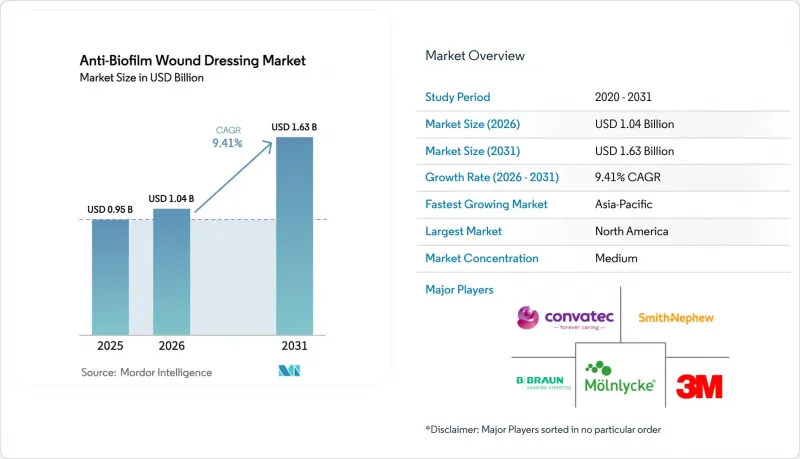
본 보고서는 작용기전별(물리적, 화학적, 생물학적), 상처 유형별(만성 상처 및 급성 상처), 드레싱 재료별(폼, 하이드로겔 등), 유효 항균제별(은계, 요오드계 등), 최종 사용자별(병원 및 진료소, 외래수술센터(ASC) 등), 지역별로 분류되어 있습니다. 본 보고서에서는 상기 각 부문별 시장 규모(단위 : 백만 달러)를 제시하고 있습니다.
세계의 항바이오필름 상처 드레싱 시장 동향 및 인사이트
만성 상처 유병률 증가
현재 호주에서만 만성 상처로 인해 연간 20억-40억 호주 달러(13억-26억 달러)의 경제적 부담이 발생하고 있습니다. 고령자나 당뇨병 환자는 면역 기능이 저하되어 있어, 이것이 바이오필름 형성을 촉진하고 있습니다. 또한, 치유되지 않는 궤양의 80%에는 바이오필름이 존재합니다. 이러한 역학적 상황을 반영하여, 치료 프로토콜은 바이오필름의 구조를 분해할 수 있는 상처 드레싱으로 전환되고 있습니다. 현재, 특히 간호사의 감독이 제한적인 재택치료 프로그램에서 조달 방침에 항바이오필름 기능이 명시되고 있습니다. 이러한 추세에 따라 치유 기간을 단축하고 전신 항생제 사용을 억제하는 솔루션에 대한 수요가 증가하고 있습니다.
외과 수술 건수의 급증
세계적으로 수술 건수 증가세가 가장 두드러지는 지역은 아시아태평양입니다. 수술로 인한 급성 상처는 몇 시간 이내에 생물막을 형성할 가능성이 있으므로, 병원에서는 수술 전후 관리 패키지에 항생물막 드레싱을 추가하고 있습니다. 대조군 연구에 따르면, 은 코팅 봉합사는 황색포도상구균 및 다제내성 녹농균의 부착을 억제하는 것으로 나타났습니다. 정형외과 및 심장병 센터에서는 현재 생물막 예방 프로토콜을 폐쇄성 상처 관리까지 확대하고 있으며, 이에 따른 수요는 만성 상처의 범위를 넘어 확장되고 있습니다. 그 결과, 항생물막 상처 드레싱 시장은 외과 감염 관리 예산에 점차 포함되고 있습니다.
기존 드레싱에 비해 높은 제품 가격
높은 가격대는 보급의 걸림돌이 되고 있으며, 특히 여전히 범용 거즈 비용을 보상해 주는 공적 의료 제도에서는 이 문제가 두드러집니다. 그러나 실제 임상 증거에 따르면, 항바이오필름 상처 드레싱가 치유 기간과 내원 횟수를 단축함으로써 총 치료 비용을 절감하는 것으로 나타났습니다. 2025년 메디케어 의사 보수 일정표에서는 원격 상처 관리 코드가 확충되어, 임상의가 지역 간호사를 원격으로 지도하여 입원 기간을 단축할 수 있게 되었습니다. 지급 기관이 성과 기반의 치료 경로를 평가함에 따라 예산의 수직적 분할 구조는 해소되고 있으며, 초기 비용으로 인한 장벽도 완화되고 있습니다.
부문 분석
2025년, 항바이오필름 상처 드레싱 시장에서 화학적 기전을 활용한 제품이 45.12%의 점유율을 유지했습니다. 이는 광범위한 항균 효과를 기대하여 병원에서 신뢰받고 있는 성숙한 은 및 요오드 기술에 힘입은 결과입니다. 미생물의 생물막을 절단하는 구조화된 폼과 같은 물리적 전략은 삼출액 관리가 필요한 환자군에서 중간 정도의 점유율을 차지하고 있습니다. 한편, 생물학적 플랫폼은 연평균 성장률(CAGR) 9.86%로 시장 점유율을 확대되고 있습니다. 재조합 탈마제와 같은 효소 분해제는 생물막을 안정화시키는 기질인 피브린, 콜라겐, 엘라스틴을 분해하여 많은 화학 물질이 안고 있는 침투성의 한계를 극복하고 있습니다.
2세대 드레싱은 현재 생물학적 접근법과 화학적 접근법을 융합하고 있습니다. 단일 기질에서 즉각적인 살균 작용을 하는 PHMB와 매트릭스를 분해하는 프로테아제를 방출함으로써, 임상의가 드레싱을 두 번 교체하지 않고도 일석이조의 효과를 얻을 수 있습니다. 이러한 통합된 메커니즘을 통해 만성기 치료 병동에서 주요 비용 요인인 간호 시간이 절감될 뿐만 아니라, 향후 출현이 예상되는 은 내성에 대해서도 제품 포트폴리오의 미래 경쟁력을 확보할 수 있습니다. 상환 코드에서는 근거에 기반한 성과가 평가되기 때문에 다중 기전을 통한 유효성을 입증한 공급업체는 단일 기전의 기존 제품으로부터 처방 목록상의 우위를 점차 빼앗고 있습니다.
알지네이트 섬유는 높은 흡수 능력과 드레싱 교체 시 취약한 조직을 박리시키지 않는 온화한 겔 형성을 통해 2025년에는 매출의 39.21%를 차지했습니다. 또한, 칼슘이 풍부한 그 격자 구조는 이온 형태의 은을 결합시키기 때문에 알지네이트는 항균제 방출을 위한 바람직한 운반체가 되고 있습니다. 폼 드레싱은 쿠션성과 비용 면에서의 이점으로 인해 중등도의 삼출액에 대해 여전히 널리 사용되고 있는 반면, 얇은 하이드로겔은 틈새 시장인 재수화 역할을 수행하고 있습니다.
하이드로콜로이드는 연평균 성장률(CAGR) 9.58%로 성장할 전망입니다. 새로운 제제에는 생물막을 뚫고 들어가는 소수성 입자가 함침되어 있으며, 이후 팽윤하여 상처 부위를 밀봉함으로써 환경 오염을 억제합니다. 각 제조업체는 착용 기간을 7일로 연장하여, 이에 따라 교체 빈도와 간호 업무의 부담이 경감되고 있습니다. 나노섬유 매트와 일렉트로스피닝 막은 임상시험에서 주목을 받고 있지만, 양산화가 여전히 과제로 남아 있습니다. 녹색 발효를 통해 얻어지는 박테리아 셀룰로오스는 생분해성이며 천연 항균성을 갖추고 있어, 병원의 지속가능성 방침에 부합하는 제품으로 가치 기반 조달 목록에 포함되고 있습니다.
지역별 분석
북미는 계속해서 주도적인 위치를 유지하며, 보험사의 첨단 드레싱에 대한 보험 적용 및 병원 내 디지털 상처 모니터링 도입에 힘입어 2025년 매출의 41.02%를 차지했습니다. 이 지역은 임상시험이 가장 집중되어 있으며, 피부 대체재의 적용 범위를 명확히 한 2025년 CMS(미국 의료보험서비스센터)의 개정 등 명확한 코딩 기준이 마련되어 있습니다. 미국 식품의약국(FDA)의 재분류안은 증거 기준을 더욱 엄격하게 할 것으로 예상되며, 탄탄한 임상 데이터 세트를 보유한 기업에 유리하게 작용할 것입니다.
유럽에서는 추적 가능성과 성능 보고를 의무화하는 EU 의료기기 규정 2017/745에 따라 정교한 규제 환경이 조성되어 있습니다. 환경 보전 노력에 따라 병원에서는 생분해성 및 무금속 플랫폼의 시범 도입이 진행되고 있습니다. 유럽 상처 관리 협회(EWMA)는 임상의의 구매 결정에 영향을 미치는 합의 문서를 갱신하고 있습니다. 독일과 프랑스에서는 유효성과 폐기물 감축을 모두 입증할 수 있는 공급업체를 우대하는 전국적인 입찰 제도가 운영되고 있습니다.
아시아태평양은 가장 높은 성장세를 보이고 있으며, 2031년까지 연평균 성장률(CAGR) 10.62%로 확대될 것으로 전망됩니다. 중국의 국내 붕대 생산량 증가와 병원 현대화로 인해 가격이 하락하고, 활용 기회가 확대되고 있습니다. 일본의 초고령화 사회에서는 간병인의 부담을 경감시키는 재택 상처 관리 솔루션이 우선시되고 있습니다. 인도의 의료기기에 대한 생산 연계형 인센티브는 비용 효율적인 생산 능력을 추구하는 다국적 기업의 파트너를 유치하고 있습니다. 호주에서는 만성 상처로 인한 경제적 부담이 주목받고 있으며, 주 정부 의료보험 제도를 통해 첨단 드레싱 재료에 대한 보험 적용 범위가 확대되고 있습니다.
기타 혜택 :
- 엑셀 형식 시장 예측(ME) 시트
- 3개월간의 애널리스트 지원
자주 묻는 질문
목차
제1장 서론
제2장 조사 방법
제3장 개요
제4장 시장 구도
제5장 시장 규모 및 성장 예측
제6장 경쟁 구도
제7장 시장 기회 및 향후 전망
AJY 26.09.01According to Mordor Intelligence, the anti-biofilm wound dressings market size in 2026 is estimated at USD 1.04 billion, growing from 2025 value of USD 0.95 billion with 2031 projections showing USD 1.63 billion, growing at 9.41% CAGR over 2026-2031.
This report is Segmented by Mechanism (Physical, Chemical, and Biological), Wound Type (Chronic Wounds and Acute Wounds), Dressing Material (Foam, Hydrogel, and More), Active Antimicrobial Agent (Silver-Based, Iodine-Based, and More), End-User (Hospitals and Clinics, Ambulatory Surgical Centers, and More), and Geography. The Report Offers the Value (in USD Million) for the Above Segments.
Global Anti-Biofilm Wound Dressing Market Trends and Insights
Rising Prevalence of Chronic Wounds
Chronic wounds now impose an AUD 2-4 billion (USD 1.3-2.6 billion) annual burden in Australia alone. Older adults and people with diabetes present impaired immunity that fosters biofilm formation, and 80% of non-healing ulcers have biofilms. The epidemiology is shifting treatment protocols toward dressings able to dismantle biofilm architecture. Procurement policies now specify anti-biofilm capability, especially for home health programs where nurse oversight is limited. This momentum elevates demand for solutions that shorten healing time and curb systemic antibiotic use.
Surge in Surgical Procedures
Global surgical volume is rising fastest in Asia-Pacific. Acute wounds from operations can form biofilms within hours, prompting hospitals to add anti-biofilm dressings to peri-operative bundles. Silver-coated sutures cut Staphylococcus aureus and multi-drug-resistant Pseudomonas aeruginosa colonization in controlled trials. Orthopedic and cardiac centers now extend biofilm-prevention protocols to closed-incision care, expanding addressable demand beyond chronic wounds. As a result, the anti-biofilm wound dressings market is embedding into surgical infection control budgets.
High Product Cost vs. Conventional Dressings
Premium price points challenge uptake, especially in publicly funded systems that still reimburse commodity gauze. Yet real-world evidence shows total treatment expense drops when anti-biofilm dressings cut healing time and facility visits. The 2025 Medicare Physician Fee Schedule expands tele-wound codes, letting clinicians guide community nurses remotely and reduce inpatient stays. As payers reward outcome-based pathways, budget silos are breaking, and upfront cost barriers are softening.
Other drivers and restraints analyzed in the detailed report include:
- Product Innovation in Advanced Wound Care
- Stewardship Shift to Topical Therapies
- Emerging Bacterial Tolerance to Silver Ions
For complete list of drivers and restraints, kindly check the Table Of Contents.
Segment Analysis
Chemical mechanisms retained 45.12% of the anti-biofilm wound dressings market in 2025 on the back of mature silver and iodine technologies that hospitals trust for broad-spectrum cover. Physical strategies, such as structured foams that shear microbial films, hold a middle share for patients needing exudate control. Yet biological platforms are carving space at a 9.86% CAGR. Enzymatic disruptors like recombinant Tarumase digest fibrin, collagen, and elastin-the scaffolds that stabilize biofilms-overcoming the penetration limits of many chemicals.
Second-generation dressings now blend biological and chemical modes. A single substrate may release PHMB for immediate bactericidal action and a protease for matrix breakdown, delivering a one-two punch that clinicians can deploy without double dressing changes. Integrated mechanisms lower nursing hours, a key cost driver in chronic-care wards, and they future-proof portfolios against emerging silver tolerance. Because reimbursement codes reward evidence-based outcomes, suppliers that validate multi-mechanism efficacy are pulling formulary preference away from single-mode incumbents.
Alginate fibers commanded 39.21% of revenue in 2025 due to high absorptive capacity and gentle gel formation that does not strip fragile tissue during changes. Their calcium-rich lattice also binds ionic silver, making alginate a favored carrier for antimicrobial release. Foam dressings remain widespread for moderate exudate because of cushioning and cost advantages, while thin hydrogels serve niche rehydration roles.
Hydrocolloids are on track for a 9.58% CAGR. New formulations impregnate hydrophobic particles that breach biofilms and subsequently swell to seal the wound, limiting environmental contamination. Manufacturers extend wear time to seven days, which reduces change frequency and nursing labor. Nanofiber mats and electrospun membranes are gaining clinical trial traction, but production scale remains a hurdle. Bacterial cellulose, harvested through green fermentation, is entering value-based procurement lists because it is biodegradable and naturally antimicrobial-aligning with hospital sustainability mandates.
Complete Report Scope:
- By Mechanism
- Physical
- Chemical
- Biological
- By Dressing Material
- Foam
- Hydrogel
- Hydrocolloid
- Alginate
- Film & Membrane
- Nanofiber / Electrospun
- Bacterial Cellulose
- By Active Antimicrobial Agent
- Silver-based
- Iodine-based
- Polyhexanide (PHMB)
- Honey / Natural Bio-actives
- Chitosan & Other Biopolymers
- Metal-oxide Nanoparticles
- By Wound Type
- Chronic Wounds
- Diabetic Foot Ulcers
- Pressure Ulcers
- Venous Leg Ulcers
- Other Chronic Wounds
- Acute Wounds
- Surgical / Traumatic Wounds
- Burns
- Chronic Wounds
- By End User
- Hospitals & Clinics
- Ambulatory Surgical Centers
- Home Healthcare Settings
- Military & Emergency Care
- By Geography
- North America
- United States
- Canada
- Mexico
- Europe
- Germany
- United Kingdom
- France
- Italy
- Spain
- Rest of Europe
- Asia-Pacific
- China
- Japan
- India
- Australia
- South Korea
- Rest of Asia-Pacific
- Middle East & Africa
- GCC
- South Africa
- Rest of Middle East & Africa
- South America
- Brazil
- Argentina
- Rest of South America
- North America
Geography Analysis
North America continued to lead, delivering 41.02% of 2025 revenue as payers reimbursed advanced dressings and hospitals adopted digital wound surveillance. The region hosts the largest concentration of trials and has clear coding pathways such as the 2025 CMS updates that clarify coverage for skin substitutes . The United States Food and Drug Administration's re-classification proposal is expected to tighten evidence standards, favoring companies with robust clinical datasets.
Europe offers a sophisticated regulatory environment shaped by the EU Medical Device Regulation 2017/745, which imposes traceability and performance reporting . Environmental stewardship drives hospitals to pilot biodegradable and metal-free platforms. The European Wound Management Association updates consensus documents that influence clinician purchasing. Germany and France run national tender systems rewarding suppliers that can document both efficacy and waste reduction.
Asia-Pacific displayed the highest momentum, expanding at an 10.62% CAGR through 2031. China's domestic bandage output and hospital modernisation lower price points, widening access. Japan's super-aged society prioritises home wound care solutions that reduce caregiver burden. India's production-linked incentives for medical devices lure multinational partners seeking cost-efficient capacity. Australia highlights the economic toll of chronic wounds, boosting reimbursement for advanced dressings through state health plans.
- 3M
- Smiths Group
- ConvaTec Group plc
- Molnlycke Health Care
- Coloplast
- B. Braun
- Urgo Medical
- Medline Industries
- Integra LifeSciences
- Imbed Biosciences
- Lohmann & Rauscher
- Argentum Medical
- KCI (Acelity)
- Hartmann Group
- DermaRite Industries
- Silverlon (Argentum)
- Genadyne Biotechnologies
- Kerecis
- Covalon Technologies
- Medtronic
Additional Benefits:
- The market estimate (ME) sheet in Excel format
- 3 months of analyst support
TABLE OF CONTENTS
1 Introduction
- 1.1 Study Assumptions & Market Definition
- 1.2 Scope of the Study
2 Research Methodology
3 Executive Summary
4 Market Landscape
- 4.1 Market Overview
- 4.2 Market Drivers
- 4.2.1 Rising prevalence of chronic wounds
- 4.2.2 Surge in surgical procedures
- 4.2.3 Product innovation in advanced wound care
- 4.2.4 Reimbursement support for antimicrobial dressings
- 4.2.5 Stewardship shift from systemic to topical therapies
- 4.2.6 AI-enabled digital wound platforms accelerating adoption
- 4.3 Market Restraints
- 4.3.1 High product cost vs. conventional dressings
- 4.3.2 Regulatory ambiguity for combination dressings
- 4.3.3 Emerging bacterial tolerance to silver ions
- 4.3.4 Environmental disposal concerns for nano-dressings
- 4.4 Value / Supply-Chain Analysis
- 4.5 Regulatory Landscape
- 4.6 Technological Outlook
- 4.7 Porter's Five Forces Analysis
- 4.7.1 Threat of New Entrants
- 4.7.2 Bargaining Power of Buyers
- 4.7.3 Bargaining Power of Suppliers
- 4.7.4 Threat of Substitutes
- 4.7.5 Competitive Rivalry
5 Market Size & Growth Forecasts (Value, USD Million)
- 5.1 By Mechanism
- 5.1.1 Physical
- 5.1.2 Chemical
- 5.1.3 Biological
- 5.2 By Dressing Material
- 5.2.1 Foam
- 5.2.2 Hydrogel
- 5.2.3 Hydrocolloid
- 5.2.4 Alginate
- 5.2.5 Film & Membrane
- 5.2.6 Nanofiber / Electrospun
- 5.2.7 Bacterial Cellulose
- 5.3 By Active Antimicrobial Agent
- 5.3.1 Silver-based
- 5.3.2 Iodine-based
- 5.3.3 Polyhexanide (PHMB)
- 5.3.4 Honey / Natural Bio-actives
- 5.3.5 Chitosan & Other Biopolymers
- 5.3.6 Metal-oxide Nanoparticles
- 5.4 By Wound Type
- 5.4.1 Chronic Wounds
- 5.4.1.1 Diabetic Foot Ulcers
- 5.4.1.2 Pressure Ulcers
- 5.4.1.3 Venous Leg Ulcers
- 5.4.1.4 Other Chronic Wounds
- 5.4.2 Acute Wounds
- 5.4.2.1 Surgical / Traumatic Wounds
- 5.4.2.2 Burns
- 5.4.1 Chronic Wounds
- 5.5 By End User
- 5.5.1 Hospitals & Clinics
- 5.5.2 Ambulatory Surgical Centers
- 5.5.3 Home Healthcare Settings
- 5.5.4 Military & Emergency Care
- 5.6 By Geography
- 5.6.1 North America
- 5.6.1.1 United States
- 5.6.1.2 Canada
- 5.6.1.3 Mexico
- 5.6.2 Europe
- 5.6.2.1 Germany
- 5.6.2.2 United Kingdom
- 5.6.2.3 France
- 5.6.2.4 Italy
- 5.6.2.5 Spain
- 5.6.2.6 Rest of Europe
- 5.6.3 Asia-Pacific
- 5.6.3.1 China
- 5.6.3.2 Japan
- 5.6.3.3 India
- 5.6.3.4 Australia
- 5.6.3.5 South Korea
- 5.6.3.6 Rest of Asia-Pacific
- 5.6.4 Middle East & Africa
- 5.6.4.1 GCC
- 5.6.4.2 South Africa
- 5.6.4.3 Rest of Middle East & Africa
- 5.6.5 South America
- 5.6.5.1 Brazil
- 5.6.5.2 Argentina
- 5.6.5.3 Rest of South America
- 5.6.1 North America
6 Competitive Landscape
- 6.1 Market Concentration
- 6.2 Market Share Analysis
- 6.3 Company Profiles (includes Global level Overview, Market level overview, Core Segments, Financials as available, Strategic Information, Market Rank/Share for key companies, Products & Services, and Recent Developments)
- 6.3.1 3M
- 6.3.2 Smith+Nephew
- 6.3.3 ConvaTec Group plc
- 6.3.4 Molnlycke Health Care AB
- 6.3.5 Coloplast A/S
- 6.3.6 B. Braun SE
- 6.3.7 Urgo Medical
- 6.3.8 Medline Industries LP
- 6.3.9 Integra LifeSciences
- 6.3.10 Imbed Biosciences
- 6.3.11 Lohmann & Rauscher
- 6.3.12 Argentum Medical
- 6.3.13 KCI (Acelity)
- 6.3.14 Hartmann Group
- 6.3.15 DermaRite Industries
- 6.3.16 Silverlon (Argentum)
- 6.3.17 Genadyne Biotechnologies
- 6.3.18 Kerecis
- 6.3.19 Covalon Technologies
- 6.3.20 Medtronic Plc
7 Market Opportunities & Future Outlook
- 7.1 White-space & Unmet-need Assessment


