

|
시장보고서
상품코드
2117212
상업용 보안 : 시장 점유율 분석, 업계 동향과 통계, 성장 예측(2026-2031년)Commercial Security - Market Share Analysis, Industry Trends & Statistics, Growth Forecasts (2026 - 2031) |
||||||
 Mordor Intelligence
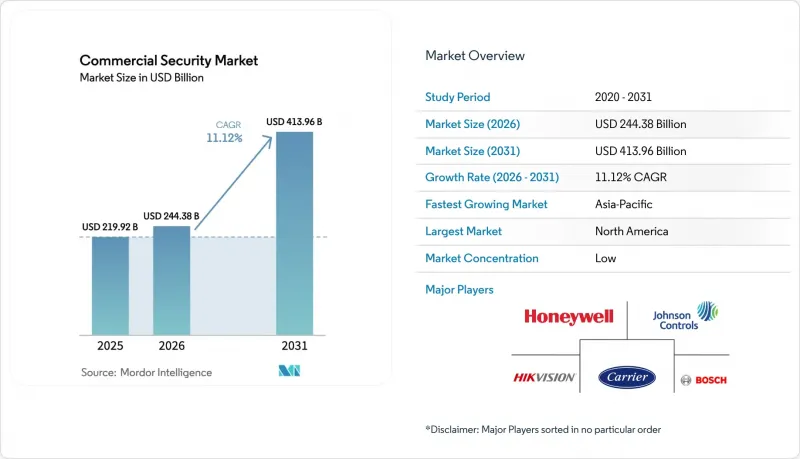
Mordor Intelligence에 따르면 상업용 보안 시장 규모는 2025년에 2,199억 2,000만 달러로 평가되며, 2026년 2,443억 8,000만 달러에서 2031년까지 4,139억 6,000만 달러에 달할 것으로 추정되며, 예측 기간(2026-2031년) 동안 CAGR은 11.12%가 될 전망입니다.
본 보고서는 보안 유형(화재 방지 시스템, 영상 감시 등), 구성요소(하드웨어, 서비스 등), 최종사용자 산업(상업용 사무실 등), 조직 규모(중소기업 및 대기업), 지역(북미, 유럽, 아시아태평양, 남미, 중동 및 아프리카)별로 분류되어 있습니다. 시장 규모 및 예측은 금액(달러) 기준으로 표시되어 있습니다.
세계 상업용 보안 시장의 동향 및 인사이트
직장 안전 규제가 멀티 센서 플랫폼 도입을 촉진
법적 프레임워크에 따라 조직은 기존의 경계 보안의 틀을 넘어선 종합적인 위협 탐지 시스템 도입을 요구받고 있습니다. 미국 내 여러 주에서 ‘알리사 법(Alissa Act)’이 시행됨에 따라, 교육 기관은 법집행기관과 직접 연계할 수 있는 비상 경보 시스템 도입이 의무화되었으며, 이에 따라 출입 통제, 영상 감시, 긴급 통신 기능을 결합한 통합 플랫폼에 대한 수요가 발생하고 있습니다. 이러한 규제적 움직임에 따라 일상적인 활동과 잠재적 위협을 구분할 수 있는 AI 기반 보안 시스템 도입이 확대되고 있으며, 현재 최종사용자의 56%가 보안 시스템을 단순한 방어 수단이 아닌 업무 최적화에 활용하고 있습니다. 안전 관련 규제 요건과 기술적 역량의 융합은 시너지 효과를 창출하고 있으며, 규정 준수 요건이 보안 인프라의 보다 광범위한 현대화를 촉진하는 촉매제 역할을 하고 있습니다. 조직들은 멀티 센서 플랫폼이 규제상 의무를 충족할 뿐만 아니라, 시설 관리 및 긴급 대응 조정을 개선하는 운영 인텔리전스도 제공한다는 사실을 점차 인식하고 있습니다. 통합 시스템은 관리 인터페이스 통합 및 인프라 구성요소 공유를 통해 총 소유 비용(TCO)을 절감하므로, 그 경제적 영향은 규정 준수 비용에만 국한되지 않습니다.
OT 네트워크에서의 물리적 보안과 사이버 보안의 융합
운영 기술(OT) 네트워크와 물리적 보안 시스템의 통합은 통합된 방어 전략을 필요로 하는 새로운 공격 경로를 만들어내고 있습니다. 산업 시설 및 중요 인프라에서는 물리적 접근 제어를 사이버 보안의 엔드포인트로 취급하는 사이버-물리적 보안 통합 프레임워크의 도입이 진행되고 있으며, 양자 내성 암호화 기술과 고급 인증 프로토콜의 사용이 필수적입니다. 이러한 통합은 특히 의료 시설에서 두드러지며, 통합된 물리적 보안 플랫폼을 통해 데이터 보호 규정을 준수하면서 사고를 신속하게 식별하고 대응할 수 있게 되었습니다. 물리적 보안, OT 보안, 사이버 보안을 통합하는 ‘3대 보안의 융합’으로의 전환은, 사일로화된 접근 방식이 고도로 정교한 위협 행위자들에게 악용될 수 있는 취약점을 야기한다는 인식에 의해 추진되고 있습니다. 조직들은 물리적 접근 이벤트와 네트워크 활동 간의 실시간 상관 분석을 수행하는 보안 프레임워크를 도입하고 있으며, 이를 통해 위협을 사전에 탐지하고 대응할 수 있게 되었습니다. 융합의 경제적 타당성은 보안상의 이점에 그치지 않고, 통합 플랫폼을 통해 운영상의 복잡성이 완화되어 보안 기능 전반에 걸쳐 보다 효율적인 자원 배분이 가능해진다는 점에도 있습니다.
분산된 건축 기준이 개보수 프로젝트를 지연시키고 있다
로스앤젤레스의 지진 후 재건 과정에서, 상업용 고층 빌딩은 말할 것도 없고, 단독 주택의 허가 취득 절차조차 1년 이상 소요되는 실태가 드러났습니다. 통합 업체는 화재, 배리어프리, 사이버 보안에 관한 다양한 추가 요건을 충족해야 하며, 그 결과 설계 공수가 증가하고 프로젝트의 내부수익률(IRR)이 하락하고 있습니다. 이러한 복잡성으로 인해 소유주들은 기존 건물의 전면 개보수를 주저하고 있으며, 특히 지자체마다 건축기준법 시행 상황이 다른 개발도상 지역에서는 이러한 경향이 두드러집니다.
부문 분석
비디오 감시는 카메라를 예측형 센서로 전환하는 AI 분석을 활용함으로써 2025년 상업용 보안 시장에서 45.32%의 점유율을 유지했습니다. 이 부문은 클라우드 스토리지 오프로드 및 실시간 물체 인식의 혜택을 받고 있으며, 이를 통해 오경보가 감소하고 소매업체는 고객 흐름에 대한 귀중한 인사이트를 얻을 수 있습니다. 한편, 출입 통제는 스마트폰 기반 인증 정보 및 IT 보안과의 융합이 사무실 및 의료 시설의 설비 갱신을 촉진하고 있어 연평균 성장률(CAGR) 11.36%로 가장 빠른 성장세를 보이고 있습니다. 모바일 솔루션은 비밀번호와 동등한 암호화 기능을 제공하며, API를 활용하여 ID 관리 도구가 즉시 출입 권한을 부여하거나 취소할 수 있게 해줍니다. 화재 감지 플랫폼은 법규 요건에 힘입어 안정적인 수요를 유지하고 있는 반면, 주변 침입 감지 시스템은 현재 야생 동물의 움직임을 필터링하기 위해 AI를 통합하고 있습니다. 여러 기기 범주에 걸쳐 분석 기능과 정책 엔진을 통합하는 통합 보안 관리 제품군은, 중앙 집중식 모니터링 화면을 원하는 기업들에게 빠르게 성장하는 틈새 시장이 되고 있습니다.
모바일 인증 정보 도입의 기세는 입주자 교체가 빈번한 코워킹 스페이스에서 가장 두드러집니다. 운영자는 원격 발급을 높이 평가하고, 이용자는 기기 없이 출입하는 것을 선호하기 때문에 배지 재고 비용을 절감할 수 있습니다. 의료 기관은 환자 치료 과정과 직원의 이동을 연계하는 감사 추적을 중시하며, 이는 인명 안전 프로토콜 준수를 뒷받침합니다. Genetec사의 접근 제어 분야에서 지난 6년간 기록한 연평균 성장률(CAGR) 28%는 소프트웨어 혁신이 하드웨어 업데이트 주기를 앞지르고 있음을 상징합니다. 사이버 방어 도구와의 통합을 통해 사고 대응 시간도 단축되고 있으며, 이는 투자자들이 출입 통제를 보다 광범위한 상업용 보안 시스템 시장에서 ‘소프트웨어 주도 분야’로 간주하는 이유를 보여줍니다.
2025년에도 하드웨어는 상업용 보안 시장 규모의 66.78%를 차지하며, 모든 설치의 기반이 되는 카메라, 컨트롤러, 센서 등을 포괄하고 있습니다. 그러나 가격 경쟁과 반도체 부족으로 인해 이익률이 압박받고 있어, 벤더들은 서비스로의 전환을 강요받고 있습니다. 고객이 복잡한 업무를 외부에 위탁함에 따라, 관리형 보안, 설계 컨설팅, 다년 계약 유지보수 서비스, 사용량 기반 클라우드 스토리지는 연평균 성장률(CAGR) 11.75%로 확대되고 있습니다. 엣지 AI 칩을 기반으로 하는 소프트웨어 분석은 원시 데이터 스트림에서 행동 패턴이나 이상 알림을 추출하여, 새로운 하드웨어에 의존하지 않는 업셀링 기회를 창출하고 있습니다.
이러한 서비스 확대 추세는 사이버 보안 수요와 밀접하게 연동되어 있습니다. 지속적인 취약점 스캔, 펌웨어 패치 적용, 규정 준수 보고는 현재 서비스 수준 계약(SLA)에 포함되어 있습니다. 존슨 컨트롤즈의 ‘Metasys 14.0’은 분석 기능 업그레이드가 무선으로 제공되며, 일회성 라이선스가 아닌 지속적인 구독이 필요한 구조를 보여줍니다. 채널 파트너에게 지속적인 수익은 현금 흐름을 안정시키고 고객 생애 가치(CLV)를 높입니다. 또한 클라우드 스토리지는 온프레미스 환경에서 RAID를 업데이트할 때 발생하는 번거로움을 해소하며, 지출을 데이터 보존 정책이나 영상 분석 빈도와 직접 연계시킵니다.
지역별 분석
북미는 엄격한 생명 안전 규제와 AI의 조기 도입에 힘입어 2025년에도 전 세계 매출의 33.78%를 차지했습니다. ‘알리사법’과 같은 규제 동향이 하드웨어 교체 주기를 지속적으로 촉진하는 한편, 클라우드 VMS 도입으로 지속적인 IT 운영 비용이 절감되고 있습니다. 스프루스파인 석영 광산의 가동 중단으로 부각된 공급망의 취약성은 국내 센서 생산이 전략적으로 필수적임을 강조하고 있습니다.
아시아태평양은 스마트 시티 계획과 클라우드 신뢰성을 중시하는 방대한 중소기업 기반에 힘입어 연평균 성장률(CAGR) 11.06%로 급속히 성장하고 있습니다. UAE와 사우디아라비아(중동 지역 일부)의 국가 AI 정책은 데이터 주권 규정을 준수하는 AI 활용 도입을 더욱 촉진하고 있습니다. 유럽의 ‘AI법’ 시행으로 생체인식 시스템이 고위험으로 간주되면서, 데이터를 국내에 보관하기 위한 로컬 에지 처리 수요가 증가하고 있습니다. GCC(걸프협력회의) 국가들의 데이터센터 급성장과 견조한 인프라 투자가 지역 전체에 새로운 수요를 창출하고 있습니다.
남미에서는 인플레이션이 완화되고 각국 정부가 공공안전에 대한 노력을 강화함에 따라 시장이 안정화 국면에 접어들고 있습니다. 멕시코의 물류 회랑과 브라질 소매업의 현대화로 인해 아날로그 CCTV에서 하이브리드 클라우드형 VMS로의 업그레이드가 가속화되고 있는 반면, 브라질의 LGPD(개인정보보호법) 등 개인정보 보호 관련 법규로 인해 벤더들은 암호화 에지 아키텍처로의 전환을 강요받고 있습니다. 대조적으로, 아프리카의 성장은 인프라의 내결함성에 좌우되고 있으며, 공항, 공공사업, 산업단지에서는 전력망의 불안정성에 대처하기 위해 견고한 센서나 태양광발전을 활용한 감시 시스템이 우선적으로 도입되고 있습니다. 두 지역 모두에서 기부 기관의 자금 지원을 받은 도시 감시 이니셔티브와 통신 사업자가 주도하는 클라우드 패키지를 통해 엔터프라이즈급 보안에 대한 접근성이 확대되고 있으며, 이는 2030년까지 기초적인 수요를 끌어올리고 있습니다.
기타 혜택:
- 엑셀 형식의 시장 예측(ME) 시트
- 3개월간의 애널리스트 지원
자주 묻는 질문
목차
제1장 소개
제2장 조사 방법
제3장 주요 요약
제4장 시장 구도
제5장 시장 규모와 성장 예측
제6장 경쟁 구도
제7장 시장 기회와 향후 전망
KSM 26.08.26According to Mordor Intelligence, the commercial security market size was valued at USD 219.92 billion in 2025 and estimated to grow from USD 244.38 billion in 2026 to reach USD 413.96 billion by 2031, at a CAGR of 11.12% during the forecast period (2026-2031).
This report is Segmented by Security Type (Fire Protection System, Video Surveillance, and More), Component (Hardware, Services, and More), End-User Industry (Commercial Offices, and More), Organization Size (SMEs, and Large Enterprises), and Geography (North America, Europe, Asia Pacific, South America, and Middle East and Africa). The Market Sizes and Forecasts are Provided in Terms of Value (USD).
Global Commercial Security Market Trends and Insights
Workplace Safety Mandates Driving Multi-Sensor Platforms
Legislative frameworks are compelling organizations to deploy comprehensive threat detection systems that extend beyond traditional perimeter security. The implementation of Alyssa's Law across multiple U.S. states requires educational institutions to install panic alert systems with direct law enforcement connectivity, creating demand for integrated platforms that combine access control, video surveillance, and emergency communication capabilities. This regulatory push is driving the adoption of AI-powered security systems that can differentiate between routine activities and potential threats, with 56% of end-users now optimizing operations through their security systems rather than viewing them as purely protective measures. The convergence of safety mandates with technological capabilities is creating a multiplier effect, where compliance requirements become catalysts for broader modernization of security infrastructure. Organizations are discovering that multi-sensor platforms not only satisfy regulatory obligations but also provide operational intelligence that improves facility management and emergency response coordination. The economic impact extends beyond compliance costs, as integrated systems reduce the total cost of ownership through consolidated management interfaces and shared infrastructure components.
Convergence of Physical and Cyber Security within OT Networks
The integration of operational technology networks with physical security systems is creating new attack vectors that require unified defense strategies. Industrial facilities and critical infrastructure are increasingly adopting cyber-physical security convergence frameworks that treat physical access controls as cybersecurity endpoints, necessitating the use of quantum-safe cryptography and advanced authentication protocols. This convergence is particularly evident in healthcare facilities, where unified physical security platforms enable the quick identification and response to incidents while maintaining compliance with data protection regulations. The shift toward three-way security convergence, integrating physical security, OT security, and cybersecurity, is being driven by the recognition that siloed approaches create vulnerabilities that sophisticated threat actors can exploit. Organizations are implementing security frameworks that provide real-time correlation between physical access events and network activity, enabling proactive threat detection and response. The economic rationale for convergence extends beyond security benefits, as unified platforms reduce operational complexity and enable more efficient resource allocation across security functions.
Fragmented Building Codes Delaying Retrofit Projects
Post-disaster rebuilding in Los Angeles reveals permitting cycles that extend past one year for single-family homes, let alone commercial towers. Integrators must navigate diverse fire, accessibility, and cyber addenda, inflating design hours and eroding project IRR. This complexity deters owners from overhauling legacy estates, especially in developing regions where code enforcement varies across municipalities.
Other drivers and restraints analyzed in the detailed report include:
- Cloud-Native Video Surveillance Reducing TCO for Multi-Site Retail Chains
- Rapid Uptake of Mobile-Credential Access Control in Co-Working Spaces
- Data-Residency Regulations Hindering Cross-Border Video Storage
For complete list of drivers and restraints, kindly check the Table Of Contents.
Segment Analysis
Video surveillance retained a 45.32% share of the Commercial security market in 2025 by leveraging AI analytics that transform cameras into predictive sensors. The segment benefits from cloud offloading of storage and real-time object recognition, which reduces false alarms and provides valuable insights into customer flow for retailers. Access control, however, is tracking the fastest 11.36% CAGR as smartphone-based credentials and IT security convergence spur refresh activity in offices and healthcare facilities. Mobile solutions deliver password-quality cryptography, while APIs let identity-management tools grant or revoke door rights instantly. Fire detection platforms hold steady demand on the back of code mandates, whereas perimeter-intrusion systems now integrate AI to filter wildlife motion. Integrated security management suites, which overlay analytics and policy engines across multiple device categories, represent a rapidly growing niche for enterprises seeking a single-pane-of-glass view.
Adoption momentum for mobile credentials is sharpest in co-working hubs where tenant turnover is high. Operators appreciate remote issuance, and occupants prefer device-free entry, which cuts badge inventory costs. Healthcare systems value audit trails that correlate patient-care events with staff movement, supporting compliance with life-safety protocols. Genetec's six-year 28% CAGR in access control symbolises how software innovation is outrunning hardware turnover. Integration with cyber-defence tools also shortens incident-response times, illustrating why investors view access control as a software play within the broader Commercial security systems market.
Hardware still comprised 66.78% of the Commercial security market size in 2025, covering cameras, controllers, and sensors that anchor any deployment. Price competition and silicon shortages, however, are squeezing margins, pushing vendors to pivot toward services. Managed security, design consulting, multi-year maintenance contracts, and usage-based cloud storage are rising at an 11.75% CAGR as customers outsource complexity. Software analytics, powered by edge AI chips, extract behavioural patterns and anomaly alerts from raw feeds, creating upsell paths that do not depend on new metal.
The services uptrend dovetails with cybersecurity demands. Continuous vulnerability scans, firmware patches, and compliance reporting are now included in service-level agreements. Johnson Controls' Metasys 14.0 demonstrates how analytics upgrades are delivered over the air, requiring ongoing subscriptions rather than one-off licences. For channel partners, recurring revenue smooths cash flow and raises customer lifetime value. Cloud storage also eliminates the headache of on-premises RAID refreshes, linking expenditure directly to retention policies and video analysis intensity.
Complete Report Scope:
- By Security Type
- Fire Protection Systems
- Video Surveillance
- Access Control Systems
- Intrusion and Perimeter Detection
- Integrated Security Management Platforms
- By Component
- Hardware (Cameras, Sensors, Panels)
- Software/Analytics
- Services (Design, Installation, AMC, Cloud Storage)
- By End-User Industry
- Commercial Offices
- Retail and Malls
- Hospitality and Leisure
- Healthcare Facilities
- Educational Campuses
- Industrial and Warehousing
- BFSI
- Others
- By Organization Size
- SMEs
- Large Enterprises
- By Geography
- North America
- United States
- Canada
- Mexico
- South America
- Brazil
- Argentina
- Rest of South America
- Europe
- Germany
- United Kingdom
- France
- Nordics
- Rest of Europe
- Asia Pacific
- China
- Japan
- India
- South Korea
- Australia
- New Zealand
- Rest of Asia Pacific
- Middle East and Africa
- Saudi Arabia
- UAE
- Turkey
- South Africa
- Kenya
- Rest of Middle East and Africa
- North America
Geography Analysis
North America retained 33.78% of global revenue in 2025, driven by stringent life-safety regulations and early adoption of AI. Regulatory momentum, such as Alyssa's Law, continues to feed hardware refresh cycles, while cloud VMS adoption cuts recurring IT overhead. Supply-chain vulnerabilities, spotlighted by the Spruce Pine quartz mine disruption, underscore the strategic imperative for domestic sensor production.
The Asia Pacific is racing ahead with an 11.06% CAGR, driven by smart-city programs and a vast SME base that values cloud credentials. National AI policies in the UAE and Saudi Arabia (part of the broader Middle East) further stimulate AI-powered deployments compliant with data-sovereignty rules. Europe's enforcement of the AI Act renders biometric systems high-risk, driving demand for local-edge processing to keep data onshore. GCC data-centre booms and strong infrastructure spending create fresh demand across the region.
South America is entering a stabilization phase as inflation eases and governments sharpen public-safety mandates. Mexico's logistics corridors and Brazil's retail modernization are accelerating upgrades from analog CCTV to hybrid cloud VMS, while privacy statutes such as Brazil's LGPD are pushing vendors toward encrypted-edge architectures. In contrast, Africa's growth is tied to infrastructure resilience, airports, utilities, and industrial parks are prioritising ruggedised sensors and solar-backed surveillance to counter grid volatility. Across both regions, donor-funded city surveillance initiatives and telecom-led cloud bundles are expanding access to enterprise-grade security, boosting baseline demand through 2030.
- Honeywell International Inc.
- Johnson Controls International plc
- Carrier Global Corporation
- Bosch Security and Safety Systems
- Hangzhou Hikvision Digital Technology Co., Ltd.
- Zhejiang Dahua Technology Co., Ltd.
- Axis Communications AB
- ASSA ABLOY AB (incl. HID Global)
- Allegion plc
- Stanley Security (SBD)
- Securitas AB
- ADT Inc.
- Panasonic i-PRO
- Hanwha Vision
- Siemens Smart Infrastructure
- LenelS2
- Brivo Inc.
- Genetec Inc.
- Gallagher Group Ltd.
- Nedap N.V.
- Milestone Systems A/S
- Teledyne FLIR LLC
- Avigilon Corporation (Motorola Solutions)
- Verkada Inc.
Additional Benefits:
- The market estimate (ME) sheet in Excel format
- 3 months of analyst support
TABLE OF CONTENTS
1 INTRODUCTION
- 1.1 Study Assumptions and Market Definition
- 1.2 Scope of the Study
2 RESEARCH METHODOLOGY
3 EXECUTIVE SUMMARY
4 MARKET LANDSCAPE
- 4.1 Market Overview
- 4.2 Market Drivers
- 4.2.1 Workplace Safety Mandates Driving Multi-Sensor Platforms
- 4.2.2 Convergence of Physical and Cyber Security within OT Networks
- 4.2.3 Cloud-Native Video Surveillance Reducing TCO for Multi-Site Retail Chains
- 4.2.4 Insurance Premium Discounts for AI-Enabled Fire Detection Systems
- 4.2.5 Rapid Uptake of Mobile-Credential Access Control in Co-Working Spaces
- 4.3 Market Restraints
- 4.3.1 Fragmented Building Codes Delaying Retrofit Projects
- 4.3.2 Data-Residency Regulations Hindering Cross-Border Video Storage (EU and GCC)
- 4.3.3 Component Lead-Time Volatility for Semiconductors and Optics
- 4.3.4 Low End-User Awareness of Total-Cost-of-Ownership Benefits in MEA
- 4.4 Industry Value Chain Analysis
- 4.5 Regulatory and Technology Outlook
- 4.6 Porter's Five Forces Analysis
- 4.6.1 Bargaining Power of Suppliers
- 4.6.2 Bargaining Power of Buyers
- 4.6.3 Threat of New Entrants
- 4.6.4 Threat of Substitutes
- 4.6.5 Intensity of Competitive Rivalry
5 MARKET SIZE AND GROWTH FORECASTS (VALUE)
- 5.1 By Security Type
- 5.1.1 Fire Protection Systems
- 5.1.2 Video Surveillance
- 5.1.3 Access Control Systems
- 5.1.4 Intrusion and Perimeter Detection
- 5.1.5 Integrated Security Management Platforms
- 5.2 By Component
- 5.2.1 Hardware (Cameras, Sensors, Panels)
- 5.2.2 Software/Analytics
- 5.2.3 Services (Design, Installation, AMC, Cloud Storage)
- 5.3 By End-User Industry
- 5.3.1 Commercial Offices
- 5.3.2 Retail and Malls
- 5.3.3 Hospitality and Leisure
- 5.3.4 Healthcare Facilities
- 5.3.5 Educational Campuses
- 5.3.6 Industrial and Warehousing
- 5.3.7 BFSI
- 5.3.8 Others
- 5.4 By Organization Size
- 5.4.1 SMEs
- 5.4.2 Large Enterprises
- 5.5 By Geography
- 5.5.1 North America
- 5.5.1.1 United States
- 5.5.1.2 Canada
- 5.5.1.3 Mexico
- 5.5.2 South America
- 5.5.2.1 Brazil
- 5.5.2.2 Argentina
- 5.5.2.3 Rest of South America
- 5.5.3 Europe
- 5.5.3.1 Germany
- 5.5.3.2 United Kingdom
- 5.5.3.3 France
- 5.5.3.4 Nordics
- 5.5.3.5 Rest of Europe
- 5.5.4 Asia Pacific
- 5.5.4.1 China
- 5.5.4.2 Japan
- 5.5.4.3 India
- 5.5.4.4 South Korea
- 5.5.4.5 Australia
- 5.5.4.6 New Zealand
- 5.5.4.7 Rest of Asia Pacific
- 5.5.5 Middle East and Africa
- 5.5.5.1 Saudi Arabia
- 5.5.5.2 UAE
- 5.5.5.3 Turkey
- 5.5.5.4 South Africa
- 5.5.5.5 Kenya
- 5.5.5.6 Rest of Middle East and Africa
- 5.5.1 North America
6 COMPETITIVE LANDSCAPE
- 6.1 Market Concentration
- 6.2 Strategic Moves
- 6.3 Market Share Analysis
- 6.4 Company Profiles (includes Global level Overview, Market level overview, Core Segments, Financials as available, Strategic Information, Market Rank/Share for key companies, Products and Services, and Recent Developments)
- 6.4.1 Honeywell International Inc.
- 6.4.2 Johnson Controls International plc
- 6.4.3 Carrier Global Corporation
- 6.4.4 Bosch Security and Safety Systems
- 6.4.5 Hangzhou Hikvision Digital Technology Co., Ltd.
- 6.4.6 Zhejiang Dahua Technology Co., Ltd.
- 6.4.7 Axis Communications AB
- 6.4.8 ASSA ABLOY AB (incl. HID Global)
- 6.4.9 Allegion plc
- 6.4.10 Stanley Security (SBD)
- 6.4.11 Securitas AB
- 6.4.12 ADT Inc.
- 6.4.13 Panasonic i-PRO
- 6.4.14 Hanwha Vision
- 6.4.15 Siemens Smart Infrastructure
- 6.4.16 LenelS2
- 6.4.17 Brivo Inc.
- 6.4.18 Genetec Inc.
- 6.4.19 Gallagher Group Ltd.
- 6.4.20 Nedap N.V.
- 6.4.21 Milestone Systems A/S
- 6.4.22 Teledyne FLIR LLC
- 6.4.23 Avigilon Corporation (Motorola Solutions)
- 6.4.24 Verkada Inc.
7 MARKET OPPORTUNITIES AND FUTURE OUTLOOK
- 7.1 White-Space and Unmet-Need Assessment


