|
시장보고서
상품코드
2117236
알루미늄 잉곳 시장 : 시장 점유율 분석, 업계 동향 및 통계, 성장 예측(2026-2031년)Aluminum Ingots - Market Share Analysis, Industry Trends & Statistics, Growth Forecasts (2026 - 2031) |
||||||
 Mordor Intelligence
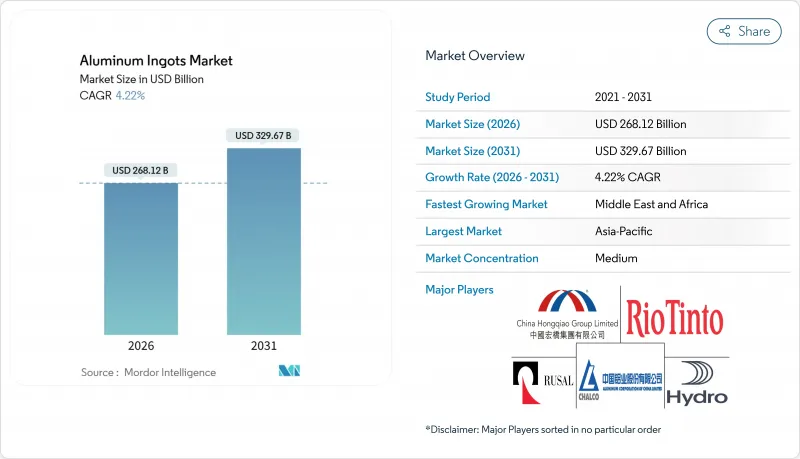
Mordor Intelligence에 의하면, 알루미늄 잉곳 시장 규모는 2026년에 2,681억 2,000만 달러로 추정되고, 예측 기간(2026-2031년) CAGR 4.22%로 성장을 지속할 전망이며, 2031년에는 3,296억 7,000만 달러에 이를 전망입니다.
본 보고서는 제조 공정별(1차 잉곳 및 2차/재활용 잉곳), 최종 사용자 산업별(건축 및 건설, 자동차, 전기 및 전자, 포장, 기계·설비, 기타 최종 사용자 산업), 지역별(아시아태평양, 북미, 유럽, 남미, 중동 및 아프리카)로 세분화되어 있습니다. 시장 전망은 금액(달러) 기준으로 제시되어 있습니다.
세계의 알루미늄 잉곳 시장 동향 및 인사이트
신흥 경제국에서의 건설 활동 급증
공공 인프라가 알루미늄 잉곳 시장의 단기 수요 대부분을 견인하고 있습니다. 인도의 ‘국가 인프라 계획’에서는 2025년까지 1조 4,000억 달러의 투자가 약속되어 있으며, 그 중 약 30%가 알루미늄을 많이 사용하는 철도 및 전력 프로젝트에 배정되어 있습니다. 2025년 중국의 도시화율은 66%에 달할 전망이며, 특히 내식성이 필수적인 연안 성에서 커튼월 및 지붕 자재에 대한 수요가 높은 수준을 유지하고 있습니다. 베트남과 인도네시아도 유사한 추세를 보이고 있으며, 베트남의 1인당 알루미늄 사용량은 2025년에 5.1kg까지 증가했습니다. 조립식 모듈의 성장에 따라 치수 공차가 더욱 엄격해지고 있으며, 주조와 압출 가공을 동일한 거점에서 통합하고 있는 제련소가 우위를 점하고 있습니다. 이러한 변화가 알루미늄 잉곳 시장의 지속적인 한 자릿수 중반대 성장을 뒷받침하고 있습니다.
자동차 및 전기차(EV)의 경량화 수요
배터리식 전기차(BEV)는 내연기관 차량에 비해 20-30% 더 많은 알루미늄을 사용하며, 그 대부분은 차체 외판과 충돌 흡수 구조에 사용됩니다. 북미 경차 1대당 평균 알루미늄 함유량은 2025년에 220kg에 달한 것으로 평가되었으며, 2030년까지 250kg으로 증가할 것으로 전망됩니다. 노벨리스(Novelis)사가 운영하는 프로그램과 같은 폐쇄형 스크랩 시스템에서는 프레스 가공 잔재물을 60일 이내에 동일한 공장으로 되돌려 보내, 합금의 화학 성분을 유지하면서 신재 수요를 줄이고 있습니다. 전기차용 배터리 박스에서 나오는 고실리콘 주조품은 재활용의 장벽이 되어 왔으나, 새로운 고상 분리 기술로 인해 취화 위험이 해소되면서 재활용 잉곳의 채택이 확대되고 있습니다. 그 결과, 알루미늄 잉곳 시장에 지속적인 수요가 발생하고 있으며, 자동차 제조업체들은 점점 엄격해지는 규제 상한선 이하로 차량군의 배출량을 유지하기 위해 인증된 저탄소 금속을 찾고 있습니다.
원자재 가격과 전력 가격의 변동
제련에는 1톤당 13-15 MWh의 전력이 필요하기 때문에 전력 가격의 변동으로 하룻밤 사이에 이익률이 사라질 가능성이 있습니다. 런던 금속 거래소(LME) 가격이 2,500달러 가까이 상승했음에도 불구하고, 가스 가격이 1MWh당 100유로를 돌파함에 따라 2025년에는 유럽의 생산 능력이 100만 톤 이상 축소되었습니다. 또한 기니공급 차질로 인해 호주 FOB 가격이 톤당 450달러를 넘어서자 알루미나 비용도 급등했습니다. 자사 제련소와 수력 발전 계약을 보유한 수직 통합형 대기업만이 수익성을 유지할 수 있었습니다. 오프테이크 대출 기관이 5년을 초과하는 전력 공급 계약을 요구할 경우, 신규 제련소의 자금 조달은 더욱 어려워집니다. 이러한 변동성으로 인해 알루미늄 잉곳 시장의 예상 연평균 성장률(CAGR)에서 0.8퍼센트 포인트가 차감됩니다.
부문별 분석
재활용 잉곳 시장은 2031년까지 연평균 성장률(CAGR) 5.32%로 확대될 전망이며, 2025년 62.41%였던 1차 잉곳 시장의 지배력을 서서히 잠식해 나갈 것입니다. 북미의 폐차 대수가 증가한 결과, 2025년에는 1,500만 대의 자동차가 회수되었으며, 각 차량에는 180kg의 알루미늄이 포함되어 있었습니다. 폐쇄형 루프 시스템을 통해 노벨리스(Novelis)는 프레스 가공 스크랩을 60일 이내에 자동차용 등급의 시트로 재생할 수 있게 되어 공급 안정성이 강화되었습니다. 현재, 솔리드 스테이트 선별 기술을 통해 과거에는 1차 금속에만 적용되던 ASTM B209의 허용 오차를 충족하는 2차 잉곳이 생산되고 있습니다.
1차 제련소는 노르스크 하이드로(Norsk Hydro)의 ‘Reduxa’나 리오 틴토(Rio Tinto)의 ‘RenewAl’과 같은 저탄소 제품을 브랜드화하여 시장 점유율을 유지하고 있으며, 이들 모두 톤당 4톤 미만의 CO2 배출량을 약속하고 있습니다. 이러한 제품들은 유럽에서 150-250달러의 프리미엄 가격이 책정되어 있어, 순도가 중요한 분야에서의 대체를 제한하고 있습니다. 음료 캔 제조업체들은 2030년까지 재활용 소재 함유율 90%를 목표로 하고 있지만, 미국의 회수율은 49%에서 정체되어 있습니다. 이러한 스크랩 부족으로 인해 2차 제품의 프리미엄 가격이 상승하고 비용 격차가 줄어들고 있으므로, 알루미늄 잉곳 시장에서는 두 공급 경로 모두 여전히 필수적인 존재로 남아 있습니다.
지역별 분석
2025년, 아시아태평양은 세계 수요의 53.46%를 차지했으며, 그 주역은 중국의 3,800만 톤과 인도의 420만 톤이었습니다. 중국의 연안 지역 구매자들은 중동에서 저탄소 금속 수입을 늘리고 있지만, 내륙 지역의 제련소는 건설용 잉곳 생산에 국내 석탄 화력 발전에 의존하고 있습니다. 일본과 한국은 국내에 제련소를 보유하고 있지 않지만, 전자기기 브랜드에 공급하기 위한 합금별 스크랩 선별에 탁월합니다. 아세안(ASEAN) 국가들은 잉곳을 수입하는 한편, 완성된 압출 성형품을 재수출하고 있습니다. 베트남에서는 2025년까지 1인당 소비량이 5.1kg으로 두 배로 증가할 전망이며, 2028년까지 두 자릿수 성장이 예상됩니다.
2025년에는 ‘인플레이션 감축법(Inflation Reduction Act)’이 현지 조달을 장려함에 따라, 2차 잉곳이 미국 수요의 48%를 충당했습니다. 알코아(Alcoa)는 워릭 제련소를 재가동했고, 센추리 알루미늄(Century Aluminium)은 호즈빌 제련소를 재개하여 50만 톤 이상의 생산 능력을 추가했습니다. 멕시코에서는 과나후아토주와 누에보레온주의 자동차 조립 클러스터가 주도적인 역할을 하며 2025년에 소비량이 증가했습니다.
2025년 유럽 수요는 완만한 증가에 그쳤지만, 에너지 가격의 급등으로 인해 국내 제련량은 2022년 대비 18% 감소했습니다. 현재 1차 수요의 60%를 수입으로 충당하고 있으며, 그 대부분은 CBAM(탄소국경조정조치) 규정을 충족하기 위해 노르웨이와 아이슬란드에서 수입한 저탄소 금속입니다. 노르스크 하이드로(Norwegian Hydro)사의 130만 톤 수력 발전 용량 덕분에 이 지역공급은 안정적입니다. 영국의 소비량은 80만 톤으로, 항공우주 산업 및 고급 자동차 분야 수요가 주를 이루고 있습니다.
남미, 중동 및 아프리카가 가장 빠르게 성장하고 있습니다. 브라질의 소비량은 파라주에 위치한 수력발전을 기반으로 하는 제련소에 의해 뒷받침되고 있습니다. 아랍에미리트(UAE)는 알 타위라에서 연간 270만 톤 규모의 생산 체계를 가동하고 있는 반면, 사우디아라비아의 마아덴(Ma'aden)사는 2027년까지 연간 120만 톤 규모의 생산 라인을 구축할 계획입니다. 아프리카 수요는 남아프리카공화국과 이집트에 집중되어 있으며, 인프라 프로젝트와 신흥 자동차 조립 산업이 금속을 흡수함에 따라 크게 증가하고 있지만, 제련 능력이 부족하여 이 대륙은 여전히 순수입국으로 남아 있습니다.
기타 혜택 :
- 엑셀 형식 시장 예측(ME) 시트
- 3개월간의 애널리스트 지원
자주 묻는 질문
목차
제1장 서론
제2장 조사 방법
제3장 개요
제4장 시장 구도
제5장 시장 규모 및 성장 예측
제6장 경쟁 구도
제7장 시장 기회 및 향후 전망
AJY 26.09.01According to Mordor Intelligence, the aluminum ingots market size is estimated at USD 268.12 billion in 2026, and is expected to reach USD 329.67 billion by 2031, at a CAGR of 4.22% during the forecast period (2026-2031).
This report is Segmented by Production Process (Primary Ingots and Secondary/Recycled Ingots), End-User Industry (Building and Construction, Automotive, Electrical and Electronics, Packaging, Machinery and Equipment, and Other End-User Industries), and Geography (Asia-Pacific, North America, Europe, South America, and Middle-East and Africa). The Market Forecasts are Provided in Terms of Value (USD).
Global Aluminum Ingots Market Trends and Insights
Surging Construction Activities in Emerging Economies
Public infrastructure drives a large share of near-term volume in the aluminum ingots market. India's National Infrastructure Pipeline committed USD 1.4 trillion through 2025, with roughly 30% routed to aluminum-heavy rail and power projects. China's 66% urbanization rate in 2025 keeps curtain-wall and roofing demand high, particularly in coastal provinces where corrosion resistance is critical. Vietnam and Indonesia replicate this pattern, as per-capita aluminum use in Vietnam rose to 5.1 kilograms in 2025. Growth in prefabricated modules tightens dimensional tolerances, rewarding smelters that integrate casting and extrusion at a single site. These shifts underpin sustained, mid-single-digit gains in the aluminum ingots market.
Lightweighting Demand in Automotive and EVs
Battery-electric vehicles use 20-30% more aluminum than internal-combustion cars, largely in enclosures and crash structures. Average aluminum content per North American light vehicle hit 220 kilograms in 2025 and should climb toward 250 kilograms by 2030. Closed-loop scrap systems-such as programs operated by Novelis-return stamping offcuts to the same mill within 60 days, preserving alloy chemistry and cutting virgin demand. High-silicon castings from EV battery boxes posed recycling hurdles, yet new solid-state separation solves embrittlement risks, widening secondary-ingot adoption. The result is a durable pull on the aluminum ingots market, with mobility brands seeking verified low-carbon metal to keep fleet emissions below tightening regulatory caps.
Raw-Material and Power-Price Volatility
Smelting uses 13-15 MWh of electricity per tonne, meaning power swings can wipe out margins overnight. European capacity contracted by over 1 million tonnes in 2025 as gas prices surged past EUR 100 per MWh, despite London Metal Exchange prices near USD 2,500. Alumina costs also jumped when supply disruptions in Guinea pushed FOB Australia quotes beyond USD 450 per tonne. Only vertically integrated majors with captive refineries and hydropower contracts stayed profitable. Financing new smelters grows harder when off-take lenders demand power deals longer than five years. This volatility subtracts 0.8 percentage points from the forecast CAGR for the aluminum ingots market.
Other drivers and restraints analyzed in the detailed report include:
- Decarbonization Push and Recyclability Advantage
- Shift Toward Liquid-Metal Supply Chains in China
- Carbon-Border Adjustments and Stricter ESG Audits
For complete list of drivers and restraints, kindly check the Table Of Contents.
Segment Analysis
Secondary ingots expanded at a 5.32% CAGR through 2031, eroding primary dominance that stood at 62.41% in 2025. Higher end-of-life vehicle scrappage in North America returned 15 million cars in 2025, each with 180 kilograms of aluminum. Closed-loop systems let Novelis turn stamping scrap back into auto-grade sheet within 60 days, strengthening supply security. Solid-state sorting now delivers secondary ingots that meet ASTM B209 tolerances once exclusive to primary metal.
Primary smelters defend share by branding low-carbon offerings such as Norsk Hydro's Reduxa or Rio Tinto's RenewAl, each promising footprints below 4 tonnes CO2 per tonne. These products earn premiums of USD 150-250 in Europe, limiting substitution where purity matters. Beverage-can makers call for 90% recycled content by 2030, yet collection plateaus at 49% in the United States. That scrap deficit lifts secondary premiums, narrowing the cost gap and keeping both routes vital within the aluminum ingots market.
Complete Report Scope:
- By Production Process
- Primary Ingots
- Secondary/Recycled Ingots
- By End-user Industry
- Building and Construction
- Automotive
- Aerospace
- Electrical and Electronics
- Packaging
- Machinery and Equipment
- Other End-user Industries
- By Geography
- Asia-Pacific
- China
- India
- Japan
- South Korea
- ASEAN Countries
- Rest of Asia-Pacific
- North America
- United States
- Canada
- Mexico
- Europe
- Germany
- United Kingdom
- Italy
- France
- Spain
- NORDIC Countries
- Rest of Europe
- South America
- Brazil
- Argentina
- Rest of South America
- Middle-East and Africa
- Saudi Arabia
- South Africa
- Rest of Middle-East and Africa
- Asia-Pacific
Geography Analysis
Asia-Pacific accounted for 53.46% of global demand in 2025, anchored by China's 38 million-tonne appetite and India's 4.2 million tonnes. Chinese coastal buyers increasingly import low-carbon metal from the Middle East, while inland smelters rely on domestic coal power for construction grade ingots. Japan and South Korea, lacking local smelting, excel at alloy-specific scrap segregation that feeds electronics brands. ASEAN nations import ingots yet re-export finished extrusions; Vietnam doubled per-capita consumption to 5.1 kilograms by 2025 and expects double-digit growth through 2028.
Secondary ingots supplied 48% of U.S. needs in 2025 as the Inflation Reduction Act incentivizes local sourcing. Alcoa restarted its Warrick smelter and Century Aluminum reopened Hawesville, adding over 500,000 tonnes of capacity. Mexico's consumption rose in 2025, led by auto assembly clusters in Guanajuato and Nuevo Leon.
Europe made up moderate demand in 2025, yet domestic smelting shrank 18% since 2022 on energy price spikes. Imports now satisfy 60% of primary needs, mostly low-carbon metal from Norway and Iceland to meet CBAM rules. Norsk Hydro's 1.3 million-tonne hydropower capacity keeps regional supply stable. The United Kingdom consumed 800,000 tonnes, weighted toward aerospace and luxury vehicles.
South America and Middle East and Africa are the fastest growers. Brazil's consumption is supported by hydropower-backed smelters in Para. The UAE operates 2.7 million-tonnes at Al Taweelah, while Saudi Arabia's Ma'aden plans a 1.2 million-tonne line by 2027. Africa's demand, concentrated in South Africa and Egypt, climbs substantially as infrastructure projects and nascent auto assembly absorb metal, yet the continent remains a net importer due to scarce refining.
- Alcoa Inc.
- Aluminium Bahrain
- Aluminum Corporation of China Ltd. (Chalco)
- BHP Billiton
- Century Aluminum Company.
- China Hongqiao Group Ltd.
- CHINA ZHONGWANG HOLDINGS LIMITED
- Constellium SE
- Dubai Aluminium Company
- Emirates Global Aluminium PJSC.
- Hindalco Industries Ltd.
- JBMI
- NALCO India
- Norsk Hydro ASA
- Rio Tinto
- RusAL
- South32
- SPIC, Inc.
- Vedanta Aluminium
- Xinfa Group Co., Ltd.
Additional Benefits:
- The market estimate (ME) sheet in Excel format
- 3 months of analyst support
TABLE OF CONTENTS
1 Introduction
- 1.1 Study Assumptions and Market Definition
- 1.2 Scope of the Study
2 Research Methodology
3 Executive Summary
4 Market Landscape
- 4.1 Market Overview
- 4.2 Market Drivers
- 4.2.1 Surging Construction Activities in Emerging Economies
- 4.2.2 Lightweighting Demand in Automotive and EVs
- 4.2.3 Decarbonization Push and Recyclability Advantage
- 4.2.4 Shift Toward Liquid-Metal Supply Chains in China
- 4.2.5 Inert-Anode and Low-Carbon Smelting Premiumisation
- 4.3 Market Restraints
- 4.3.1 Raw-Material and Power-Price Volatility
- 4.3.2 Carbon-Border Adjustments and Stricter ESG Audits
- 4.3.3 Hydropower-Related Water-Scarcity Curbs
- 4.4 Value Chain Analysis
- 4.5 Porter's Five Forces
- 4.5.1 Bargaining Power of Suppliers
- 4.5.2 Bargaining Power of Buyers
- 4.5.3 Threat of New Entrants
- 4.5.4 Threat of Substitutes
- 4.5.5 Degree of Competition
5 Market Size and Growth Forecasts (Value)
- 5.1 By Production Process
- 5.1.1 Primary Ingots
- 5.1.2 Secondary/Recycled Ingots
- 5.2 By End-user Industry
- 5.2.1 Building and Construction
- 5.2.2 Automotive
- 5.2.3 Aerospace
- 5.2.4 Electrical and Electronics
- 5.2.5 Packaging
- 5.2.6 Machinery and Equipment
- 5.2.7 Other End-user Industries
- 5.3 By Geography
- 5.3.1 Asia-Pacific
- 5.3.1.1 China
- 5.3.1.2 India
- 5.3.1.3 Japan
- 5.3.1.4 South Korea
- 5.3.1.5 ASEAN Countries
- 5.3.1.6 Rest of Asia-Pacific
- 5.3.2 North America
- 5.3.2.1 United States
- 5.3.2.2 Canada
- 5.3.2.3 Mexico
- 5.3.3 Europe
- 5.3.3.1 Germany
- 5.3.3.2 United Kingdom
- 5.3.3.3 Italy
- 5.3.3.4 France
- 5.3.3.5 Spain
- 5.3.3.6 NORDIC Countries
- 5.3.3.7 Rest of Europe
- 5.3.4 South America
- 5.3.4.1 Brazil
- 5.3.4.2 Argentina
- 5.3.4.3 Rest of South America
- 5.3.5 Middle-East and Africa
- 5.3.5.1 Saudi Arabia
- 5.3.5.2 South Africa
- 5.3.5.3 Rest of Middle-East and Africa
- 5.3.1 Asia-Pacific
6 Competitive Landscape
- 6.1 Market Concentration
- 6.2 Strategic Moves
- 6.3 Market Share/Ranking Analysis
- 6.4 Company Profiles (includes Global level Overview, Market level overview, Core Segments, Financials as available, Strategic Information, Market Rank/Share for key companies, Products and Services, and Recent Developments)
- 6.4.1 Alcoa Inc.
- 6.4.2 Aluminium Bahrain
- 6.4.3 Aluminum Corporation of China Ltd. (Chalco)
- 6.4.4 BHP Billiton
- 6.4.5 Century Aluminum Company.
- 6.4.6 China Hongqiao Group Ltd.
- 6.4.7 CHINA ZHONGWANG HOLDINGS LIMITED
- 6.4.8 Constellium SE
- 6.4.9 Dubai Aluminium Company
- 6.4.10 Emirates Global Aluminium PJSC.
- 6.4.11 Hindalco Industries Ltd.
- 6.4.12 JBMI
- 6.4.13 NALCO India
- 6.4.14 Norsk Hydro ASA
- 6.4.15 Rio Tinto
- 6.4.16 RusAL
- 6.4.17 South32
- 6.4.18 SPIC, Inc.
- 6.4.19 Vedanta Aluminium
- 6.4.20 Xinfa Group Co., Ltd.
7 Market Opportunities and Future Outlook
- 7.1 White-space and Unmet-need Assessment