|
시장보고서
상품코드
2117241
보안 웹 게이트웨이 시장 : 시장 점유율 분석, 업계 동향 및 통계, 성장 예측(2026-2031년)Secured Web Gateway - Market Share Analysis, Industry Trends & Statistics, Growth Forecasts (2026 - 2031) |
||||||
 Mordor Intelligence
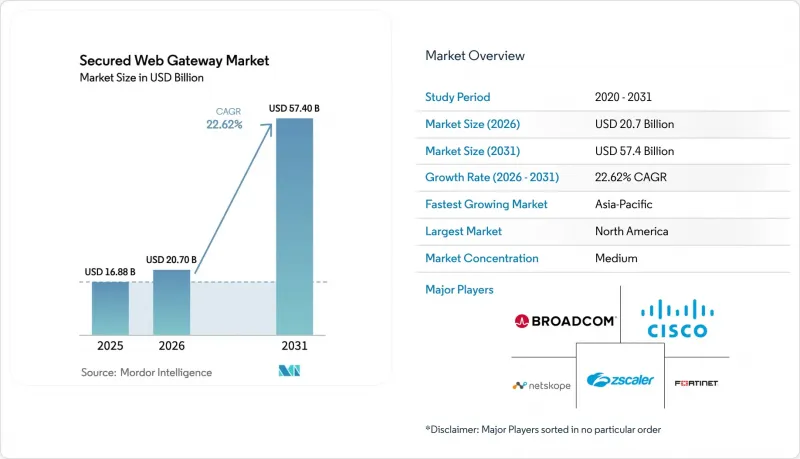
Mordor Intelligence에 의하면, 보안 웹 게이트웨이 시장 규모는 2025년 168억 8,000만 달러로 평가되었고, 2026년에는 207억 달러로 추정되고, 2026-2031년 CAGR 22.62%로 성장을 지속할 전망이며, 2031년에는 574억 달러에 이를 것으로 예측됩니다.
본 보고서는 구성 요소별(솔루션, 서비스), 조직 규모별(대기업, 중소기업), 배포 방식별(클라우드, 온프레미스), 최종 사용자 산업별(은행, 금융서비스 및 보험(BFSI), 의료, 제조, 정부·국방, IT 및 통신, 전문 서비스, 교육, 기타 산업) 및 지역별로 분류되어 있습니다. 시장 예측은 금액(달러)으로 표시되어 있습니다.
세계의 보안 웹 게이트웨이 시장 동향 및 인사이트
고도화된 AI를 활용한 사이버 공격의 급증
현재, 폴리모픽형 랜섬웨어 프레임워크는 실행할 때마다 악성 코드를 변화시키기 때문에 정적 시그니처는 더 이상 효과가 없습니다. 보안 연구소는 세션 도중 해시 값과 동작을 모두 변화시키는 ChatGPT 생성 악성코드를 실증했으며, 이로 인해 방어 측에서는 행동 분석과 지속적인 검증이 불가피해졌습니다. 사이버 범죄로 인한 피해액은 2025년에 10조 5,000억 달러에 달할 것으로 예상되며, 실시간 이상 점수 평가가 가능한 AI 추론 엔진을 통합한 보안 웹 게이트웨이의 중요성이 더욱 커지고 있습니다. 아시아태평양은 기록된 인시던트의 약 3분의 1을 차지하고 있어, 다국어 지원 위협 인텔리전스 피드를 갖춘 게이트웨이의 도입이 시급한 과제가 되고 있습니다.
기업의 클라우드 전환과 하이브리드 근무 인력의 확대
SaaS 및 IaaS로의 전환으로 인해 데이터센터의 ‘방어벽’은 사라졌습니다. 직원과 워크로드는 현재 관리 대상 외의 기기나 에지 위치에서 연결되고 있습니다. 마이크로소프트의 ‘Security Service Edge’는 ID, 엔드포인트, 네트워크 제어 기능을 통합하여, 로그인 시뿐만 아니라 모든 요청에 대해 Office 365 및 Azure에 대한 액세스를 검증합니다. 시스코는 SD-WAN과 클라우드 네이티브 보안을 통합한 SASE 아키텍처를 통해 이러한 추세를 더욱 강화하고 있습니다. 이를 통해 보안 정책은 네트워크가 아닌 사용자를 따라가게 됩니다. 의료 서비스 제공업체인 메인 라인 헬스(Main Line Health)는 네트워크를 재설계하지 않고도 마이크로 세분화를 구현하여, 동적 정책 자동화가 다운타임을 방지하면서 환자 데이터를 보호하는 방법을 보여주었습니다.
다형성을 지닌 악성 사이트 필터링의 어려움
AI로 생성된 코드는 엔드 디바이스에서 처음 결합되는 무해한 HTML, CSS, JavaScript 조각 속에 페이로드 조립을 은폐하게 되었습니다. 기존의 보안 웹 게이트웨이는 네트워크 계층에서 트래픽을 검사하기 때문에 클라이언트 측에서의 조립을 놓치고 맙니다. ‘BlackMamba’와 같은 개념 증명(PoC) 익스플로잇은 동적 분석이 브라우저 자체까지 확대되어야 함을 입증하고 있습니다. 각 벤더들은 DOM 수준에서의 가시성을 확보하기 위해 경량 격리 에이전트 통합을 시작하고 있지만, 그 복잡성과 비용으로 인해 중소기업에서의 도입이 지연되고 있습니다.
부문별 분석
2025년, 솔루션 분야의 매출액은 119억 2,000만 달러에 달한 것으로 평가되었으며, 이는 보안 웹 게이트웨이 시장 전체 매출의 70.65%에 해당합니다. 대기업은 URL 필터링, 샌드박스,CASB, DLP를 단일 정책 엔진에 통합한 통합 제품군을 선호하고 있으며, 이를 통해 관리 콘솔 증가를 억제하고 있습니다. 포티넷의 ‘FortiMail Workspace Security’는 이메일 방어를 협업 앱까지 확장하고, 머신러닝을 활용해 사용자 행동 프로파일을 구축함으로써 이러한 통합의 대표적인 사례를 보여주고 있습니다. 평가, 도입 및 풀 매니지드 운영을 포함하는 서비스 부문은 연평균 성장률(CAGR) 18.55%로 성장할 전망입니다. 기술 인력 부족 현상은 여전히 지속되고 있으며, 클라우드 보안 아키텍트 채용 공고 수백 건이 미충원 상태인 만큼, 아웃소싱 기업들은 벤더 플랫폼에 대해 연중무휴 24시간 모니터링 체계를 구축하고 있습니다. 제로 트러스트에 관한 컨설팅과 종량제 과금을 결합한 서비스를 제공하는 관리형 제공업체는 전담 분석가를 고용할 수 없는 중소기업으로부터 강력한 지지를 얻고 있습니다.
기업들이 하드웨어 어플라이언스에서 클라우드 트래픽 제어 방식으로 전환함에 따라 자문 서비스에 대한 수요도 증가하고 있습니다. 통합 업체는 레거시 액세스 제어 목록을 신원 중심 정책에 매핑하고, CASB의 감지 기능을 미세 조정하며, SD-WAN 에지 노드를 오케스트레이션해야 합니다. 그 결과, 보안 웹 게이트웨이 업계에서는 컨설팅 프로젝트가 단기적인 개념 증명(PoC)에서 정책 위반을 확실하게 감지할 수 있는 수년에 걸친 변혁 프로그램으로 전환되고 있습니다. 벤더들은 통신 사업자와 긴밀히 협력하고 있습니다. BT는 Zscaler의 AI 기반 게이트웨이를 자사의 MPLS 백본에 통합한 세계 최초의 제공업체가 되어, 통신 사업자가 전환 후 통합 보안을 통해 어떻게 수익을 창출할 수 있는지 보여주고 있습니다.
2025년에는 대기업이 매출의 63.88%를 차지한 것으로 평가되었으며, 이는 IT 예산 규모가 크고 리스크 관리 의무화가 강화된 점을 반영한 결과입니다. 많은 포춘 500대 기업은 의심스러운 트래픽을 격리된 브라우저 세션으로 유도하는 파일럿 샌드박스를 운영하고 있는데, 이 접근 방식은 예산이 제한된 기업에게는 현실적이지 않지만, 지적 재산권 보호에는 필수적입니다. 반면, 중소기업은 가장 빠르게 성장하는 시장으로, 분산된 팀 전반에 걸쳐 공격 표면이 확대됨에 따라 연평균 성장률(CAGR) 20.05%로 성장하고 있습니다. 전형적인 중소기업은 여전히 연간 IT 지출의 10% 미만을 보안에 할당하고 있지만, SaaS를 통한 제공으로 초기 어플라이언스 도입 비용이 필요 없어지고 사용자 단위 구독으로 대체됨에 따라 진입 장벽이 낮아지고 있습니다.
클라우드 마켓플레이스 등재 역시 중소기업의 도입을 가속화하고 있습니다. 기업은 보안 웹 게이트웨이 비용을 단일 Azure 청구서로 통합할 수 있어 조달 프로세스가 간소화됩니다. WatchGuard의 ‘Unified Security Platform’은 바로 이러한 중소기업을 타겟으로 하며, 방화벽,DNS 계층 필터링, MDR 대시보드를 IT 일반 담당자도 조작할 수 있는 단일 인터페이스로 통합하고 있습니다. 경쟁사와의 차별화를 이끄는 핵심 요소는 신속한 도입 마법사, 미리 입력된 규정 준수 템플릿, 그리고 정책 불일치가 발생하기 전에 관리자에게 알리는 자동 상태 점검 기능입니다.
지역별 분석
2025년, 북미는 전 세계 보안 웹 게이트웨이 시장 매출의 45.92%를 차지했습니다. 대통령령 제14028호, 행정관리예산국(OMB)의 M-22-09에 명시된 기한, 그리고 CISA의 제로 트러스트 성숙도 목표에 따라, 연방 정부 기관 및 공급업체는 2025 회계연도 말까지 피싱 방지 기능을 갖춘 다단계 인증(MFA) 도입과 자산 감지를 완료해야 합니다. 민간 부문의 도입 현황 또한 공공 부문과 마찬가지로 시급성을 반영하고 있습니다. T-Mobile이 3개월 만에 VPN에서 클라우드 게이트웨이로의 전환을 완료한 사례는 사용자 경험이 개선된다면 대기업이라도 신속하게 실행할 수 있음을 입증하고 있습니다. 캐나다의 규제 역시 이에 발맞추어 강화되고 있으며, 법안 C-27 초안에서는 데이터 부적절 취급에 대한 벌칙이 전 세계 매출의 5%로 상향 조정됨에 따라, 금융 및 의료 서비스 제공업체들 사이에서 게이트웨이 조달이 가속화되고 있습니다.
아시아태평양은 연평균 성장률(CAGR) 19.15%로 가장 빠르게 성장하고 있는 지역입니다. 호주, 싱가포르, 일본 정부는 제로 트러스트 로드맵을 발표했으며, 그 안에서 보안 웹 게이트웨이를 핵심 제어 수단으로 권장하고 있습니다. 이 지역의 사이버 보안 지출은 2022년 176억 달러에서 2025년까지 320억 달러로 증가할 것으로 예상되며, 사이버 보험료는 연간 약 50%의 속도로 증가하고 있습니다. 그러나 규제 차이로 인해 국경을 넘는 데이터 흐름이 복잡해지고 있습니다. 중국의 규정안에서는 일부 수출 보안 평가가 면제될 가능성이 있지만, ‘중요 데이터’의 정의는 여전히 모호한 상태이며, 다국적 기업들은 중국 본토 내에 별도의 로그 기록 시스템을 유지해야 하는 상황입니다. 베트남, 태국, 말레이시아 등 디지털화가 급속히 진행되고 있는 경제권은 하드웨어 설비를 구축하지 않고도 현지화된 데이터센터를 제공할 수 있는 클라우드 네이티브 제공업체들에게 진입 목표로 떠오르고 있습니다.
유럽에서는 GDPR(EU 개인정보보호규정)(일반 데이터 보호 규정)에 따른 데이터 주권 의무화를 배경으로, 꾸준한 확산이 진행되고 있습니다. 금융 규제 당국은 현재 클라우드 이전을 승인하기 전에 웹 트래픽의 비식별화 증거를 요구하고 있으며, 그 결과 기밀성이 높은 데이터 범주를 EU 내 검사 노드를 경유하도록 하는 안전 대책이 마련되고 있습니다. 2025년, 유럽 데이터 보호 위원회는 EU 역외 클라우드에서 처리되는 가명화된 분석 데이터가 종단 간암호화 상태를 유지해야 함을 명확히 했으며, 이에 따라 인라인 필드 레벨 토큰화 기능을 갖춘 게이트웨이에 대한 수요가 증가하고 있습니다. 라틴아메리카와 중동은 현재 규모는 작지만, 디지털 뱅킹 이니셔티브와 스마트 시티 프로그램의 확대에 따라 공격 표면이 넓어짐에 따라 두 자릿수 성장을 보이고 있습니다. 중동에서는 국영 석유 회사가 공급망 공격으로부터 운영 기술(OT) 네트워크를 보호하기 위해 브라우저 격리를 도입하고 있는 반면, 브라질의 핀테크 기업들은 오픈 뱅킹 요건을 충족하기 위해 SWG를 채택하고 있습니다.
기타 혜택 :
- 엑셀 형식 시장 예측(ME) 시트
- 3개월간의 애널리스트 지원
자주 묻는 질문
목차
제1장 서론
제2장 조사 방법
제3장 개요
제4장 시장 구도
제5장 시장 규모 및 성장 예측
제6장 경쟁 구도
제7장 시장 기회 및 향후 전망
AJY 26.09.01According to Mordor Intelligence, the secured web gateway market size is expected to grow from USD 16.88 billion in 2025 to USD 20.7 billion in 2026 and is forecast to reach USD 57.4 billion by 2031 at 22.62% CAGR over 2026-2031.
This report is Segmented by Component (Solutions, Services), Organization Size (Large Enterprises, Small and Medium Enterprises), Deployment Mode (Cloud, On-Premise), End-User Vertical (BFSI, Healthcare, Manufacturing, Government and Defense, IT and Telecommunication, Professional Services, Education, Other Verticals), and Geography. The Market Forecasts are Provided in Terms of Value (USD).
Global Secured Web Gateway Market Trends and Insights
Explosion in Sophisticated AI-Enabled Cyber-Attacks
Polymorphic ransomware frameworks now iterate malicious code each time they execute, rendering static signatures obsolete. Security laboratories have demonstrated ChatGPT-generated malware that shifts both hash value and behavior mid-session, forcing defenders toward behavioral analytics and continuous validation. Cyber-crime damages are expected to crest USD 10.5 trillion in 2025, placing a premium on secure web gateways that integrate AI inference engines capable of real-time anomaly scoring. Asia-Pacific bears roughly one-third of recorded incidents, adding urgency for gateway deployments with multilingual threat-intel feeds.
Enterprise Cloud Migration and Hybrid-Workforce Expansion
Migration to SaaS and IaaS removes the data-center moat; employees and workloads now connect from unmanaged devices and edge locations. Microsoft's Security Service Edge integrates identity, endpoint, and network controls so that Office 365 or Azure access is verified on every request, not just at login. Cisco reinforces the pattern by fusing SD-WAN and cloud-native security into a unified SASE architecture, allowing security policies to follow the user rather than the network. Healthcare provider Main Line Health achieved micro-segmentation without redesigning its network, illustrating how dynamic policy automation protects patient data while avoiding downtime.
Difficulty Filtering Polymorphic Malicious Sites
AI-generated code now hides payload assembly within benign HTML, CSS, and JavaScript fragments that only coalesce on the end device. Classic secure web gateways inspect traffic at the network layer and therefore miss client-side construction. Proof-of-concept exploits such as BlackMamba confirm that dynamic analysis must extend into the browser itself. Vendors have begun embedding lightweight isolation agents to gain DOM-level visibility, yet complexity and cost slow adoption for smaller firms.
Other drivers and restraints analyzed in the detailed report include:
- Regulatory Push for Zero-Trust Web Controls
- Integration of SWG into SASE Refresh Cycles
- Productivity Impact from Blocking Uncategorised URLs
For complete list of drivers and restraints, kindly check the Table Of Contents.
Segment Analysis
Solutions generated USD 11.92 billion in 2025, equal to 70.65% of total revenue for the secured web gateway market. Large enterprises gravitate toward integrated suites that combine URL filtering, sandboxing, CASB, and DLP in a single policy engine, reducing console sprawl. Fortinet's FortiMail Workspace Security demonstrates this convergence by extending email defense to collaboration apps while using machine learning to profile user behavior. The services segment, encompassing assessment, implementation, and fully managed operations, will expand at 18.55% CAGR. Skill shortages persist: hundreds of vacancies remain open for cloud-security architects, prompting outsourcers to wrap 24 X 7 monitoring around vendor platforms. Managed providers that bundle zero-trust consulting with consumption-based billing appeal strongly to SMEs that cannot hire dedicated analysts.
Demand for advisory services also rises as companies migrate from hardware appliances to cloud traffic steering. Integrators must map legacy access-control lists into identity-centric policies, fine-tune CASB discovery, and orchestrate SD-WAN edge nodes. The secured web gateway industry therefore sees consulting engagements shift from short proof-of-concepts to multi-year transformation programs that guarantee policy drift detection. Vendors partner closely with carriers; BT became the first global provider to embed Zscaler's AI-driven gateways inside its MPLS backbone, illustrating how telecoms can monetize integrated security post-migration. .
Large enterprises held 63.88% revenue in 2025, reflecting broader IT budgets and risk-management mandates. Many Fortune 500 corporations run pilot sandboxes that push suspicious traffic into isolated browser sessions, an approach impractical on smaller budgets yet critical to IP protection. Conversely SMEs represent the fastest-growing opportunity, expanding at 20.05% CAGR as attack surfaces widen across distributed teams. The typical SME still allocates less than 10% of its annual IT spend to security, but SaaS delivery erases up-front appliance costs and replaces them with per-user subscriptions, leveling entry barriers.
Cloud marketplace listings also accelerate SME uptake; businesses can roll the secured web gateway market into a single Azure invoice, simplifying procurement. WatchGuard's Unified Security Platform targets precisely this persona, bundling firewall, DNS-layer filtering, and MDR dashboards into an interface that IT generalists can operate. Competitive differentiation centers on rapid deployment wizards, pre-populated compliance templates, and automated health checks that notify administrators before policy mismatches occur.
Complete Report Scope:
- By Component
- Solutions
- Services
- By Organization Size
- Large Enterprises
- Small and Medium Enterprises (SME)
- By Deployment Mode
- Cloud
- On-premise
- By End-user Vertical
- BFSI
- Healthcare
- Manufacturing
- Government and Defense
- IT and Telecommunication
- Professional Services
- Education
- Other Verticals
- By Geography
- North America
- United States
- Canada
- South America
- Brazil
- Argentina
- Europe
- Germany
- United Kingdom
- France
- Russia
- Rest of Europe
- Asia-Pacific
- China
- India
- Japan
- South Korea
- Australia and New Zealand
- Rest of Asia-Pacific
- Middle East
- GCC Countries
- Turkey
- Rest of Middle East
- Africa
- South Africa
- Nigeria
- Rest of Africa
- North America
Geography Analysis
North America contributed 45.92% of global secured web gateway market revenue in 2025. Executive Order 14028, Office of Management and Budget M-22-09 deadlines, and CISA zero-trust maturity targets require federal agencies and suppliers to complete phishing-resistant MFA rollouts and asset discovery by the end of fiscal 2025. Commercial adoption mirrors public-sector urgency. T-Mobile's three-month cutover from VPN to cloud gateways proves that large enterprises can execute at speed when user experience improves. Canadian regulations are tightening in tandem; draft Bill C-27 elevates penalties for data mishandling to 5% of global revenue, prompting accelerated gateway procurement among financial and healthcare providers.
Asia-Pacific is the fastest-growing region at 19.15% CAGR. Governments across Australia, Singapore, and Japan have published zero-trust roadmaps that recommend secure web gateways as a foundational control. Regional cybersecurity spending is expected to rise from USD 17.6 billion in 2022 to USD 32 billion by 2025, with cyber-insurance premiums growing nearly 50% annually. Yet regulatory divergence complicates cross-border data flows: China's draft rules may waive some export security assessments, but "important data" remains undefined, forcing multinational companies to maintain separate logging instances inside the mainland. Fast-digitalizing economies such as Vietnam, Thailand, and Malaysia become entry targets for cloud-native providers that can offer localized data centers without building hardware footprints.
Europe demonstrates steady uptake, driven by GDPR data-sovereignty mandates. Financial regulators now request evidence of web-traffic de-identification before approving cloud migrations, leading to guardrails that route sensitive categories through EU-resident inspection nodes. In 2025 the European Data Protection Board clarified that pseudonymized analytics data processed in non-EU clouds must remain encrypted end to end, increasing demand for gateways with inline field-level tokenization. Latin America and the Middle East, though smaller today, show double-digit growth as digital banking initiatives and smart-city programs expand their attack surfaces. In the Middle East, national oil companies deploy browser isolation to protect operational-technology networks from supply-chain attacks, while Brazilian fintechs adopt SWG to satisfy open-banking requirements.
- Zscaler Inc.
- Cisco Systems Inc. (Cisco Umbrella)
- Broadcom Inc. (Symantec Enterprise Division)
- Netskope Inc.
- Fortinet Inc.
- Palo Alto Networks Inc.
- Trend Micro Incorporated
- Check Point Software Technologies Ltd.
- Sophos Ltd.
- McAfee LLC
- Trustwave Holdings Inc.
- Barracuda Networks Inc.
- Forcepoint LLC
- Cloudflare Inc.
- Skyhigh Security
- Proofpoint Inc.
- Menlo Security Inc.
- Akamai Technologies Inc.
- Kaspersky Lab
- iboss Inc.
Additional Benefits:
- The market estimate (ME) sheet in Excel format
- 3 months of analyst support
TABLE OF CONTENTS
1 INTRODUCTION
- 1.1 Study Assumptions and Market Definition
- 1.2 Scope of the Study
2 RESEARCH METHODOLOGY
3 EXECUTIVE SUMMARY
4 MARKET LANDSCAPE
- 4.1 Market Overview
- 4.2 Market Drivers
- 4.2.1 Explosion in sophisticated AI-enabled cyber-attacks
- 4.2.2 Enterprise cloud migration & hybrid-workforce growth
- 4.2.3 Regulatory push for zero-trust web controls
- 4.2.4 Integration of SWG into SASE refresh cycles
- 4.2.5 Rise of AI-powered real-time zero-day blocking
- 4.2.6 Shortage of in-house cybersecurity talent
- 4.3 Market Restraints
- 4.3.1 Difficulty filtering polymorphic malicious sites
- 4.3.2 Productivity impact from blocking uncategorised URLs
- 4.3.3 Latency from deep SSL inspection for high-bandwidth apps (under-reported)
- 4.3.4 Vendor lock-in via proprietary policy languages (under-reported)
- 4.4 Value / Supply-Chain Analysis
- 4.5 Regulatory Landscape
- 4.6 Technological Outlook
- 4.7 Porter?s Five Forces Analysis
- 4.7.1 Bargaining Power of Buyers
- 4.7.2 Bargaining Power of Suppliers
- 4.7.3 Threat of New Entrants
- 4.7.4 Threat of Substitutes
- 4.7.5 Intensity of Competitive Rivalry
5 MARKET SIZE AND GROWTH FORECASTS
- 5.1 By Component
- 5.1.1 Solutions
- 5.1.2 Services
- 5.2 By Organization Size
- 5.2.1 Large Enterprises
- 5.2.2 Small and Medium Enterprises (SME)
- 5.3 By Deployment Mode
- 5.3.1 Cloud
- 5.3.2 On-premise
- 5.4 By End-user Vertical
- 5.4.1 BFSI
- 5.4.2 Healthcare
- 5.4.3 Manufacturing
- 5.4.4 Government and Defense
- 5.4.5 IT and Telecommunication
- 5.4.6 Professional Services
- 5.4.7 Education
- 5.4.8 Other Verticals
- 5.5 By Geography
- 5.5.1 North America
- 5.5.1.1 United States
- 5.5.1.2 Canada
- 5.5.2 South America
- 5.5.2.1 Brazil
- 5.5.2.2 Argentina
- 5.5.3 Europe
- 5.5.3.1 Germany
- 5.5.3.2 United Kingdom
- 5.5.3.3 France
- 5.5.3.4 Russia
- 5.5.3.5 Rest of Europe
- 5.5.4 Asia-Pacific
- 5.5.4.1 China
- 5.5.4.2 India
- 5.5.4.3 Japan
- 5.5.4.4 South Korea
- 5.5.4.5 Australia and New Zealand
- 5.5.4.6 Rest of Asia-Pacific
- 5.5.5 Middle East
- 5.5.5.1 GCC Countries
- 5.5.5.2 Turkey
- 5.5.5.3 Rest of Middle East
- 5.5.6 Africa
- 5.5.6.1 South Africa
- 5.5.6.2 Nigeria
- 5.5.6.3 Rest of Africa
- 5.5.1 North America
6 COMPETITIVE LANDSCAPE
- 6.1 Market Concentration
- 6.2 Strategic Moves and Partnerships
- 6.3 Market Share Analysis
- 6.4 Company Profiles (includes Global level Overview, Market level overview, Core Segments, Financials as available, Strategic Information, Market Rank/Share for key companies, Products and Services, and Recent Developments)
- 6.4.1 Zscaler Inc.
- 6.4.2 Cisco Systems Inc. (Cisco Umbrella)
- 6.4.3 Broadcom Inc. (Symantec Enterprise Division)
- 6.4.4 Netskope Inc.
- 6.4.5 Fortinet Inc.
- 6.4.6 Palo Alto Networks Inc.
- 6.4.7 Trend Micro Incorporated
- 6.4.8 Check Point Software Technologies Ltd.
- 6.4.9 Sophos Ltd.
- 6.4.10 McAfee LLC
- 6.4.11 Trustwave Holdings Inc.
- 6.4.12 Barracuda Networks Inc.
- 6.4.13 Forcepoint LLC
- 6.4.14 Cloudflare Inc.
- 6.4.15 Skyhigh Security
- 6.4.16 Proofpoint Inc.
- 6.4.17 Menlo Security Inc.
- 6.4.18 Akamai Technologies Inc.
- 6.4.19 Kaspersky Lab
- 6.4.20 iboss Inc.
7 MARKET OPPORTUNITIES AND FUTURE OUTLOOK
- 7.1 White-space and Unmet-need Assessment